

The Czech Republic has surprisingly become the birthplace of many surrealist masters. It’s enough to recall such iconic figures as Josef Šíma and Jan Švankmajer. As early as the 1930s, an entire group called the “Czech Surrealists” emerged here, laying a solid foundation for future generations.
Today, these traditions are carried on in an unexpected way by Jakub Dvorský, founder of the Amanita Design studio. However, he does so not through the brush or the silver screen, but through an entirely different medium: video games. His creative path began unconventionally: his thesis at the Prague University of Applied Arts was not a painting or a cartoon, but a full-fledged game. This experiment surprised his professors, and instead of receiving the highest grade, he received only a “B.”
But the result spoke for itself: in 2003, Samorost caused a minor sensation and effectively paved the way for a new direction—minimalist, atmospheric quests. This success was cemented by a sequel, and then by projects like Machinarium and Botanicula, which made Amanita Design recognizable worldwide.
However, Dvorsky’s true triumph came later—with the release of Samorost 3, where his surreal vision finally took shape as a full-fledged work of art, far transcending the boundaries of ordinary games.
Table of Contents
Samorost 3 Free Steam Account
In the Samorost series, Jakub Dvorsky seems to have created his own version of the “Little Prince”. Tiny planets and asteroids hover in the boundless blackness of space, on one of which lives a funny dwarf in a hat and felt boots. In the first game, he saved his homeland from an imminent collision with an asteroid, in the second, he set off on a journey to return a dog abducted by aliens.
The game mechanics were extremely simple — some would even call it primitive. But that’s exactly what gave the project its special magic. The puzzles were unusual, the music was mesmerizing, and the visual style turned each screen into a separate work of art. It’s easy to find a snail with a hammer, a squirrel with a girl’s face, or strange mechanisms whose purpose can only be guessed. All this made Samorost look like either a fairy tale or a dream.
Since the release of the first parts and the official announcement of Samorost 3 in 2013, the genre of quests has changed a lot. Even in other games of the Amanita Design studio — Machinarium and Botanicula — many modern techniques have appeared: mini-games, inventory, additional mechanics. But Dvorsky took a different path. In the new part, he fundamentally ignores fashion trends, maintaining the same atmosphere of minimalism. Here, a spaceship can be built from an old bathtub and a plastic bottle, dialogues are replaced by pictures, and the player still “clicks” on interactive points, discovering tiny wonders.
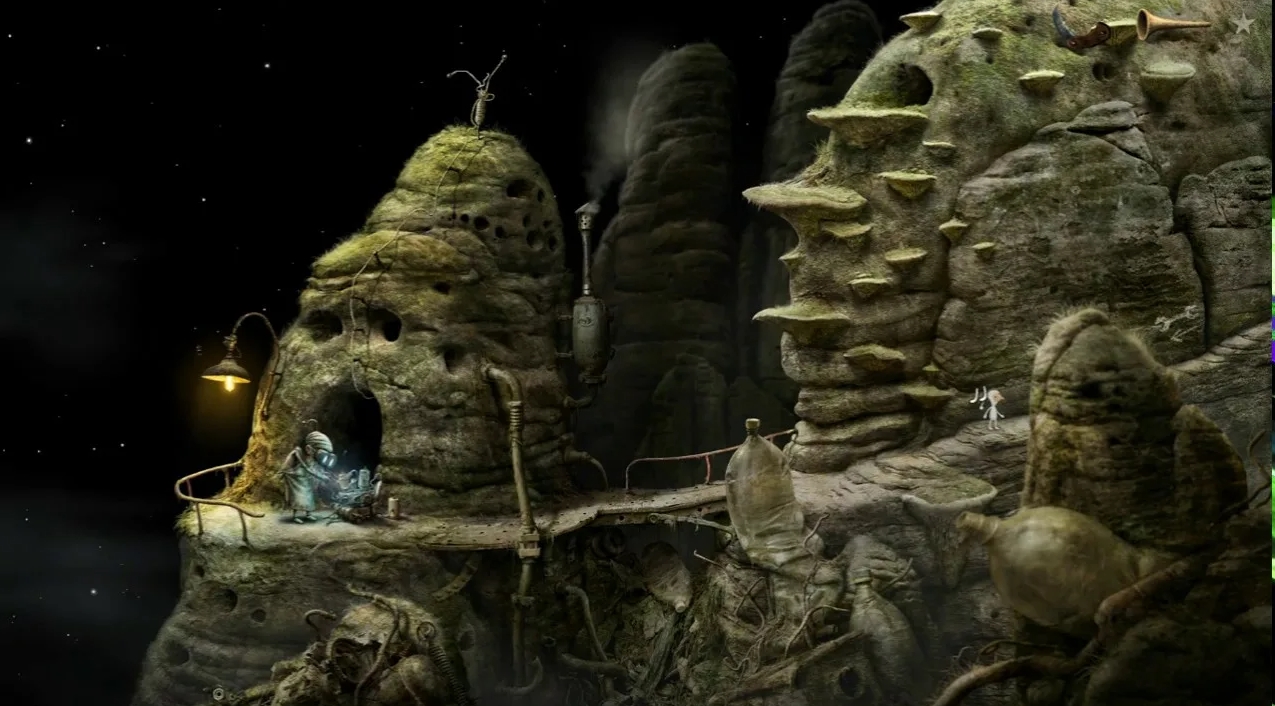
There are still changes, but they are barely noticeable. Sometimes you can use objects to interact with the environment, but they are usually no more than a couple per location. There are no full—fledged inventory, superpowers, temporary movements or character changes here – and this is what sets the game apart from modern adventure games.
The main difference is the scale. Previously, the passage took an hour or two and only fit into seven screens, but now the player is waiting for more than thirty locations and a full five to six hours of travel. And the plot has become much more ambitious: exploring nine unique planets, a dwarf in a cap must fight a giant iron dragon, controlling a robot suspiciously similar to Bender from Futurama, only significantly enlarged in size.
Samorost 3 remains true to its roots — it’s not about complex mechanics, but about the atmosphere, mood and surprise of each new screen. That is why the game feels not like a product of the industry, but like a small miracle created by the hands of a storyteller.
Game your way with a ready-to-play free steam account with games.
Why you should play Samorost 3: pros and cons
It’s clear that Samorost 3 isn’t for everyone. For some, its expanded scope is a new round of magic and discovery, while for others, it’s just “chaos devoid of logic.” After all, why insert a key into the belly of a giant beetle, pop bubbles on the shell of a giant turtle, or make three crocodiles sing while waving reeds? It all feels more like a delirious dream than a classic quest. And the mushrooms all around are no coincidence: the very name of the studio, Amanita, hints at its “fly agaric” inspiration.
It’s easy to chalk this all up to the madness of the creators. But it’s far more difficult to accept the rules of their game, come to terms with this surrealism, and allow yourself to dissolve into it. If you’re ready to take this step, Samorost 3 will give you a wondrous and unique world, living and breathing, full of color and detail. Every location here is a work of art, every encounter surprising and enchanting. And when logic completely eludes you, a book of hints comes to the rescue, helping you avoid getting stuck in this phantasmagoria.
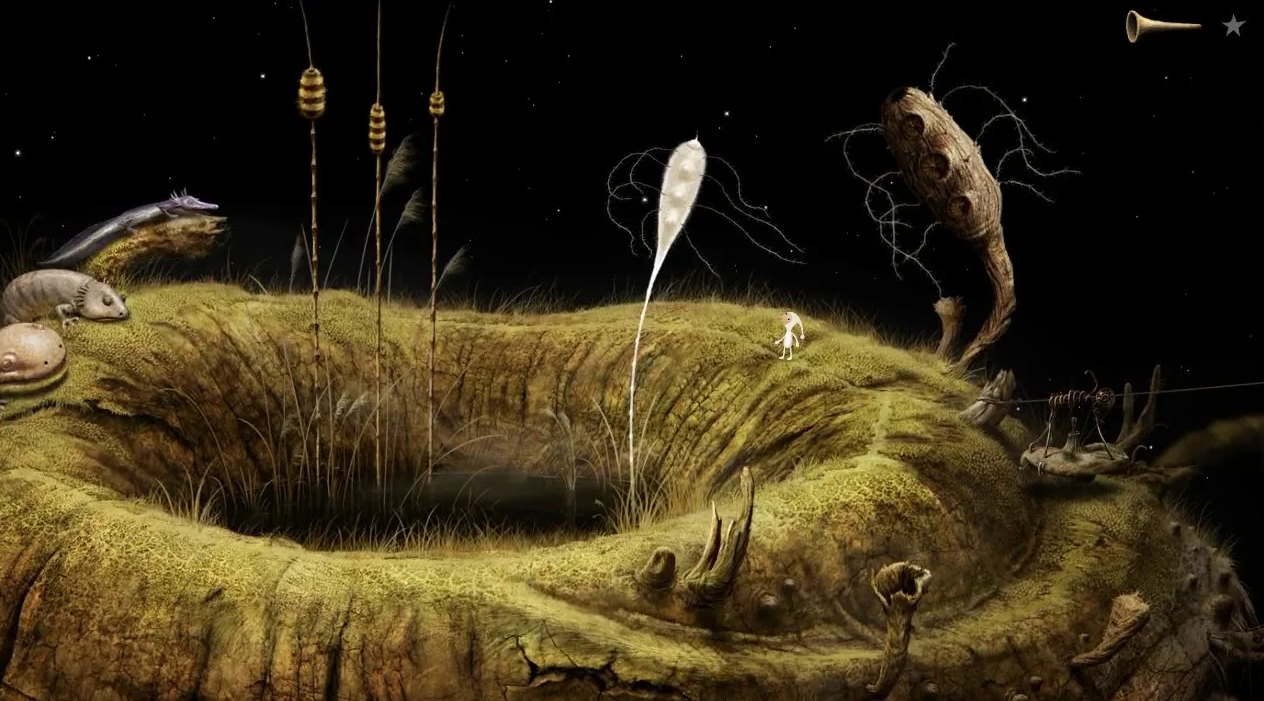
There is, however, one slightly irritating aspect: many of the puzzles have migrated straight from the first game. You still have to conduct bugs and insects, listen to and repeat melodies, as if playing a strange version of “Guess the Tune.” There are indeed quite a few repetitions: the gnome again tugs on the bugs’ antennae, applies his pipe to various creatures and objects, summoning their spirits, and the player has to run back and forth between locations.
However, it’s worth remembering that Amanita Design games have never been just about puzzles. Samorost 3 is not so much a set of puzzles as it is a story about a little hero who sets off on a great journey. It is a story of courage, humor, and sadness, of surprising encounters and dangerous situations. This is an expedition game where solving puzzles isn’t as important as experiencing the journey. And for this, for giving us such an adventure again after all these years, I want to say a huge thank you. And a handshake. Or, in the spirit of the game, a leg.
Pros of Samorost 3:
-
Mesmerizing fantasy world;
-
Notably increased scale;
-
Fresh and unusual situations;
-
Lively, vibrant visuals;
-
Rich soundtrack.
Cons of Samorost 3:
-
Some puzzles are too similar;
-
Occasional repetitions and unnecessary running around;
-
Strange, and sometimes completely non-existent, logic.
Samorost 3 System Requirements
Samorost 3 System Specs
How to play Samorost 3 for free on Steam via VpeSports
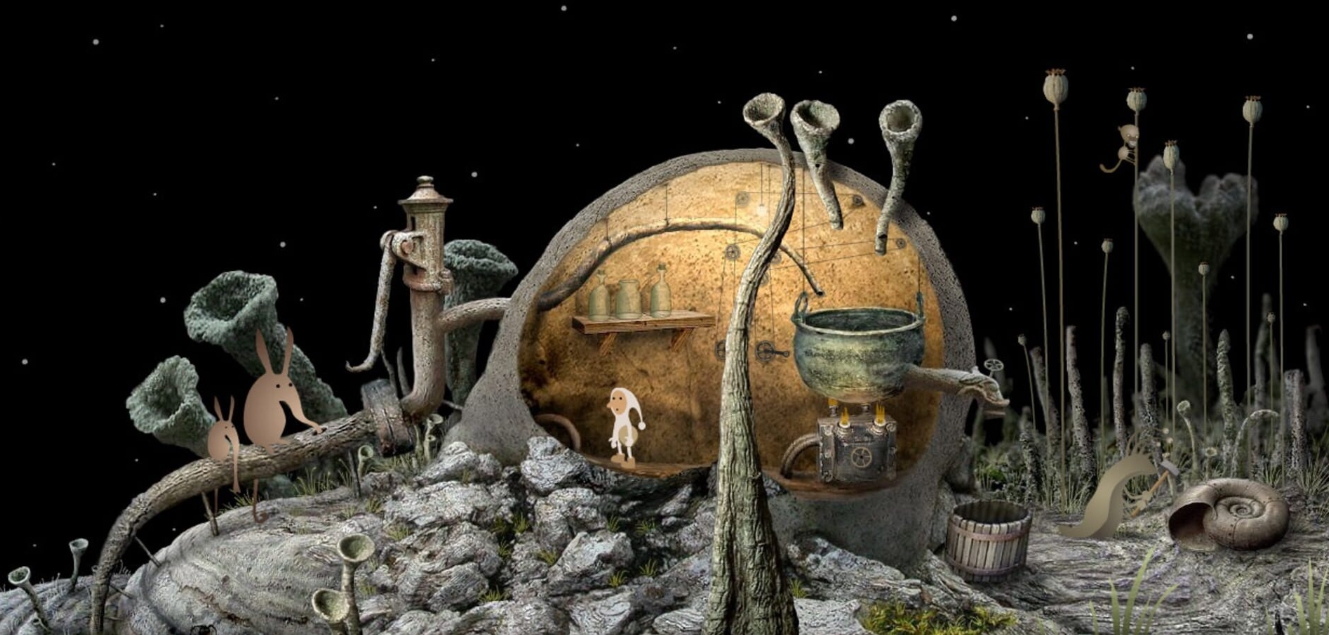
Samorost 3 is a story about a little traveler who one day finds a magic flute and decides to follow its call through space. This game is like a waking dream.: You find yourself in a world where every tree breathes, stones hold secrets, and sounds turn into a language that only those who are willing to listen can understand. There is no usual haste and strict rules here — there is only a path full of mysteries and wonders.
Playing Samorost 3 means becoming an explorer of the unknown. You set foot on planets that look like living paintings, meet strange creatures and learn to communicate with them through music and attention. This journey is more like meditation.: It makes you forget about the daily hustle and bustle and feel like a child seeing a miracle for the first time.
So that you can easily travel to this magical space, we have made the process as simple as possible. It is enough to create a profile on our website, and Samorost 3 will already be waiting for you, along with clear instructions for launching through the free steam account. No difficulties, just a step into a world where fantasy becomes reality.
After the game, don’t forget to share your impressions. Your emotions will help others decide on this path too. And to keep up to date with the news, take a look at our Telegram channel — there we post fresh accounts, share updates and discuss games with those who also like atmospheric stories.
And if you suddenly get confused somewhere or encounter difficulties, don’t worry. We have a whole section with tips and guides, and you can always ask for advice in the chat. We are here to make your trip easy and unforgettable.