

When a game showed up on Steam with graphics that looked like 1996 and a twenty-dollar price tag, most people scrolled past. Those who didn’t are still talking about it. DUSK is one of those rare cases where a solo indie developer built something that manages to be both nostalgia and a genuine discovery at the same time. This isn’t an emulation of the past. It’s an attempt to recreate what Quake and Doom felt like — not what they actually were, but what they became in memory over twenty years.
Table of Contents
What Is DUSK: Next-Level Retro Shooter or Just Imitation?
DUSK is an old-school first-person shooter developed by a single person: Polish-American indie developer David Szymanski. The publisher is New Blood Interactive — a small label dedicated specifically to reviving the spirit of classic 90s FPS games. The game launched in December 2018 on Windows, with later releases for Linux, macOS, Nintendo Switch, PlayStation 4, and Xbox Series X/S.
On the surface it all seems obvious: low-polygon graphics, breakneck pace, waves of enemies, color-coded keycards, and a shotgun capable of turning a cultist into a fine red mist. But spend fifteen minutes with it and something becomes clear: behind the retro wrapping is something far more interesting.
The game takes place in the fictional town of Dusk, Pennsylvania. The unnamed protagonist — a bounty hunter — wakes up on a meathook in someone’s murder dungeon and has to fight his way through farms, industrial zones, abandoned buildings, and a world slowly slipping into otherworldly dimensions. The story follows Carmack’s maxim: it exists to justify the gameplay. That is exactly the right call.
DUSK’s Three Campaign Episodes: What to Expect From Each One
The single-player campaign is split into three episodes with fundamentally different aesthetics. These aren’t just texture swaps — each chapter feels like a distinct little shooter living inside a bigger one.
Episode 1 — “The Aughts”
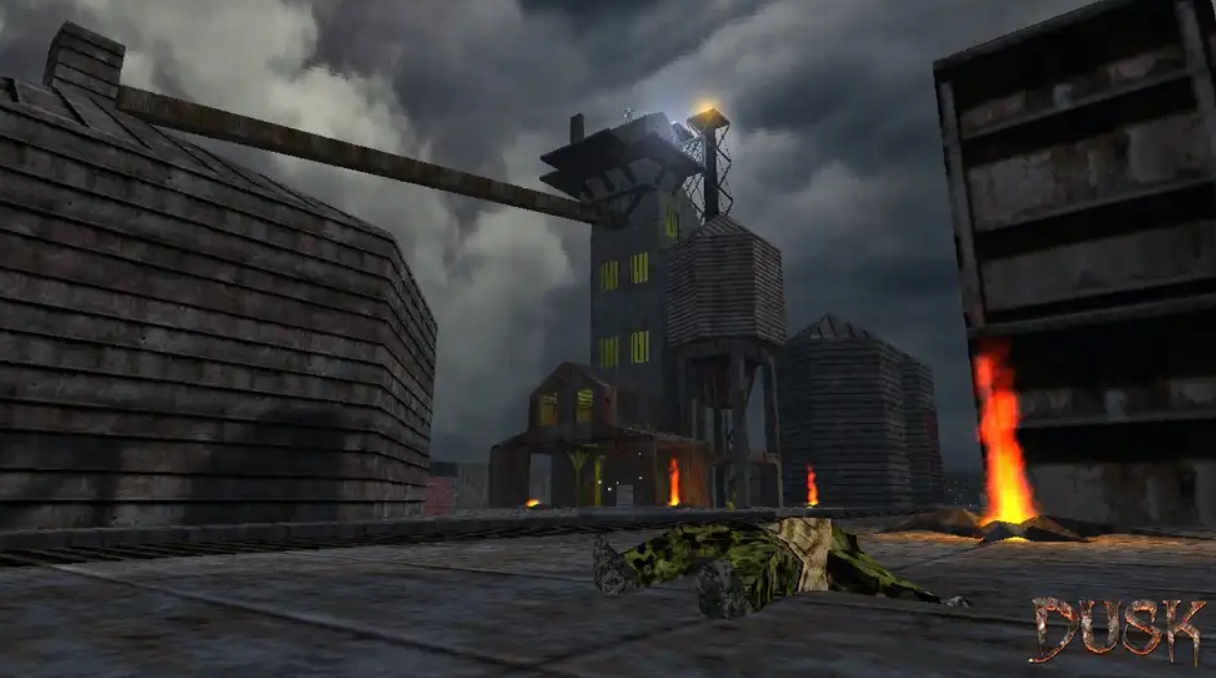
The action begins on the rural farms of Pennsylvania: cornfields, wooden barns, irrigation ditches. Enemies are hooded cultists, possessed scarecrows, and animals touched by dark magic. The atmosphere lands somewhere between The Texas Chain Saw Massacre and the opening levels of Blood. This is where the game teaches you the fundamentals: how to move so you don’t die, how to clear arenas, how to find hidden passages.
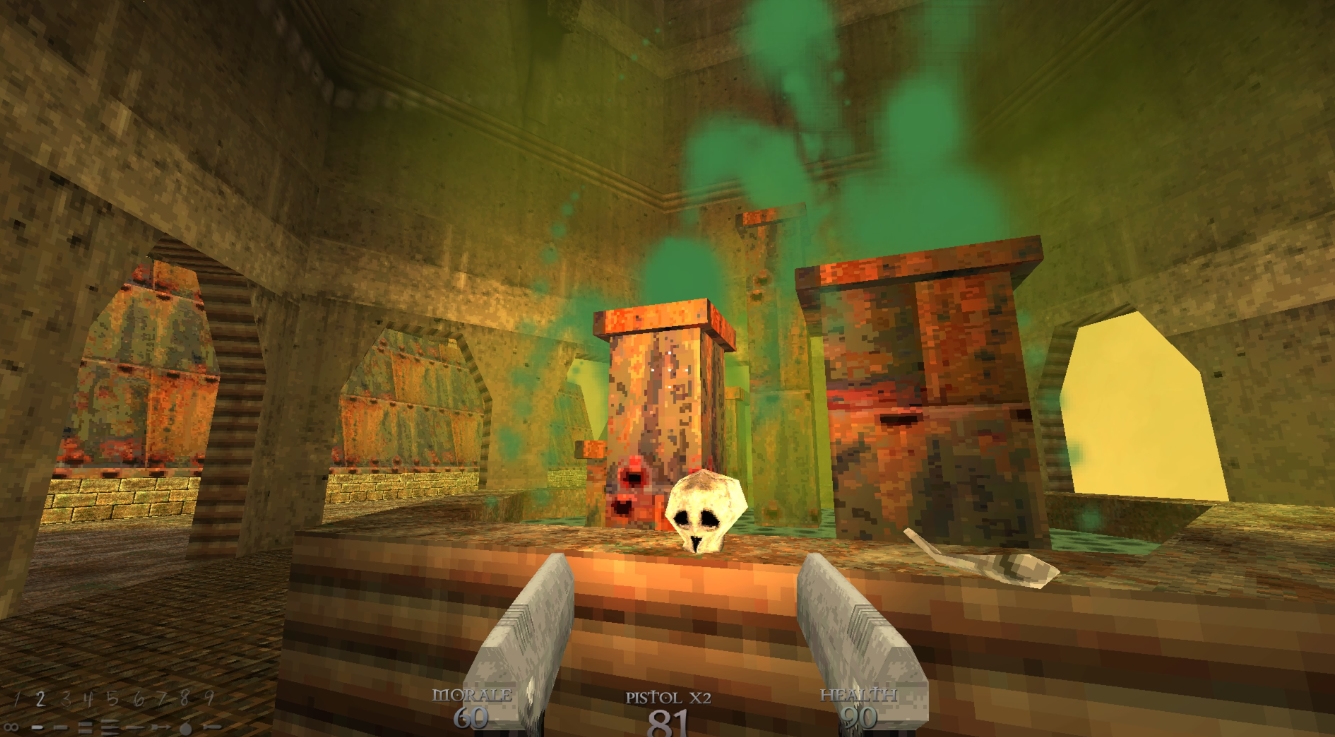
Episode 2 — “Industry”
Industrial zones, factories, sewers — the aesthetic shifts sharply toward grim techno-horror. Enemies grow more aggressive, levels become more vertical. This is where DUSK really starts pressing down: darkness, tight corridors, enemies appearing from behind. One encounter made reviewer feel “an actual chill run down his back” — not from a monster, but from a closed door labeled “Ruins Access” with the sound of raspy breathing just behind it.
Episode 3 — “The Otherworld”
The final third pulls the game into overtly Lovecraftian territory: warped dimensions, geometry that gradually stops making sense, enemies that resist any logical classification. This is the hardest and most atmospheric stretch of the game. Quake’s influence is strongest here — but filtered through Szymanski’s ability to work with space and tension in ways that put many AAA developers to shame.
DUSK Gameplay: Speed, Weapons, and Why Bunny Hopping Is a Feature, Not a Bug
The central tool in DUSK is speed. Not as a bonus or a progression mechanic, but as a survival requirement. Most enemies either charge straight at your face with melee attacks or flood you with swarms of projectiles. The only way to deal with any of it is to keep moving, constantly.
Szymanski deliberately implemented bunny hopping — the technique where chaining jumps builds momentum — as a core design principle. It was an engine quirk in Quake and old Counter-Strike that many considered a bug. Here it becomes a philosophy. Moving through DUSK’s levels feels like touring an art gallery on a motorcycle: fast, barely in control, and absolutely alive.
DUSK’s Full Arsenal: From Sickles to Rocket Launcher
| Weapon | Type | Key Feature |
|---|---|---|
| Sickles | Melee / Throwable | Can be thrown like a boomerang |
| Pistols | Rapid fire | Dual-wield by default |
| Super Shotgun | Close range | Double-barrel with devastating kick |
| Lever-Action Rifle | Precise | Balances speed and damage |
| Assault Rifle | Automatic | Great against groups |
| Sniper Rifle | Long range | Built for open spaces |
| Grenade Launcher | Explosive | Pure chaos in enclosed rooms |
| The Riveter | Exotic | Industrial rivets that explode on contact |
| Rocket Launcher | Explosive | Classic; dangerous to yourself at close range |
Special mention goes to the Riveter — an industrial rivet gun that fires hot construction-grade welding rivets which, for no physically explainable reason, detonate spectacularly on impact. There’s no logical justification for this. But the satisfaction of using it is immense.
The sickles you start with can be thrown like boomerangs as well as swung. It’s a small detail that signals exactly what kind of game DUSK is: everything was designed around what would be fun, not what would be realistic.
DUSK Level Design: Secrets, Keycards, and Environmental Horror
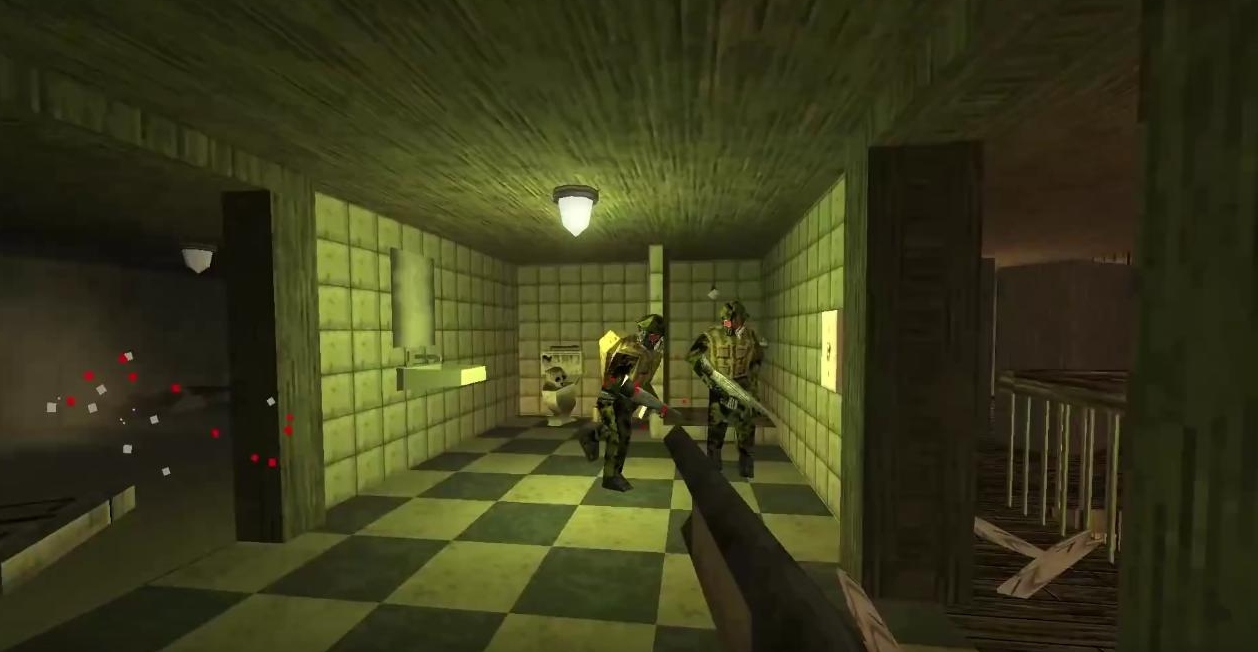
One of the game’s more debated elements is its return to color-coded keycards. Modern shooters largely abandoned this convention because it pushes players into tedious backtracking through empty corridors. Szymanski solves the problem through sheer design elegance: levels are compact enough that you can navigate them from memory. Ten minutes into any DUSK level you already know the yellow door is by the bookstore and the blue one is past the bar.
The average level takes around twelve minutes to complete at a normal pace. That is a deliberate design choice. DUSK doesn’t try to be monumental — it prefers to be dense. Every twelve minutes is a self-contained piece of mayhem you can actually put down afterward. The built-in level timers are a direct nod to the speedrunning community that quickly made this game their own.
The secrets are everywhere and rarely obvious: sometimes you need to shoot an air vent grate, sometimes press an unmarked section of wall. What truly distinguishes Szymanski as a designer, though, is his environmental storytelling. Blood-scrawled messages on walls, invisible enemy footprints tracked in a flashlight beam, a trapdoor opening where you least expect it. The noted that a single encounter — a demonic deer appearing from pitch darkness while its invisible footsteps approached — topped anything they’d found in an entire Fallout game’s worth of environmental narrative. That sounds like hyperbole until you see it for yourself.
Unlock massive fun through our free steam accounts.
DUSK Enemies: More Variety Than You’d Expect From an Indie Game
DUSK’s bestiary is one of its strongest assets. Enemies aren’t just “soldier,” “monster,” and “big monster.” Each type demands a genuinely different approach:
-
Cultists — hooded figures hurling dark magic. Fast, clustered, unpredictable projectile arcs.
-
Scarecrows — slow but absorb massive punishment. Don’t let them close the distance.
-
Invisible creatures — detectable only by sound and blood-trail footprints. Among the most unsettling enemy types in the game.
-
Demonic deer — they erupt from the darkness beneath a wall message reading “don’t trust your eyes.”
-
Bosses — each one is effectively a kiting and vulnerability puzzle in its own right.
Mix all of these types in a single encounter and you get a constantly shifting engagement pattern — a chess problem solved at 100 mph.
DUSK Graphics: Low-Poly Aesthetics as an Artistic Statement, Not a Budget Constraint
The blocky, pixelated visuals are the first thing people notice about DUSK and the first thing that puts part of the audience off. That’s an honest reaction. It’s also the most surface-level reading possible.
Technically the game runs on Unity. Low-polygon enemy models and environmental objects are paired with modern lighting, particle effects, and physics systems. That combination produces a specific visual language: angular monsters against dynamic shadows don’t look dated — they look deliberately unsettling, like an old woodcut print that someone brought to life.
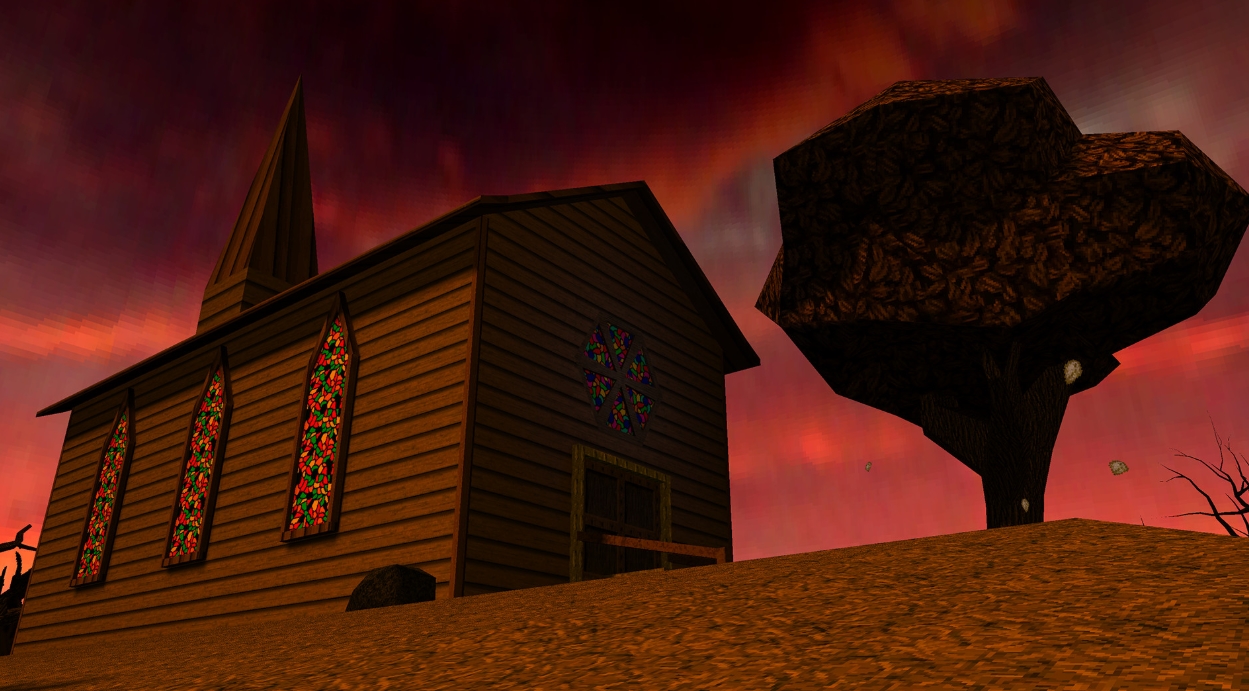
The corn mazes in DUSK are frightening partly because of the low-resolution textures. A rural church with blurred stained-glass windows feels genuinely cursed rather than simply “unfinished.” This isn’t a technical limitation. It’s an aesthetic position.
On a practical note: on a test rig of i5 4690k, 16GB RAM, and a GTX 970, the game ran completely stable at maximum settings — even in the most crowded fights with dozens of enemies, exploding barrels, and blood geysers filling the screen. DUSK’s system requirements are minimal, making it accessible on virtually any modern PC.
DUSK System Requirements (Minimum and Recommended)
| Component | Minimum | Recommended |
|---|---|---|
| OS | Windows 7 (64-bit) | Windows 10 (64-bit) |
| CPU | Intel Core i3 | Intel Core i5 |
| RAM | 4 GB | 8 GB |
| GPU | NVIDIA GT 730 | NVIDIA GTX 970 |
| DirectX | Version 11 | Version 11 |
| Storage | ~3 GB | ~3 GB |
DUSK Soundtrack: Andrew Hulshult and the Metal Heart of the Game
The music was composed by Andrew Hulshult — the same person behind the soundtracks for Brutal Doom and Quake Champions. If you know either of those, you already understand: this is not background noise.
The DUSK OST is heavy, aggressive, and unmistakably metal in character. But it never turns monotonous. There are tracks built around an almost meditative industrial drone — these play in the deepest, darkest sections of the third episode. There are bursts of frantic thrash metal for boss arenas. And there are moments when the music cuts out entirely, and the silence turns out to be scarier than any riff could be.
The album is available separately and has long since found its way into playlists belonging to people with no connection to video games whatsoever. If you loved the original Doom or Quake OST, this is required listening.
DUSK vs. The Classics: An Honest Comparison With Doom, Quake, and Blood
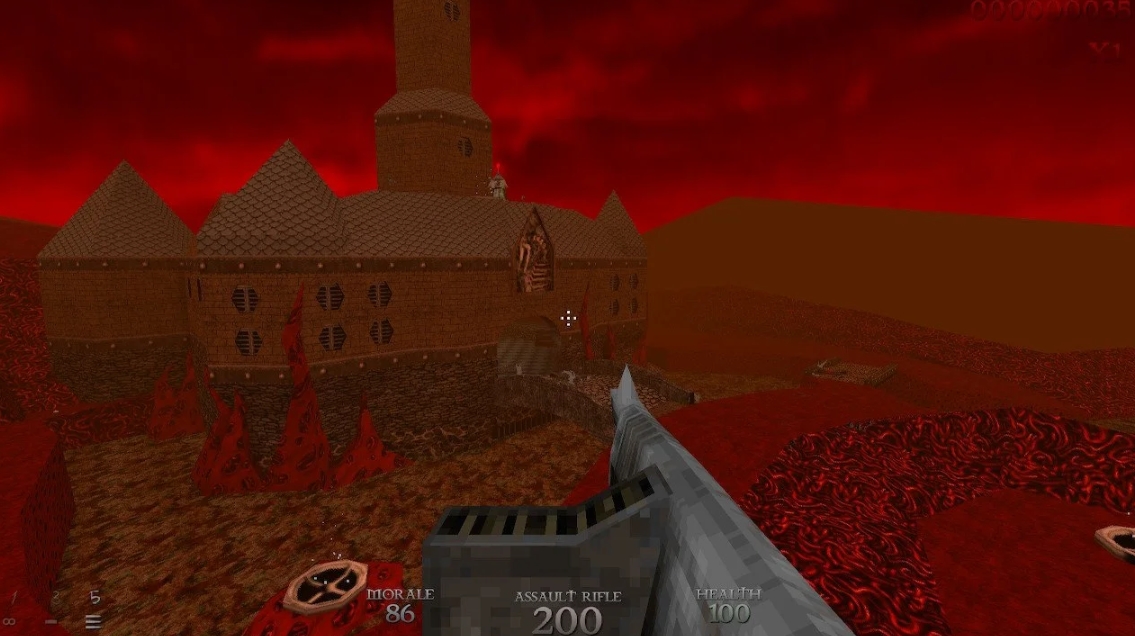
The claim that DUSK “just copies” Quake and Doom tends to come from people who haven’t played either of those games carefully enough.
What DUSK takes from Doom: movement pace, crowd control fundamentals, the color-keycard system, the logic of finding secrets. But DUSK’s levels are not maze corridors. They are visually readable because they have recognizable context: a bar, a bedroom, a library.
What DUSK takes from Quake: movement physics (bunny hop), arena verticality, multiplayer deathmatch, the general darkness and metallic atmosphere. But Quake was never actually scary — it was cold and technological. DUSK is scary.
What DUSK takes from Blood: the cult and American rural horror themes, specific enemy types (cultists, scarecrows), the sense that the world has been rotten from the inside long before you arrived.
What DUSK does differently: it doesn’t recreate these games — it recreates the memory of them. If you boot up the original Doom or Quake today, you’ll see how much of it was provisional, unfinished, and awkward. DUSK works with the rose-tinted version of those games that lives in your head. That’s precisely why it ends up feeling better than the originals — at least in terms of sensation.
DUSK Multiplayer: An Honest Look at the Weakest Part of the Package
DUSK’s multiplayer is arena deathmatch in the spirit of original Quake. It’s fast, weapon spawns are positioned across the maps, matchmaking runs without meaningful downtime. The arenas use strong vertical geometry, and the gun feel is convincing throughout.
But here’s the honest observation: multiplayer is the weakest part of DUSK. Not because it’s bad — it’s perfectly functional. It’s just that next to the single-player campaign, it reads as a more direct recreation of the classics, missing the “spiritual reimagination” that makes the singleplayer so special. If you want a multiplayer retro FPS, Quake Champions, Diabotical, and Quake Live are better choices for that specific purpose. DUSK is bought for its singleplayer, and that’s exactly what deserves your money.
Is DUSK Worth Playing in 2026: Who It’s For, and Who It Isn’t
DUSK is not a game for everyone. That’s not a flaw — it’s honesty.
DUSK is right for you if:
-
You played Quake, Doom, Blood, or Half-Life and miss that specific feeling
-
You’re tired of modern shooters that turned into interactive films with action sequences
-
You value games where movement skill matters as much as aiming
-
American folk horror in the vein of The Texas Chain Saw Massacre, The Hills Have Eyes, or early Lovecraft appeals to you
-
You want an indie game with high replay value: speedrunning, secret hunting, higher difficulty modes
DUSK probably isn’t for you if:
-
Low-poly or pixel-style graphics cause you genuine discomfort
-
You expect a developed story with dialogue and characters
-
You’ve grown accustomed to auto-regenerating health and checkpoint saves
-
Slow, tactical shooters are your preferred pace
It’s also worth acknowledging the broader context: in the years since its release, DUSK became the reference point for an entire wave of retro-FPS games — Ultrakill, Ion Fury, Prodeus, Amid Evil. All of them owe something to what Szymanski built. Understanding where this revival started is reason enough to spend time with DUSK.
How to play DUSK for free on Steam via VpeSports
If you’ve ever heard of DUSK and thought, “Come on, another retro shooter,” I get it. I thought so myself. But it’s worth starting the first episode, as you understand: It’s not just nostalgia for the good old days of Quake and Heretic. It’s something alive, evil, and incredibly honest towards the player. New Blood Interactive has done something that modern studios rarely do — they’ve created a game that doesn’t hold your hand or apologize for its complexity. Gloomy farms with cultists, rusty factories where something clearly went wrong, and completely insane otherworldly levels that really start to go crazy. All this is accompanied by a heavy soundtrack that knocks you into a chair from the very first note. And yes, you can try it all for free, right now.
To gain access, you don’t need to be a tech-savvy person or spend an hour parsing instructions. Just register on the website, log in to your account and find the GET AN ACCOUNT button at the very beginning of the article. Then everything is laid out step by step — briefly and to the point. We have specially removed everything unnecessary so that there are no unnecessary barriers between you and the game.
And to keep up to date with everything, subscribe to our Telegram channel. It’s not just dry news: we post fresh accounts, discuss patches, sometimes argue about which episode is better, and in general, we’ve gathered people who care about what they’re playing. If something goes wrong— the “How to play for free — the complete guide” section will close most of the questions, but if not, just write to the chat, we are real people and we will answer.