

Unheard – Voices of Crime is a detective game that deliberately deprives the player of the familiar tools of the genre. There are no interrogations with a choice of lines, no forensic mini-games, no spectacular cut scenes. There is only sound. And you are an analyst sitting in a room with a terminal, able to “connect” to recordings from crime scenes.
Table of Contents
Unheard – Voices of Crime Free Steam Account
At first glance, the concept seems almost abstract. Here is a schematic map of the building: apartment, warehouse, bar, yacht. You can freely move around the rooms, watching the characters from above, but you only hear what sounds within the radius of the selected point. Your task is not to manage events, but to understand them. Who’s who? Who’s lying? At what point was the turning point in history?
The uniqueness of the game is that it builds the entire gameplay around hearing and logic. This is not a “quest” in the classical sense, but rather an interactive reconstruction of a crime, where you act as an attentive listener and analyst. Developers from NEXT Studios have created an experience that requires concentration rather than reaction. And it is felt from the very first minutes.
Unheard doesn’t try to impress with graphics or scale. She works with minimalism. There is a certain courage in this: the game trusts the player. He does not lead by the hand, does not highlight the obvious, does not chew out motives. She offers you space, sound, and time—and then it all depends on your ability to connect the facts.
Plot and case structure in Unheard – Voices of Crime: how crimes unfold
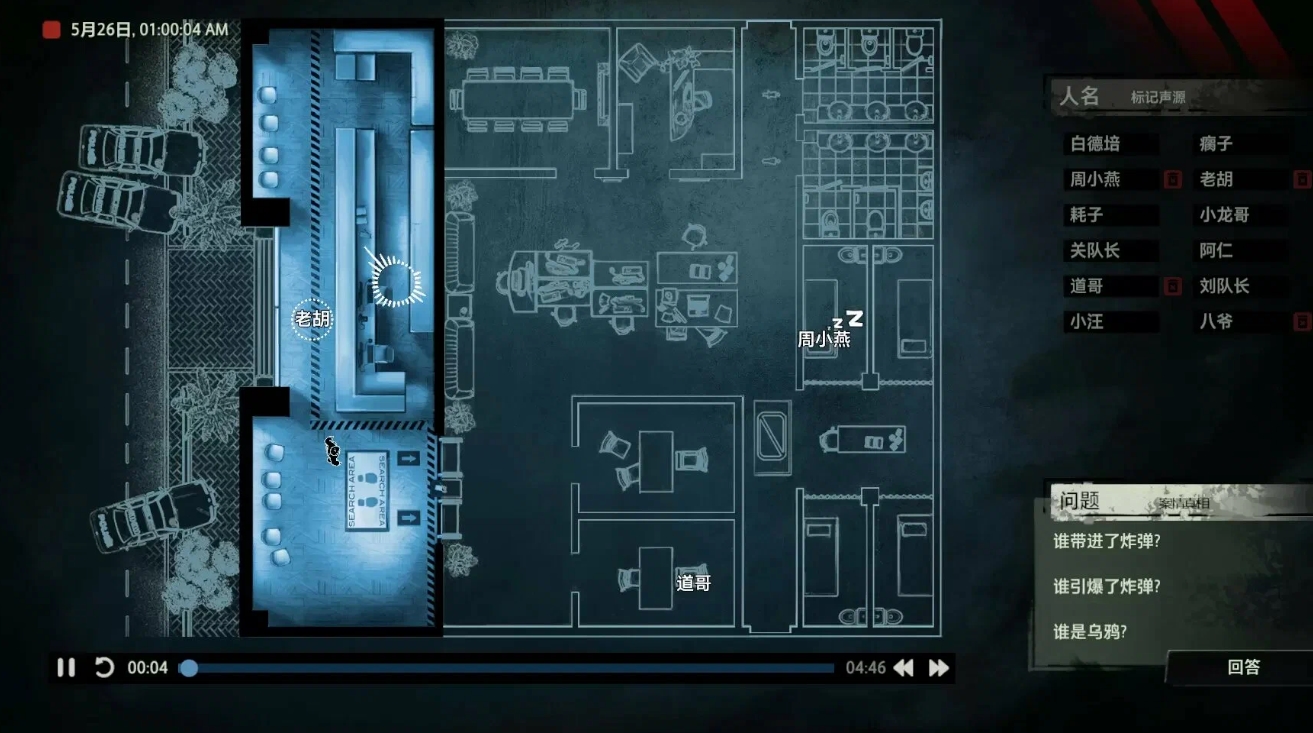
Unheard is based on several separate cases, united by a common framework — the story of a mysterious technology that allows you to “hear the past.” However, the central line remains more of a background. The main focus is on the investigations themselves.
Each case is a closed scene played out in real time. The events go on continuously, and you can rewind the recording forward or backward, stop it, and return to key moments. The structure is designed so that the player gradually untangles the tangle:
-
First, the chaos of voices and unclear connections;
-
Then the first coincidences and suspicions;
-
Later — building a clear picture of events;
-
The final section contains answers to specific questions.
An important point: the game does not tell the story linearly. You decide which character to start with, who to follow, and which conversation to listen to. Sometimes one carelessly thrown word completely changes the understanding of what is happening.
Unheard’s scenario is based on domestic conflicts, jealousy, financial fraud, and coincidences. These are not high-profile political conspiracies, but human dramas. And that’s what makes the cases compelling. In one story, I found myself listening to the dialogue for the third time, trying to catch the intonation, and suddenly I realized that the character was not just making excuses, but deliberately leading the conversation away. Such moments work more than any staged scene.
Level up instantly using a free account in steam!
Gameplay Unheard – Voices of Crime: Investigation mechanics through sound and timeline
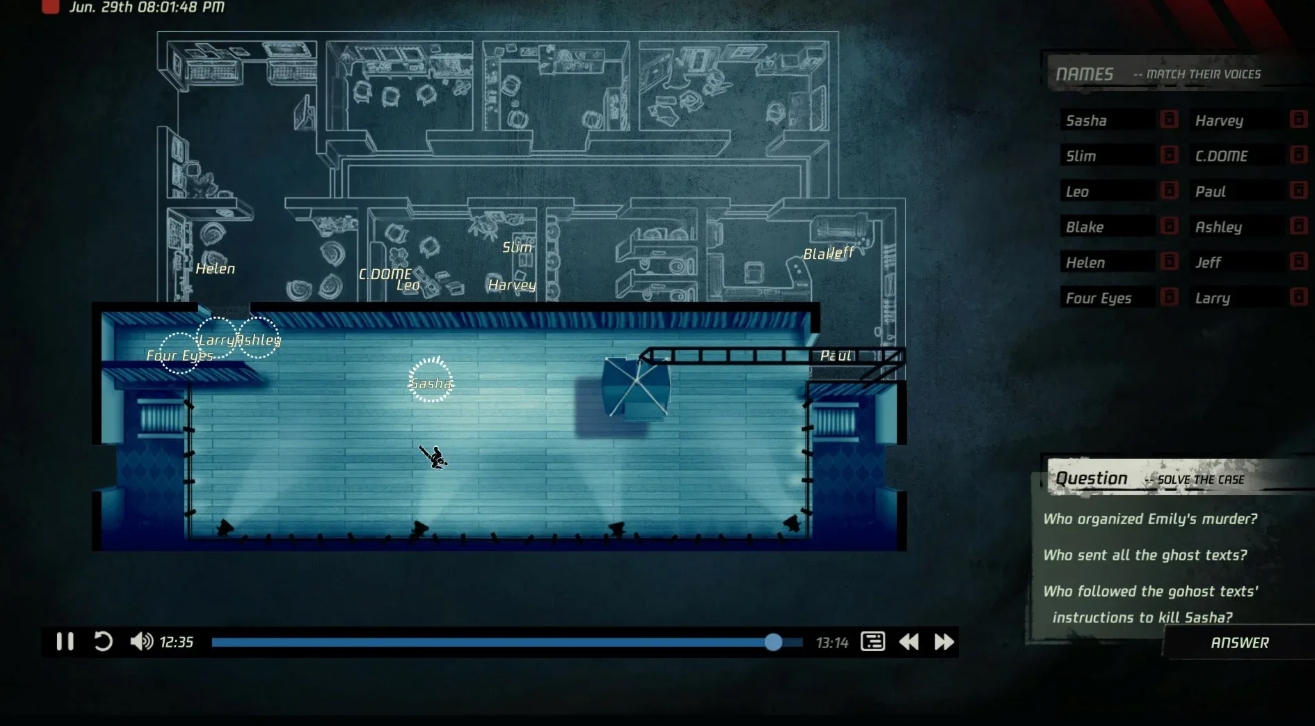
The gameplay can be described as a combination of observation, audio analysis and deduction. There is a level map with marked characters on the screen. Each character moves through space, communicates with others, and performs actions. You can:
-
Move between rooms;
-
Follow a specific character;
-
Rewind time back and forth;
-
Stop recording for analysis.
The key tool is the timeline. It is she who turns the chaotic flow of conversations into a structured system. You notice that at 2:32 p.m. someone enters the office, and at 2:35 p.m. there is a scream. So, it’s worth going back to those minutes and tracing the routes of all the participants.
The game requires attention to detail. Not only to words, but also to sounds: footsteps, a door slamming, a shot, an object falling. Sometimes the answer lies not in the dialogue, but in the pause between phrases.
It is important to understand that Unheard does not adjust to the “right” pace. You can spend an hour on one task, or you can spend three. There are no penalties for mistakes, except for the need to re-listen to the material. This is a rare case where the game respects the player’s intellectual process.
How to play Unheard – Voices of Crime: Principles of Deduction, Logic, and Dialogue Analysis
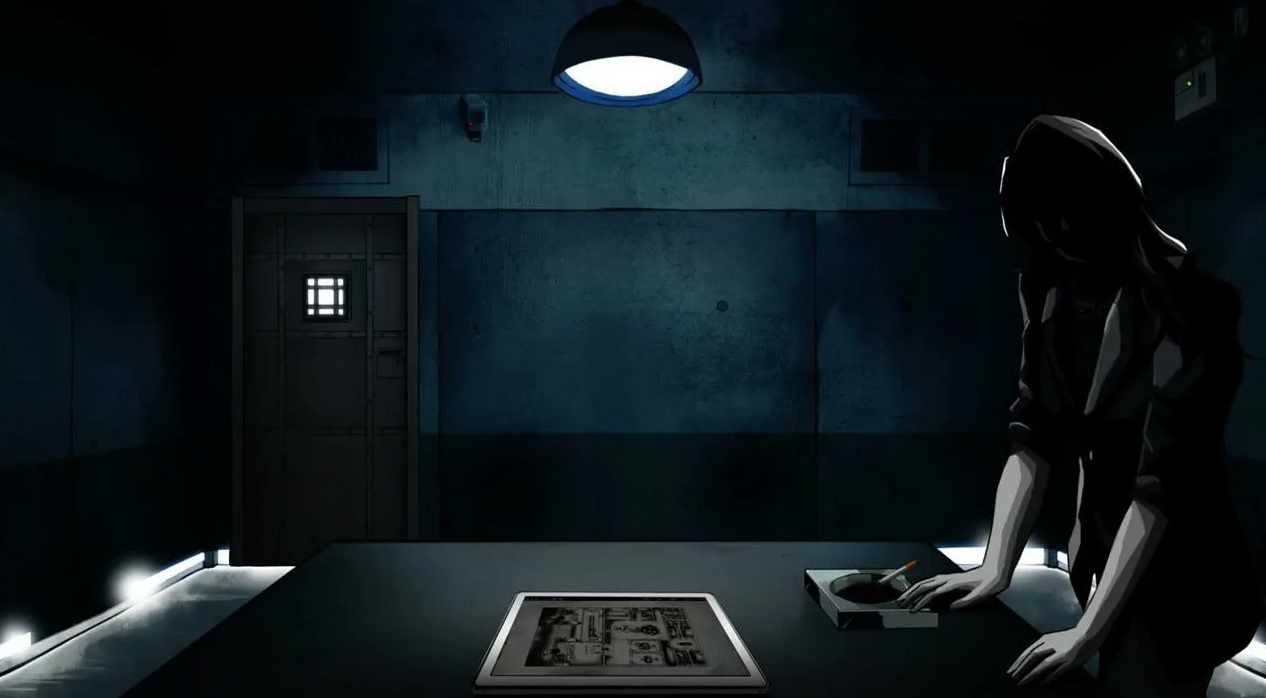
If you approach Unheard like a regular detective game, you can quickly get confused. It is important to develop a strategy here.
First, don’t try to cover everything at once. It is better to choose one character and follow his path from beginning to end. Then another one. Comparing routes often gives more than a chaotic switch.
Secondly, record the names and roles. The game intentionally does not sign the characters in advance. You have to figure out for yourself which of the voices is an accountant, who is a security guard, who is a relative. This enhances the effect of presence, but requires concentration.
Third, pay attention to the contradictions. Often, characters say one thing and do another. It is in these discrepancies that the key lies.
My personal experience has shown that the method of consistently narrowing the circle of suspects works best. First you understand the general structure of the event, then you filter out the impossible versions, and only after that you move on to the details.
Unheard is not about guessing. It’s about analysis. And that’s her strength.
DLC and additional Unheard content: Is it worth going through extensions
After completing the main campaign, the game offers additional content. Among the extensions, The Lethal Script case stands out, which adds a more complex narrative structure and a larger number of characters.
DLCs feel like a logical development of an idea. They complicate tasks, introduce more confusing scenarios, and require even more attention to detail. If the main game seemed too simple to you, the extensions pleasantly raise the bar.
However, it’s worth considering: the mechanics remain the same. No new tools are being added. It’s all the same work with sound and time. Therefore, additional content will appeal to those who have already mastered the basic concept. If you are tired of the format, DLCs are unlikely to change the impression.
Pros and cons of Unheard – Voices of Crime after completing the full course
After completing all the cases, the impression is quite solid.
Strengths:
-
the original concept of investigation through sound;
-
respect for the player’s intelligence;
-
thoughtful scenarios with human motives;
-
no artificial time limits.
Weak points:
-
a minimalistic visual presentation may seem dry;
-
lack of variability in mechanics;
-
high entry threshold for inattentive players.
The game doesn’t try to please everyone. It’s pretty niche. But that’s exactly why it’s memorable.
Final verdict: Is it worth playing Unheard – Voices of Crime in 2026
In 2026, when the market is full of high–profile releases with photorealistic graphics and open worlds, Unheard – Voices of Crime looks almost ascetic. And this is its advantage.
This is a game for those who like to think. For those who enjoy analysis, the search for patterns, and the moment when disparate fragments add up to a single picture.
It doesn’t give you adrenaline. It doesn’t impress with special effects. But it gives a rare feeling of intellectual satisfaction. After the final case, I found myself thinking that I had not just “passed the game”, but had actually conducted an investigation.
If you are looking for a non—standard detective experience on PC, are ready to spend time listening attentively and are not afraid of difficult tasks, Unheard deserves attention even years after its release.
It’s not a massive hit. But this is an honest, thoughtful and truly unique project that proves that sometimes just one instrument – sound — is enough to create a deep and memorable gaming experience.
Unheard – Voices of Crime System Requirements for PC
Unheard – Voices of Crime
How to play Unheard – Voices of Crime for free on Steam via VpeSports
Sometimes the loudest evidence is a quiet whisper in the background. In Unheard – Voices of Crime, you don’t just play — you listen. Into other people’s conversations, into nervous pauses, into footsteps in the hallway, into the creak of the door, which sounds suspiciously timely. This is a rare format where there are no “come here” markers and “here’s the criminal” arrows. There is only you, the space, and the voices that are gradually forming the truth.
Every case feels like a personal investigation. First, chaos: dozens of phrases, names, events. Then there’s guesswork. You start going back to individual moments, listening to scenes, noticing who is lying to whom, who is not telling what, and who is trying too hard to look innocent. And then at some point everything clicks. The story is building up in my head, like a puzzle that has finally come together. This feeling cannot be faked — it must be lived.
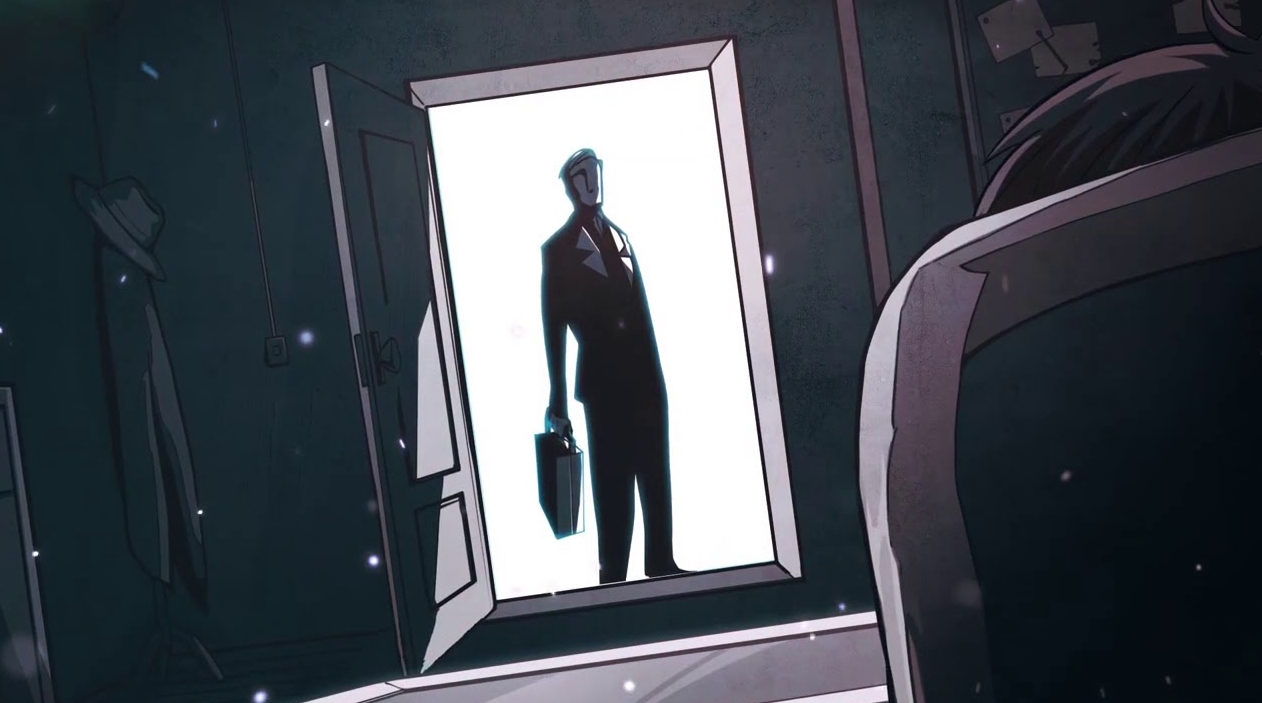
We understand that we want to move from words to action faster, so we tried to simplify the access process. All without confusing instructions and unnecessary steps. Register on the website, log into your personal account and return to the top of the page — there you will find the GET AN ACCOUNT button. Then there are clear instructions so that you can dive into the first investigation almost immediately.
If you are one of those who likes to discuss theories, argue about the motives of characters and share your conclusions, be sure to check out our Telegram channel. There we publish fresh accounts, news and updates, and also just communicate with those who are really interested in this unusual detective format. And if something doesn’t work out or you have questions, you will find detailed explanations in the “How to Play for Free – Complete Guide” section. And, of course, you can always write to us in the chat — we are the same fans of solving mysteries and we will be happy to help.