

Picture this: you’re standing on a dead, rust-colored planet. No air. No water. No life of any kind. Your suit is slowly burning through its oxygen reserves, and all you have is a workbench, a handful of iron scraps, and the audacious idea of turning this barren rock into a living world. No enemies. No gunfights. Just you, a stack of resources, and a terraforming index ticking upward on your screen. The Planet Crafter is a game that resists easy genre labels — survival without combat, crafting without conveyor belts, progression without experience points. And yet: 96% positive reviews on Steam, over 27,000 ratings. That doesn’t happen by accident.
Table of Contents
What Is The Planet Crafter? More Than Just Another Survival Crafting Game
The Planet Crafter is an indie game developed by Miju Games — a studio that started with literally two developers — which launched into full release on April 10, 2024, after several years in Early Access. The official genre tag reads “survival open world terraforming crafting,” and every word earns its place.
The premise is deceptively simple. You’re a convict dropped onto a lifeless planet with one mission: make it habitable for humanity. No rescue teams, no companions. Just the Terraforming Index (TI) — a single progress metric you raise by building machines and launching rockets.
What sets it apart from almost every other survival game on the market is the complete absence of combat. No monsters hunt you, no hostile factions raid your base, no PvP. The only real threats are oxygen, water, and food. Step outside without your suit and you die — at first. But as the atmosphere thickens, that restriction gradually lifts. Eventually you’re walking outside in a blue-skied world you built yourself. That’s the hook, and it’s a remarkably powerful one.
How Terraforming Works in The Planet Crafter: From a Dead Rock to a Living Biosphere
The Terraforming Index is the single spine the entire game is built around. Every machine you place, every satellite you launch, every rocket you fire feeds into this number. Cross certain thresholds and the planet visibly, tangibly changes around you.
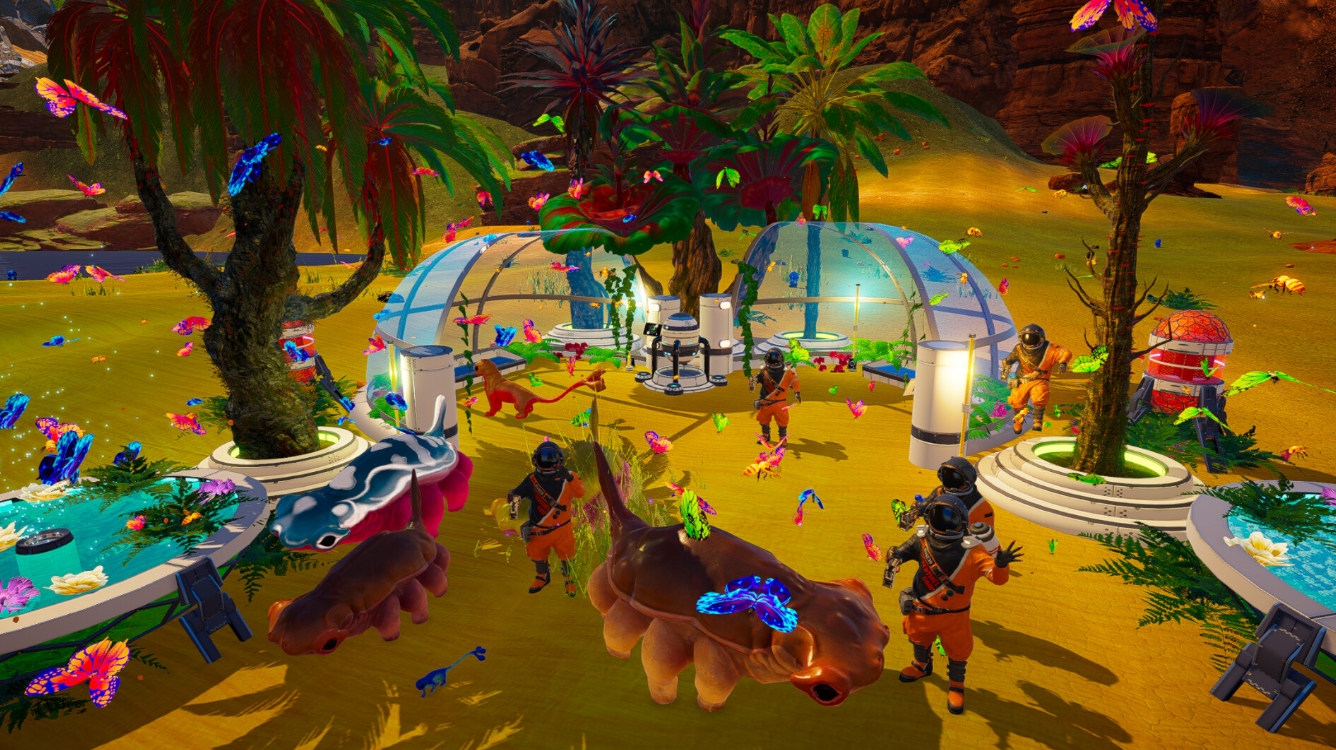
The main terraforming stages, in order:
-
Lifeless Planet — the starting point. Orange-red surface, zero atmosphere.
-
Blue Sky — the first real milestone (175 kTI). The sky shifts to blue. A genuine “wow” moment.
-
Clouds & Rain — the atmosphere continues to thicken.
-
Liquid Water — surface water appears; some ice caves begin to thaw.
-
Lakes — larger bodies of water form; previously frozen zones with rare ores become accessible.
-
Moss, Grass, Trees — vegetation spreads across the surface.
-
Insects, Fish, Amphibians — fauna appears organically.
-
Late Stages — continued biosphere development beyond named milestones.
None of this is purely cosmetic. Each new stage unlocks access to new map zones, new ores (including those sealed behind ice caves), and new blueprints. The system is elegantly designed: the visual reward and the gameplay reward are the same thing. When the sky turns blue, you don’t just feel good — you also know the osmium caves are about to open up.
Terraforming speed is driven by heat generators, pressure machines, oxygen producers, and eventually orbital satellites that multiply your TI gain dramatically. Launching satellites also unlocks the in-game map system.
How to Get Osmium in The Planet Crafter: Locations, Strategy, and What It’s Used For
Osmium is one of the most important mid-to-late game resources in The Planet Crafter. It’s a dark blue crystalline mineral used to craft the Ore Extractor T2, the DNA Manipulator, Teleporters, the T2 and T3 Jetpack, and — critically — the Fusion Energy Cell.
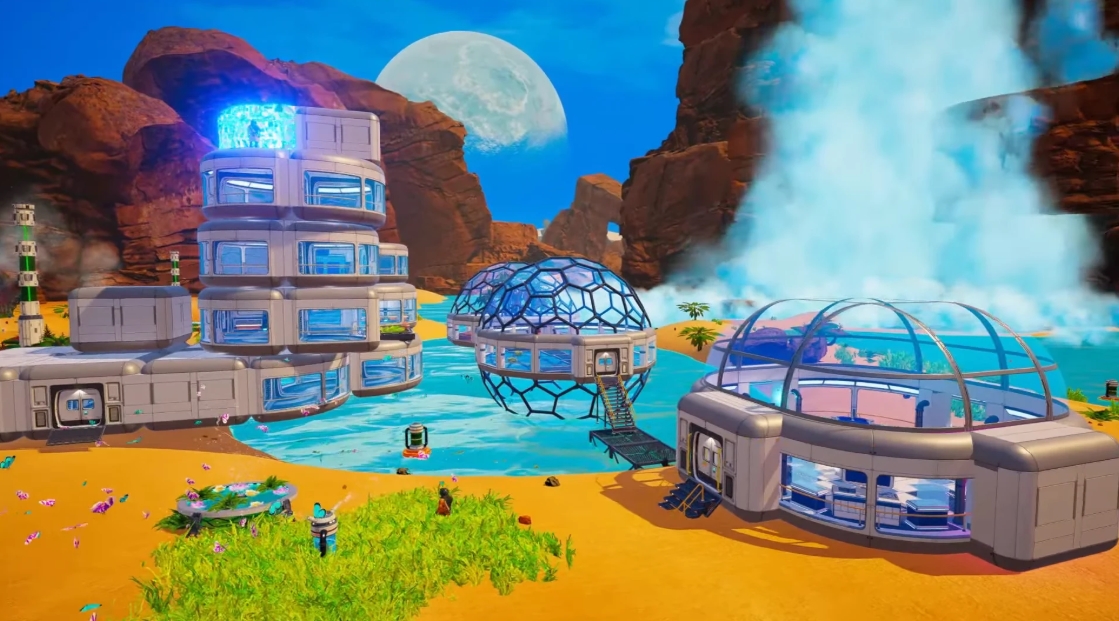
The catch: most osmium deposits are sealed behind ice and only become accessible after the Lake Stage of terraforming. This creates a classic bottleneck where you need osmium to progress, but full access to osmium requires progression you don’t yet have.
Ways to obtain osmium:
Two mixed-mineral caves worth knowing: coordinates 973:43:−975 (Osmium + Pulsar Quartz) and 328:4:−181 (Osmium + Iridium). Note that some caves don’t have enough flat soil to place an Ore Extractor — in those cases, manual collection is your only option, and once it’s gone, it’s gone for good.
The best long-term strategy: as soon as you unlock the T2 Ore Extractor, plant one in an osmium cave. It eliminates the resource bottleneck for the rest of the game.
The Planet Crafter Ore Crusher: What It Does and How to Use It Efficiently
The Ore Crusher is a processing machine that lets you extract additional materials from already-mined resources — a useful optimization tool in the mid-game when raw ore is still scarce.
It’s worth noting that The Planet Crafter deliberately avoids the deep production chains found in games like Factorio or Satisfactory. There are no conveyor belts, no power grids to wire up, no multi-step logistics puzzles. Most craftable items require two or three ingredients at most. This is an intentional design choice — the game keeps its production side accessible so the focus stays on exploration and terraforming.
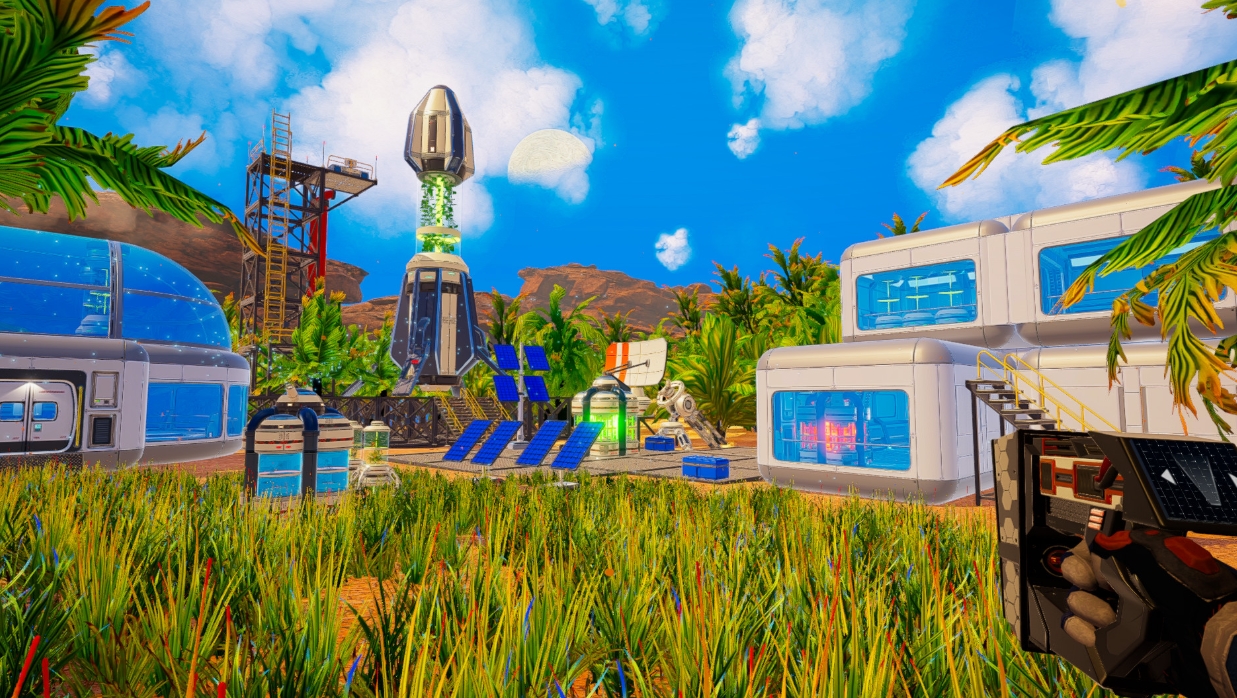
A few resource management tips that work well alongside the Ore Crusher:
-
Store iridium and uranium as Rods rather than raw ore — they take up less inventory space, and you can convert them back to ore without loss using a recycling machine when needed.
-
Ore Extractors passively gather resources while you’re doing other things — building a network of them is the foundation of any efficient late-game setup.
-
Some rare resources like Zeolite and Pulsar Quartz don’t regenerate when manually mined — conserve your stock carefully until you can automate collection.
The Planet Crafter Fusion Reactor: How to Activate It and What It Unlocks
The Fusion Reactor is one of the game’s most satisfying environmental puzzles — and one the tutorial doesn’t explain at all. It’s a device built into several crashed ships scattered around the map. Activating it opens previously locked sections of those ships, which typically contain rare loot valuable for late-game terraforming.
How to activate the Fusion Reactor:
-
Craft a Fusion Energy Cell at an Advanced Craft Station. Recipe: 1 Super Alloy + 2 Osmium + 3 Pulsar Quartz.
-
Locate a ship containing a Fusion Reactor. One is found at coordinates 355:131:946, near where most players establish their starting base.
-
Interact with the reactor and insert the Fusion Energy Cell.
-
The reactor activates, unlocking the sealed doors inside the ship.
Important: Once you insert a Fusion Energy Cell, you cannot remove it. The action is permanent. Multiple ships on the map contain Fusion Reactors, each in a different location and each with different loot behind the locked doors.
Pulsar Quartz (needed for the Fusion Energy Cell) can be found in Storage Crates, crafted in a Biolab, or mined in a dedicated cave — though that cave has no soil for an extractor. Obsidian is found near the volcanic area in the southwestern part of the map.
The Planet Crafter vs Stationeers: Two Completely Different Takes on Space Survival
The comparison between The Planet Crafter and Stationeers comes up constantly in the community, and it’s a fair one to examine. Both are space survival games with no traditional combat. Both involve building and exploration. But beyond that, they represent almost opposite design philosophies.
The Planet Crafter is about the feeling of growth and visible progress. Stationeers is about engineering puzzles and hard sci-fi simulation. The first is the right pick if you want to switch your brain to a quieter frequency and build a world. The second is for players who enjoy figuring out why their reactor’s gas mixture is wrong.
Players looking for something in between often point to Subnautica or Astroneer. The Planet Crafter feels closest to Subnautica — the same pace of world discovery, the same sense of expanding possibility as survival constraints gradually lift.
A free steam account with games can be useful when you don’t want to install everything manually.
The Planet Crafter Platforms: Is It on Xbox, PS5, or Nintendo Switch?
As of this writing, The Planet Crafter is available exclusively on PC (Windows) via Steam. There is no official Xbox, PlayStation 4/5, or Nintendo Switch version currently released.
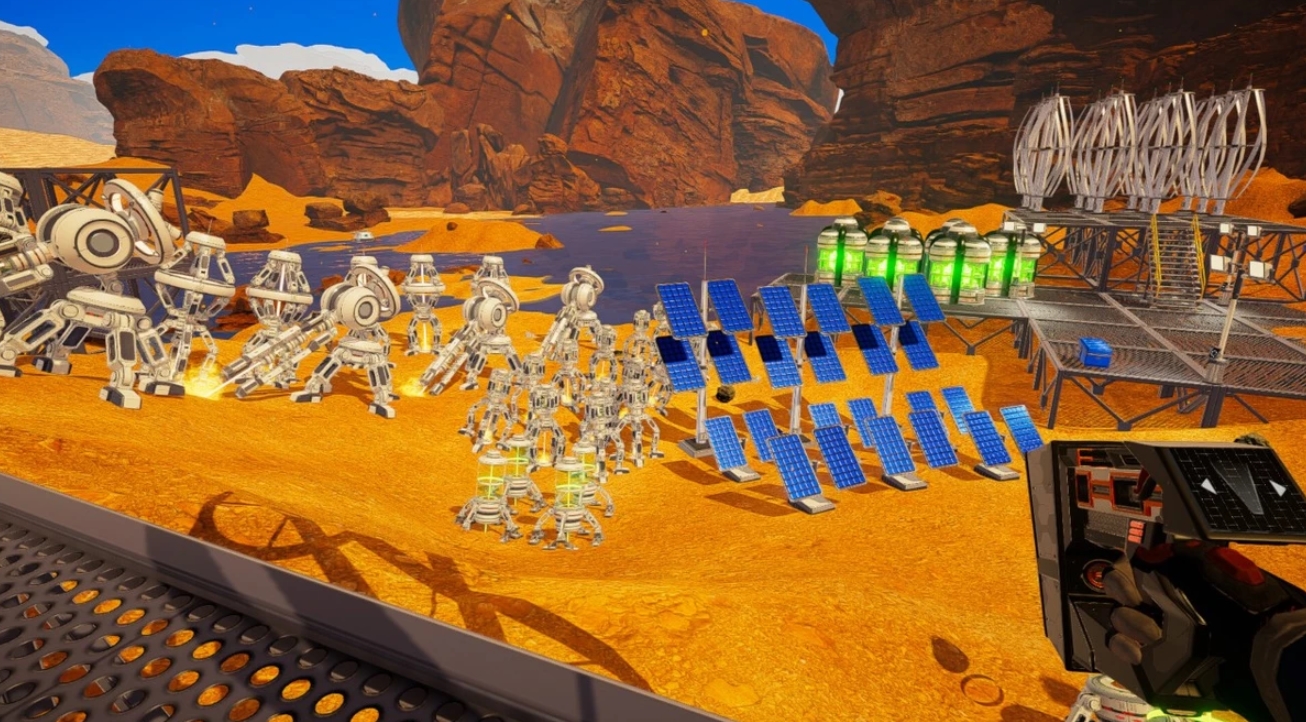
Console ports — particularly an Xbox version and potential inclusion in Xbox Game Pass — are among the most frequently requested features in the community. However, Miju Games remains a small studio, and porting to console platforms is a significant undertaking. For the most current information on platform announcements, check the official Miju Games channels directly.
The Planet Crafter PC System Requirements:
The game supports multiplayer for up to 10 players — co-op terraforming substantially speeds up progress and adds a genuinely fun social dimension to the experience.
The Honest Downsides: What The Planet Crafter Gets Wrong
The Planet Crafter is not a flawless game. After the first 10–15 hours, the euphoria of watching a world come to life starts bumping up against the reality of a fairly repetitive grind loop. Reviewers and longtime players consistently point to several friction points.
Late-game monotony. Once you’ve hit the blue sky milestone, the gameplay loop becomes predictable: build more machines → wait for TI to climb → unlock the next blueprint → repeat. Without combat or complex production puzzles to break it up, the late game can feel like going through the motions. Some players report dozens of hours played “on autopilot.”
A world that runs out of space. The map is sizeable but not vast. After enough hours, every corner becomes familiar. The Planet Humble DLC adds a new planet at roughly 50% of the original map’s footprint — but with significantly more verticality — which helps extend the experience.
Physics quirks and minor bugs. Some objects behave oddly. Portal zones and interior ship areas can occasionally produce strange interactions. Nothing game-breaking, but noticeable in an otherwise polished experience.
Visual modesty. This is a two-person indie studio — AAA production values aren’t on the table. The starting environment looks sparse and generic. That said, the visual payoff as terraforming advances is real, and by the endgame the planet genuinely looks alive.
A weak opening. The game’s beginning lifts heavily from Subnautica’s structure — escape pod landing, initial workbench, starter chest — but without the same quality of animation or narrative impact. First impressions can underwhelm players expecting a cinematic entry point.
Is The Planet Crafter Worth Playing in 2026? Final Verdict
The full release of The Planet Crafter delivered what the Early Access version always promised: a complete arc, polished progression, and a DLC planet that extends the experience meaningfully. The game doesn’t try to be everything. It occupies a specific niche — meditative, progress-driven, visually rewarding crafting — and it occupies that niche exceptionally well.
If you find satisfaction in watching your own actions reshape an environment over time, The Planet Crafter offers something genuinely rare. That feeling — a dead world slowly waking up because of what you built — carries the game from first hour to last. If you’re looking for combat, complex factory logistics, or deep narrative, look elsewhere.
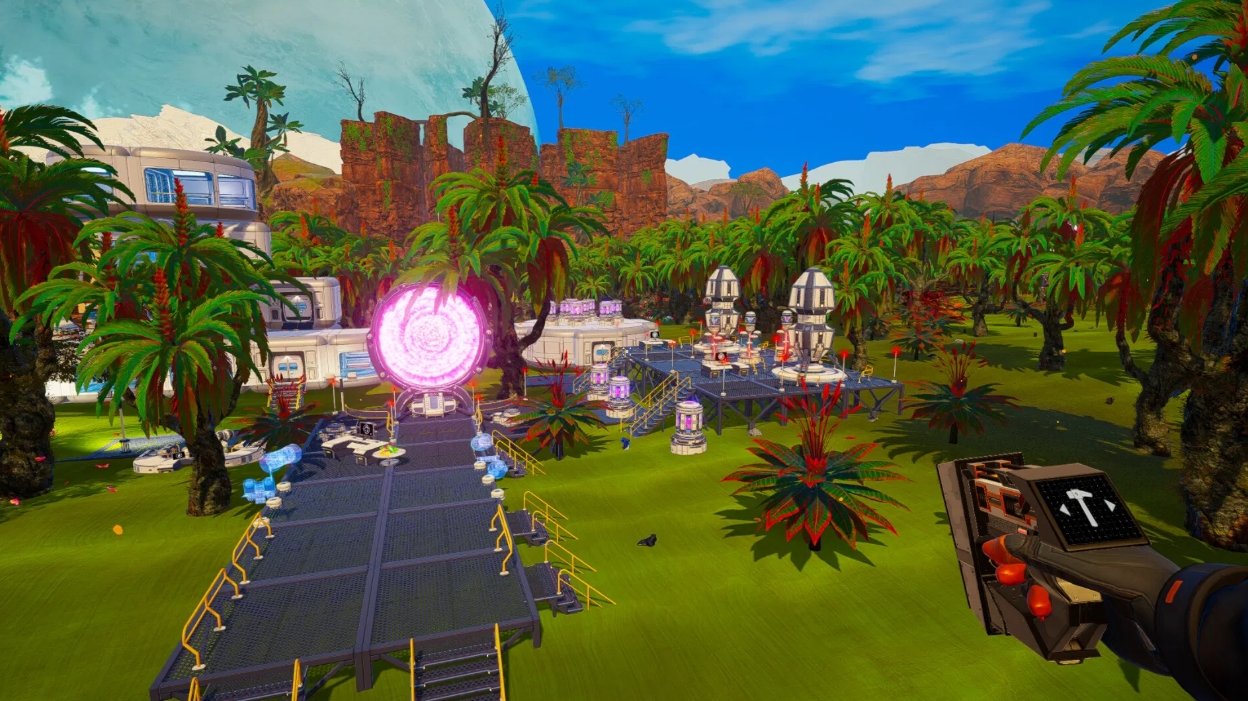
For its price and scale, this is one of the most player-respectful games in the genre. No artificial retention hooks, no punishing loops designed to waste your time. Just you, a planet, and one persistent question: what happens if I push the TI a little higher?
How to play The Planet Crafter for free on Steam via VpeSports
Imagine: You wake up on a lifeless planet, surrounded only by rock, dust, and thin, poisonous air. No vegetation, no water, no signs of life. That’s where The Planet Crafter begins — and it’s up to you to change everything. Not in one day, not at the snap of your fingers, but step by step, generator by generator, until one day you see the first clouds in the sky and you understand: It worked out.
The game doesn’t catch on with action or plot twists — it catches on with the process. That feeling when you turn a dead stone into a living world with your own hands. First you build a modest base, then you start atmospheric reactors, extract rare minerals, and at some point you notice: the temperature has increased, the pressure has changed, and the first puddle of water has appeared on the surface. This is one of those moments worth playing for.
You can try all this for free — we’ve already made sure that you don’t have to figure out a bunch of settings and instructions. Just register on the website, log in to your account and click get account at the beginning of the article. You’ll find all the next steps there — there aren’t many of them, and everything is intuitive.
Well, in order not to miss new accounts, updates and interesting discoveries about the game, subscribe to our Telegram channel. There is live communication, the latest news and answers to questions. If something doesn’t work out, take a look at the “How to play for free — full guide” section or write to the chat directly — we will help you figure it out.