

The Callisto Protocol is a rare guest among modern AAA releases. This is a full-fledged survival horror, and even in the cold scenery of space sci-fi, which in itself sets the game apart from typical blockbusters. This combination of genre and setting inevitably evokes associations with the Dead Space series, and this is not a coincidence at all. Glen Schofield is behind the project, a man who is rightfully called the ideological father of “Dead Space.” He was the one who came up with the concept, convinced Electronic Arts to give the green light and led the creation of the first part, which set the standards for atmospheric horror, level design and narrative presentation.
Table of Contents
The Callisto Protocol Free Steam Account
After the success of the original, Schofield left Visceral Games and did not participate in the development of subsequent installments. Over the years, he has openly said that he would like to return to the genre and make a “real” Dead Space — the way he originally conceived it, without compromise and pressure from the publisher. Moreover, according to him, the sequels went wrong in many ways, and ideally he would prefer to start all over again. These statements only fueled the interest of the audience and fueled the expectations of horror game fans.
Years later, at the head of his own studio and with the support of publisher Krafton, a company known for PUBG, Scofield really returned to his favorite format. From the very beginning, The Callisto Protocol was positioned as the spiritual heir of Dead Space, demonstrating how modern space horror should be: dark, violent, focused on survival, bodily fear and intense gameplay. Moreover, if we recall that the original concept of Dead Space unfolded in a prison in orbit, the similarity becomes even more obvious — Callisto looks like a reinterpretation of that same unrealized idea.
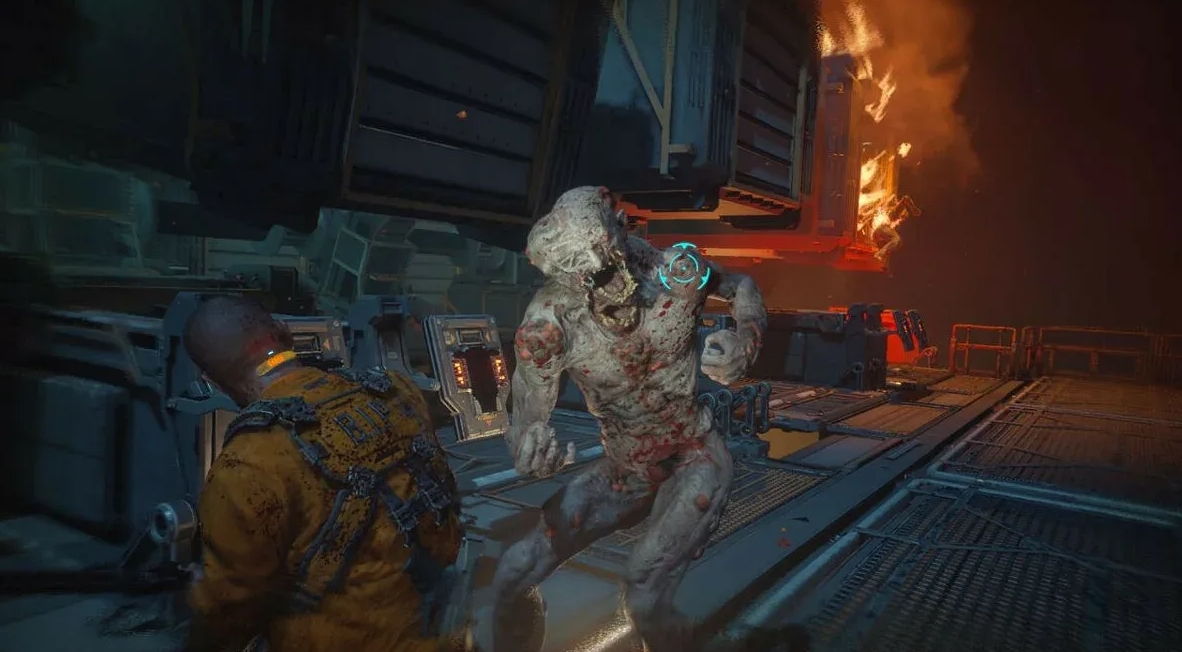
Unsurprisingly, fans of “Dead Space” perceived the project almost as the canonical Dead Space 3, which they never received. The situation was further fueled by the announcement of a remake of the first part from Electronic Arts, creating a sense of direct competition and provoking endless comparisons. The Callisto Protocol trailers did their job: the thick atmosphere, tough scenes, emphasis on horror elements and visual style inspired confidence. At that moment, it seemed that this particular project would be able to seize the initiative. To be honest, I was waiting too. And then my bet would be on Callisto.
Enjoy what others pay for with our free steam accounts!
The Callisto Protocol Plot
The events of The Callisto Protocol unfold in the relatively near future, where humanity has already managed to master a significant part of the Solar System. The plot centers on Jacob Lee, an ordinary space trucker who transports cargo between planets with his partner. His profession and routine gameplay create a down-to-earth science fiction feel at the beginning, but the calm doesn’t last long. Another flight from the Black Iron prison, located on Jupiter’s moon Callisto, turns into a disaster: terrorists get on board, the ship crashes, and the survivors, instead of being rescued, are arrested and turned into prisoners of that prison. Then events rapidly move into the survival horror genre — a riot breaks out, and an unknown infection begins to turn people into aggressive mutants, setting the tone for the entire passage.
For players who want to explore the story on their own, this description is more than enough. However, if you try to evaluate the plot as an independent component, the picture becomes much less rosy. Many reviews have rightly noted that the script does not shine with originality and actively uses hackneyed cliches. Personally, even before the start of the passage, I had a pretty accurate idea of what was waiting for me — and I was right about almost everything. Moreover, some elements, including the motivation of the main antagonist, turned out to be even weaker than the most modest expectations. In the context of science fiction and horror narratives, this looks especially painful: the characters lack depth, and the conflict causes neither an emotional response nor interest.
Unfortunately, The Callisto Protocol cannot stand comparison with high-quality sci-fi stories or any part of Dead Space. The plot here rarely becomes a source of tension or meaning, practically does not develop ideas and does not offer memorable characters. Instead, it sometimes slips into the level of B-movies, where events exist for their own sake. Yes, the game does not cause constant facepalm, but there is practically nothing to cling to in it — the script seems to perform a formal function without becoming part of the atmosphere of horror.

Even more frustrating is the world of the game. Remembering the first Dead Space, it is impossible not to note how detailed the setting was there: Ishimura, the life of its crew, colonies, resource extraction, technology, corporations, religion — all this formed the feeling of a living universe. In Callisto Protocol, even with careful study of audio diaries, the player learns only fragments of information about the colony that existed before the prison, and about the outbreak of the epidemic itself. Ent is served sparingly and does not add up to a complete picture.
Practically nothing is told about the Earth, humanity, the level of technological development or even the device of Black Iron itself. Some games show a minimum of detail, but at the same time their world feels large-scale and full. Here, everything looks different: the environment seems to be a set of decorations taken out of context, existing in a vacuum without history and internal logic. This seriously impairs immersion and destroys the sense of sci-fi authenticity.
The same problem applies to the staging of scenes. The beginning with the shipwreck and the arrest of the hero is really well done: there is tension, dynamics, competent directing. But at the same time, everything looks surprisingly intimate. For comparison, it is enough to recall how in Dead Space the player was slowly brought to the Ishimura, allowing him to examine the ship and the planet, feel the scale and atmosphere. Or as in The Chronicles of Riddick, the path through the prison under escort gradually revealed the space and its structure.
There is almost no such thing in The Callisto Protocol. Here’s the ship, here’s the fall. A few seconds in prison, a cutscene in the infirmary, and the hero is already in the cell. The player does not see Callisto from orbit, does not get a general plan of the prison, does not observe it in a “peaceful” state. We don’t understand the size of the complex, its structure, and its role in the game world. As a result, locations are perceived as disparate, and the environment is disconnected not only from the global context, but also from each other.
The Callisto Protocol’s visual style and gameplay
In many ways, the overall feel of the game continues with its visual component. It is important to make a reservation right away: from the point of view of graphics, The Callisto Protocol looks impressive. The technical performance is excellent — rich frames, detailed animations, dense work with light and textures. Locations, character models, weapons, spacesuits, and equipment are executed with great attention to detail. The design of the environment feels realistic and down-to-earth, and it’s easy to believe in it, which is especially important for sci-fi horror.
The little things that shape the verisimilitude of the world deserve special mention. For example, armor plates worn over the usual uniform of guards. It looks logical and vital — much more convincing than if everyone was just dressed in identical spacesuits. In general, the visual style tends towards a rough, crafting aesthetic: metal, scuffs, massive shapes. This brutality fits perfectly with the harsh prison atmosphere and even refers to the early parts of Gears of War, where humanity also looked heavy and angular.
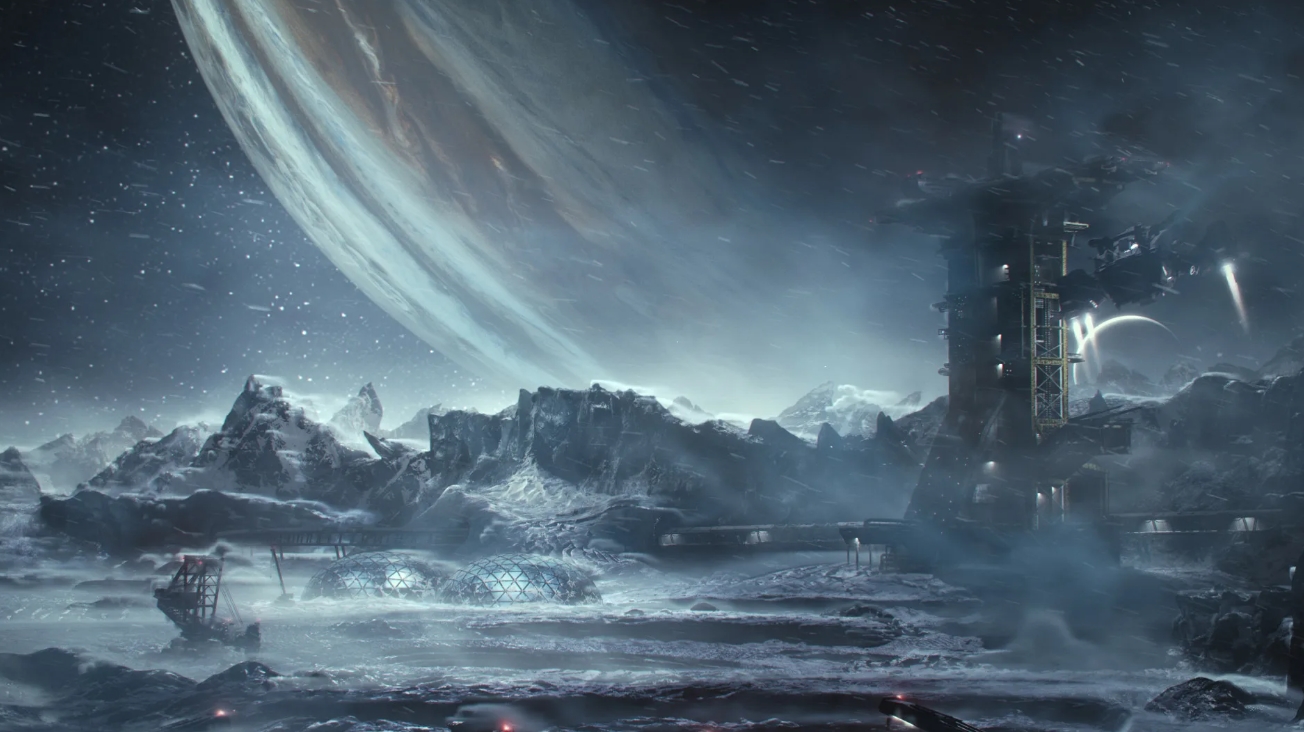
However, for all the beauty of the picture, there are unexpectedly few memorable scenes in the game. Most of the time, the player wanders through the same type of underground rooms: workshops, laboratories, sewers and technical compartments. The color palette hardly changes — either an infernal red light or a sickly green. If you show random screenshots from different hours of the passage, it will not be easy to distinguish them from each other. Yes, there are several visually striking episodes in the game, but they are short and quickly give way to the usual routine. The only truly fresh moment is coming to the surface of Callisto, into the icy darkness of a blizzard, which is really memorable and brings a breath of air.
And it is precisely such episodes that are sorely lacking. The contrast between enclosed spaces and open locations could work much more effectively. A conditional alternation — an hour in the corridors, then 15-20 minutes on the surface — would noticeably refresh the pace of passage. For example, at the beginning of the game, when the hero does not have a full-fledged spacesuit yet, it would be possible to force him to make a short but strenuous transition across the icy surface in an emergency mask. Such scenes worked great in Riddick’s Chronicles and are still remembered as one of the most powerful.

Unfortunately, similar problems can be traced in gameplay with level design. The game too often slips into repetitiveness. First, the player is given a baton and basic opponents — and for more than an hour nothing fundamentally changes: the same enemies, the same combination of punches, dodges and block. It’s only after a while that firearms and leveling elements appear, but by this point the mechanics already have time to get bored.
A similar situation arises with sound-oriented opponents. Blind monsters, ideal for stealth, are initially perceived as an interesting variety. But then for the next few hours, the player almost exclusively sneaks up on them and eliminates them one at a time, occasionally being distracted by other enemies. Instead of escalating the difficulty, the game prefers a safe monotony.
To summarize, the main problems of combat collisions look like this:
-
a rare combination of different types of enemies in one battle;
-
minimal escalation of difficulty as you progress;
-
excessive betting on single opponents instead of group dynamics;
-
weak use of the environment as a source of threat;
-
repeatability of collision scenarios without tactical variations.
The Callisto Protocol seems to deliberately avoid complex and layered situations. Exploding monsters appear only a couple of times and, as a rule, alone, without support. Invisible creatures also always act alone. Even rooms filled with blind creatures quickly turn into a mechanical routine. At the same time, the potential is obvious: it would be worthwhile to add sighted opponents or enemies with a different radius of aggression — and the tension would increase significantly.
You can go even further. For example, a collision with active enemies in a room where the walls are dotted with “sleeping” monsters embedded in them, reacting to noise. In such a scenario, the player would not just have to fight, but control position, distance and accuracy, avoiding accidental mistakes. Such ideas are on the surface, but the game hardly uses them.
The variety of opponents generally leaves mixed impressions. There are few enemies, and none of them are truly original. They are mostly mutated people with ulcers, tumors, and deformed limbs: some are faster, others are more massive, others spit acid, others explode, and others become invisible. The latter are the most successful: fights with them really require concentration and keep you in suspense. But even they don’t save the big picture. Against the background of the variety of necromorphs from the first Dead Space, the local bestiary looks poor.
Separately, it is worth mentioning small crawling slugs and stationary “devils from a snuffbox.” These enemies are hard to read, difficult to spot in advance, and attacks almost always deprive the player of control, dragging them into QTE. In fact, they exist only as sources of screamers — more precisely, attempts to scare. The problem is that developers repeat this technique too often, and it stops working after the first collisions.
As a result, the game turns out to be not so much scary as intense. There are few screamers, most of them are predictable and repeat themselves regularly. In terms of fear, the sensations are comparable to Dead Space, but the presentation seems cheaper and less inventive. Even hallucinations, which are supposed to enhance the horror atmosphere, appear without a clear plot rationale and do not leave a strong emotional trace.
The combat system in The Callisto Protocol
If you delve into The Callisto Protocol combat system, it becomes obvious that the developers were making a serious bet on it. The player has at his disposal a standard baton of a guard for close combat and a solid arsenal of firearms: three types of pistols, two types of shotguns and an assault rifle. Complementing all this is the local equivalent of kinesis, a gravitational tool that allows you to attract enemies and objects, and then hurl them at opponents or use elements of the environment as weapons. All the equipment can be improved on the workbench, leveling up the characteristics, discovering new baton techniques and alternative shooting modes, which directly affects the gameplay and the feeling of progression.
The logic of the arsenal itself is interestingly implemented. In fact, all firearms are modules that Jacob installs on two platforms: one-handed and two-handed. The first one contains three pistols and a compact shotgun, the second one contains a pump—action shotgun and an assault rifle. Switching between platforms is almost instantaneous, and changing the module takes a few seconds. As a result, the player actually always has two types of weapons at hand, which encourages combat preparation and tactical planning.
Nevertheless, the key feature of the combat system is the emphasis on close combat, which remains relevant throughout the game. The baton allows you to deliver a quick series of attacks, use powerful punches, block attacks from opponents, reducing damage and stunning them. However, dodging becomes the main tool of survival. They are implemented as simply as possible and look spectacular: it is enough to pinch the movement to the left or right, necessarily alternating sides, and the hero evades any melee attack.
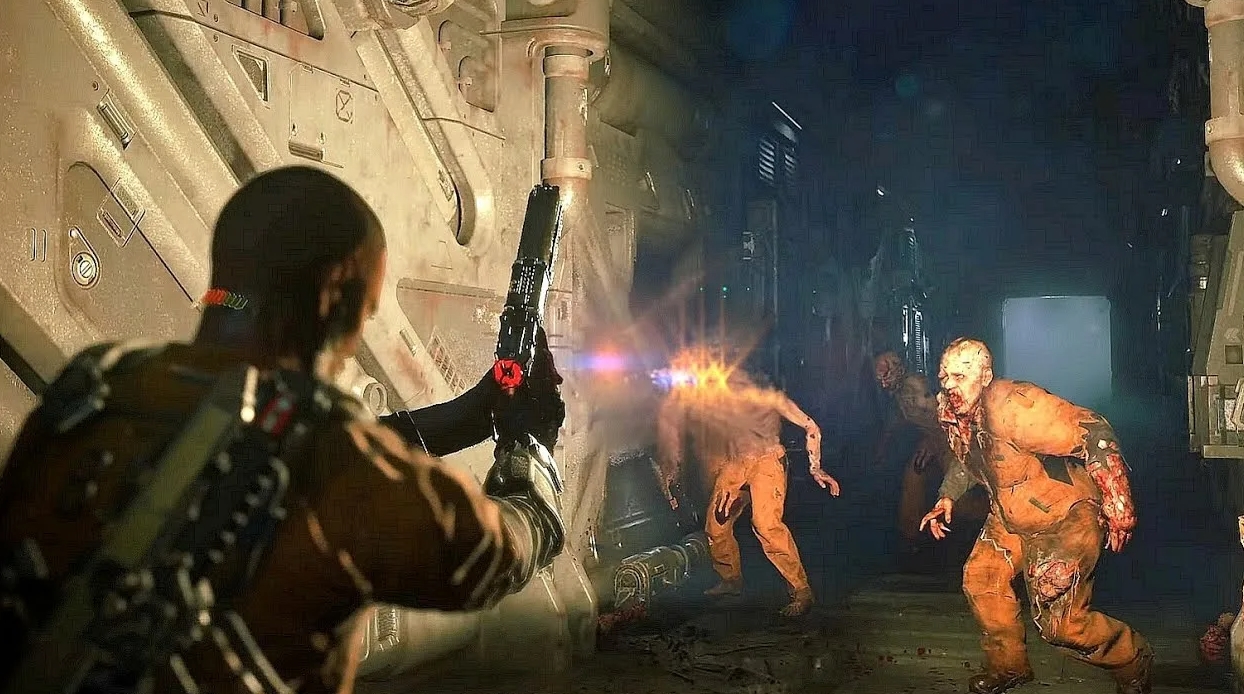
From the point of view of the logic of the world, it remains a mystery where an ordinary space trucker learned such a technique and reaction. But as soon as the player learns this mechanic, it becomes clear: in single combat, Jacob is practically invulnerable. One-on-one, no creature on Callisto poses a serious threat — combinations work flawlessly, and enemies quickly lose the initiative.
And here it is important to emphasize the word “alone”. As long as the enemy is alone, the combat system opens to the fullest. Fast and heavy punches, dodges, counterattacks after blocks, instant gunfire switches, the use of kinesis and environment add up to a spectacular and aggressive dance of death. At such moments, the player feels full control over the situation and gets real pleasure from the gameplay.
But if two or more enemies appear in battle, the whole slender structure begins to fall apart. The problems of multiple collisions are particularly pronounced:
-
A hard lock on one opponent makes it difficult to control the environment;
-
a close camera limits the view and reaction to threats from the side;
-
Close combat makes it almost impossible to work effectively on multiple targets;
-
The hero cannot cancel attack animations, which makes mistakes fatal;
-
Being surrounded by enemies almost always ends in a quick death.
In such conditions, the player can either aggressively “rush”, hoping to destroy the enemies one at a time faster than they can deal with him, or completely abandon hand-to-hand combat, switching to firearms and telekinesis. The second option is safer, but it turns battles into simple and almost risk-free shooting, devoid of tension and tactical depth.
For the same reason, bosses turn out to be surprisingly boring. Almost every fight with them boils down to a primitive formula: dodged, shot, dodged again, hit — repeat until victory. Neither the development of mechanics nor a real challenge offer such collisions. It’s tedious and devoid of entertainment, which is especially disappointing against the background of the system’s potential.
Yes, the game encourages a more thoughtful approach: exploring the environment, using traps, and positioning. Yes, the error sends a message to the checkpoint quickly. But there is no sense of an honest balance. The difficulty jumps from bullying passive enemies to situations where the hero absorbs tons of damage without being able to respond adequately. As a result, the player fights not so much with opponents as with the limitations of the mechanics themselves.
And all this is especially disappointing, because the potential of the combat system is huge. The punches feel weighty, the shots are powerful, and the hits are truly tactile. In the rare moments when everything works as it should, The Callisto Protocol shows how intense, tough, and entertaining its gameplay could be with a more thoughtful balance and combat design.
How to improve combat in The Callisto Protocol
The longer you play The Callisto Protocol, the more clearly you realize that the combat system here could and should have been developed further. And not through cosmetic changes, but through a deliberate expansion of mechanics that would enhance dynamics, control, and a sense of power over the situation. The foundation is already there — animations, impact, tempo — it all works. But the system desperately lacks flexibility and depth, especially in encounters with multiple enemies.

If we ignore the current limitations and look at the fighting game as a blank, it’s easy to imagine which way it would be worth pumping. For example:
-
Move the camera slightly to give the player more visibility and control over the environment;
-
add a dash and the ability to cancel strikes at least in the early stages of animation, reducing the penalty for mistakes;
-
loosen the hard lock of the camera and the character on the same enemy, replacing it with soft auto-aiming;
-
Allow melee strikes to hit multiple opponents at once;
-
expand crowd control tools — stuns, repulsions, temporary disruptions;
-
It is logical to integrate a shocker into the setting as a means of temporarily removing the enemy from battle;
-
develop the baton in two directions: as an electric weapon of control and as a destructive “electric sword” capable of maiming and severing limbs;
-
Add parries with timings that reward the player with stun or increased damage;
-
introduce the mechanics of counter-firing at the moment of an enemy attack, similar to Bloodborne;
-
redesign telekinesis by making throws an ultimate technique with a cooldown, and the main tool is thrusting and pulling, which affect positioning and work on the area after pumping;
-
Diversify the attacks of enemies with unblockable strikes, which you need to avoid through movement, jerks or accurate shots.
Such changes would make the gameplay more aggressive, fast and tactical, and most importantly — honest towards the player. The fights would cease to be a struggle with the camera and animations and turn into a controlled chaos where reaction, positioning and choice of tools are decided.
Ideally, by taking the best of God of War, Bloodborne and Star Wars Jedi, the developers could disperse the action game, make it angrier, richer and more diverse. With an increase in the number of enemies and the expansion of their roles on the screen, an extremely rare subgenre could be born — survival-horror slasher, where fear coexists with rage, and aggression becomes a way of survival. There are few similar examples in the industry — The Suffering dilogy only comes to mind.
In practice, The Callisto Protocol gets stuck somewhere in the middle. The game has interesting ideas, decent rudiments and strong animation solutions, but all this is clearly not brought to mind and poorly balanced. The combat system is really enjoyable at times, but too often it feels like you’re not fighting monsters, but the game itself. This is compounded by the general staging of battles, where developers almost do not create complex scenarios and do not combine enemy types so that the mechanics are fully revealed.
The Callisto Protocol System Requirements
The Callisto Protocol – PC System Requirements
How to play The Callisto Protocol for free on Steam via VpeSports
There are games that you turn on “for the evening,” and there are those after which you sit in silence for a long time and replay the experience in your head. The Callisto Protocol belongs to the second category. It’s not just a space horror — it’s a story about fear, loneliness, and trying to survive in a place where everything around you wants to destroy you. The cold corridors of the Black Iron prison, the disturbing sounds outside the walls and the feeling of complete isolation make you forget that you are even on this side of the screen. Here, every decision is difficult, and every fight feels like a struggle for another breath.
You can get into this world without unnecessary headaches and financial expenses. We tried to make the process as friendly as possible so that you don’t encounter annoying little things. All you need to do is register on the website, log in to your profile and scroll back to the very beginning. There you will see the GET AN ACCOUNT button, which is where your path to The Callisto Protocol begins. A few simple actions, and the game is already waiting for you.
And then it all depends on whether you want to be a part of the community. Our Telegram channel gathers people who are close to this atmosphere of tension and gloomy aesthetics. We share news, updates, new accesses and just discuss the game without dry officialdom. If you have any questions or difficulties at any point, don’t be left alone with them – the detailed “How to Play for Free — Complete Guide” and live chat are always at hand to help you continue on your way.