

About two decades ago, Lucas Pope, a talented programmer, made a difficult decision — he left the Naughty Dog studio. He didn’t want to dive into working on another part of Uncharted again. Instead, he was drawn to something more personal, experimental — creating unusual and intimate games. In 2013, his name thundered throughout the gaming world: his project Papers, Please — a simulator of border guard work in a fictional totalitarian country — became a real sensation. Despite a modest nine-month development cycle, the game received critical acclaim and even competed for the title of game of the year at BAFTA, competing with such giants as The Last of Us and GTA V. But Lucas didn’t stop there. His next project turned out to be much larger and more ambitious. Almost five years passed from the moment the idea appeared until the release — and players’ expectations grew with each month. But Pope lived up to the hype: Return of the Obra Dinn didn’t just surprise, it raised the bar in several genres, showing that originality and attention to detail can captivate just as much as blockbusters.
Table of Contents
Return of the Obra Dinn Free Steam Account
At the very beginning of the 19th century, the merchant ship Obra Dinn disappeared without a trace. Several dozen people on board – and not a single explanation. However, years later, the ship suddenly appears off the coast, empty and silent. The East India Company sends an inspector on board to find out what really happened and to compile an official report. At the hero’s disposal is a mysterious book with a note: “Complete each chapter with all possible care.” But how can you reconstruct the picture of what happened if it all happened so long ago?
The answer is in the unusual artifact that the hero takes with him. In addition to the book, he has a pocket watch that can return him to the last seconds of the lives of the deceased. It is enough to approach the remains – be it a whole skeleton or just a couple of bones in the shadows under the stairs – and the past unfolds before your eyes. At first – darkness and voices, phrases of crew members, torn from the past. And then a scene frozen like a photograph at the most tense moment: a shot, a scream, a blow, and now dozens of figures in different corners of the deck are in front of you. This is the last second of someone’s life – and it is up to you to figure out who this person was and how he died.
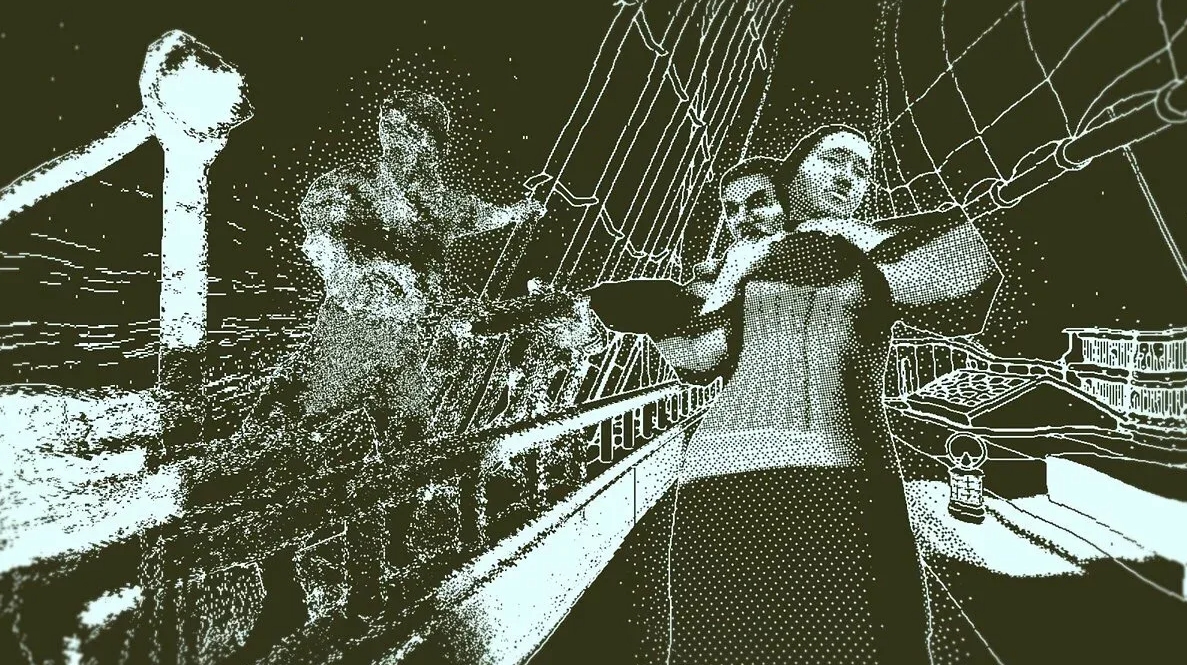
At first glance, the solution seems simple. One died – because he got a bullet in the chest. Another was pierced by a spear. Someone froze, someone was struck by lightning. And yet this is only part of the puzzle. Understanding the cause of death is not enough – you also need to figure out who exactly did it and what the name of the deceased was. The difficulty is that names are almost never mentioned in dialogue, and most of the faces are unfamiliar. But “Return of the Obra Dinn” is a game not so much about magic as it is about logic. It makes you look closely, pay attention to the smallest details, compare clues, read every line. One person may appear in two or three memories, another in fifteen. Sometimes the solution lies on the surface, and sometimes it takes time and patience. Each character has a page in the book: on one side is a dossier where you write down the name, cause and culprit of death, on the other is a point on the diagram where the body was found.
Return of the Obra Dinn is not just an investigation. It is a real detective work, where every discovery gives incredible satisfaction, and every found fragment of the mosaic brings you closer to solving the greatest sea mystery.
You’ll be surprised how much is included with a steam account free.
Exploring the Unique Investigation System in Return of the Obra Dinn
Return of the Obra Dinn doesn’t have traditional cutscenes or story trailers. Everything is built on attention to detail and the player’s ability to build chains of logical reasoning from seemingly random trifles. Sometimes you’ll hear a name in a dialogue – but who said it and who was he addressing? Or maybe a passenger just shouted something in a foreign language – and then you have to go to the translator to figure out where he’s from. This can be the very detail that puts everything in its place.
The game constantly encourages observation. Who is talking to whom? Which door did the person come out of? Why are these two standing next to each other, and one by himself? Sometimes even the sketches of the ship’s artist are not just entourage, but direct clues: the illustrations depict the entire crew, and you can understand a lot by who is drawn how and where. It’s a kind of puzzle theater where everything makes sense, and the game’s creator Lucas Pope deliberately placed the characters and events so that you can come to your own conclusions – but without intrusive hints and unnecessary comments.
What’s especially cool is that the faces you briefly saw at the very beginning suddenly come to life in your memory when you find new data hours later. “Oh, right, that guy was in the first scene! He was standing by the stairs in that ridiculous hat!” – such insights happen often. It’s like you’re unraveling a tangle, and each new piece of information makes you re-examine previous scenes from a different angle. Gradually, the notebook next to you fills up with notes: “Most likely from Sweden”, “Stood next to the captain”, “Died in battle with that creature” – and you can’t tear yourself away. This intellectual hunt is completely captivating. If you start playing in the evening, you risk meeting the dawn in front of the screen.
And you don’t start from scratch. The main character, an insurance inspector, arrives at the Obra Dinn with a book that lists the names, positions, and nationalities of almost everyone on board. With the help of a magic watch, you see the last seconds of each deceased person’s life, and in these scenes you need to notice everything: accents, behavior, surroundings, lines. Did you realize that the person speaks Danish? All that’s left is to check who on the crew was from Denmark – and that already narrows down the circle of suspects. And the ship’s map helps you navigate in space: here are the cabins, here is the dining room, and over there is the captain’s cabin. Every place is important. Even if at first glance it looks like an ordinary walk-through deck. If some terms are confusing – for example, you don’t know who the topmen are or what an orlopdeck is – no problem. At the end of the book there is a glossary that explains what’s what. And it’s done subtly: no boring tutorials or tutorials. Everything is to the point, to the point — and only if you really need it.
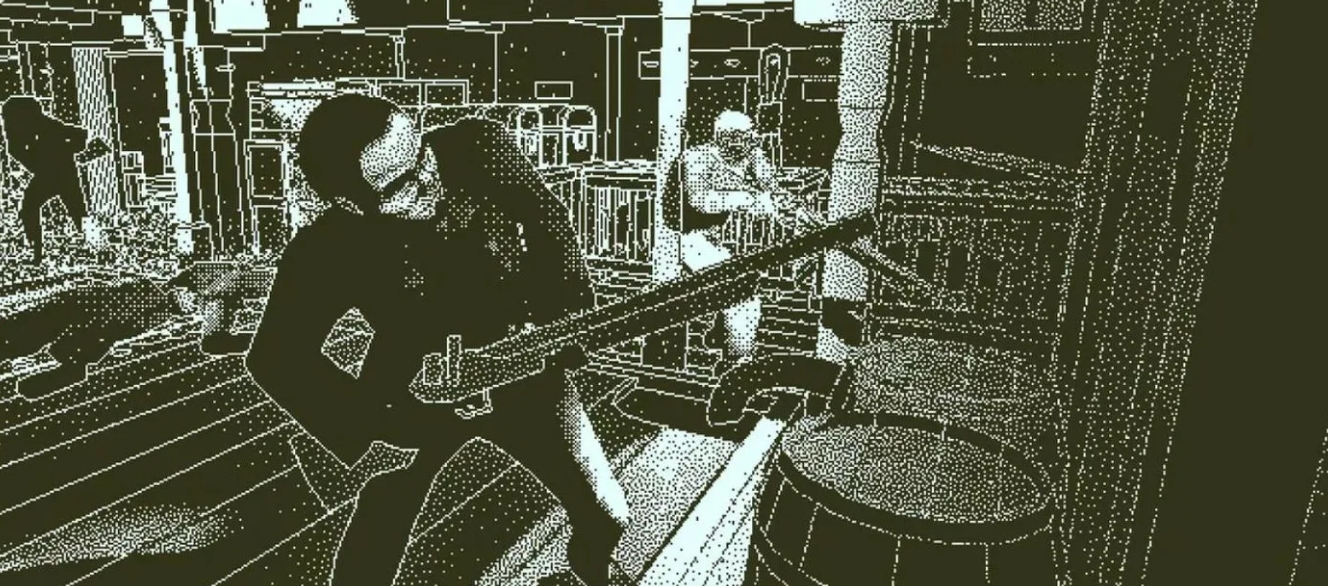
Despite its depth, the game does not overwhelm you with the amount of information. There are mechanics that help you not to drown in guesswork. For example, at the very beginning, the portraits of all the dead people in the illustration look blurry. They become clear only when you have enough data for logical conclusions. This is an unobtrusive way to say: you are on the right track, keep digging. And in the book, each character is indicated in how many scenes he appears, when exactly this happens, and where — thanks to this, you can go back, check, look for details that you may have missed.
The game rewards accuracy. When you correctly determine the fates of three people — who died, who killed, in what way — the book reacts magically. Handwritten pages with these characters are replaced with neatly printed ones. This is a kind of confirmation: you did everything correctly. But the “magic” only works with complete accuracy — you need to guess everything. Moreover, there are dozens of ways to die: stabbed, drowned, strangled, beheaded, crushed, fell from a height, frozen, and so on. Sometimes you need to specify not only what happened, but also what weapon was used to do it. Yes, there is a temptation to go the selection route if you are sure of at least two of the three fates – but, you must admit, such a walkthrough is devoid of taste. After all, the essence of the game is precisely to unravel, not to select.
And even if at times you will sit with a full set of clues, but still not understand how to collect them into a single whole – this is part of the pleasure. There is a temptation to look at the walkthrough, especially if you are stuck. But believe me, like in The Witness, Return of the Obra Dinn is revealed only when you go to the end yourself, without help. These are rare works made with intelligence and soul, and they should be treated as an intellectual meditation, and not as a quest for the evening. Do not rush. Read, think, guess, make mistakes – and find your own answers.
Why Return of the Obra Dinn Is One of the Best Detective Stories in Games
The new game by Lucas Pope, the author of the famous Papers, Please, feels completely different. If his previous project made you want to come back again and again to see different versions of the events, Return of the Obra Dinn is a detective puzzle that is assembled once, but with full dedication. When you finally unravel all the fates of the passengers of the mysterious ship, there is practically no motivation to replay the game. For some, this may seem like a drawback – like, everything ends too quickly.
But in fact, this is the strength of Obra Dinn. This is not a game that you go to for an evening, and then return to it a couple of weeks later. This is an atmospheric, rich and completely self-sufficient adventure for 10-15 hours, after which you have the feeling that you have read an outstanding novel – and now you will be scrolling through individual scenes in your head for a long time. Compared to other detective quests, Return of the Obra Dinn looks like a real work of art: not a single scene here seems superfluous, and the investigation is not a set of formalities, but a full-fledged intellectual work.
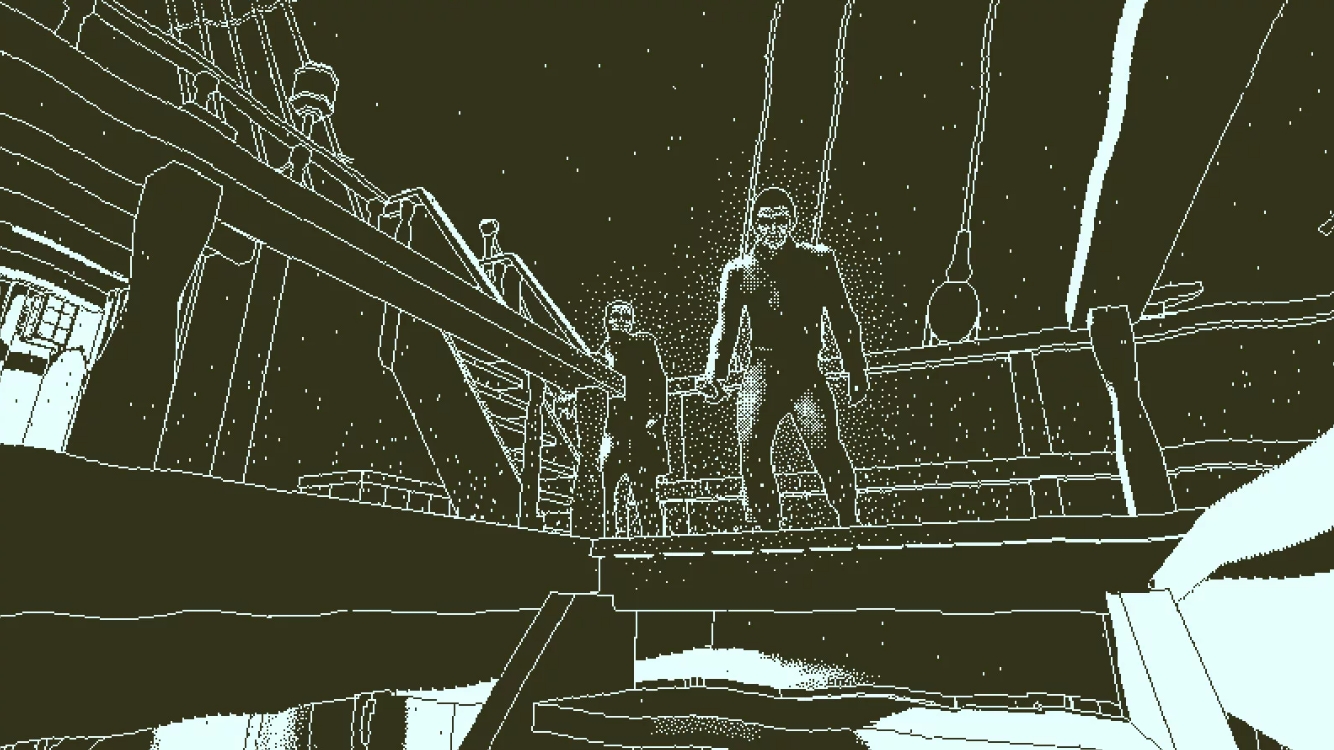
The plot pleases with its depth and atmosphere. Despite the fact that the game unfolds on a gloomy, abandoned ship filled with skeletons and shadows of the past, each story you uncover lives and breathes. The ship seems to be saturated with secrets, and each of its rooms holds a drama, tragedy or feat.
Pros of the game:
-
A huge and meticulously designed mystery ship, where each room is a fragment of a large puzzle.
-
Unique game mechanics that require thoughtfulness, attention to detail and the ability to draw logical conclusions.
-
All dialogues are perfectly voiced, and the sound design creates a powerful atmosphere and enhances the effect of presence.
-
Intellectual challenge – the game does not lead you by the hand, but makes you think.
Cons:
-
The Russian translation leaves much to be desired: the term gun is translated as “pistol”, although muskets and rifles are often used in the game, and the word boss is turned into a strange “senior”, which stands out from the overall style.
-
Lack of replayability: after the finale, the motivation to return almost disappears, since all the mysteries have already been revealed.
-
For some players, the pace of the game may seem too measured, especially if a classic “quest” with action was expected.
Return of the Obra Dinn System Requirements
System Specs – Return of the Obra Dinn
| Minimum Setup | Ideal Setup |
|---|---|
| Operating System: 64-bit Windows 7 or newer | Operating System: Windows 10, 64-bit edition |
| CPU: 2.4GHz Core 2 Duo or similar | CPU: Intel i3 or higher |
| RAM Memory: 4 GB | RAM Memory: 8 GB |
| GPU: 512MB VRAM, supports OpenGL 3.3 | GPU: 1GB VRAM, dedicated graphics card |
| DirectX Support: Version 11 | DirectX Support: Version 11 |
| Disk Space: 2 GB available | Disk Space: 2 GB available |
How to play Return of the Obra Dinn for free on Steam via VpeSports
Imagine: an old ship appears on the shore after many years of absence. Not a single living crew member. Only silent decks, scattered personal belongings and traces of someone’s tragedy. This is where your investigation begins – in the world of Return of the Obra Dinn, where the past comes to life in black and white flashes of memory. This is not just a game, it is a mystery that you solve step by step, using logic, observation and a pinch of intuition.
You are an insurance inspector who is tasked with finding out what happened on board. Every person on this ship is a story. And they are all waiting for you to put their fates together into a single picture. Sounds, frames, scenes of frozen time – everything is important. And everything is deeply absorbing.
To get started, you do not need to complicate anything. We have everything prepared: simple registration, access to the game without unnecessary fuss and clear instructions for starting. By the way, if you were looking for a way to complete Obra Dinn without spending money – we have a solution. We provide a free Steam account so you can immerse yourself in the atmosphere for free.
When you reveal the secret, share your thoughts. We are interested in what you felt. All reviews are moderated, so if yours does not appear immediately, just wait a little. As soon as it is approved, the necessary data will be automatically sent to your email.
And yes, if you want to stay up to date with new accounts, updates and interesting finds, check out our Telegram and chat channel. The most devoted game lovers live there, useful tips, and, perhaps, your next favorite story.