

Card roguelike games have long been entrenched in the status of a “crowded” genre in the card-battler space: it seems that all successful ideas have already been used, and new deckbuilding roguelike projects only vary familiar mechanics. However, HELLCARD finds a way to stand out neatly. The game relies on cooperative play and an unusual system of placing opponents on the battlefield. This doesn’t turn the genre upside down, but it adds fresh accents and forces you to take a closer look at the project — especially when viewed through a Slay the Spire comparison lens. We tell you exactly what HELLCARD catches on to already at the preview stage.
Table of Contents
HELLCARD Free Steam Account
The first acquaintance with the game begins unexpectedly. Instead of the usual introductory video or quick training, the player is transported to a mysterious room where there are seven ancient music stands. So far, only two are active — there are books on them, symbolizing the previous projects of the developers. With this technique, the authors subtly hint at the general connection of their games and the fact that switching between them in the future can be literally instantaneous, reinforcing the idea of a shared Paperverse universe. The intro works more as an atmospheric gesture than as a full—fledged introduction, but it fulfills its purpose – it sets the tone and intrigues.
If we talk directly about HELLCARD, then at the early access stage the plot here is formal. The off-screen narrator briefly introduces the story, telling about a group of adventurers who went to the “paper dungeons” to finish off the archdemon. The story serves as a backdrop and doesn’t pretend to be deep—at least not yet, functioning mainly as part of a broader paper-craft fantasy world.
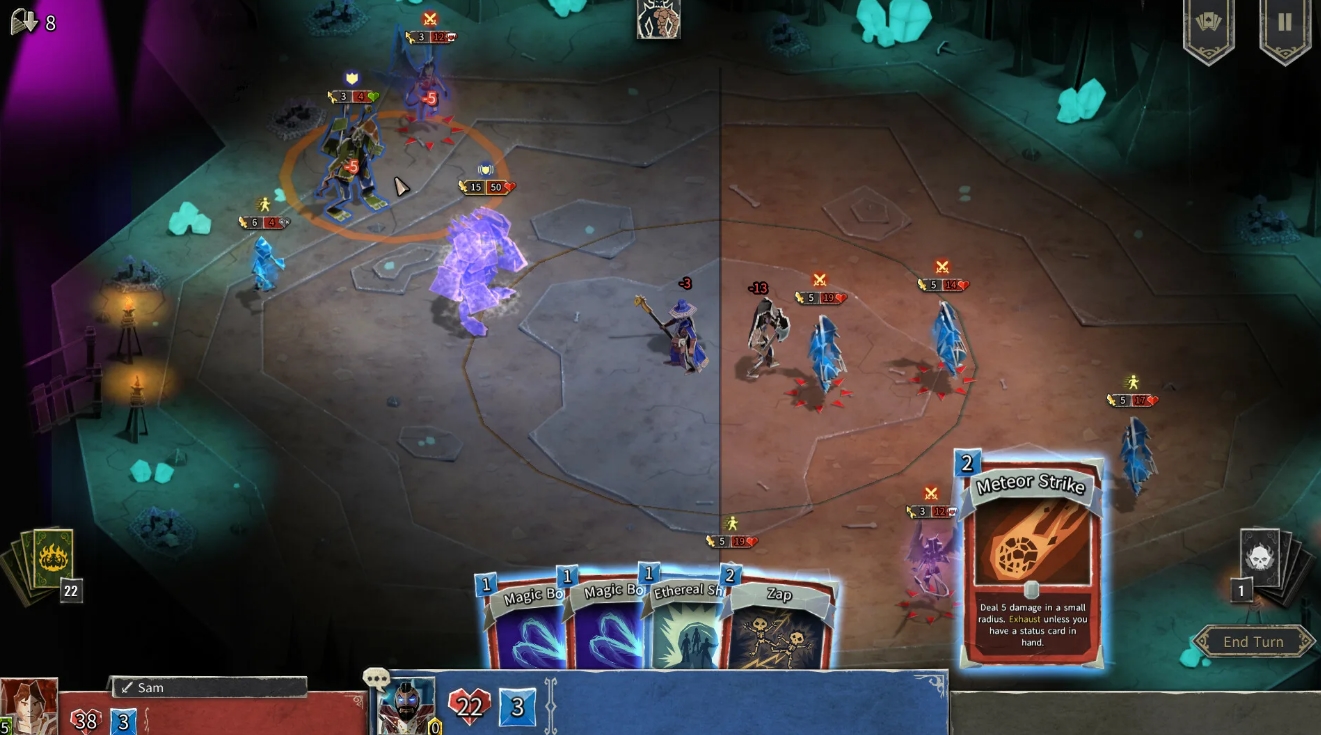
At some point, the speaker’s monologue is suddenly interrupted by a cheeky girl who suspiciously resembles Tiny Tina from Borderlands in her manner of speech and behavior. She ridicules the banality of the story and, without ceremony, “improves” it by simply adding even more monsters. Globally, this does not change anything: no matter how you look at it, the player’s path still lies through dungeons filled with monsters. But the feed becomes more lively and makes it clear that HELLCARD is not going to take itself too seriously.
As a result, already at the preview stage, the game gives the impression of a project that understands the scope of the genre, but tries to work with them carefully and with humor. Cooperative, non—standard mechanics and ironic presentation – it is on these elements that HELLCARD builds its personality, making this Early Access review surprisingly confident.
You’ve never played like this – thanks to steam free accounts.
Classes and Deckbuilding: Warrior, Mage, and Archer
Before going to the dungeons and methodically dismantling skeletons for spare parts, the player is offered to create a character. The choice here is extremely concise: three classic archetypes — warrior, mage and archer, essentially three classes warrior rogue mage in spirit. At this stage, you should not expect flexible customization: appearance, skills and style of play are set in advance. The only thing that can be influenced in early access is the starting artifacts, which can significantly facilitate the first race and set its pace from the first moves.
Each character comes with a strictly defined deck, and the total number of cards in the game exceeds one hundred per class. In total, HELLCARD offers over 300 unique maps, and it is these, rather than character customization, that form the basis of tactical diversity. In the current version, the differences between classes are felt primarily through the mechanics of the maps, rather than through the variability of the builds and long-term meta-progression.
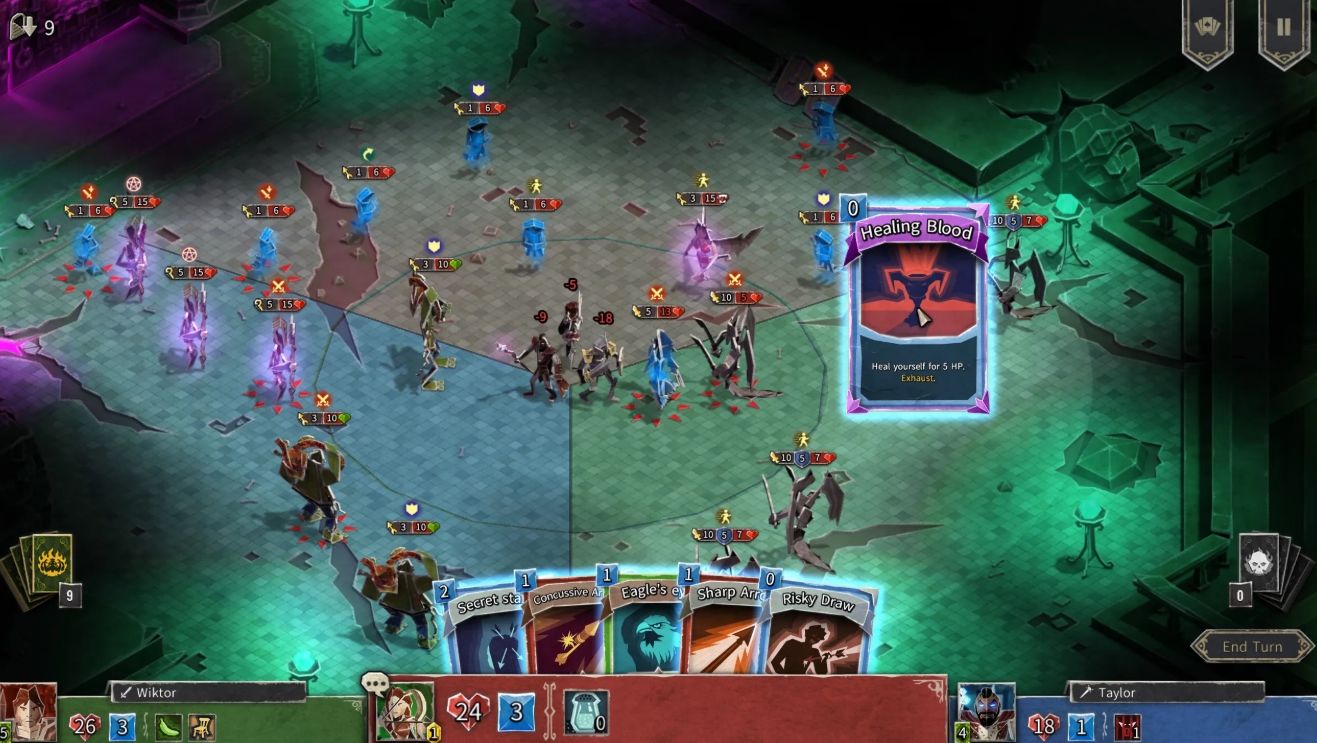
At the start, the player actually determines only the basic conditions of the race by choosing:
-
one of the three archetypes with a fixed style of play;
-
starting artifacts that affect the difficulty and pace of the passage;
-
the strategy of deck development during the descent into the dungeon.
Core Loop: 12-Floor Dungeon Runs, Events, and Boss Fights
From the point of view of the content structure, everything is very clear and without unnecessary distractions. There is one mode available in HELLCARD — descent through 12 floors of the dungeon, where you have to survive 12 levels in a row. At each level, the player will either have a battle with ordinary opponents, or a boss fight on dedicated boss floors. Any mistake, like defeating the final enemy, ends the race and sends it to restart. At the same time, progress is felt: the artifacts found make the hero stronger and allow him to feel more confident in the next attempts — a classic bagel formula that works flawlessly thanks to artefacts as permanent unlocks.
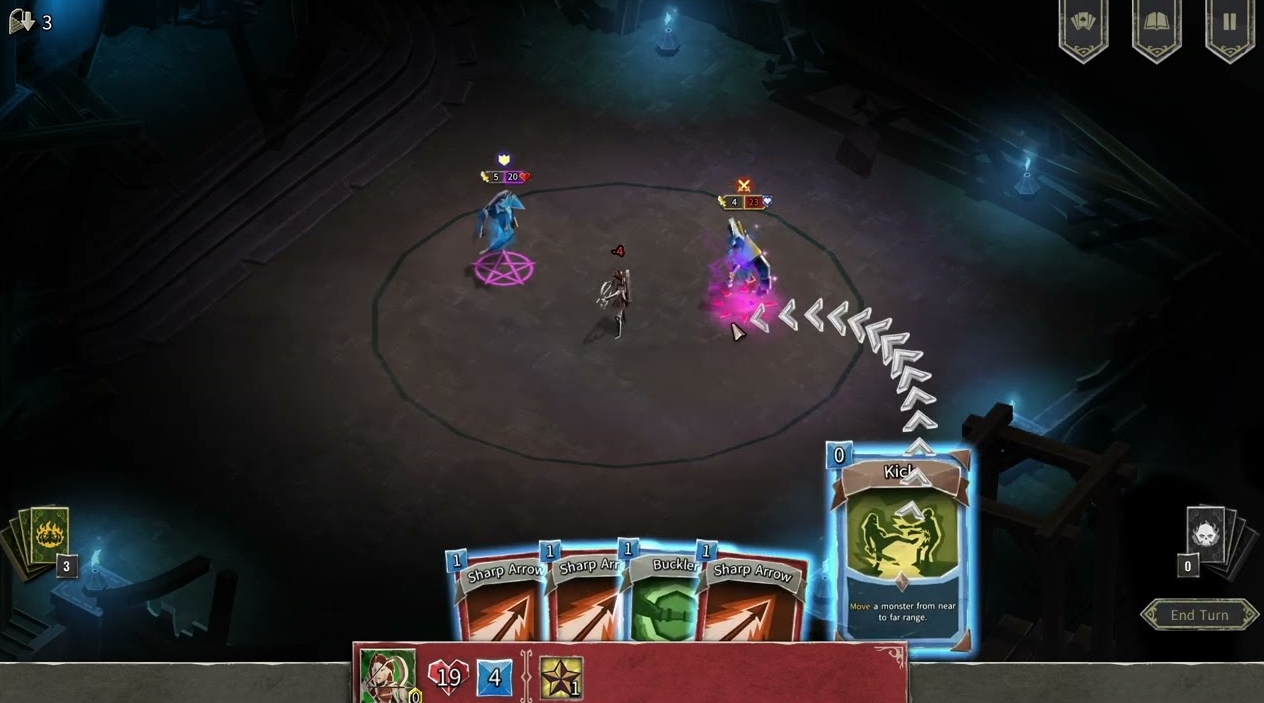
The route selection is the most interesting. Technically, almost every floor has a fork in the road, but instead of the usual “event icons”, the player chooses which monsters he will face next — it turns the whole climb into a randomised dungeon run. All additional activities are hidden in text events: after a victory, you can stumble upon a blacksmith to upgrade cards in the armoury, restore health in the temple or camp to heal, look into a merchant’s shop or get another useful bonus. This approach shifts the focus from research to tactical planning and highlights the key idea of HELLCARD — every decision must have weight.
As a result, the game builds gameplay around fighting and deck work, deliberately simplifying everything else. A minimum of unnecessary systems, a clear structure and a clear focus on card mechanics form a cohesive and focused experience already at the early access stage.
Combat System: Circular Arena, Positioning, and Sectors
HELLCARD really reveals itself in battles – this is where the game clearly shows its face, with fully turn-based combat. The key feature of the battles is the non-standard system of placing opponents. Thanks to it, collisions feel different than in most card roguelike games. Characters and enemies do not line up in the usual rows “face to face”, but are arranged in a circle in the arena, and the battle itself is presented in an isometric perspective.
There are heroes in the center of the field, while monsters are distributed around the circumference of the location. With each turn, the monsters gradually close the distance, approaching the squad and attacking as soon as they are in range. This formation creates a feeling of pressure from all sides and forces you to constantly monitor the position of your opponents, rather than just playing cards according to a pattern.
Attack, defense, and skill cards familiar to the genre are used in combat, with mana to cast cards shaping what you can do per turn. Their number is impressive — more than a hundred per character. At the same time, it cannot be said that they are all equally interesting: some of the effects are repeated, and really fresh options are revealed only as you progress and through a series of protracted battles. Over time, effective card synergy / combos become the main way to stabilize difficult encounters.
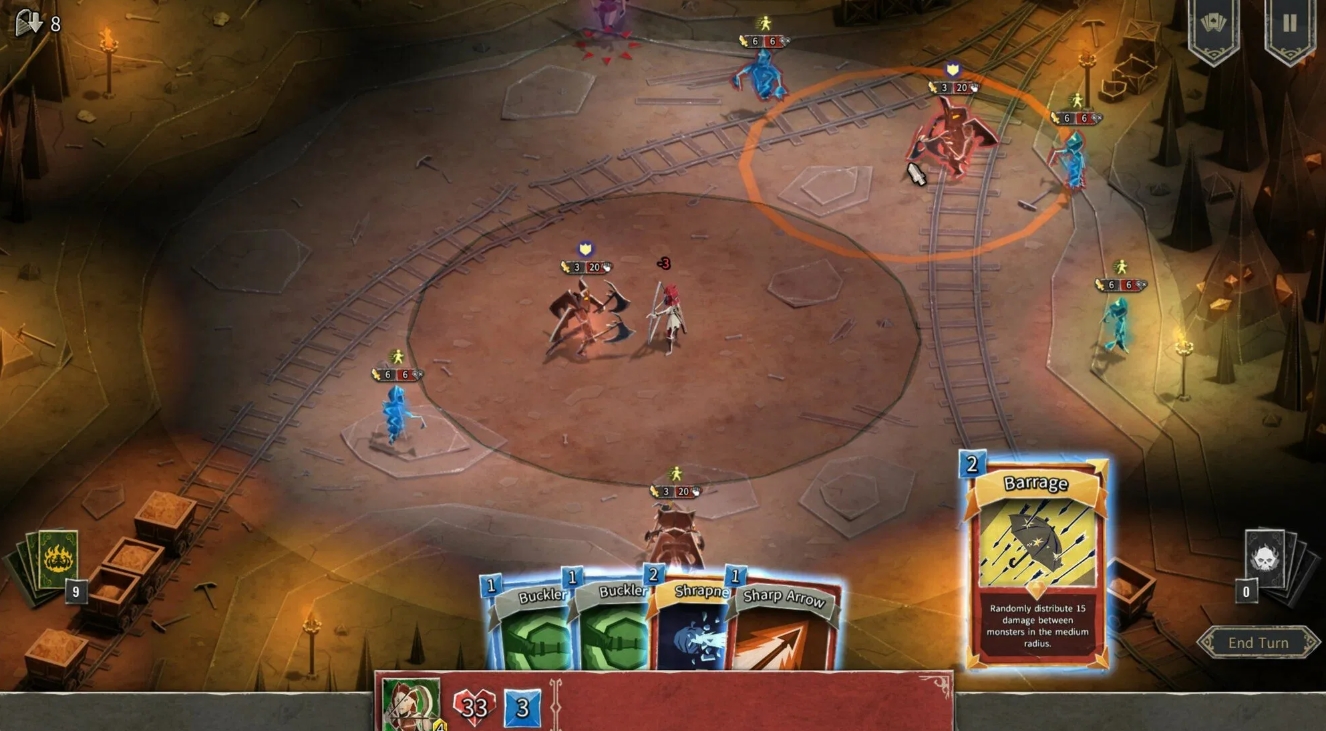
The sector system deserves special attention. Each member of the group controls their own attack zone, as if the heroes are standing with their backs to each other, forming a protective circle. These sectors divide the arena into short and long distances, clearly emphasizing melee vs ranged distance, and here the differences between classes become especially noticeable.
Taken together, all these elements form a truly tactical gameplay, where tactical play and positioning matter as much as raw card power. The player has to take into account not only the cards in his hand, but also the positions of the enemies, the reach zones, the characteristics of each hero and the likely actions of the opponents.
Enemies and Bosses: Threat Priorities and Constant Pressure
The variety of enemies in HELLCARD is pleasantly surprising already on the first floors of the dungeon. Along the way, there are skeletons, zombies, necromancers, fighters in heavy armor and other unpleasant creatures, each of which behaves in its own way. You can’t operate on autopilot here: ignoring the characteristics of your opponents is almost guaranteed to end in defeat.
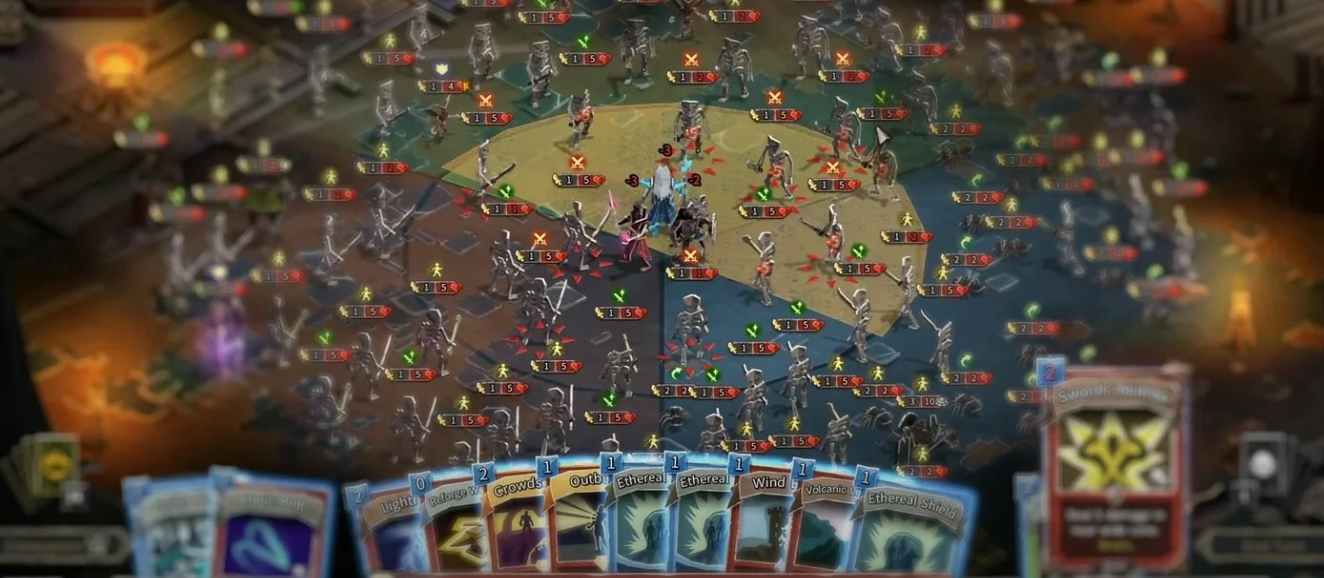
Especially dangerous are the enemies capable of exerting pressure from the first moves. The most problematic opponents include:
-
Archers who start dealing damage immediately with long-range weapons;
-
Mages endlessly summoning minions and quickly cluttering up the arena;
-
Summoned creatures, weak individually, but extremely dangerous in large numbers.
-
If you do not respond to these threats in a timely manner, the battlefield turns into chaos in a matter of moves, where each new move only exacerbates the situation.
Bosses in HELLCARD are also made with imagination and are not limited to a banal increase in health. I especially remember the skeleton leader, who created new, smaller skeletons when receiving damage. As a result, after the formal victory over the leader, the battle did not end — on the contrary, it was necessary to deal with his “legacy”. In one of these battles, the number of enemies in the arena reached almost ten, turning the final level into a protracted and intense tactical test.
As a result, the opponent’s system works to create a general sense of constant threat. HELLCARD forces you to analyze the priorities of goals, control the number of enemies and think through each move in advance. Even the types of monsters familiar to the genre are revealed here in a new way, forcing you to play consciously, and not just play cards in the hope of luck.
Co-op multiplayer: companions, real-time turns, and team synergy
Why do we need a cooperative at all? This is where we come to the second key feature of HELLCARD — the ability to go through the dungeons not alone, as a co-op card game. The main character can be joined by up to two companions: these are either AI-controlled characters or live players, and over time companions join your party through progression systems. In the case of computer partners, all control falls on the shoulders of one person, but the real interest begins in a full-fledged cooperative.
Joint games take place in real time: within one turn, each player plays his cards, and the allies see each other’s intentions. With real people, battles become not only more dynamic, but also noticeably more comfortable — while solo play is harder, coordinated teamwork often turns the odds in your favor.
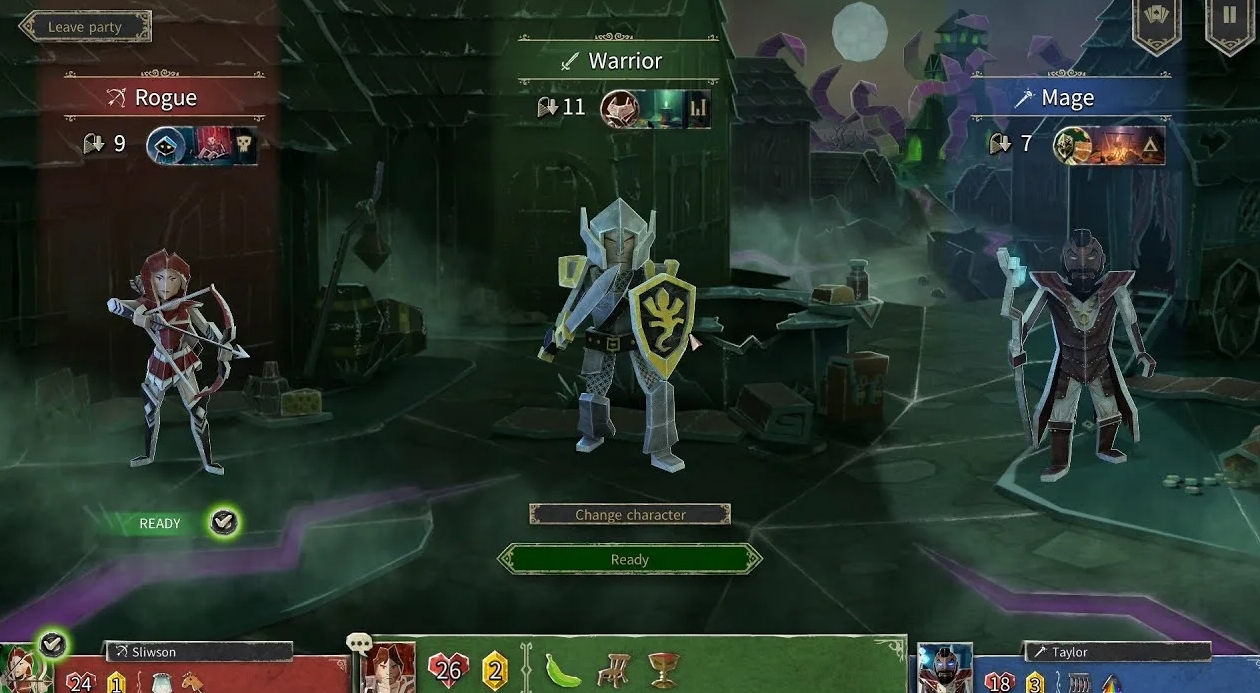
We should also praise the visual part. HELLCARD is made in an unusual style: The characters look like paper figures, and the enemies look like they’re made of origami. This approach gives the game its own character and distinguishes it from its competitors. Each action — attack, defense, or move — is accompanied by smooth animations and high-quality sound effects, which makes the fights visually enjoyable and readable.
However, it was not without a fly in the ointment. The Russian-language localization still leaves much to be desired: the text periodically “leaves” the borders of the buttons, spelling errors and translation inaccuracies occur. In addition, the difficulty level may seem excessive to those who are used to playing mechanically without thinking about interacting with their allies. But it is teamwork that often becomes the decisive factor for success here.
Verdict: who should play HELLCARD and what to expect after Early Access
As a result, HELLCARD is hardly a revolution for the genre of card roguelike games. This is not a breakthrough or a radically new look at familiar mechanics, but it is definitely an original and promising project. The emphasis on co-op, unusual presentation and tactical depth make the game worthy of the attention of fans of the genre. It remains to wait for a full-fledged release and see if the developers can unlock the potential that is already being guessed between the lines.
HELLCARD System Requirements for PC
HELLCARD is a roguelike card game with a gloomy atmosphere that does not place high demands on hardware. The project is perfect for owners of weak and medium PCs, allowing them to comfortably play even on basic configurations.
HELLCARD
A dual-core processor, 2 GB of RAM, and a DirectX 9.0c-capable graphics card are enough to run the game, making HELLCARD accessible to a wide audience of players.
How to play HELLCARD for free on Steam via VpeSports
Sometimes the game is needed not to relax, but to feel something click inside. HELLCARD is just one of those. She is in no hurry to be friendly and does not promise easy victories. Here you enter a dark, oppressive world where every card is a risk, and every fight tests your endurance. Demons don’t forgive mistakes, allies are as important as the deck, and tension is felt even in the silence between moves. HELLCARD doesn’t just entertain —it makes you think, doubt, and make decisions that you’ll have to answer for.
We are well aware that long instructions and murky access schemes kill all interest even before the game starts. Therefore, everything was done humanly. You register on the website, log in to your profile, return to the top of the page and click GET AN ACCOUNT. A couple of minutes and you have a ready—made HELLCARD account in your hands, without dancing with a tambourine and unnecessary gestures. You just log into the game and start the journey.
And then you don’t stay alone. Our Telegram channel is constantly in full swing: someone is sharing a successful build, someone is discussing a fresh patch, and someone is just swearing at another vape — and that’s the beauty of it. We post new accounts, keep an eye on updates, and keep you informed of everything important. If you suddenly have any questions or something goes wrong, you can always take a look at the detailed guide for the free game or write to the chat. We’re not here “for show” — we’re really responding and helping you get through this hell a little more confidently.