

I’m not going to beat around the bush — I’ve completed Graveyard Keeper twice in recent months and spent a total of 77 hours in the game. A lot, anyway. And now it’s time to share your personal experiences and impressions of this strange, sometimes audacious project by Lazy Bear Games studio.
This is not just a gravedigger simulator at all. We have a whole world in front of us, where caustic sarcasm, philosophical hints and routine game mechanics are intertwined into some kind of bizarre alchemy, forming a special atmosphere. In order not to lump everything together, it is logical to divide the review into two main parts: the plot and gameplay. First, let’s talk about Laura, the minor characters, and the meanings hidden behind the black humor, and then we’ll look at the mechanics, the progression system, and how the game holds your attention for dozens of hours in a row.
And yes, I warn you in advance — there is nowhere without subjectivity. Graveyard Keeper is one of those games that sharply divide the audience: some fall head over heels in love with it, others get tired of the monotony after just a couple of evenings. But that’s where her special charm lies. She takes her time, slowly and persistently dragging the player into her slightly rotten, but surprisingly lively world.
Table of Contents
Graveyard Keeper Free Steam Account
If you think about it, there’s hardly a darker job than being a cemetery caretaker. Day after day— digging graves, repairing old tombstones, tending columbariums and maintaining order among the dead. There’s not much romance in it, and even more fun. And the type of such characters usually evokes associations with someone like the caretaker Filch from Harry Potter or Walder Frey from Game of Thrones – sullen, grumpy and far from the most charming characters.
However, the developers from Lazy Bear Games have managed to look at this dreary profession from a completely different angle. They have done the impossible — they have turned the gravedigger’s routine into an exciting adventure where cynicism, irony and an entrepreneurial streak become the main tools of survival. In the Graveyard Keeper world, moral principles easily give way to pragmatism: after all, here every grave can become a source of profit, and every transaction is a step towards prosperity.

It is this contradiction between the theme of death and the thirst for profit that makes the game truly special. She doesn’t just make fun of the mortician’s everyday life, but turns it into a strange, almost philosophical journey along the line between holiness and sin, where humor and absurdity go hand in hand with craft and management.
Play smarter, not harder – start with a free steam account with.
Graveyard Keeper’s plot — the story, characters, and mysteries of the game world
The Graveyard Keeper story begins matter-of-factly and suddenly. You’re walking down the street, texting with your lover, and suddenly it all ends with a sharp clap of metal and the hum of an engine. The next moment, the hero is no longer a man from the 21st century, but a newly minted cemetery caretaker somewhere in a strange world reminiscent of the dark Middle Ages. Now your days are filled with completely different concerns: digging graves, beautifying the cemetery, establishing contact with local residents and building a church. But there is still one burning goal in the hero’s heart — to return home to his love. It takes 30-40 hours to complete this journey, and believe me, it’s more than generous for a farm.
Characters and story
The plot is based on six key figures, each of whom is not just a quest giver, but an important part of the lore. Conversations with them gradually reveal the depth of the world to the player. Everyone has their own character, motives, and inner dramas hidden behind grotesque features.
A merchant driven by insatiable greed, a Snake is a cold and cynical pragmatist, a Bishop is narcissistic and comically vain, a Stargazer is an old man tired of life, but who has not lost the spark of curiosity. These characters are easy to remember — their manner of speaking, gestures and actions form a recognizable image, causing not only laughter, but also unexpected sympathy.
And although the plot can be retold in a couple of sentences, its strength lies in the details and the development of relationships with these characters. Therefore, I deliberately do not go into details, so as not to ruin the pleasure of discovery.
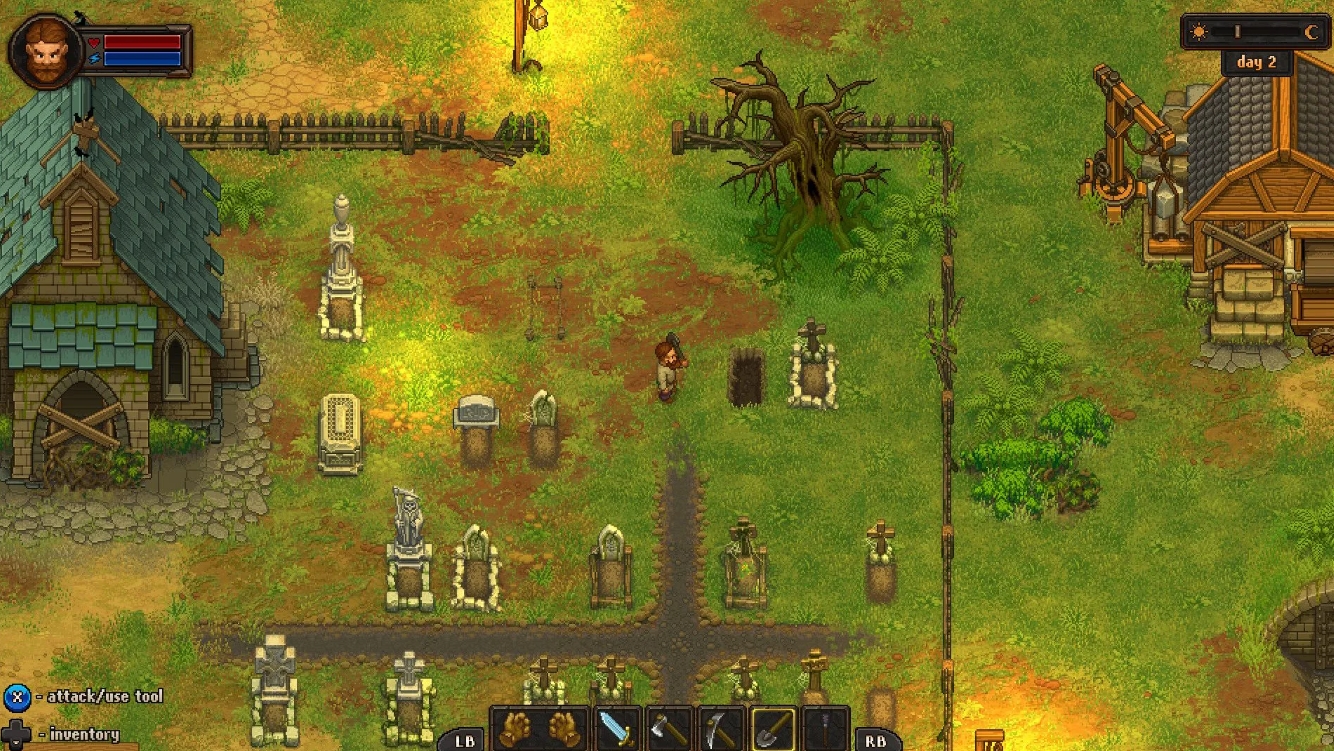
Ent and atmosphere
The longer you play, the more clearly you realize that this world is not as simple as it seems at the beginning. The gloomy surroundings of the cemetery conceal a rich mythology, intrigues and conspiracies, ancient gods and interconnected destinies. Gradually, you begin to see that every little thing, every remark or object is part of the bigger picture.
After 20 hours, everything that seemed secondary makes sense. You start to look at NPCs differently, whose personal stories are suddenly intertwined with the main line. Graveyard Keeper deftly combines the everyday routine of the simulator with elements of mysticism and philosophy — and this is its special charm.
Humor and color
Special thanks to the developers should be said for their black humor. He’s everywhere here—in dialogues, quests, and even inventory items. Only in this game you can meet a talking skull, a communist donkey, a crazy old man obsessed with sweets, and a beekeeper who creates an army of combat bees. All this creates an incredibly distinctive atmosphere where tragedy and absurdity perfectly coexist.
The developers have generously saturated the game with references to pop culture, movies and classic RPGs, so attentive players will constantly find small surprises. It is clear that Lazy Bear Games has put their soul into the world of the game — it feels alive, albeit slightly rotten.
DLC and content
However, to experience the full depth of this universe, basic adventures alone will not be enough. Unfortunately, without two story additions — Stranger Sins and Game of Crone — the game loses some of its charm. The main version seems incomplete: the world looks less saturated, and key storylines are cut short.
With the DLC, everything falls into place. They reveal new aspects of lore, add interesting missions and characters, enhancing emotional perception. We can say that these additions are not just extensions, but a necessary part of the Graveyard Keeper canon.
The plot of Graveyard Keeper is not just a story about an undertaker trapped in another world. This is a parable about human weaknesses, ambitions, and the price we are willing to pay for returning to those we love. Ironic, sometimes sad, but truly atmospheric — it makes you think, and not just click the mouse for another resource.
Graveyard Keeper gameplay — Mechanics, craft, and a balance between routine and progress
If the plot of Graveyard Keeper pleases with its atmosphere and presentation, then everything is a little more complicated with the gameplay. There is a contradiction here: on the one hand, the developers from Lazy Bear Games tried to create the most diverse simulator, and on the other, they failed to maintain a balance between the depth of mechanics and their real usefulness.
There are many possibilities, but none that are really necessary.
At first glance, the game impresses with the number of available activities. The hero can do literally anything: mine stone and ore, chop wood, hold funerals, serve in a church, brew wine, fish, practice alchemy, and even run his own tavern. In theory, this is an endless field for experimentation, in the spirit of the best “farm” simulators.
However, in practice, half of these activities lose their meaning over time. Most often, it is easier for a player to buy the necessary resource from a merchant than to spend hours creating complex production chains. These mechanics look thoughtful, but in reality they turn out to be unnecessary — as if the developers have created a huge system that does not bring satisfaction from progress.
The Burnout Effect: From enthusiasm to routine
The gameplay is really exciting for the first 15-20 hours. I want to try everything: to study every profession, develop a craft, set up a household and build an ideal church. But gradually the enthusiasm fades. The player realizes that development ceases to bear tangible fruits, and many mechanics simply duplicate each other.
By the end of the passage, your cemetery area turns into a chaotic cluster of buildings, and the main actions are reduced to moving between NPCs and completing the same type of tasks. The simulator ceases to be a “farm” and becomes a slow wandering quest, where interest is replaced by habit.
The Church, Faith, and useless labor
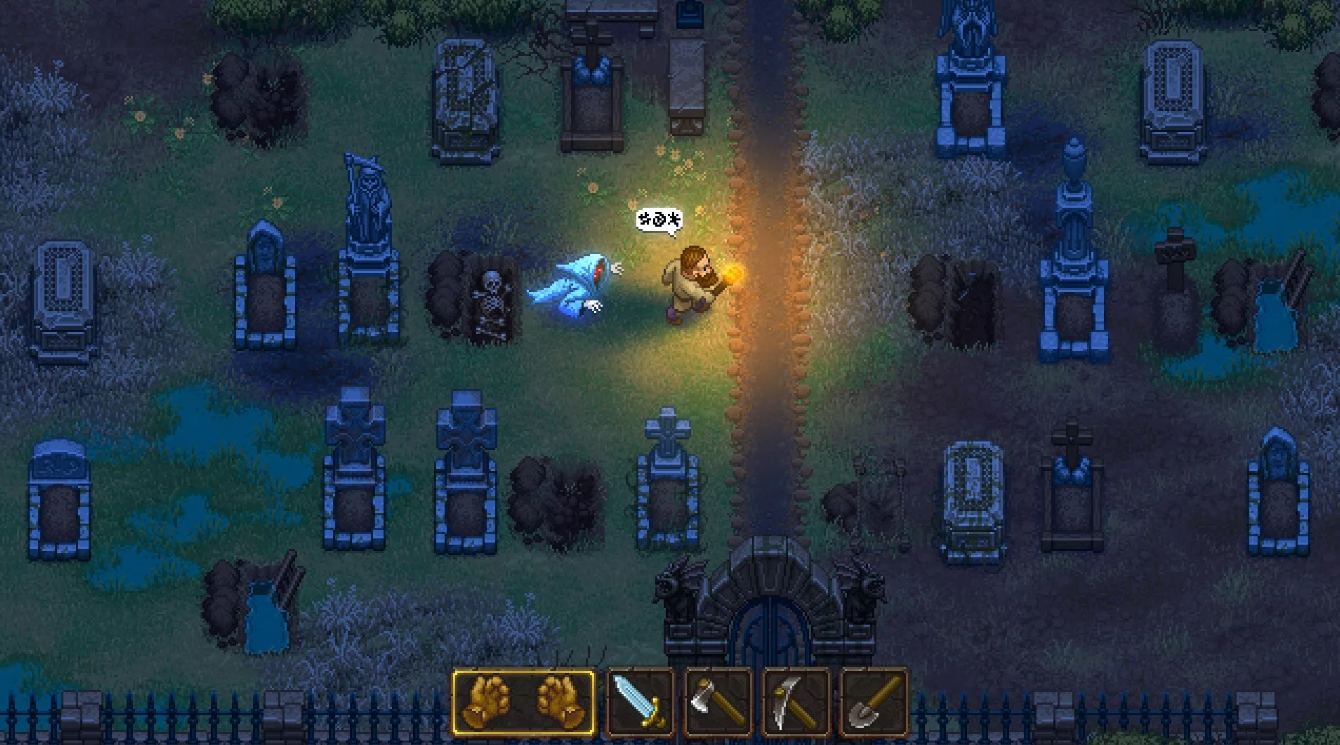
It’s especially disappointing for the part of the gameplay that is connected with the church and the cemetery. In theory, this is the heart of the game. In practice, the development of this branch is necessary only for the sake of fulfilling the chain of tasks of the Bishop. The money received from the sermons is scanty, and the accumulated faith is enough already in the first half of the passage.
As a result, what should have been a key mechanic turns into a symbolic obligation. Graves are annoying, cemetery maintenance gets boring quickly, and you start avoiding this part of the content, even though it was supposed to shape the unique look of the game.
Experience system: Red, green and blue
Admittedly, the skill leveling system turned out to be interesting. The player gets three types of points:
-
The reds are for crafting and creating objects.,
-
The greens are for interacting with nature,
-
Blue — for spiritual and scientific actions.
But this progress turns into torment: in the early stages, there is a catastrophic lack of blue experience, and development literally stops. Later, scarcity turns green when resource extraction is automated. The only way to overcome this barrier is a dull grind: for example, to create dozens of fences in order to dismantle them later for the sake of glasses. It’s absurd, but there’s no way without it.
Trade and economic imbalances
Another important element is the trading system. At the start, you have to sell everything in order to somehow survive. But as soon as you establish winemaking and open a tavern, the economy collapses: money begins to pour in an endless stream, and the old difficulties disappear. Instead of strategy and planning, there is a feeling that the balance is simply not calculated.
The gameplay of Graveyard Keeper is amazing in scale, but it loses its dynamics over time. The mechanics, which at first seem fascinating, turn into a formality. After twenty hours of intense play, she slips imperceptibly into a monotonous cycle — “from home to the NPC and back.”
This doesn’t make the game bad, but it clearly shows that Graveyard Keeper is a project with a great idea and a tired implementation. She charms with the atmosphere, but tires with the process.
Graveyard Keeper System Requirements
How to play Graveyard Keeper for free on Steam via VpeSports
Imagine: you wake up in the fog, among cracked tombstones and old trees that seem to whisper to you: “This is your place now.” From now on, you are the new keeper of the cemetery, a man who has to deal not only with bodies, but also with issues of morality, alchemy and life after death. Do you want to live this story without spending a penny? Then VPEsports is your way into the Graveyard Keeper world.
Everything is simple and human: visit the VPEsports website, create your profile and open the Free Steam Account section. There you will find a list of games that are already ready to launch. Choose Graveyard Keeper, leave a comment under the game’s page, and after moderation, you will receive login information to your email. No complications — just you, a shovel and a couple of dubious alchemical recipes. Detailed instructions can be found here!
We value live communication, so user feedback is more important to us than any algorithms. If your comment didn’t appear right away, don’t worry, just tweak it and it will definitely pass moderation. After all, we have a person behind every profile, not a soulless system.
Would you like to keep up to date with new free games or ask a question about Graveyard Keeper? Subscribe to our Telegram channel and visit the support chat – there is always someone in touch: someone will tell you how to bargain with the inquisitor, and someone will simply share the story of their first excavation.
VPEsports is not just about accessing games. It’s a community of people who love adventure, irony, and a little bit of darkness. So grab a flashlight, get a pickaxe ready and take on the role of the most unusual cemetery keeper. Your new underground kingdom is already waiting for you.