

The sequel to the best RPG of 2003 was awaited by everyone — from battle-hardened hardcore role-players to fans of the Star Wars universe and even those gamers who simply could not afford to miss the big hit. But it is worth admitting: the number “2” in the title Knights of the Old Republic: The Sith Lords is a little misleading. In fact, this is not a full-fledged new project, but a huge, truly large-scale add-on.
As we already mentioned in the preview, the development of The Sith Lords was carried out in parallel with the creation of the first part. The work was entrusted to the Obsidian Entertainment studio, which includes many veterans of the legendary Black Isle. For those who are suddenly not in the know, it was this studio that gave the world all parts of Fallout, Baldur’s Gate, Icewind Dale and one of the most unusual role-playing games in history – Planescape: Torment. These names are forever etched in gold letters into the history of the genre, and the experience gained in their creation is clearly felt in the sequel KOTOR.
Visually, The Sith Lords remains true to the style of the original, but its atmosphere and presentation have a different, darker and deeper spirit that sets a special mood for the entire game.
Table of Contents
STAR WARS Knights of the Old Republic II – The Sith Lords Steam Account
New faces – old ailments. And once again the time-worn plot engine comes to the fore: amnesia. As in the first KotOR, it was not without it. Our freshly created hero wakes up without memory and belongings, finding himself at the Peragus mining station, where his crashed ship was brought by pure chance. Instead of a warm welcome – gloomy, dismal corridors, littered with the bodies of workers and aggressive robots, and silence behind him – communication with the outside world is cut off. You can forget about the legendary lightsaber: for now you have to wave an ordinary vibroknife.
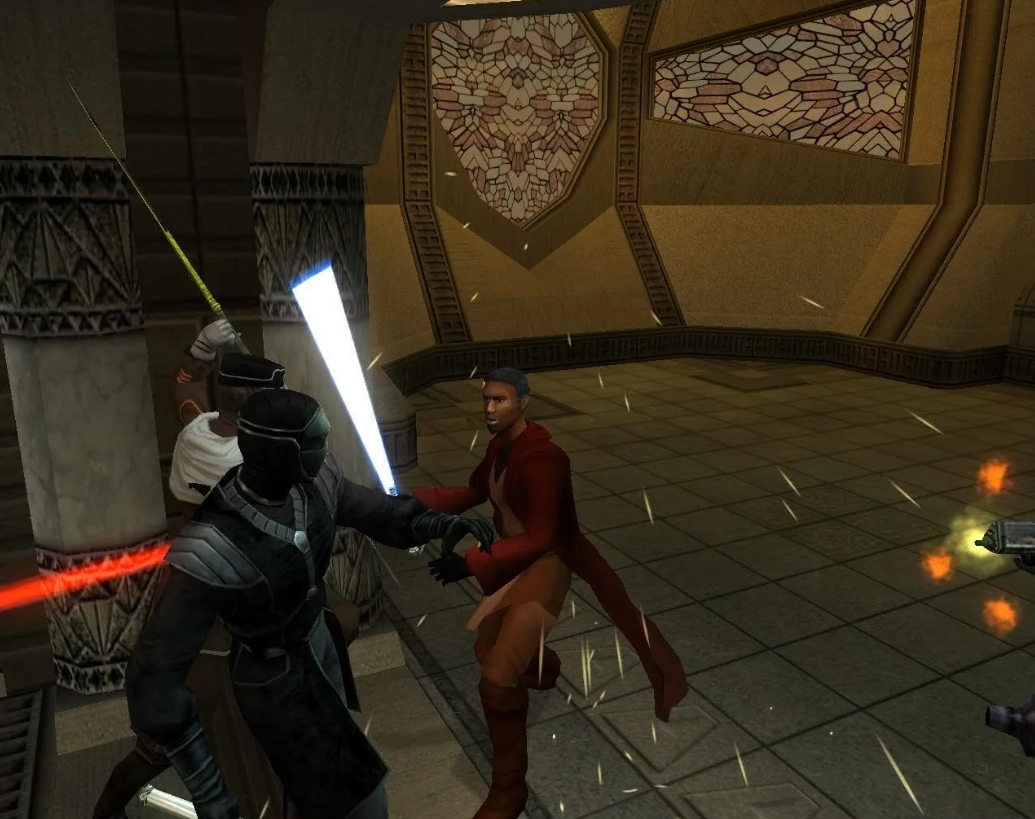
The moral is simple: do not get involved in wars if you are not ready for their consequences. A decade ago, he and several other Jedi disobeyed the Council and went to war with the Mandalorians themselves, who decided to swallow the Republic. Victory came at a high price – Revan and Malak, who led the resistance, found a taste for the dark side and ignited an even more merciless conflict. Our hero himself paid a different price: for his disobedience, he was deprived of his lightsaber and connection to the Force. Now the Exile – as both friends and ill-wishers call him – remains the last known Jedi in the Galaxy. And he must relearn how to wield midichlorian magic, relying on the vague instructions of a blind old woman, whose words sometimes seem both a riddle and a threat.
The easiest way to game? Our steam free accounts!
KotOR 2: Analysis of the plot, characters and problems of the second part
The plot remains the same: we are once again racing through the galaxy aboard the Ebon Hawk, in the company of a motley crew, collecting pieces of a common story, helping random people we meet and invariably finding ourselves embroiled in conflicts. But, alas, the secondary nature of the main idea, the drawn-out introduction and the crumpled ending slightly spoil the impression of the initially strong literary basis.
The first location, the Peragus mining station, is like thick, viscous syrup. It should have been a successful training stage, especially for those who missed the first KotOR: we are carefully immersed in the events, explained what happened over the past five years, and allowed to walk along space corridors. But wandering around monotonous decks and compartments for many hours hardly moves the plot forward. Only just before departure are the players given at least a little dynamics and sent to Tylos – still without the coveted lightsaber, but already with a baggage of questions that have no answers yet.
This drawn-out exposition can be forgiven – after all, the dialogues sometimes turn the game into an interactive novel, giving us an opportunity to understand the motives and characters of our companions more deeply. Gradually, we learn what brought each of them to the team, and what they are ready – or not ready – to tell us. In KotOR 2, the concept of “influence” appeared – only a skilled player will be able to fish out innermost secrets by correctly pressing on the right strings in the soul of the interlocutor. Some are touched by honesty, others – by brute force, others – by unpredictable violence, and others – by skillful manipulation. Sometimes even a simple conversation can strengthen your position in the eyes of a companion.
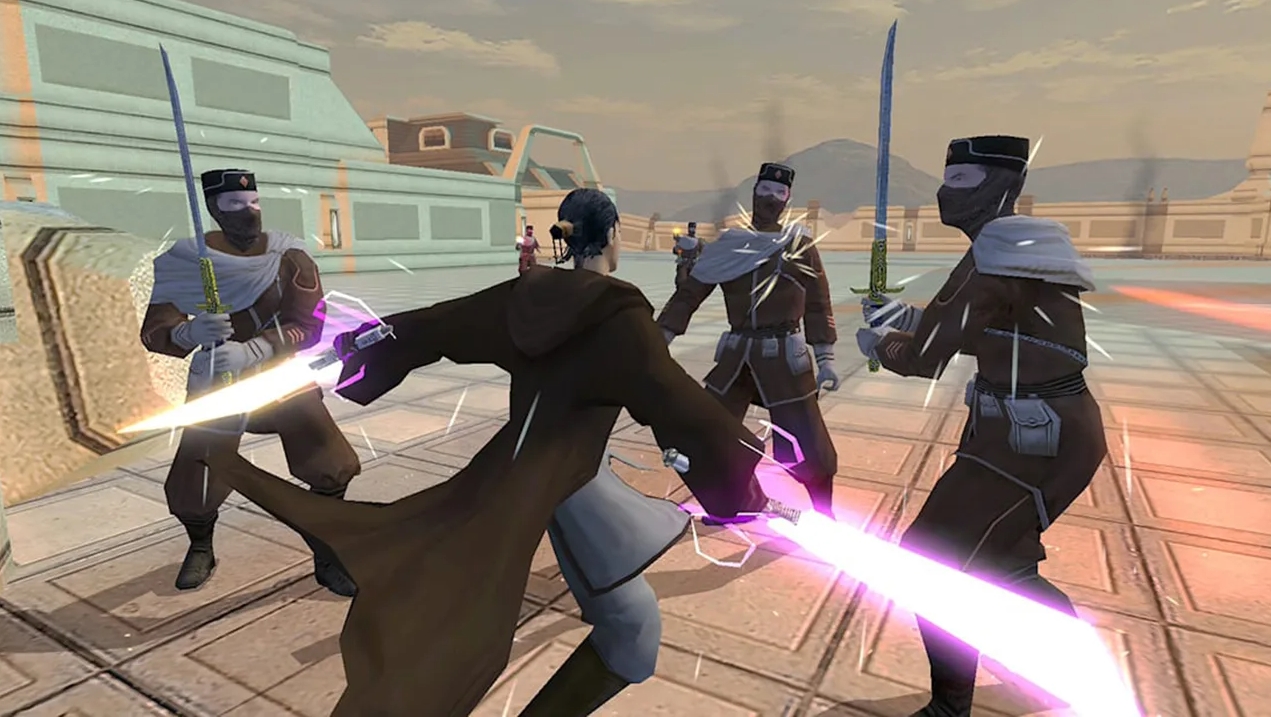
The theme of the struggle between light and darkness was also developed. Our actions gradually change the worldview of the crew members, but, unfortunately, it was not possible to fully reveal the consequences of these changes – a significant part of the ideas was simply cut out. The result almost always comes down to two options: make a Jedi out of the character or slightly improve his parameters. Then everything freezes. In the first part, companions sooner or later offered additional quests, revealing themselves from a new side. Here, it’s like a wall. We are offered only rare hints of romantic lines, but most often everything ends with dry phrases like “Never mind” or “What do you mean?” Bright and lively characters gradually turn into silent tools for passing, and after returning to Dantooine, they are completely lost against the background of rapidly accelerating events.
The main problems of the second part become obvious:
-
The plot lines of many characters remain unfinished.
-
The final chapters look hastily assembled and lose emotional power.
-
The atmosphere built at the beginning collapses due to monotonous fights and weak bosses.
If in Vampire: The Masquerade — Bloodlines the plot lines were somehow brought to the end, then in Sith Lords they hang in fragments, and by the denouement even the main antagonist does not bother to explain his own motives. For twenty hours we dive into other people’s lives, bring secrets to light, and end up in emptiness.
The last third of the game turns into a soulless run through identical rooms filled with hordes of stupid enemies. The atmosphere that the writers built so carefully collapses in an instant. Two magnificent villains are suddenly thrown overboard by the story, and their final battles are so faceless that it seems as if you are fighting not experienced masters, but inexperienced students who accidentally picked up a sword.
Why Star Wars: Knights of the Old Republic II Was Unfinished
The main reason for all the troubles is simple — there was a catastrophic lack of time. When Obsidian, consisting of former Black Isle Studios developers, signed a contract with LucasArts, the team was well aware that they were taking on a dangerous adventure called “KotOR 2”. Only 14 months were allocated for the full cycle — from the first lines of the design document to the release of discs for sale. For a large-scale RPG, this is almost a death sentence. Only the tested engine of the first part, the support of BioWare and the experience accumulated during the time of working with Interplay helped to save the situation. A less experienced studio would most likely have produced a sequel that was much more truncated and chaotic.
It is especially sad for the colorful characters, whose storylines were mercilessly cut. Bao-Dur, an already taciturn technician, completely loses his voice after turning into a Jedi. Kreia had an entire alternative development branch cut out. The image of the mafioso Goto and his robot secretary remained only as a brief shadow – this will be briefly reminded before the final scene. The sarcastic android killer HK-47, the author of the most killer lines, was supposed to take us to the factory where his improved brothers were produced, but this level never survived until the release. You won’t even be able to talk to him about his previous owner – the corresponding dialogues disappeared along with Revan, who was originally part of the plot.
It’s wrong to accuse the developers of laziness – they managed to connect the events of the sequel with the original and wrote a total of 11 MB of text, but … got bogged down in self-quoting. Fans of Planescape: Torment will experience a sense of déjà vu more than once: if you remove the scenery of “Star Wars”, underneath you will find a reimagined story of the Nameless One from another universe. An alternative ending posted on the Obsidian website only strengthens these parallels.
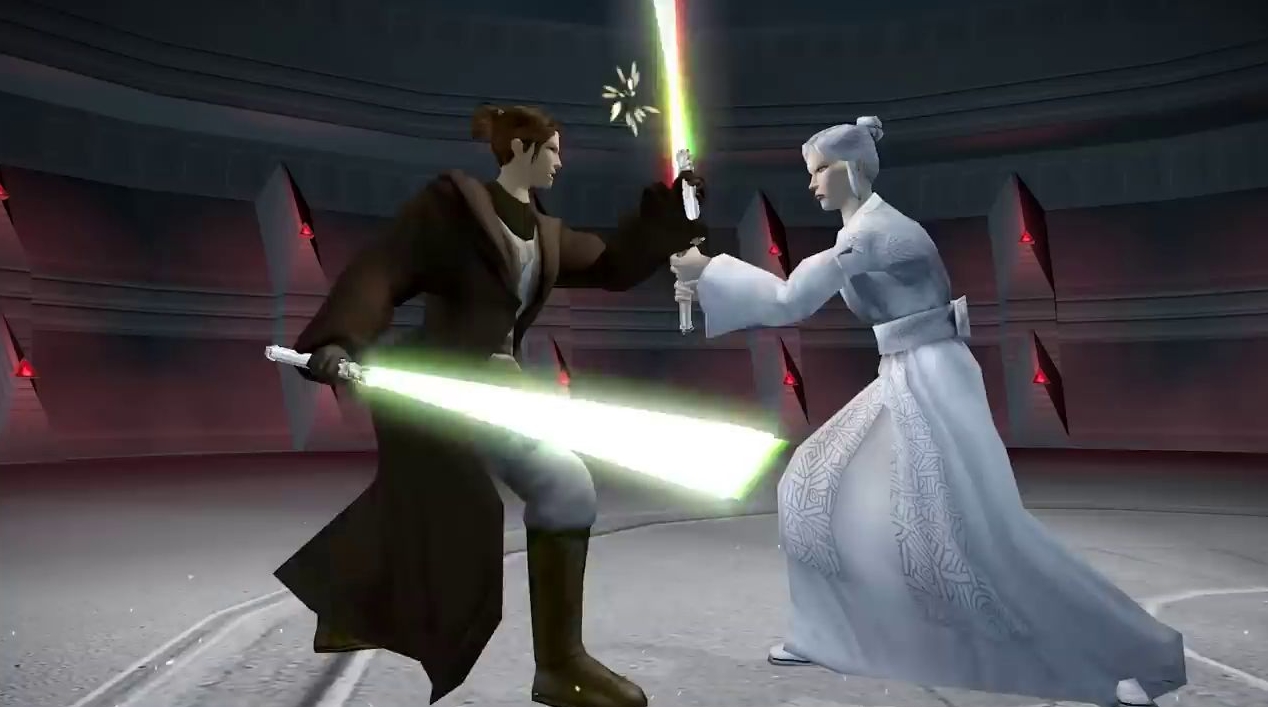
The quests are mediocre. Yes, there is a moral choice, yes, the “Dominate Mind” ability sometimes saves the situation, but there are few truly memorable moments. The optimal route through the game is Tylos, Nar Shadda, Dantooine, Daxan/Onderon, and Korriban in the finale. This clearly shows how the quality of the design gradually decreases from planet to planet. Before writing the review, I tried to write down a dozen of my favorite quests – in the end, there was only one line left on the list: “Defense of the government base on Dantooine.” The rest are meaningless assignments or simple dialogues. The repetition of events is also not encouraging: during the game, the team ends up captured at least three times and comes under enemy fire five times when landing on planets. It is hard to believe that they couldn’t come up with more fresh twists.
The culmination of forced savings is Korriban. Three small locations assembled from scraps of BioWare’s work: the Sith tombs were hastily boarded up with dull textures, some of the lighting was turned off in the Academy, and an abandoned burial ground was turned into a kind of “ghost park” with Revan, Malak, Bastila Shan and other familiar faces. It’s a pity to look at this – especially when you realize that a talented team was forced to hastily assemble someone else’s blanks instead of revealing their own ideas.
All changes and improvements in Knights of the Old Republic 2
As for the innovations, alas, the developers limited themselves mainly to cosmetics – a little more makeup, shadows and disguise. Yes, the list of weapons, “spells” and various skills has been expanded, the maximum level has grown to 50, and the number of modifications for lightsabers has increased from three to six. Now you can extract components even from the simplest items. The interface – inventory, map, statistics and other menus – has finally learned to work with resolutions higher than 640×480. There is also an opportunity to collect useful things from unnecessary ones at special stations, but in practice there is little sense in this: I did not notice a shortage of first aid kits, repair kits and parts during the entire playthrough. Antigravity speeder racing and card “puzzle” remained in place. True, the former suffer from glitches, and the latter is more for die-hard fans – there is enough money in the game without card battles. That same annoying gunfire from the ship’s cannon that tormented players in the first part occurs only three times, and, fortunately, it can simply be skipped.
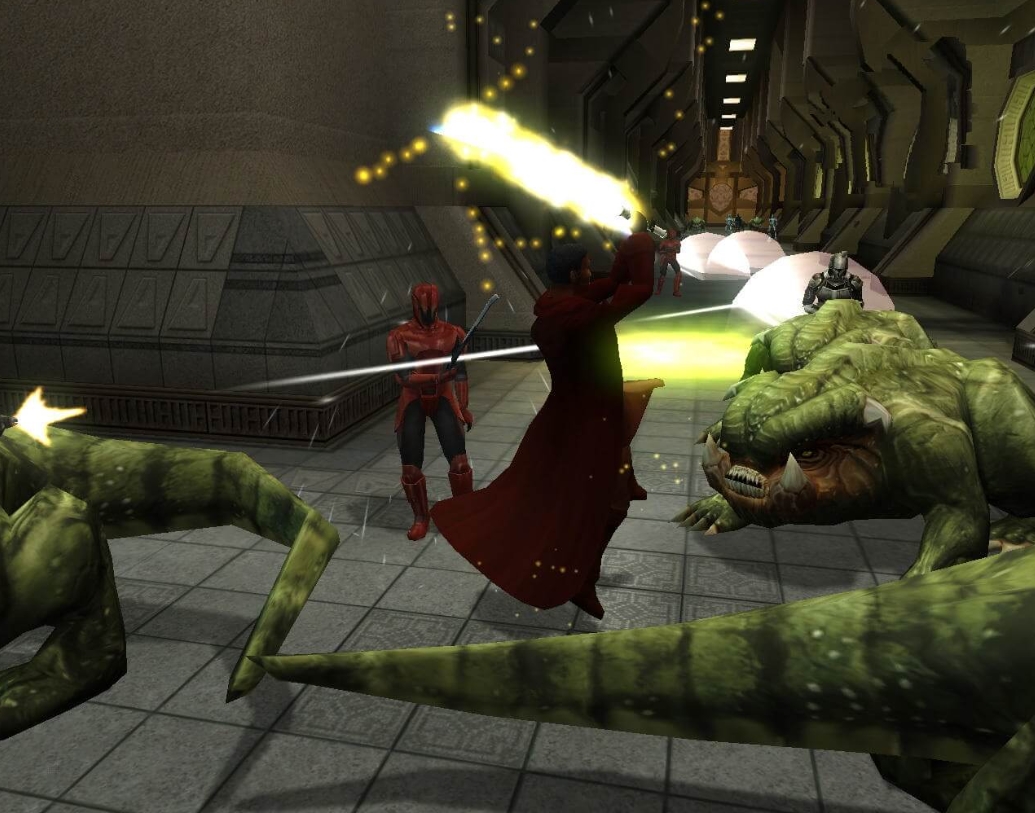
The combat system has migrated from the original KotOR almost unchanged. Among the innovations are a button for quickly changing weapons and a noticeably “stupid” artificial intelligence. Allies ignore the set tactics, get into close combat with a blaster in their hands, arbitrarily change targets, and almost every battle turns into a chaotic series of one-on-one duels. The character rushes between enemies, trying to deal with three at once, and the player furiously presses the spacebar and tells the fool ten times who to shoot or when to use the Force.
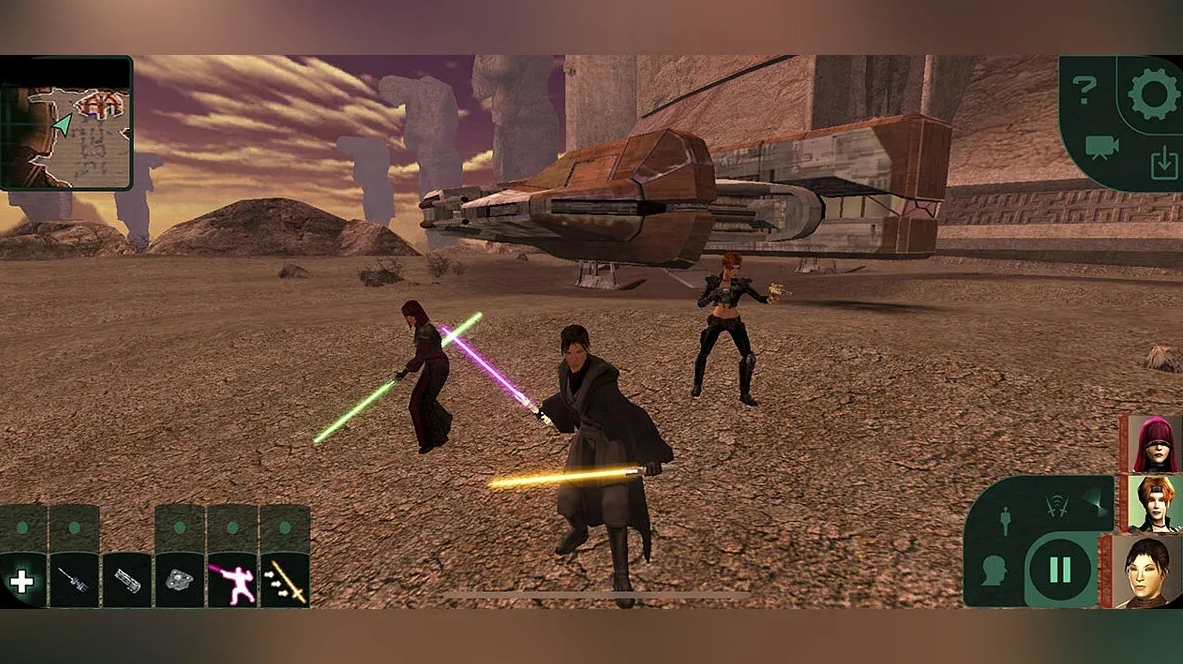
It seems that no one has heard of teamwork here – neither your own, nor your enemies. The enemy can calmly watch as three of your companions beat up his comrade, and not interfere until it is his turn. On the one hand, this simplifies the player’s life, but on the other, it looks like the height of absurdity.
The following moments seem especially strange:
-
Monsters leave money after death, as if they were carrying it in their pockets.
-
The AI of allies acts unpredictably and interferes in battle.
-
The old mini-games remain, but some work with errors, and others are not needed at all.
And yes, about the oddities: defeated monsters still drop money. It would seem that by 2005 all self-respecting studios had already abandoned this archaism, but no – the tradition is alive.
Why KotOR 2’s Graphics and World Disappointed Players
The graphics in KotOR 2 were a real disappointment — the drop in quality is noticeable even without a direct comparison with the first part. The game looks dull and outdated, and decent textures were only given to the main characters. Everything else — background figures, secondary NPCs and the environment — are drowned in muddy, inexpressive details. The “improved” animation does not save either: after the spectacular duels from Star Wars Galaxies, local fights are perceived almost painfully.
The game world seems extinct. The rooms are a chaotic mixture of sharp angles and strange shapes, where a bed can easily be confused with an ironing board, and a chair with some kind of museum exhibit. The refugee base resembles a construction set of different-sized cubes. The Sith Academy greets you with empty halls, where there is nowhere to even sit. The capital of one of the Republic planets looks more like a stage set – tightly closed houses and silent NPCs wandering aimlessly through the streets. Nar Shadda is striking in its poverty and lifelessness; perhaps only Dark Forces 2 had it worse. Of all the variety of locations, only the green planet Daxan looks more or less decent – dense jungle hides the shortcomings, but even there the Mandalorian camp leaves a questionable impression.
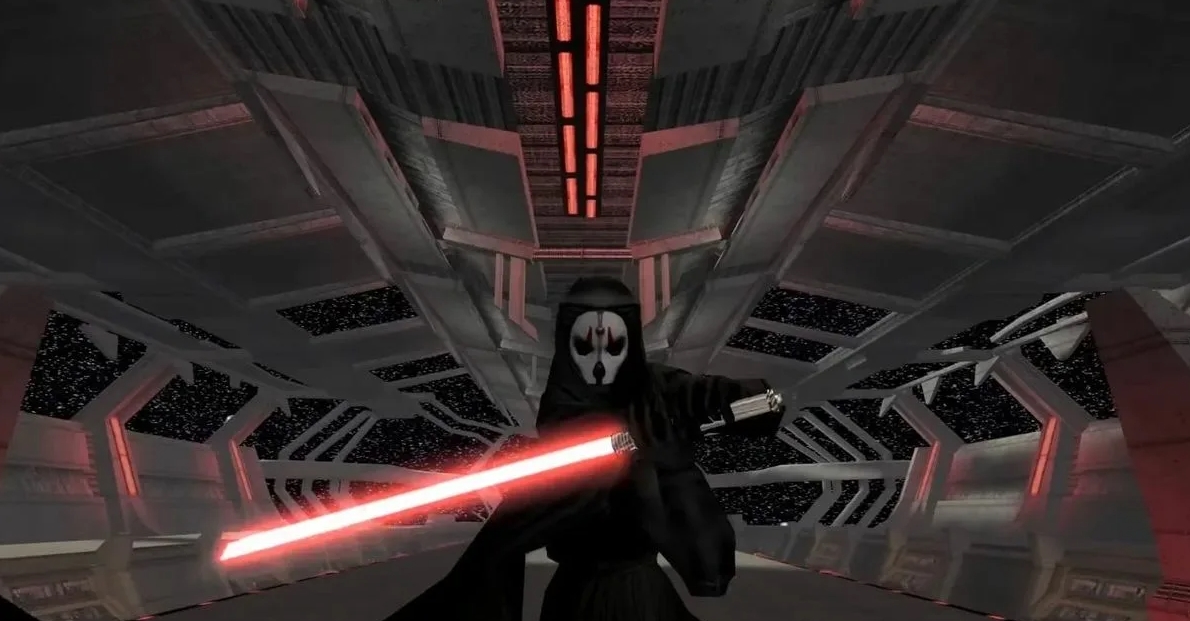
The script settings are not very inspiring. The director seems to seriously believe that static shots and boring angles are the pinnacle of cinematography. Pre-rendered videos suffer from angular models, distorted colors and unpleasant “comb” interlacing. Of the bright sides, only special effects can be noted: lightsabers leave beautiful traces, sparks fall on the floor, force fields flicker, creating the illusion of dynamics. However, we’ve already seen all of this two years ago.
But the technical flaws are impressive in their scale: impossible tasks, broken scripts, looped dialogues, holes in the mechanics that allow you to farm resources, frequent crashes, graphical bugs and inexplicable slowdowns. When starting the game, it persistently suggests playing in windowed mode, and for full-screen mode you have to go into the settings every time. The question arises – did they do any testing at all?
Against the background of all this, complaining about a couple of poorly chosen voices is somehow frivolous, especially since the other actors did an excellent job. But the music was disappointing: the in-house LucasArts composer was never able to come close to the style of John Williams. The solemn themes lack power, and the lyrical ones lack melody.
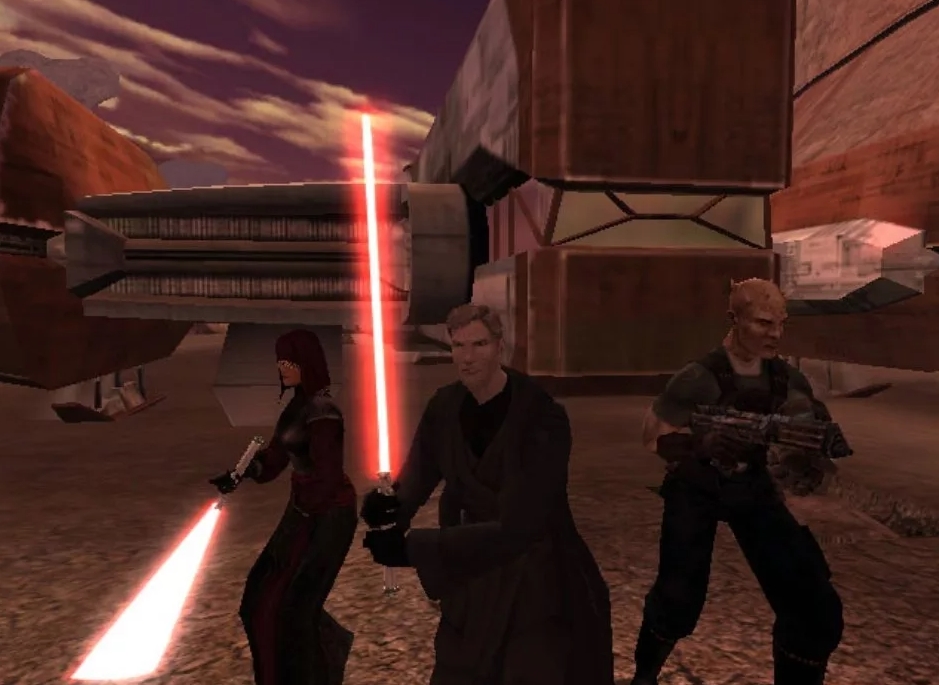
It’s sad that it all turned out this way. What was supposed to be a grand sequel that could have gone down in history ended up being a helpless Frankenstein project, where none of the ideas were ever brought to fruition. It’s hard to say for sure whose fault it is – the stubborn and overly confident Obsidian or the greedy LucasArts for quick profits. One thing is clear – we, the players, are the losers.
STAR WARS Knights of the Old Republic II – The Sith Lords System Requirements
System Specs – STAR WARS KOTOR II
How to play STAR WARS Knights of the Old Republic II – The Sith Lords for free on Steam via VpeSports
Close your eyes and imagine it — the distant stars stretching endlessly before you, the faint hum of hyperspace, and the knowledge that you are one of the last lights in a galaxy consumed by darkness.
In STAR WARS Knights of the Old Republic II – The Sith Lords, you become the Jedi Exile, a figure haunted by past choices, returning to a galaxy still reeling from war. The Jedi Order has been shattered, the Sith are hunting down the survivors, and the line between right and wrong has never been so thin. Every planet hides its own mysteries — from ancient temples echoing with the whispers of the Force to bustling cantinas where danger hides in plain sight. The fate of the galaxy rests on your lightsaber… and your conscience.
We’ve made sure the only thing you’ll need to focus on is your journey. No complicated setups, no endless tinkering — just sign up on our site, log in, and the game will be waiting for you. We even provide a simple, clear guide on how to start playing, whether you launch it directly or through a free steam account. In moments, you’ll be crossing lightsabers with Sith Lords and uncovering secrets buried for millennia.
And when you’ve faced your trials, we want to hear about them. Share the twists of your story, the allies who stood by you, and the choices that changed everything. Leave your review — if it doesn’t show up right away, tweak it slightly and it will be approved. Once it is, your login details will be sent straight to your email.
If you want to keep one foot in this galaxy at all times, join our Telegram channel — your personal Holonet hub. There we drop fresh accounts, announce patch updates, share game news, and dive into spirited discussions with other fans. And should you ever need help, our “How to play for free – Complete guide” is ready with advice, solutions, and tips to make your adventure smoother and chat.