

Have you ever experienced that peculiar sensation when various components of something meant to create a unified whole simply fail to fit together? Perhaps this feeling struck you while watching the trailers for “Assassin’s Creed” and “Warcraft,” where the musical scores felt completely out of sync with the stunning visuals on screen. Or maybe it happened while enjoying a film featuring an exceptional cast but marred by poor direction? You might have felt this disconnect while playing the reboot of Tomb Raider… or Prototype 2? The latter is what I want to delve into in this review, as I explore how it diverges from its original concept and vision, leaving players wanting more in terms of coherence and engagement.
Table of Contents
Prototype 2 Free Steam Account
In June 2009, the first installment of the Prototype franchise made its debut, developed by Radical Entertainment and published by Activision. While it didn’t achieve universal acclaim, it did manage to cultivate a notable level of popularity and a dedicated fanbase. This success largely stemmed from its relatively innovative concept, immersive atmosphere, and a distinctive main character, Alex Mercer, along with several other commendable features. The game offered players a unique experience that resonated with many, making it stand out in a crowded market. Given that the initial title attracted fans eagerly clamoring for a sequel, it seemed only fitting to develop one, aiming to refine the flaws of its predecessor. This highly anticipated sequel eventually arrived in 2012, three years after the original’s launch, marking a significant moment for fans who had been waiting for more.
The core of the second part remains true to the roots of the original. We once again find ourselves in the role of a man – although this status is already questionable – infected with a unique virus that gives him the ability to absorb other creatures, transform his own body into a deadly weapon and perform amazing, almost superhuman actions. The owner of these extraordinary powers moves freely around a huge open world, completing both main missions and a variety of side quests, each of which adds depth and richness to the gameplay. The sequel “Prototype” starts with a cinematic, visually captivating opening scene, in which the viewer is introduced to a new protagonist – soldier James Heller. Immersed in personal tragedy after the loss of his family at the hands of a cruel enemy, he sets out on a path of vengeance, driven by a simple but universally understandable goal – to punish the guilty.
The commitment to learn from past mistakes and the eagerness to enhance the shortcomings of the first installment truly shine through from the very beginning. The introduction effectively establishes a compelling mood and exciting momentum that pulls players in. The videos are crafted in a captivating style that not only delights the eye but also immerses the viewer in the experience. The enhanced graphics stand out immediately, showcasing significant progress compared to the original. Beautiful shadows, stunning visual effects, slow-motion moments, and a vivid red trail during movement all elevate the visual experience of the abilities—everything looks remarkably impressive for an open-world game, providing a sense of dynamism and engagement.
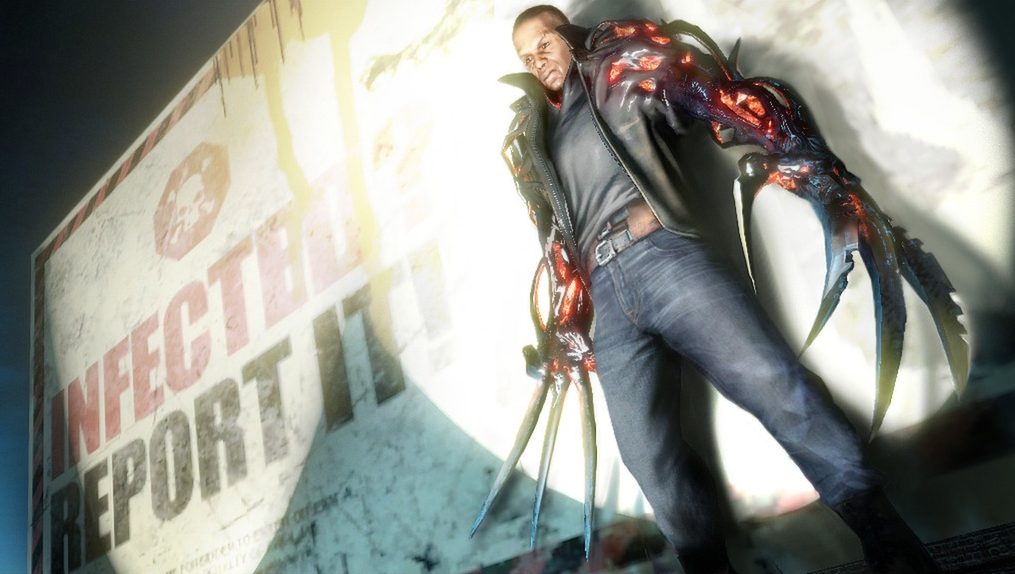
All in-game cutscenes share a consistent and striking color scheme, utilizing bold contrasts of black and white, alongside vibrant red and blue, which adds to the overall aesthetic impact.
Positive manifestations of mutational variability
Shortly after, you have the opportunity to dive into the revamped combat system, which has evolved significantly and become far more enjoyable. Heller “locks on” to a specific enemy and relentlessly pummels them, reminding players of the Arkham series featuring Batman, and making for a truly satisfying experience. Right from the start, you don’t just feel like an ordinary human; you feel more like a superhero, endowed with a wide array of advantages over regular people. Before long, you acquire claws that give you the sensation of being a fierce version of Wolverine, and the excitement escalates dramatically. You leap at enemies with ferocity, tearing them into gory bits, feeling every moment of the action. In the heat of battle, you also rip a rocket launcher from an enemy armored vehicle, turning the tide of combat as you fire it at your foes. You consume a couple of enemies to replenish your health, fully embracing your newfound power and abilities as you dominate the battlefield.

At its finest, Prototype 2 delivers an exhilarating experience, with adrenaline and fierce action bursting from the screen like a wild storm. It’s reminiscent of slicing through enemy hordes in Diablo, but here, everything is more visually stunning, intense, bloody, and downright enjoyable. The gameplay evokes a genuine sense of childlike excitement and joy, making each encounter feel fresh and thrilling. Heller has lost some of the mutations that Alex possessed, yet in return, he gains a truly spectacular ability that showcases the game’s creativity. This section of the game truly shines, captivating players with its relentless pace and engaging mechanics. I have no urge to dwell on its shortcomings, even though they do exist and can sometimes be frustrating. Still, I’d like to first highlight the strengths and advantages of this sequel, as they significantly enhance the overall experience.
One of the key advantages of the updated game is a more expressive and dynamic urban landscape. Now it is skillfully divided into zones with varying degrees of infection, which emphasizes the depth of the game world. Modern graphics and complex architecture make the city not just a background, but a full-fledged, living organism. On the roofs of buildings, you can meet survivors ready to come to the rescue, which opens up new opportunities for interaction. At the same time, there is a lively movement on the streets – both pedestrian and transport, which was so lacking in the original part. As the player explores the city, rich details are revealed to him – Black Watch posts, isolated quarantine zones with people imprisoned in cages. All this enhances the atmosphere and makes the world more realistic. Each turn reveals new stories, allowing you to immerse yourself deeper into the gameplay and feel humanity in the conditions of total chaos.

As you transition from one zone to another, you’re met with breathtaking visual transformations, a feature the first part seriously lacked. In that game, only a few visual effects were introduced, and the types of “passersby” on the streets changed slightly. However, stepping into the red zone for the first time creates an incredible “wow effect,” filling you with excitement and wonder. You can’t help but want to glide through this vibrant space, soaking in all the stunning sights and details. Navigating the city feels effortless and enjoyable, as all the essential abilities for movement, like flying and wall-running, are available right from the start. This accessibility enhances your experience, allowing you to fully immerse yourself in the dynamic environment and explore at your own pace.
Negative consequences of mutations
The game’s strengths are easy to recognize, but its weaknesses should not be ignored. Some of them were inherited from the original version, while others are the result of innovations, and, what is noteworthy, sometimes the very attempts to eliminate old flaws turn into new problems. One of the most noticeable shortcomings was the extremely unconvincing and poorly developed stealth mechanics, which, surprisingly, is encountered quite often. Its main problem is the primitiveness of the implementation and the complete lack of plausibility in game situations. For example, in missions related to the Black Watch organization, everyone knows that a dangerous mutant with destructive abilities is roaming the city. The alert is raised, the security is brought to full combat readiness. But despite this, the hero, disguised as an ordinary soldier, calmly overcomes three-meter barriers, runs along the roofs in the field of view of observers and passes by surveillance cameras installed supposedly for complete control. None of this evokes any reaction – the situation seems not just implausible, but almost parodic. This creates a serious dissonance between the dramatic tension embedded in the story and how this tension is realized in the gameplay. The story tries to build an atmosphere of threat and urgency, but the mechanics undermine this effect, leaving players with a strange feeling: at once easy and disappointed by the missed potential. During the mission, you can quietly eliminate the target figure right inside the base, methodically and with impunity eliminating all scientific personnel – the guards will not even blink an eye. By destroying everyone outside, you will not cause the slightest unrest inside – the inhabitants of the bunker have no connection with the outside world. There are many more examples, but the essence of the problem is already extremely clear. It would be elementary to fix this, and such a revision would only add depth and authenticity to the game. However, alas, the “disease” of the first part has passed unchanged to the second. When the soldiers look indifferently at the guy calmly hovering above their heads, you can only shrug your shoulders – you simply do not believe in such a reality.

A form of movement that seems mundane to soldiers, part of a daily routine devoid of any drama.
But the bigger problem is the complete lack of a real challenge in the gameplay. You don’t just feel powerful, you feel like a dominant force, a predator at the top of the food chain that no one can resist or even slow down. I still vividly remember my battles in Prototype – thirty agonizing, almost hopeless minutes, during which I desperately tried to outrun the relentless military helicopters that were chasing me with relentless fury. In those moments, I was overcome by an animal instinct for self-preservation. The nearest safe point was too far away, and I had no means of protection at my disposal. I raced through the streets without paying attention to the road, throwing pedestrians around as if they were nothing more than decorations in the way, jumping from rooftop to rooftop. Sometimes I stopped only to feed on the bodies of my enemies, recuperating on the run. All the while, I was pursued by the roaring explosions and the incessant roar of machine gun fire – a constant, ominous reminder that death was closing in on me with every step. One of the final bases in the original game was a real challenge: its defense was tightly organized, and the perimeter was guarded by elite soldiers and attack helicopters. Even with almost fully upgraded gear, each skirmish felt like a real struggle to the point of exhaustion. The battle with one of the key bosses could easily take an hour – and that’s provided that you thoroughly knew his habits and weaknesses. The sequel, however, is strikingly different in tone: the sense of danger is gone. Neither supersoldiers nor other improved enemies, including the final boss, are able to truly challenge the player. Defeating most enemies is easy, and a failed attempt is almost always compensated for by a successful one on the second try. I started the playthrough on Hard, although my experience in the hack-and-slash genre is quite modest – and even with this condition, the game felt more like a visual attraction than a test of skill. In terms of aesthetics and presentation, this is an impressive project. But if you’re the type who values tension and a sense of overcoming in games, you may find the depth and challenge lacking. It’s still a thrilling adventure, but it’s unlikely to test your gaming skills.

In the first installment, these characters had the power to create significant chaos, even for a fully upgraded Mercer. However, in the sequel, they only manage to generate minor annoyances that hardly pose a threat. As you delve into this review, you might be wondering why I even mentioned the introduction, especially since I haven’t connected it to any relevant topics so far. The introduction is vital because it brings me to the third and most prominent flaw in the game for me: the storyline and the protagonist. Remember when I mentioned that the main character is driven by a desire for vengeance due to his family’s tragic demise? Inside James Heller’s mind, two conflicting thoughts are constantly at war—one fixated on his lost family, the other consumed by the thirst for revenge. These two thoughts rarely come together cohesively, leading the protagonist to deliver overly dramatic and cringeworthy lines that fail to resonate. Additionally, he makes some incredibly poor choices that leave players shaking their heads. Alex Mercer has been transformed into a painfully clichéd villain, and it feels like the rich narrative from the first part has been completely disregarded. Some plot twists had me facepalming in disbelief, while others filled me with genuine frustration towards the writing team. For anyone interested in reading more about my grievances and indignation regarding these issues, I invite you to follow me to the spoilers section.
Dana, who betrays her “brother” only because he changed – although in the first part she somehow put up with it. The absurd Alex Mercer, who does not destroy Heller – although it is already clear that he has gone out of control. And Heller himself, the embodiment of stupidity, who never tires of throwing pompous remarks in his theatrical bass, treats his prototype ally – the only one who really went over to his side – like dirt under his fingernails. And then suddenly he is imbued with sympathy for the general of the “Black Watch”, because, you see, he has children. Brilliant. And the fact that before this you cut out hundreds of people who also had families – this does not count, right? Brrr … by God, it would have been better to leave Mercer in the role of the protagonist. Than stuff the game with strained, unnecessary “humanity” in the person of this parody hero.
In the end, I can only admit: I deliberately gave in to the final boss, hoping that this would lead to an alternative ending that could shed light on the story from a new angle. Alas, my expectations were not met – no other ending is provided. Moreover, it seems that the gameplay and the plot exist in complete isolation from each other. The protagonist is deeply shaken by the loss of his family, which forms in him a keen empathy and respect for human life – he openly talks about this in cutscenes. However, in reality, the game leaves no chance: you are forced to eliminate dozens, if not hundreds, of civilians, even with a sincere desire to avoid violence. Initially, I tried to strictly adhere to role-playing behavior – to spare civilians, entering into conflicts only with clearly hostile characters.
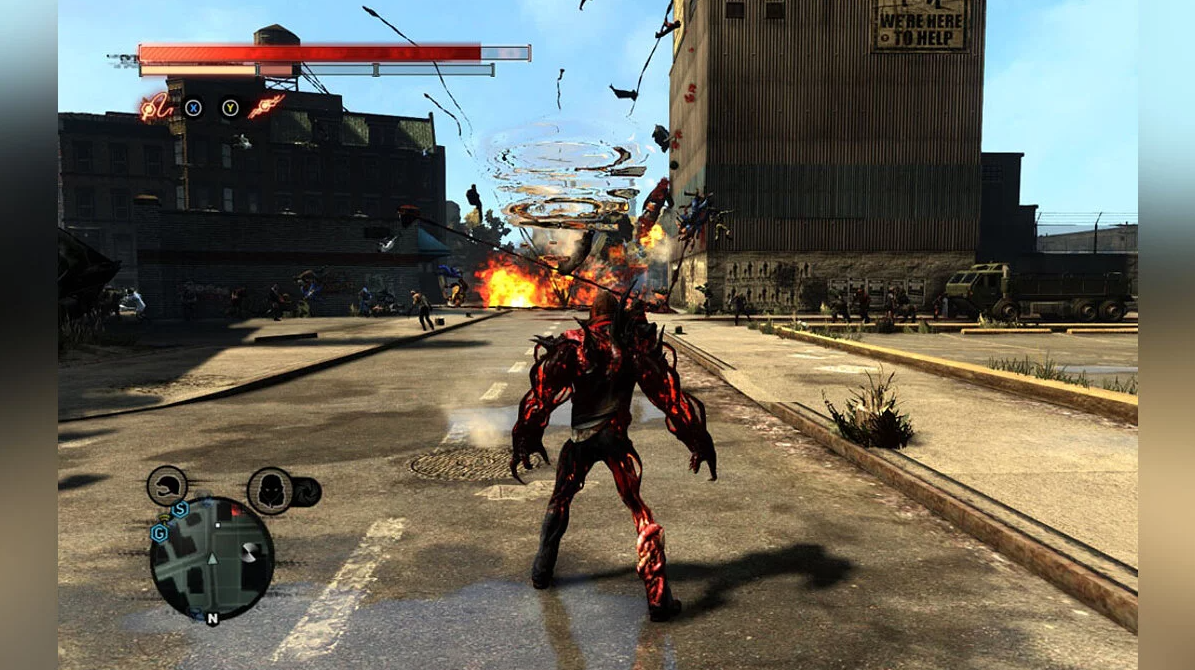
In this mood, I went outside – and there in front of me was a cage with locked people. Well, I’m a good guy, I should help. There is no “open” button… what can I do? That’s right: hit. Hit – and ten people in the cage turn into a bloody mess.
Oops.
“Black Watch” raises the alarm, and now with the help of “Tentacles” I hang soldiers and a couple dozen civilians on the streets, like a New Year’s garland – from guts and blood.
Oops again.
In the first part, Alex did not even think about the value of human life – and this is what organically formed the basis of the gameplay. Attempts to impose drama and morality in the spirit of “human life is priceless” are completely inappropriate in this context. This game is not about that.
Is mutation the result of evolution?
I could go into more detail about the improved character development system, the variety of side quests, the interesting mutations, and the new enemies that the player has to fight. Of course, all of these elements deserve attention, but they do not have a decisive influence on the overall perception of the project. The game is undoubtedly high-quality – in some moments it even approaches the level of a truly outstanding work. However, the previously mentioned shortcomings do not allow me to rate it higher than it deserves. From a subjective point of view, I would call this adventure rather “forgettable” – mainly because of the nondescript protagonist, who completely discourages the desire to return to this world and relive the story. However, if you evaluate it more objectively, the project deserves a solid mark of “worthy of respect”, only slightly falling short of the status of “excellent”. The game certainly has its strengths, but the noted weaknesses continue to pop up in my memory, noticeably affecting my final impression.
Pros:
-
The game amazes with its visual component – the graphics are top-notch, and the special effects are literally breathtaking, creating a bright and rich impression. The protagonist has a wide arsenal of abilities, which gives scope for a creative approach and a variety of tactics. Dynamic scenes and an adrenaline rush partially compensate for its shortcomings, making the passage truly exciting.
Cons:
-
However, the main character sometimes behaves so annoyingly that it can knock you out of the atmosphere. The script is not without frankly ridiculous moments that violate the logic of the narrative and interfere with immersion. Stealth is poorly implemented and sometimes looks caricatured. In addition, the lack of a noticeable level of difficulty can leave hardcore players indifferent.
Important to know:
If you are the owner of an AMD video card, I highly recommend that you first download the trial version of the game via torrent to evaluate its stability. Performance can “dance” without any system: for example, 15 minutes after the start, lags began to appear in my case, despite a smooth start. And after switching to a monitor with a higher resolution, the lags became noticeable right in the main menu, making the game unplayable. All screenshots in this article are taken from the Internet, since it was not possible to make my own.
Prototype 2 system requirements
To fully enjoy Prototype 2, you’ll need at least 2 GB of RAM and 10 GB of free space on your hard drive. The minimum graphics card that you can use is a GeForce 8800 GT, but for a significantly better gaming experience, the developers highly recommend opting for a GeForce GTX 460. In terms of processors, the Core 2 Duo E7300 is the basic requirement, but if you wish to enhance the graphical settings and enjoy a smoother and more immersive gameplay experience, it’s advisable to choose a Core 2 Quad Q9505 or an even better model.
| Parameter | Minimum Requirements | Recommended Requirements |
|---|---|---|
| Graphics Card | NVIDIA GeForce 8800 GT with 512 MB RAM, ATI Radeon HD 4850 with 512 MB RAM | NVIDIA GeForce GTX 460 (1GB) or better, ATI Radeon HD 5850 (1GB) or better |
| Processor | Intel Core 2 Duo 2.6GHz, AMD Phenom X3 8750 | Intel Core 2 Quad 2.7 GHz or better, AMD Phenom II X4 3 GHz or better |
| Memory | 2 GB | 4 GB |
| Storage | 10 GB | No data |
| Operating System | Windows® XP / Vista / 7 | Windows 7 |
| DirectX | 9.0c or later | No data |
How to play Prototype 2 for free on Steam via VpeSports
Imagine yourself in the heart of infected New York — mutants on the streets, government conspiracies, and you are not just a soldier, but a living weapon. This is not just a game — Prototype 2 draws you into the epicenter of the disaster, where your decisions and your rage determine the fate of the entire city. Here, legends are not from fairy tales, but from laboratories, where humanity pales in comparison to the thirst for power. You are not an observer. You are a virus. You are a judge.
We have done everything so that nothing distracts you from immersion in this cruel, infected world. No complicated settings, forums or hassle. Just register on the site, go to your profile — and the game is already waiting for you. One click — and you are on the streets, where around every corner there can be both a chance for survival and something much more terrible. We have many accounts for every taste — here is a complete list of Free Steam accounts!
When you complete the first mission and get a taste of revenge, don’t be silent. We really care what you think. Write a few lines about your impressions. If the review doesn’t appear right away, change the wording a little. As soon as it is approved, you will immediately receive all the necessary data by email.
Do you want to be closer to the world of Prototype 2 and to those who are also not afraid to be infected by force? Join our Telegram channel. There are fresh accounts, news, updates – and just live communication. And if something doesn’t work or is unclear – look in the “How to play for free” section or write to us directly in the chat. We are here.