

The multiplayer shooter Wildgate from Dreamhaven studio unexpectedly but pleasantly breaks the usual patterns: you can play it for free, without subscriptions and initial investments. It becomes clear from the very first minutes that this is not a passing online action game, but a project with character and ambitions.
The name of the person behind the creation of the game gives special weight to the game. Dreamhaven was founded by Mike Morhaime, one of the key architects of Blizzard Entertainment’s success. And this is felt not at the level of a high-profile brand, but in the details: in the pace of the matches, in the feeling of shooting, in the way the game encourages teamwork rather than chaotic running around the map.
Table of Contents
Wildgate Free Steam Account
Wildgate is a sci—fi first-person shooter that expertly mixes PvE exploration with fierce PvP competition. At its core, the game is simple and straightforward, but there is much more depth behind this simplicity. In each match, up to five teams of four are at stake, and each of them is fighting for dominance not only with weapons, but also with tactics. The battles unfold both in outer space and on earth, constantly changing the rhythm and feel of the gameplay.
The game world of Wildgate is catchy from the very first minutes. This is not just a set of arenas, but a whole sci-fi universe that you want to delve into. Abandoned ships, gloomy dungeons and strange alien structures are scattered across the maps so that exploration becomes part of the strategy. It is important not only to shoot well, but also to understand the environment, find shortcuts and use space wisely.
There is an Artifact in the center of each match. It is he who becomes the point of attraction for all the teams. After receiving it, players are faced with a choice: try to escape and complete the round with a victorious escape, or stay and destroy the enemy ships, turning the match into a large-scale space meat grinder. This decision is always risky, but it is precisely such moments that create the very emotions for which you want to launch the next match.

Before the start, the player chooses his Prospector, a character for whom he will have to fight. Visually, the characters look fresh and memorable: a slightly cartoonish style, fantasy sci-fi and alien motifs are perfectly combined with each other. Each character has their own story, which is revealed gradually — through leveling, mini-tasks and active actions in matches. It’s an unobtrusive but enjoyable way to add flavor and depth.
In terms of gameplay, the Prospectors don’t differ radically, but enough to make it feel like it. One character, for example, does not think about oxygen at all and can move freely in space — an ideal option for covert sorties and sabotage. The other is able to detect enemies who have infiltrated your ship in advance, which often saves the team from sudden defeat. These abilities directly affect the style of play and team synergy.
So far, the character roster seems a little modest, and this may be alarming. However, given the beta version status, this limitation looks temporary, and the potential for expansion is obvious.
Weapons and equipment complete the picture. You can open them and adjust them for yourself before the match, choosing the most convenient set. The arsenal feels pretty standard so far, but it fits well into the overall balance and doesn’t overload newcomers with unnecessary mechanics.
Finally, a separate feature of Wildgate is the choice of a ship. Each of them differs in characteristics, maneuverability and location of turrets. These nuances directly affect the tactics, fighting style and distribution of roles in the team. As a result, the ship becomes not just a transport, but a full-fledged instrument of victory.
We believe everyone deserves access to free steam accounts.
Wildgate Gameplay: Exploration, Loot, and Tactical Decisions
The Wildgate begins to open exactly at the moment when the coveted “Match has begun” appears on the screen. There are no pre—assigned roles and strict instructions – just a live team and quick decisions. Already in the first seconds you have to negotiate on the go: who takes the helm, who stays at the turrets, and who goes on a risky exploration. This freedom of choice makes each match truly unique and sets the tone for the entire gameplay.
The size and structure of the cards enhance the feeling of freedom. The locations here are large, seamless, and surprisingly “tangible”: you can land on almost any surface, enter an alien ship, or get lost among the debris in outer space. Procedural generation works as it should — there is no sense of deja vu after a dozen matches. And random events like asteroid clusters regularly disrupt familiar routes and force you to rebuild tactics on the fly.

One of the key advantages of Wildgate is the flexibility of team roles. During the match, the players naturally distribute responsibilities, and most often the team looks something like this:
-
Pilot is responsible for the ship’s maneuvers, positioning in combat and avoiding dangerous areas;
-
Turret operator — holds the line and covers for allies during clashes;
-
Scout — explores the map, enters enemy targets and extracts valuable loot;
-
Saboteur — infiltrates rival ships, knocks out systems and creates chaos.
Looting in the game is not a secondary activity, but the basis of progress. They don’t farm here for the sake of numbers or formal experience: each item found is a specific reinforcement that affects the outcome of future battles. Therefore, research and resource collection feel intense and meaningful.
You rarely encounter other teams at the beginning of a match. The game seems to give players a break by directing them to local “dungeons”. It is there that upgrades are hidden: improved turrets, reinforced ship armor, rare ammunition, special gadgets and personal weapons. Not only the set of improvements is important, but also the speed — whoever gathered earlier gets a strategic advantage.
The process of exploring locations is one of the most atmospheric elements of Wildgate. Abandoned outposts, ancient ruins, and dilapidated labs are inhabited by aggressive alien NPCs and sometimes offer simple but relevant puzzles. However, the main tension is created by the thought that you are not alone here: at any moment, an enemy team may be around the next corner.
The game encourages cunning and innovative solutions. You can wait until the opponents get bogged down in a battle with robots, and stab them in the back. Or you can quickly pick up loot and disappear, leaving your rivals to deal with the consequences. Such a “space guerrilla” style often proves to be no less effective than open firefights.
From personal experience, I once encountered a pack of aggressive slugs in the depths of a space cave. After the sweep, an abandoned mining camp with dynamite and jetpacks was opened — not the most powerful, but potentially useful loot. I intuitively dragged all this onto the ship, and, as it turned out later, I did absolutely the right thing.
About twenty minutes later, an enemy ship began firing at us from a great distance. It was obvious that the rivals had found long-range weapons, and we had no chance in a fair shootout. Then my partner and I decided to play dirty — go into outer space and arrange a diversion.
It was the pre-assembled items that made it possible to neutralize their cannon and turn the enemy ship into the epicenter of chaos. Such moments best show the essence of Wildgate: victory here does not depend on patterns, but on ingenuity, team synergy and the ability to use the possibilities of the world.
How Shooting and Ship Shape the Wildgate Experience
In Wildgate, the gameplay is built around two equal pillars — the shooting familiar to FPS and the almost “simulation” interaction with your own ship. The game constantly balances between these states, forcing the player to concentrate on tracking down the enemy with weapons in his hands, or in a panic to save the ship, which is about to fall apart. It is this contrast that makes what is happening truly vivid and memorable.
The shooting itself feels honest and fast. Weapons are not overloaded with unnecessary effects, hits are easy to read, and enemies fall fast enough so that the pace does not sag. Matches often turn into an intense game of reaction and attentiveness: In most cases, whoever notices the goal first comes out victorious. At the same time, death is not perceived as a serious punishment — after 20-30 seconds you return to battle again, having been reborn on the ship. At some point, you begin to understand clearly: a personal account is secondary, the main thing is to save your ship.
And that’s where Wildgate really starts to surprise. The ship’s controls are intuitive, but not primitive. The ship feels massive, inert, with character. Sudden maneuvers require calculation, and every mistake is immediately felt. Especially when gravity comes into play: once the pilot makes a crazy turn, the whole team begins to fly through the compartments, grabbing onto the walls and continuing to perform their tasks in this controlled chaos.
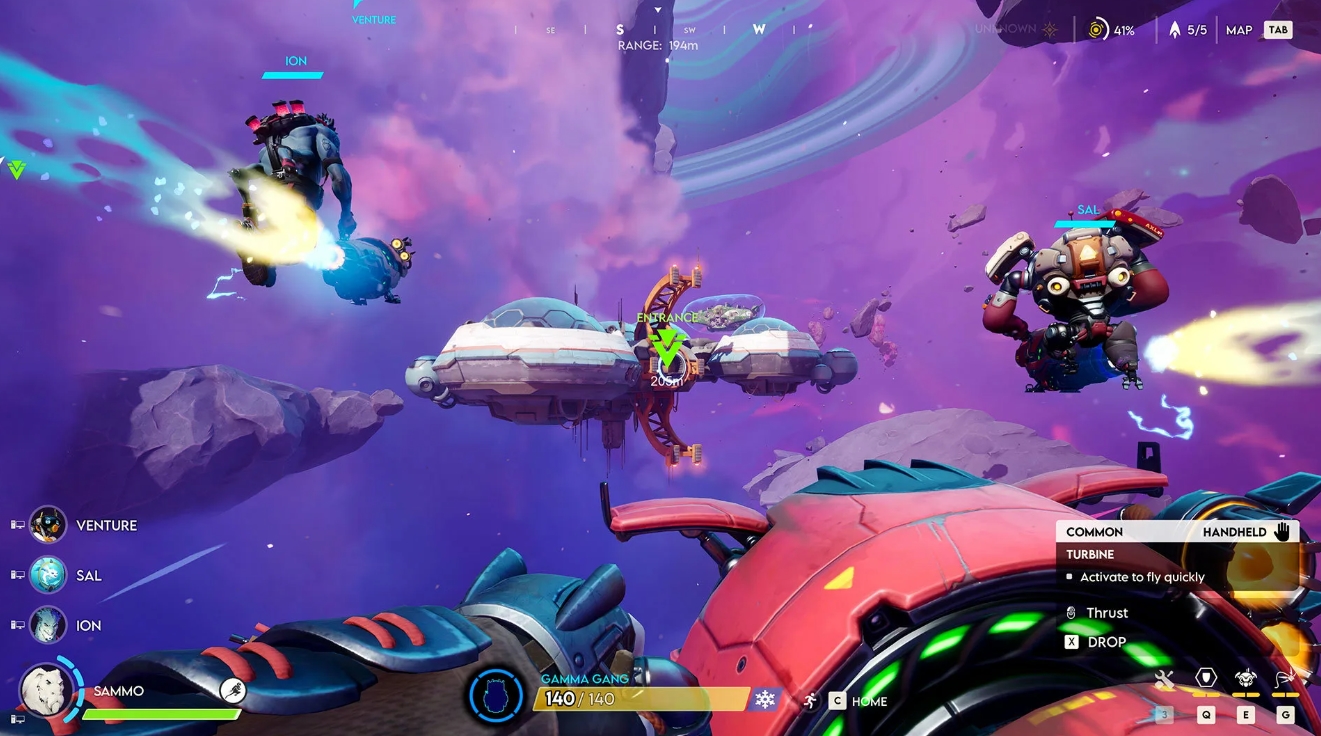
The resource system adds a separate depth. In the game, you constantly have to keep two indicators in mind — fuel and ice. The first is needed for movement and combat, the second is for reactor cooling and repairs. Both resources are mined in drifting asteroids, and each mission for them is a conscious risk that can either save the team or put it at risk.
Gradually, the ship ceases to be just a “rebirth base” and turns into the center of the entire game logic. During a match, the team actually performs several critical tasks at once:
-
controls the maneuvers and positioning of the ship, avoiding dangerous areas and enemy fire;
-
monitors the condition of the systems, repairing modules on time and extinguishing fires;
-
uses turrets and upgrades to protect and pressure opponents;
-
launches reconnaissance probes to find enemies, loot, or weakened targets;
-
it reflects boarding and sabotage, preventing opponents from disabling the ship from the inside.
The ship in Wildgate is a full—fledged “living organism” that can and should be improved. Turrets, defensive modules and passive upgrades change the style of the game and allow you to adapt to the situation. Add guided reconnaissance drones to this, and there are even more tactical solutions. Sometimes it is the probe launched on time that decides the outcome of the battle, allowing you to finish off a battered opponent with an accurate shot from a long-range weapon and take his loot.
But you have to pay for any mistake. In the midst of the battles, the ship is critically damaged, the systems fail, and the compartments are engulfed in fire. At such moments, the team stops being just a group of shooters and turns into an emergency team. Sabotage is especially dangerous: one precise explosion or shot can leave you without turrets and make you easy prey.
The constant threat of boarding and attacks by other ships does not allow you to relax for a second. Wildgate is not about calm shootouts, but about intense survival in space, where victory goes to those who know how to think in command, adapt quickly and treat their ship as the most valuable resource.
Wildgate System Requirements
Wildgate
How to play Wildgate for free on Steam via VpeSports
There’s a feeling when you’re not looking for a game to “try it out”, but for it to really catch on. So that after the first match I would like to say: “one more and go to sleep.” Wildgate is just about that. She doesn’t lead you by the hand or overload you—she immediately checks how ready you are to think, react, and feel the pace of the fight. It’s important not only to press buttons quickly, but also to understand what’s going on around you, trust the team, and seize the moment. That’s why every visit feels alive and real.
We have done everything to ensure that the path to the game does not take either nerves or time. Without unnecessary explanations and complicated schemes. You register on the website, log in to your account, and return to the top of the page. There’s a GET AN ACCOUNT button there, and that’s where it all starts. Then you just follow the prompts and get access to Wildgate. Everything works logically and calmly, without the feeling that you can do something wrong.

And yes, you’re not alone here. People have already gathered around the game, and it’s just as important for them to play, discuss, and share their experiences. In our Telegram channel, we don’t just post updates and new Wildgate accounts – there’s live communication, questions, answers, and real discussions. If something suddenly didn’t work out or you have doubts, you can always open a detailed guide on the free game or write to the chat. We try to be a support service, not a service, so that you feel comfortable, understandable, and want to come back again.