Valorant is a competitive shooter that has gained immense popularity, and much like other competitive titles (including CS 2, which it often goes head-to-head with), it incorporates a ranking system and player ratings. In this article, we’ll take a closer look at the different ranks available within the game and discuss the challenges players face when trying to achieve a higher rank. Whether you’re a newcomer or a seasoned player, understanding these ranks can give you valuable insights into your gaming journey and what it takes to improve your skills.
Table of Contents
Valorant Rank System Update
Since the release of Valorant in 2020, the game has undergone a serious evolution, and the rank system has become one of the key points of development. One of the first noticeable steps was the renaming of the top rank from Valorant to Radiant, to emphasize the elite nature of players who managed to conquer the top.
But Riot Games did not stop there. On June 22, along with the 5.00 update, a completely new rank was introduced – Bloom. It is located between Diamond and Immortal, adding fresh dynamics to the competitive process and making the transition to the top divisions smoother. Now ambitious players have an additional goal – to get through Bloom on the way to Immortal.
The current Valorant rank ladder is thought out to the smallest detail:
- Radiant is exclusive to the 500 best players in the region. This is the peak of skill, where only the strongest get.
- Immortal is a closed club, which includes only about 1% of players. Reaching it means proving your professionalism.
This system motivates progress and creates a clear development path – from a beginner to an eSports legend.
How many games are needed for calibration?
To initiate the calibration process in Valorant, you first need to reach level 20 by engaging in unranked matches. Successfully completing these matches will unlock access to the ranked mode. The calibration phase itself comprises five matches. The highest rank you can achieve during this calibration is Radiant 1, which represents the pinnacle of competitive play in the game.
Additionally, it’s important to note that at the end of each Act, your rank will reset. This means you will need to play another set of five calibration matches to establish your rank anew.
Rank Visibility
Your rank in Valorant becomes hidden if you don’t play any ranked matches for a consecutive two-week period. To restore visibility of your rank, all you need to do is participate in at least one ranked match.
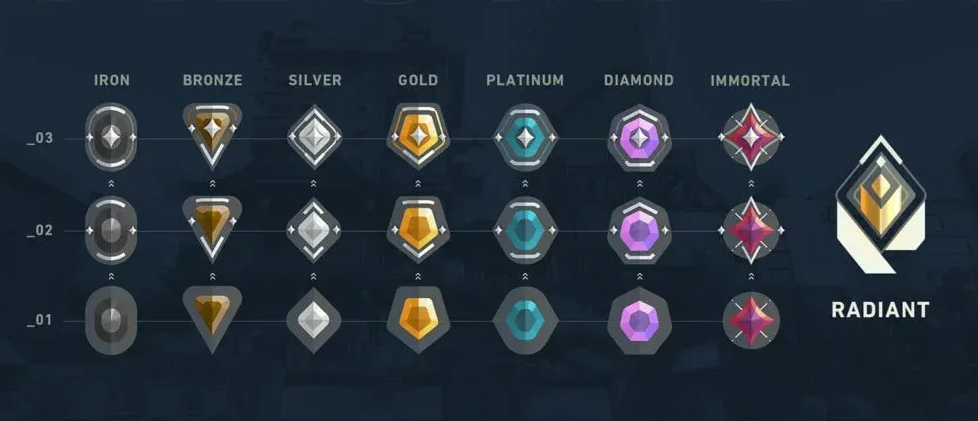
Full list of valorant ranks
Hardware (1, 2 and 3)
- Hardware 1: Those same newbies who are just discovering the world of the game. They are still confused by the controls and trying to understand how the mechanics work. Mistakes? There will be many of them, and this is normal – after all, every mistake is a step forward.
- Hardware 2: Here, players already understand what and where to press, but they are far from confident. Sometimes they make cool moments, but then they make typical mistakes again. The main thing is to learn from their mistakes.
- Hardware 3: The level is growing: the aim becomes more accurate, the movements – more confident. But there are still stupid fails that in decisive seconds can cost the victory.
Bronze (1, 2 and 3)
- Bronze 1: Players are already starting to see the bigger picture – they understand the importance of playing in a team. However, sometimes in typical difficult situations they get lost and act in an extraordinary way. The experience is still raw.
- Bronze 2: The game begins to develop structure: coordination with the team, first working strategies. But there is a lack of stability – there are both brilliant moves and failures.
- Bronze 3: These guys are almost reliable partners. They know how to implement ideas, but for a serious level, subtle tactical techniques are needed.
Silver (1, 2 and 3)
- Silver 1: The maps are studied, the agents are mastered. The players begin to communicate and plan, understanding that victory is based on tactics, and not on incomprehensible shots.
- Silver 2: The aim is more accurate, the positions are chosen wisely. Here you can already feel the understanding of team dynamics and the first competitive nuances.
- Silver 3: These are stable players: less fuss, more tactics. They know how to adapt and change the plan during the match.
Gold (1, 2, and 3)
- Gold 1: Players are confident in holding a gun and know how to help the team. They start to take responsibility for themselves, and not just follow others.
- Gold 2: Decisions become mature, moves are smart. Players use the capabilities of agents to the maximum, creating instant coups.
- Gold 3: These are not just reliable teammates – they are small leaders who can lead, teaching less experienced ones.
Platinum (1, 2, and 3)
- Platinum 1: Confidence + mechanics at a level. Such players often carry matches, taking on special moments.
- Platinum 2: Tactical thinking comes to the fore. Players know how to set traps and play ahead.
- Platinum 3: Almost elite. They read the game like a book, get used to it quickly and rarely make stupid mistakes.
Diamond (1, 2 and 3)
- Diamond 1: High skill, composure in critical moments. These players do what others think is impossible.
- Diamond 2: They motivate the team, take the lead and decide the outcome of the round with one brilliant move.
- Diamond 3: Almost a pro here. Every step they take is calculated, and against them the game becomes a real test.
Immortal (1, 2 and 3)
- Immortal 1: These are already elite. They consistently show a top level, play beautifully and confidently.
- Immortal 2: Their tactics and strategy are on a different level. They dominate, and opponents often simply do not know what to do.
- Immortal 3: The absolute top. These players set the standards that everyone else is equal to.
Radiant
Radiant is the highest ranking system in Valorant, where only a few get into. This rank is created for true professionals in their field in the game, who not only know all the mechanics, but also feel the dynamics of the match on an intuitive level. Radiant players demonstrate phenomenal precision, strategic thinking and the ability to work in a team, like professionals in the eSports scene. Their style of play is a combination of strong analytics and quick decisions, which makes them incredibly dangerous opponents. Every battle with the participation of Radiant is a spectacle where skill and tactics are brought to absolute perfection.
How the Rank System and RR Distribution Work in Valorant
In Valorant, the ranking system evaluates several factors for players striving to improve. The most significant aspect is the match outcome. Winning a match boosts your RR/MMR, while a loss will decrease it. Additionally, developers assess how “decisively” you achieve victories or suffer defeats. For instance, a win with a poor KDA may yield fewer rating points compared to a win with an impressive KDA. Conversely, a loss where you perform notably well might result in a smaller deduction of points. However, it’s important to note that at the highest rank, Radiant, only the final match outcome is considered for point adjustments.
Now, let’s delve into the specifics of point distribution. Here’s how it works in Valorant:
- 10 to 50 RR for a victory: The exact amount depends on your performance and the skill level of your opponents.
- 30 to 10 RR for a defeat: Again, this can vary based on how well you played compared to your team and opponents.
- Up to 20 RR for a tie: Ties are less common but still impact your rating.
Understanding these mechanics can significantly help you strategize and improve your gameplay to climb the ranks effectively.
How players are ranked
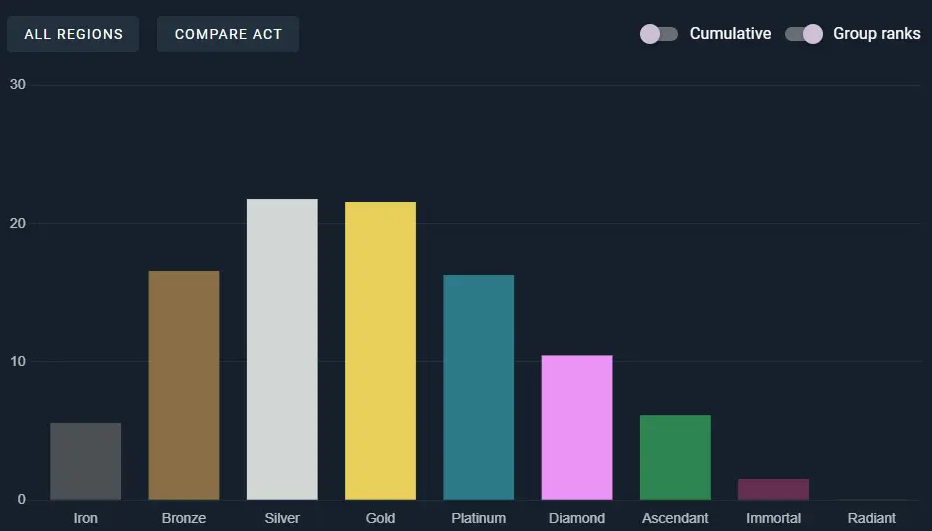
To find out how many players are at a specific rank in Valorant, you can explore various statistical portals. Unfortunately, Riot Games doesn’t currently release detailed rank distribution data, so it’s wise to turn to unofficial sources. One of the most trusted is vstats, which many analysts and content creators rely on. According to the 2025 rank distribution in Valorant, here’s how it breaks down:
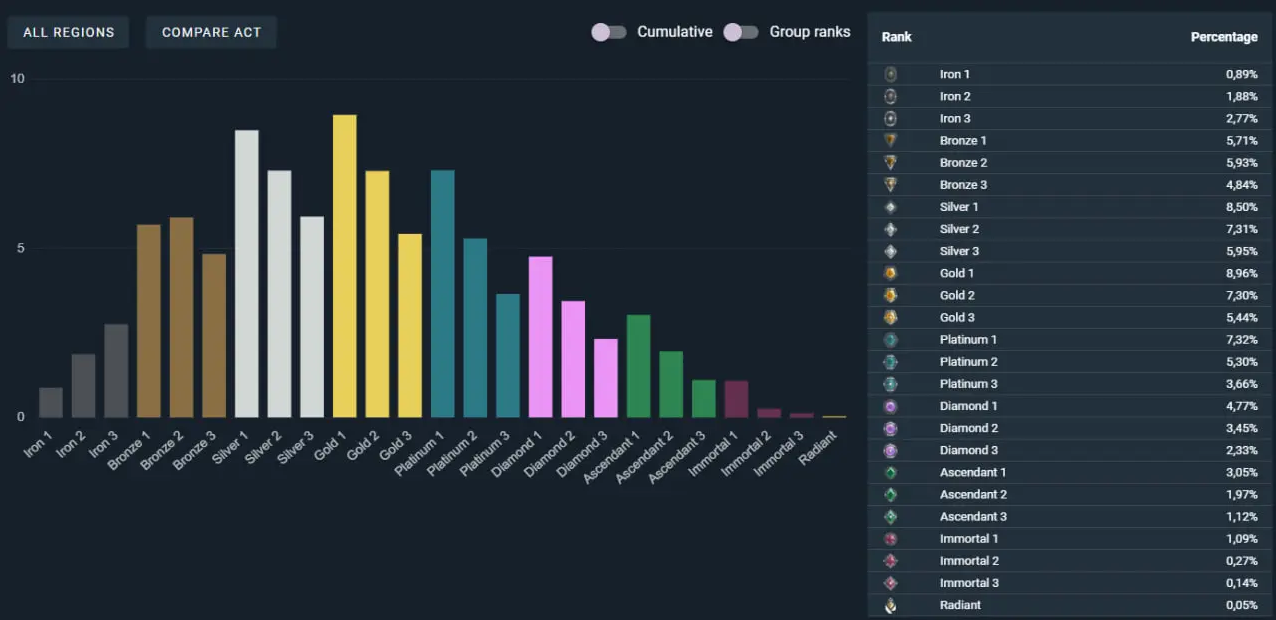
As illustrated in the image, Gold 1 stands out as the most common rank as of May 27, representing 8.92% of all players. Silver 1 closely follows, accounting for 8.54% of the player base. Unsurprisingly, Radiant has the smallest share, with just 0.05%. Here’s a quick summary of the rank distribution:
- Iron: 5.59%
- Bronze: 16.58%
- Silver: 21.77%
- Gold: 21.55%
- Platinum: 16.29%
- Diamond: 10.45%
- Ascendant: 6.14%
- Immortal: 1.53%
- Radiant: 0.05%
While vstats is the go-to source for rank distribution, it’s also worth checking out trackergg. This site provides slightly different figures for rank percentages in Valorant, which are as follows:

As shown in the image, Gold 1 remains the most popular rank here too, with a player share of 9.17%. Silver 1 holds the second position at 8.68%. Interestingly, Radiant in this data accounts for only 0.023% of players. While it’s hard to say which portal offers the most accurate statistics, one thing is clear: the top two ranks in Valorant are consistently Gold 1 and Silver 1.
Console Player Distribution
In addition to the traditional analysis of Valorant player statistics on PC, there is increasing interest in the console audience — PS5 and Xbox owners, who burst onto the market in late 2024. However, detailed information on console players is still limited. Of all the services, only Tracker.gg offers data on how ranks are distributed among players on these platforms.
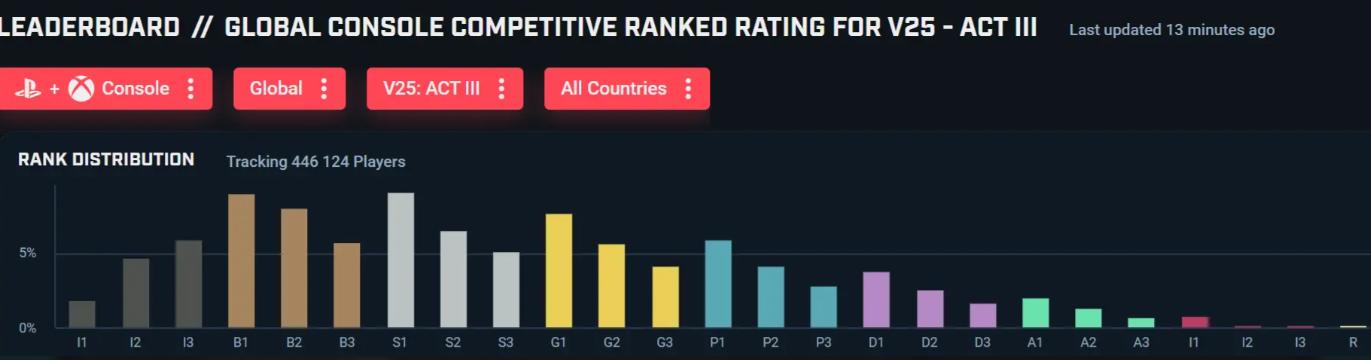
According to the latest study, which covered an impressive sample of 446,000 console players, the Silver 1 rank was the most popular, with 9.15% of users holding it. Slightly behind was Bronze 1 with a result of 9.04%. And now the most impressive thing: only 85 people from the entire base reached the legendary Radiant rank, which is a tiny 0.019%. This striking imbalance highlights how difficult it is to break into the top of Valorant’s ranking system.
Overall online and statistics comparison
To better understand the overall picture, it is worth comparing this data with the global statistics of the game. According to Vstats, about 17 million players log into Valorant every month. This impressive figure confirms the game’s status as one of the leaders in the esports industry.

Now, if you combine the data from Tracker.gg and Vstats, we get an approximate distribution of players by rank:
- Iron – 956,505 players
- Bronze – 2,837,005 players
- Silver – 3,726,777 players
- Gold – 3,687,422 players
- Platinum – 2,787,383 players
- Diamond – 1,789,811 players
- Rising – 1,052,327 players
- Immortal – 261,798 players
Why is this data important?
It should be emphasized: the information is not official from Riot Games, but is an analytical assessment collected from open sources. Yes, there may be some errors in it: hidden accounts, outdated data, and other factors. But even with the inaccuracies, these numbers give a valuable insight into the current balance of power and how diverse the Valorant audience is.
For players, this is not just dry statistics. This data helps understand what the real level of competition is, what the “average” player looks like, and what you should aim for if you want to raise your rank. This is especially relevant for those who are just starting out or dreaming of getting to the top.
Want to test yourself in Valorant’s competitive mode? Here’s what you need to know
If you’ve decided to take things to the next level and try your hand at Valorant’s ranked matches, you’ll want to prepare. The system of requirements for players is there for a reason: it helps maintain balance and makes games fair and fun for everyone involved.
Minimum account level
The first thing you need to do is reach account level 20. This barrier serves as a kind of filter: you’re already familiar with the maps, agents, weapons, and basic tactics. This experience ensures that you’ll act consciously and not at random in ranked battles.
Number of matches played
Previously, you had to play about 10 unranked games before you could be admitted to the rankings, but in the latest updates, the main criterion has become the account level. The idea is the same – to give you the opportunity to “get your hand in” and understand the mechanics before the stakes are raised.
Calibration Battles
After completing the basic requirements, you will have 5 placement matches to determine your starting rank. Don’t worry if the result doesn’t seem perfect: the ranking system is designed to gradually find a comfortable level of opponents for you.
An active and secure account
Last but not least, Riot Games account verification. A linked email and identity verification will ensure security and make communication with the team and support easier.
Valorant Matchmaking Rules and Rank Limits for Full and Mixed Stacks
Currently, in Valorant’s ranked matchmaking, players can form parties or premades consisting of up to five individuals. When a full stack of five is created, it allows players of any rank to join the team. However, if there is even one player with a rank of Immortal 1 or higher in the group, all members will see their rating changes adjusted; they will gain or lose 25% less rating than usual. This ensures a level of balance in competitive play. Additionally, there are various other restrictions that apply to ranked matches. If you’re not playing as a full stack, the difference in ranks among team members must stay within specific boundaries. For instance, in a group that includes a Radiant player, the rank disparity cannot exceed three ranks. This rule is similar for players who are ranked Platinum and above. For a deeper understanding of rank differences in ranked team games, more details are provided below:

Players with ranks of Immortal 1 and above are limited to participating in matchmaking only as solo, duo, or full-stack teams. Furthermore, it is not permitted to play ranked matches with a stack of four players, ensuring that gameplay remains fair and balanced.
Why It’s Important to Avoid Lag in Valorant and How It Will Help You Rank Up
In action games like Valorant, connection stability is crucial. Any delay can turn a precise shot into a miss, and a well-thought-out strategy into chaos. Lags spoil not only the gameplay, but also the mood, preventing you from climbing the rating ladder.
To minimize lag, gamers increasingly choose ExitLag, a service that lays the fastest and most reliable routes for your game traffic. This reduces packet loss and reduces ping, making the game as smooth and predictable as possible.
With ExitLag, you get that very competitive advantage: your reaction becomes faster, your control more precise, and your victories are closer. When every action decides the outcome of the match, a stable connection is your main ally on the way to the top of the rating.