

The Lord of the Rings is not just a cult saga, but a fundamental media franchise that has shaped an entire era in popular culture. When no one was talking about “Star Wars” yet, the works of John Ronald R. R. Tolkien were already heard all over the world, uniting millions of readers. For many of them, their love for Middle—earth has become part of their personal history, the one that remains for life. It was this world that largely set the canons of fantasy, influenced the development of geek culture, and left a deep mark on board games, role-playing systems, and the approach to building fictional universes.
However, with the video game adaptations of the legendary universe, everything turned out to be much less straightforward. Despite the rich lore, expressive mythology and strong characters, there were relatively few games in Middle-earth. And those that appeared rarely boasted stable quality. The real hits are in the past, whereas modern releases are more likely to cause disappointment than delight. An illustrative example is The Lord of the Rings: Gollum, whose scores and technical condition have become a symbol of the franchise’s crisis in the game format.
Against this alarming background, the announcement of The Lord of the Rings: Return to Moria was perceived with a noticeable degree of skepticism. A little-known development studio, an almost complete lack of marketing, and a minimum of gameplay details didn’t inspire confidence. A logical question arose: would the project become another faceless survival that would get lost in the stream of releases and be forgotten after a couple of weeks? The doubts seemed justified, especially considering the difficult reputation of the latest Lord of the Rings games.
Table of Contents
The Lord of the Rings: Return to Moria Free Steam Account
Of course, I have touched the works of John Ronald Reuel Tolkien, including the ponderous, almost academic “Silmarillion”. But for all the depth of the Middle-earth world, I’ve never considered myself a fan who’s ready to take ent apart line by line. My interest in The Lord of the Rings: Return to Moria arose for another reason: I have long had a weakness for games based on dungeon exploration, resource extraction and meditative “digging”. Minecraft, Terraria, Dwarf Fortress, Starbound — all these projects teach you in their own way to enjoy a slow dive deep into the world, where each new layer may hide a find or danger. And Moria is one of the most recognizable underground realms in all of fantasy, so it was simply impossible to get past such a concept.
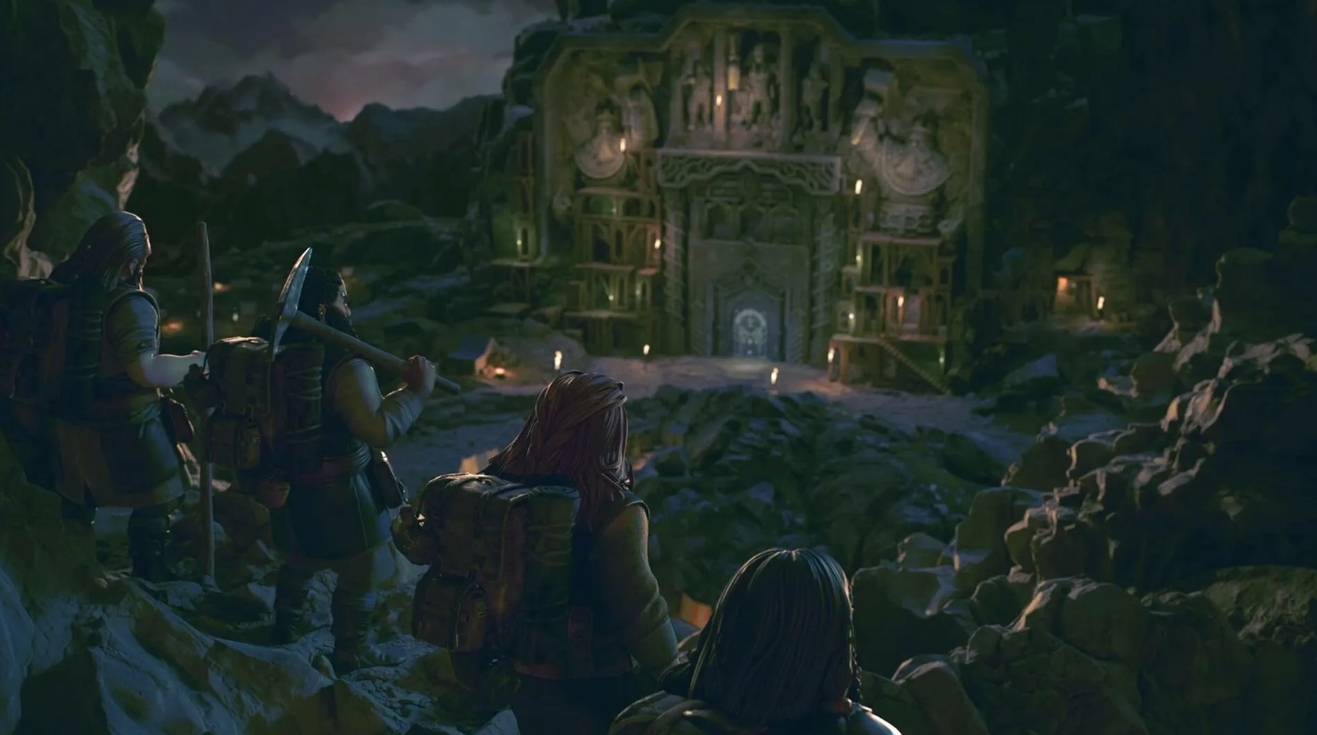
If the atmosphere and conformity to the canon are important to you, there is good news here. The game confidently conveys the character of Moria and the image of the dwarves, albeit not so much through the book source as through the visual language of the Peter Jackson film trilogy. The local dwarves are the same noisy, bearded and stubborn hard workers that the audience remembered from the films: they are equally eager to meet threats and everyday trivia, maintaining amazing cheerfulness even in the darkest conditions. Moreover, Gimli himself appears in the game, and his voice once again belongs to John Rhys-Davies, which noticeably enhances the effect of recognition and immersion.
Plot of The Lord of the Rings: Return to Moria
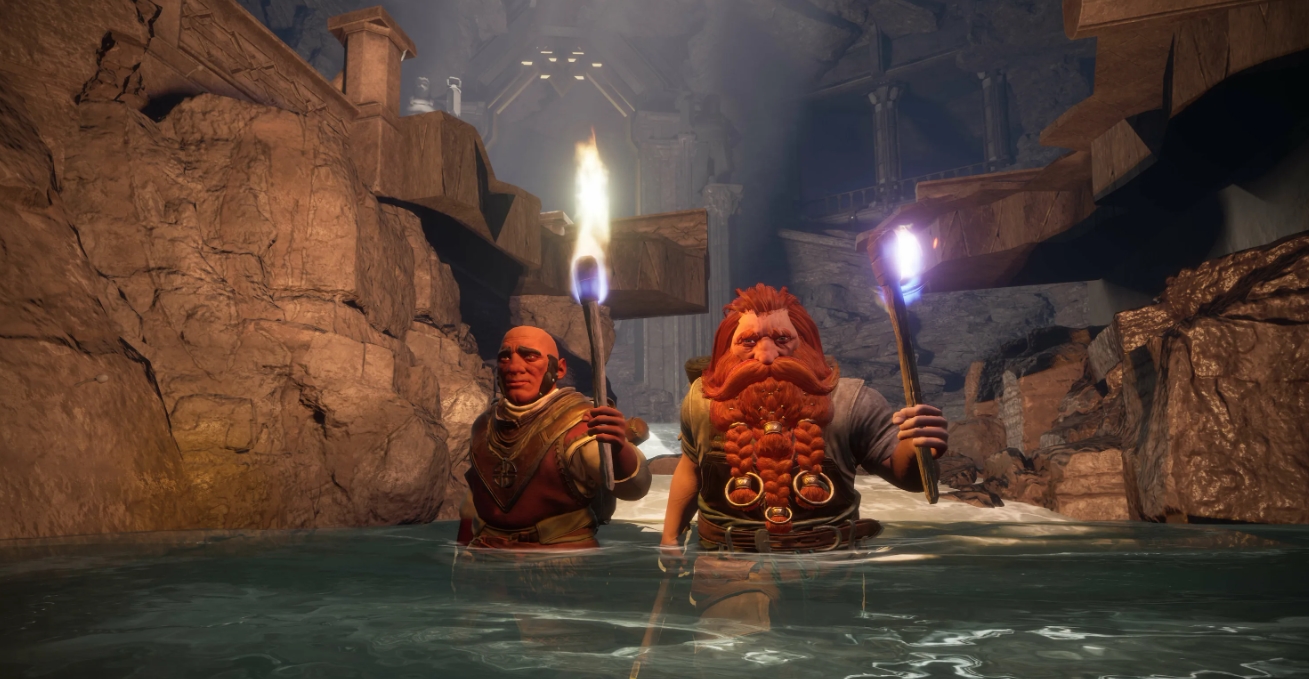
The plot unfolds after the events of The Lord of the Rings, in an era when Middle-earth is trying to heal old wounds. Gimli gathers an expedition to bring back to life Khazad-Dum— the ancient name of Moria, the forgotten and abandoned underground kingdom of the dwarves. Your hero is one of the volunteers who responded to this call. The expedition reaches its goal, but everything does not go according to plan: the gates to the city are tightly sealed, and an attempt to solve the problem radically ends in disaster. The collapse cuts off the way back, and you are left deep in the dungeons, where survival, exploration and finding a way out become the only possible scenario.
All your favorite genres in one free steam account!
At the same time, Return to Moria is pleasantly surprising in that it is not limited to a formal introduction, as is often the case with sandbox games. The developers carefully weave the narrative into the survival process. Along the way, you can find records that reveal the way of life of the Morian dwarves, their traditions and difficult relations with the elves. These elements are served unobtrusively, without breaking the pace of gameplay, but noticeably enhance the feeling of a living world. In parallel, the main storyline develops — the path to the surface and the confrontation with the mysterious “shadow”, a strange and dangerous phenomenon lurking in the lower levels of the mines.
As a result, the game confidently holds the balance between authenticity and freedom. Fans of lore will find here a respectful attitude to the original source and careful work with mythology, while those who come for adventure and survival mechanics can safely ignore most of the text — it will not affect the pleasure of exploration, crafting and atmosphere in any way.
Return to Moria Gameplay: Survival, Crafting, and Underworld Exploration
If we put aside ent and mythology for a while, The Lord of the Rings: Return to Moria is really perceived at first as quite a classic survival project. Logically, it is closest to Valheim: resource extraction, equipment crafting, environment exploration, and gradual character enhancement are important here. At the same time, the game does not impose co—op at all – the single-player passage feels comfortable, even if it requires more patience due to the slower grind. The worlds system allows you to transfer your character between sessions without restrictions, regardless of whether you play locally or connect to someone else’s host, and the inventory with rare resources always stays with you, opening up space for a completely legal simplification of the progression.
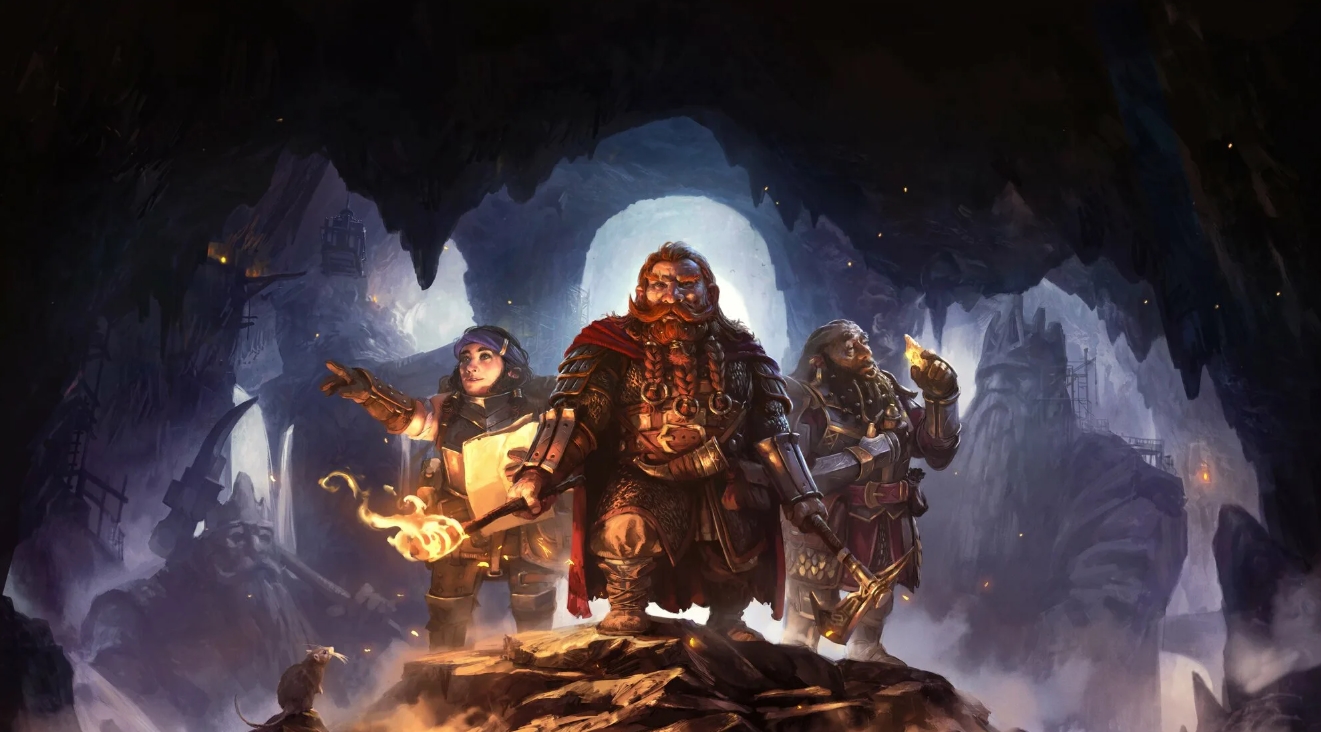
At a basic level, Return to Moria relies on familiar genre mechanics, and it is these that form the first impression. These include:
-
collecting resources and constantly grinding materials for survival;
-
crafting weapons, tools, and base items;
-
free exploration of the world without rigid scenario frameworks;
-
the opportunity to play both alone and in co-op;
-
transfer your character and progress between different worlds.
However, it would be unfair to reduce the game to the formula of “another survivor”. In addition to the already mentioned plot framework, there is another important element that sets the project apart from competitors — the structure of the map. Instead of the usual biomes, we are waiting for a whole underground kingdom, once majestic, but now abandoned and plunged into decay. From a visual point of view, this works perfectly: ruined halls, old mines, ork camps, lairs of unknown creatures, ore veins and abandoned dwarf houses form a convincing feeling of a living but lost world. The atmosphere of Middle—earth is constantly felt, although navigation sometimes fails – even with a detailed map with markers, it is surprisingly easy to get lost here.
Procedural generation deserves special mention. It usually conflicts with expressive artistic stylistics, but in Return to Moria this balance is unexpectedly maintained. If you don’t look at the mini-map, which divides the space into conventional squares in a fairly straightforward way, after a couple of levels it’s hard to understand that the locations weren’t created manually. The algorithms work carefully and almost imperceptibly, and rare roughness — like a staircase going straight into a wall — rather emphasize the liveliness of the world than destroy immersion.
Resource mining, combat, and base building in Return to Moria
The process of resource extraction, alas, turned out to be noticeably simpler and more straightforward than I expected. It seemed that the game would give you the freedom of real underground digging — almost like in Minecraft, where you can tunnel in any direction, subjugating the landscape to your imagination. However, in practice, everything is much stricter. Each level is a set of conditional “rooms” and passages filled with fragments of ruins, remnants of buildings and solid massifs of stone. It is impossible to drill the rock freely: it is allowed to interact only with the bridges between the zones and individual ore veins. The vertical design partially saves the situation — the large-scale shafts extending hundreds of meters down are really impressive. Having reached the Mines of Moria, it is difficult not to feel the extent of this underground space, especially considering that this is far from the deepest point of the ancient dwarf kingdom.
However, the hero here is conceived more as a warrior and explorer than as a diligent miner. The bestiary of the game is impressive and diverse: from the eternal opponents of dwarves like orcs and goblins to the inhabitants of the underground fauna — spiders, bats and aggressive rats. Unfortunately, it is the combat system that looks like the weakest element of the gameplay. Most fights, with the exception of boss fights, come down to the same type of scenario: convergence, a series of strikes, rare blocks. Ranged combat with a bow is formally present, but due to too low damage, it turns into a protracted and low-impact fuss. Visually, all this involuntarily refers to the MMORPG of the early noughties — blows through models, pop-up damage figures, disappearing enemy bodies and sudden spawn of opponents right in front of the player’s eyes. The atmosphere of survival in such moments is noticeably sagging.
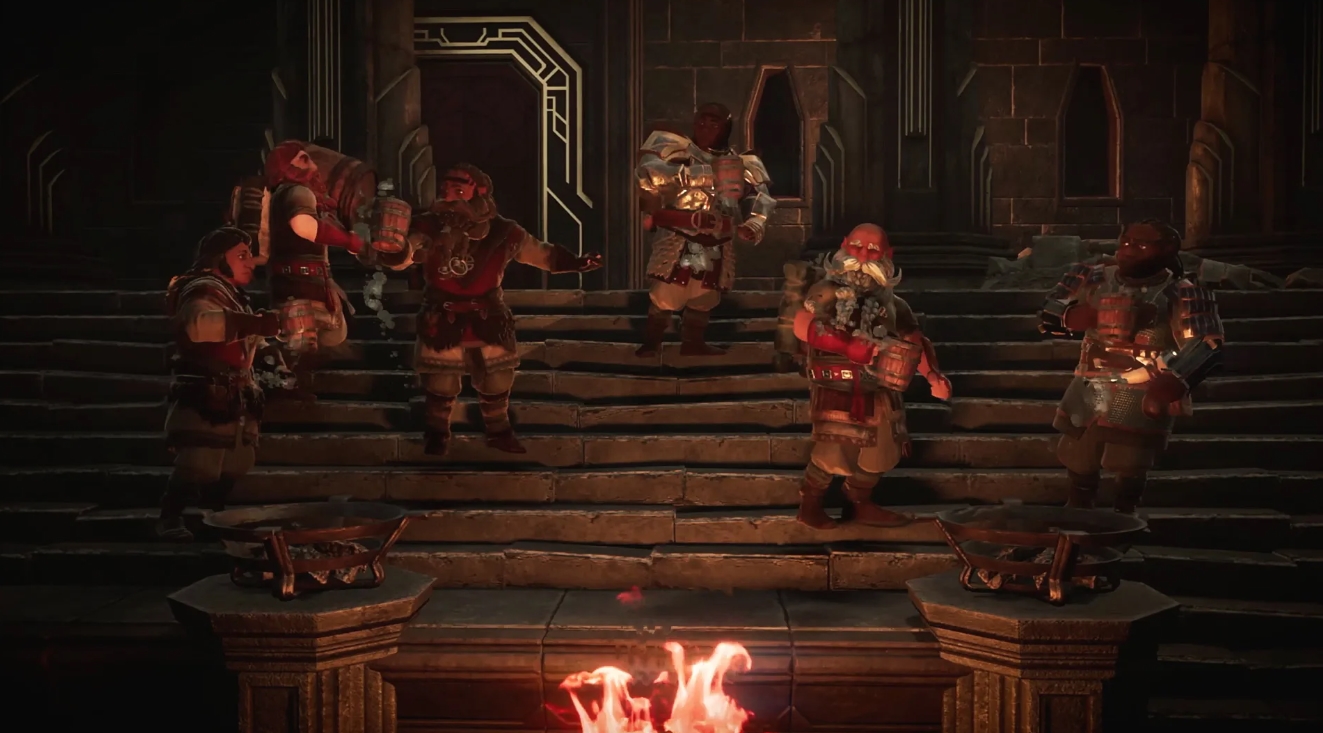
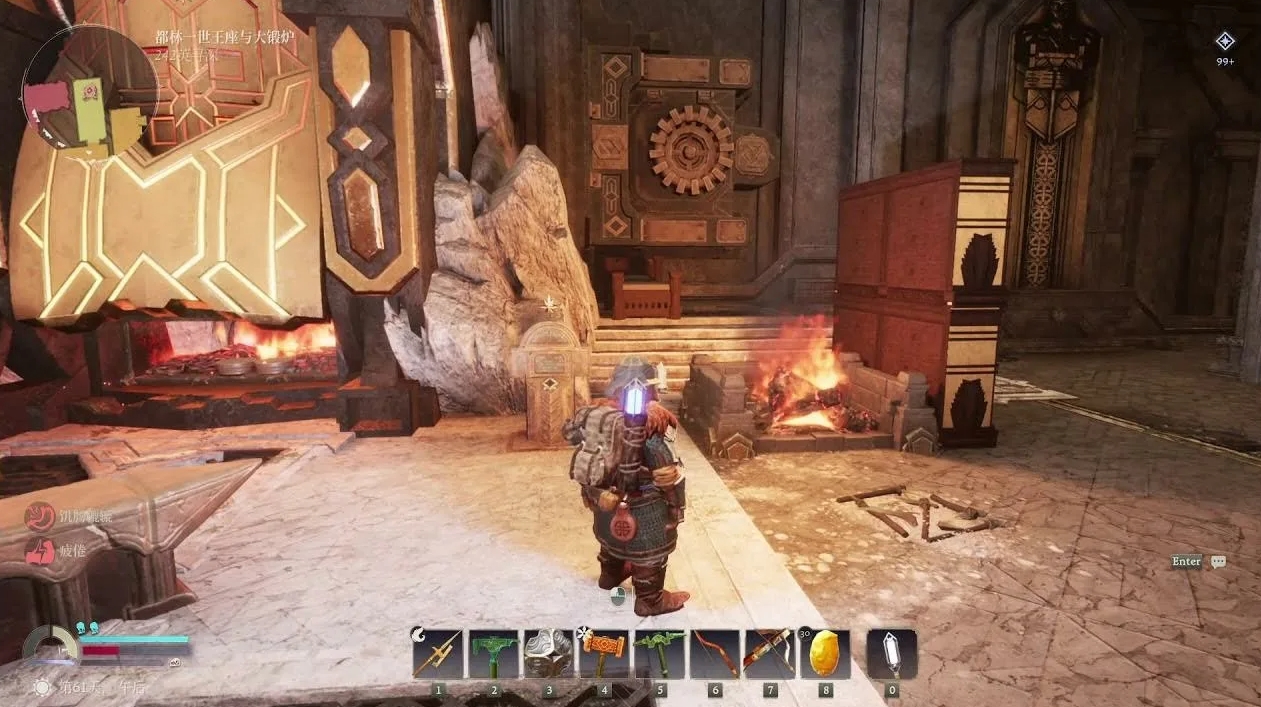
But the construction of the base has been implemented much more confidently. Despite the underground surroundings, there is no shortage of space here at all: The high vaults and gigantic halls of the Morian mines create a feeling of almost limitless volume. If desired, you can set up several outposts at once and move freely between them using a special obelisk — however, an extremely rare resource will be required for its construction. There are no restrictions on the number of bases, which encourages experimentation with planning and logistics.
It is also important that the base performs not only the function of a respawn point. The stone hearth, which serves as the heart of each settlement, provides access to the construction of key facilities — workshops, forges, kitchen tables and other elements of survival. Platforms and ladders, on the contrary, can be placed anywhere, which is especially helpful in vertical locations and simplifies navigation. The range of buildings is pleasantly surprising: in addition to utilitarian structures, there are many decorative elements that make it possible to give the home personality. There are also very exotic solutions — for example, a pile of gold, the contemplation of which temporarily enhances the characteristics of the dwarf, adding a light role-playing touch to the game.
Survival in Return to Moria: Buffs, Debuffs, Enemies, and Environmental Conditions
During the outings, the game regularly throws up external conditions that directly affect the behavior and effectiveness of the character. A set of active effects — buffs and debuffs — can noticeably change the usual tactics, forcing you to adapt literally on the go. The sources of negative states are quite mundane and logical for the survival genre: the darkness of dungeons, piercing cold, hunger, or a growing sense of fear. At the same time, the positive effects are not limited to banal satiety — even a song performed during resource extraction can cheer up a dwarf and give him a temporary advantage. Such small things work for the atmosphere and enhance the feeling of a living world reacting to the player’s actions.
However, it is not customary to relax here. Any noise — be it the clink of weapons, the blows of a pickaxe, or the fuss during construction — inevitably attracts the attention of the inhabitants of the depths. It is dangerous to linger in one place: the dungeon seems to listen, and then responds with a visit from uninvited guests. Raids also occur on bases, although it is usually not difficult to fend them off. The problem is that the combat system remains too straightforward and quickly loses its edge. In part, the situation is saved by a diverse bestiary: each new biome throws up new creatures, and the purely exploratory interest in who is hiding around the next bend does not disappear anywhere.
From a technical point of view, The Lord of the Rings: Return to Moria does not try to surprise. Visually, the project can hardly be called modern, but the constant darkness of the dungeons and the general style of Moria smooth out this impression. More importantly, the game is stable: there are almost no serious bugs, crashes or critical errors during the passage. The only weak point is the network connection, which sometimes behaves erratically and can suddenly throw a partner out of the world. However, it cannot be ruled out that in a particular case the provider was to blame, and not the technical part of the game itself.
Is Return to Moria Worth Playing? Final Impressions and Conclusions
Despite some disappointments — limited freedom in excavation and a frankly simplified combat system — The Lord of the Rings: Return to Moria eventually leaves a much more complete and positive impression than one might expect from the first hours. These disadvantages are offset by other, much more significant advantages: the expressive visual style of underground locations, the abundance of research areas, a well-thought-out construction system and the presence of a not outstanding, but full-fledged plot. The campaign allows you to play the game alone, almost like a classic adventure with a linear goal, which is rare for the survival genre.

At the same time, the sandbox is revealed most strongly in the cooperative. Joint forays, base development, and exploration of the depths of Moria transform the routine of resource extraction into a meaningful team process. In this format, the weaknesses of the action game are felt less acutely, and the atmosphere of Middle-earth begins to work at full capacity. Therefore, even for those who are far from Tolkien’s work and do not follow lore, the project is worth at least a try — due to the gameplay variety and sense of scale, it is able to captivate on its own.
Pros:
-
the atmosphere of Middle-earth and recognizable fantasy surroundings;
-
detailed underground locations and vertical design;
-
a sandbox that does not conflict with the plot and logic of the world;
-
a well-developed system of base construction and development.
Cons:
-
visually outdated graphics;
-
confusing navigation in multi-level zones;
-
a primitive and monotonous combat system.
The Lord of the Rings: Return to Moria System Requirements
The Lord of the Rings: Return to Moria – PC
How to play The Lord of the Rings: Return to Moria for free on Steam via VpeSports
There’s a special feeling when you take the first step into the dark and realize there’s no turning back. In The Lord of the Rings: Return to Moria, this feeling accompanies you all the time. Moria here is not just a location and not a beautiful background, but a lively, dangerous place with its own memory and character. The stone vaults retain traces of their former greatness, the silence presses down harder than any enemy, and the rare sound of a cave-in or a growl from the depths makes you involuntarily freeze. This game is not about haste or ostentatious heroism — it’s about survival, caution, and the quiet joy of finding a safe room after a long time of darkness and being able to catch your breath.
So that you can get under the mountain as quickly as possible and start your journey, we have removed everything unnecessary. No confusing actions or unnecessary steps. You register on the website, log in to your account, go back to the beginning of the article and click GET AN ACCOUNT. Then everything happens logically and clearly — just a couple of minutes, and you are already preparing a pickaxe, lighting a torch and descending into the depths of Moria.
If you want to feel like you’re not alone in these dungeons, join our Telegram channel. The same players gather there, who share their experiences, discuss updates, rejoice at successful finds and swear at especially insidious moments of the game. We publish fresh accounts, news and patches, and we are always ready to help if something raises questions. Take a look at the “How to Play for Free — Complete Guide” section or write in the chat — we are in touch and will help you to make your return to Moria not only difficult, but also truly exciting.