

Usually, the relationship between video games and books resembles a light flirtation — unobtrusive references, recognizable names, hidden quotes, designed for an attentive player. Such Easter eggs are not conspicuous, but they add depth and cultural context to the world. Take Devil May Cry, for example: Dante and Virgil are not just sonorous names, but a direct bridge to the “Divine Comedy”, which sets the philosophical subtext of the confrontation between the characters. And in the foggy and disturbing Silent Hill, Stephen King’s influence is felt at the emotional level — through the oppressive atmosphere, psychological breakdown, distorted reality and the feeling that the city itself is watching the player.
But sometimes the gaming industry goes beyond mere hints and decides to take a bolder step — a full-fledged dialogue with literature. This is how adaptations appear, where the book becomes not the background, but the foundation. Quests based on the works of Agatha Christie and Arthur Conan Doyle have long proved that the classic detective story fits perfectly into the game format: investigations, clues, deduction and non-linear passage. Sherlock Holmes, who lives on Baker Street, has become one of the most “playable” literary characters, seamlessly fitting into the mechanics of the interactive plot. The story of the Witcher developed according to a similar principle — the book Geralt of Rivia gained additional depth in the games due to the choices, dialogues and consequences that form a unique gaming experience. And the dilogy of American McGee’s Alice completely reinterpreted a familiar fairy tale, turning it into a dark psychological journey with an expressive visual style.
It was this conscious path that The Invincible developers turned to. Based on the novel of the same name, they did not literally transfer the plot to the screen, but used the literary source as a starting point for their own interpretation. The author of Invincible, Stanislav Lem, is a truly ambitious figure. The Polish writer and futurist was able to look far ahead, reflecting on technologies that seemed fantastic at the time of writing. Artificial intelligence, drones, global networks, personal devices — Lem analyzed all this long before it became a part of everyday life. For Poland, he is not just a classic, but an intellectual landmark, and therefore addressing his legacy does not look like a fashion statement, but a respectful gesture.
Starward Industries studio is responsible for the development of the game — a relatively small team, but with a solid track record. It consists of people who worked on The Witcher 3, Dying Light and Layers of Fear 2, which means they are well acquainted with building atmosphere, narrative and emotional immersion. At first glance, everything is almost perfect: a strong sci-fi foundation, philosophical overtones, experienced developers, and a desire to tell a story rather than just “make a game.” At such moments, you can’t help but believe that we may have a rare example of a truly thoughtful adaptation. Although, as practice shows, even the most correct ingredients do not always guarantee the perfect result — the intrigue persists until the very end.
Table of Contents
The Invincible Free Steam Account
The story of The Invincible begins without a swing and immediately immerses the player in an atmosphere of suspense. Biological scientist Jasna wakes up on the lifeless planet Regis III — there is only a harsh landscape, traces of an alien presence and a complete lack of answers. Memory fails, the events of the past are restored in fragments, but quite quickly a clear goal appears — to find the missing crew of the scientific ship “Dragonfly”. In this single study, however, not one is clear: astrogator Novik, the captain who remained in orbit, is constantly in touch with her by radio. He guides, prompts and supports the heroine, trying to maintain professional restraint, although his concern for the fate of his colleague is felt in almost every dialogue. Such interaction enhances the effect of presence and emphasizes the emotional depth of the narrative.
It is Clear’s dialogues and internal monologues that become one of the key pillars of the plot. The characters not only talk about specific events on Regis III, but also reflect on space, science, and the role of man in the universe. These conversations are in the spirit of classic science fiction from the 60s – with its sincere optimism, faith in progress, and at the same time a hidden fear of how humanity manages its discoveries. This presentation makes the narrative thoughtful and meditative, creating a special atmosphere where philosophy is more important than action, and emotions are born from words and silence.
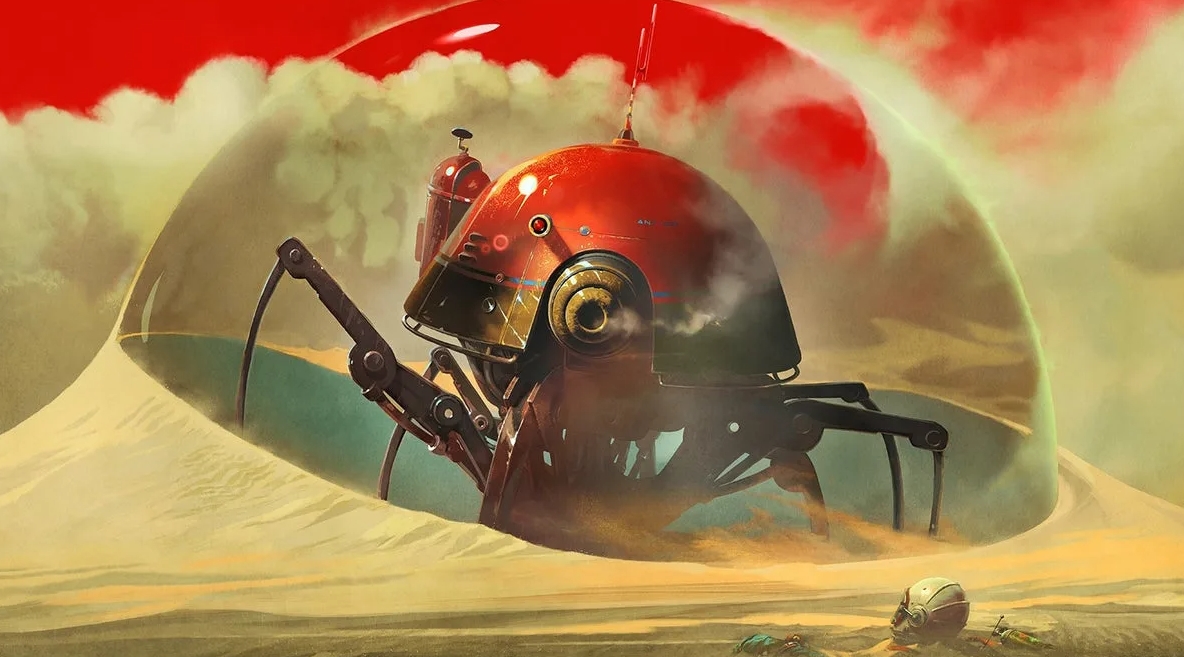
Although Stanislav Lem’s novel “Invincible” is also dedicated to the expedition to Regis III, Starward Industries deliberately chose the path of interpretation rather than direct adaptation. There are other characters in the game — the developers did not transfer the main character of the book into an interactive form, so as not to destroy the literary image created by Lem. At the same time, the connection between the work and the game is constantly felt: familiar motives, ideas and philosophical questions are easily read by those who are familiar with the original source. That is why getting to know the novel after completing it looks like the best option — the game has a much stronger effect on those who do not know exactly where the plot can turn.
Despite the deliberately slow pace, The Invincible’s story is eventful. For the convenience of the player, the key points are recorded in a separate menu in the form of a gradually assembled comic book — a visual and stylish solution that helps not to lose the thread of the narrative. In general, the presentation of the plot here is as straightforward as possible: Yasna speaks her thoughts, explains what is happening and leaves almost no room for guesswork. Even the meaning of the name is revealed quite straightforwardly, without trying to hide the idea behind symbols or semitones.
Towards the end, the mood of the game changes noticeably — the study turns into a source of growing anxiety. Formally, The Invincible cannot be classified as a horror genre, but individual episodes do cause anxiety and discomfort. Additional interest is created by the variability of the passage and the presence of 11 endings at once, depending on the player’s decisions. However, due to the meditative rhythm and measured gameplay, not everyone will have the desire to replay the game over and over again. This is more of an experience for a thoughtful, calm dive than a project designed for multiple runs.
Tap into an epic catalog with a free steam account today.
The Invincible Gameplay: Planetary Exploration, Mechanics, and Endings
Philosophy and beautiful packaging aside, The Invincible primarily feels like a leisurely walking simulator — and one where the word “leisurely” sometimes borders on the tedious. In the beginning, it works for the game: Yasna’s slow gait highlights the loneliness and vulnerability of a person on an alien planet and gives them time to experience the scale of alien landscapes. The first hours are really fascinating — the plot is just beginning to unfold, and Regis III seems mysterious and alive. But closer to the middle of the passage, the pace begins to weigh down: the heroine stops more and more often to catch her breath, and the long transitions between points of interest turn into a test of patience. The realism of the spacesuit and the conditions of the planet is understandable, but the feeling of tightness becomes obsessive over time.
The developers seem to have realized this problem and tried to smooth it out with a fairly straightforward solution — by adding an all-terrain vehicle to the game. However, it does not appear immediately, and up to this point a significant part of the route has to be overcome on foot. With its appearance, the walking simulator suddenly turns into a riding simulator, but globally, the rhythm of passing does not change so much. In addition, the path remains linear, and the terrain of Regis III is often disorienting: visually similar ledges can behave in different ways – one turns out to be passable, the other suddenly becomes insurmountable. In search of the right hotspot, Yasna regularly scratches her spacesuit on rocks, and sometimes curiosity leads to places from where she can’t get out without restarting. Starward Industries promises to bring the technical part to mind for release, and I want to believe that problems with collisions and getting stuck in geometry will not become constant companions of the game.
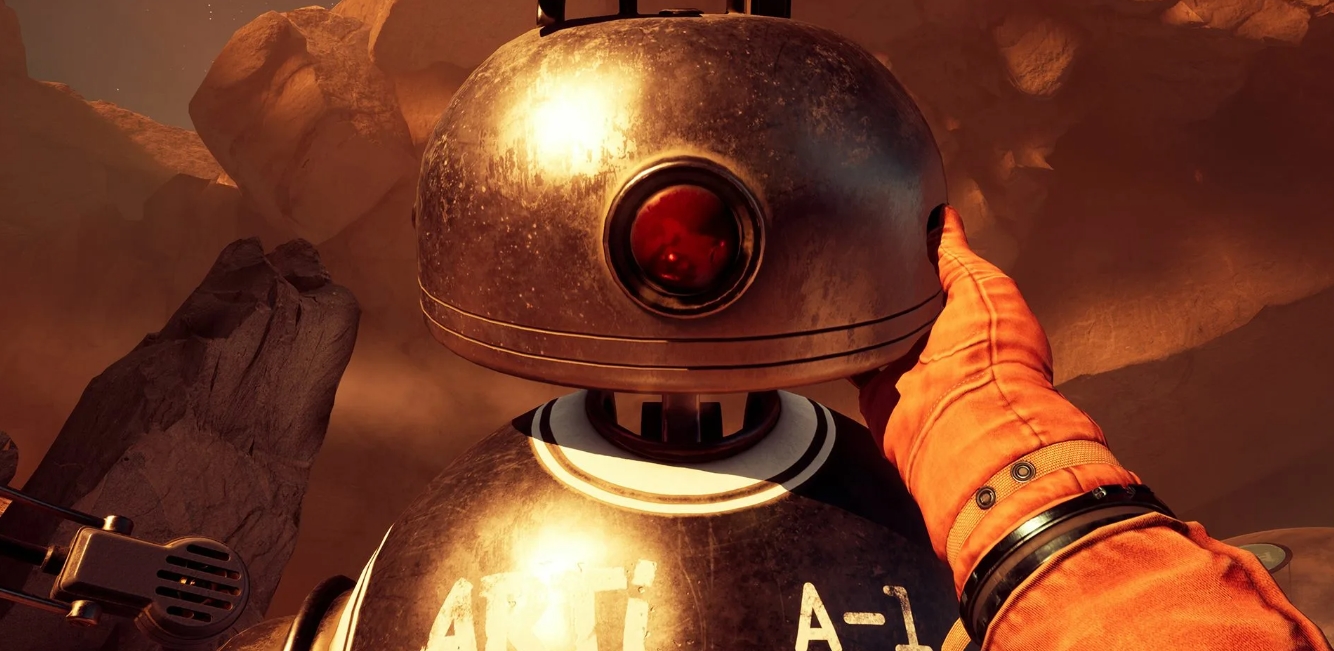
In addition to endless walks, The Invincible offers simple interactive challenges built into the exploration process. You should not expect difficult puzzles from them — rather, they are calm actions that maintain the rhythm of the narrative and enhance immersion. Most often, the player will have to:
-
set the desired radio frequency for communication or signal search;
-
choose a suitable place to install a scientific probe;
-
activate or calibrate the research equipment;
-
scan the area using the tracker to get your bearings on the map.
Atompunk gadgets that perfectly fit into the retrofuturistic aesthetics of the world help in this. The tracker allows you to quickly assess your surroundings, and the log with the map accurately records the heroine’s route and current position, eliminating unnecessary wandering and accidental disorientation.
For all its linearity, the game still leaves the player with space for personal involvement. The variability here is not based on freedom of movement, but on choice of solutions and dialogues. By choosing our lines, we form the character of Yasna: she can argue with astrogator Novik, agree with his logic, or take risks, deliberately endangering her own safety. And sometimes, on the contrary, retreat and act cautiously. These seemingly small decisions gradually add up to different plot endings. Thanks to this, The Invincible ceases to be just a meditative stroll on an alien planet and turns into a personal story where the player feels responsible for what is happening, rather than watching it from the sidelines.
Is The Invincible Worth Playing? Pros, Cons, and Overall Impressions
After completing The Invincible, a strange but curious aftertaste remains. It feels like you haven’t completed the game so much as you’ve read—or even listened to—a good science fiction book with expressive illustrations and a carefully constructed atmosphere. And at some point, the question involuntarily arises: is gameplay really necessary here? Technically, it exists — with gadgets, exploring locations, and riding an all—terrain vehicle – but it seems that the interactive part serves more as a link between fragments of history than as an independent value. At the same time, the influence of Firewatch is easily read: radio communication as the main way of communication between the characters is stable and emotional. The dialogues are clear and her commander sounds lively, and the characters themselves quickly arouse sympathy and sincere empathy.

Even despite the moments when the game seems drawn out and tedious due to the slow pace of the passage, the plot holds your attention until the very end. And this is not only about the foundation laid by Stanislav Lem, but also about how Starward Industries has managed to carefully and respectfully rethink the literary source. The developers did not just transfer the novel’s ideas into a game format, but tried to adapt them to an interactive narrative, preserving philosophical reflections on science, responsibility and the place of man in the universe. As a result, the story works as an independent work, even for those who are not familiar with the book.
Pros:
-
expressive retrofuturistic setting and visual style;
-
charismatic main character and well-written dialogues;
-
a variety of solutions and multiple endings;
-
a fascinating plot that carefully works with a literary basis.
Cons:
-
moving too slowly across vast locations;
-
riding an all-terrain vehicle with an uncomfortable viewing angle quickly tires you out;
-
simple tasks and puzzles that lack depth and ingenuity.
To summarize, The Invincible is perceived more as a narrative experience than as a full-fledged game in the usual sense. She takes on the atmosphere, visual style, and themes, but she doesn’t always manage to keep the interest at the expense of game mechanics. Below is a brief but illustrative balance of the strengths and weaknesses of the project.
The Invincible System Requirements
How to play The Invincible for free on Steam via VpeSports
There are games that take their time. They don’t shout, they don’t flash, and they don’t demand instant solutions. The Invincible is exactly such a story. You step onto the surface of Regis III and almost immediately find yourself with a strange feeling: everything is empty, but there is no loneliness here. Step by step, you walk across a harsh planet, listen to a voice on a walkie-talkie, peer at the horizon and begin to realize that this journey is not so much about exploration as about an inner dialogue with yourself. The game gently asks uncomfortable questions and does not rush to give ready-made answers.
We have made access to this experience as calm and understandable as possible — without nerves and unnecessary fuss. It all comes down to a few simple actions: register on the website, log in to your account, and click the GET AN ACCOUNT button at the top of the page. Then you just follow the prompts and very soon you will find yourself on an alien planet, and not in endless instructions.

Over time, there is a desire to share thoughts, discuss the plot, or just find out what’s new around the game. To do this, we have a Telegram channel – a live place where people with a similar mood gather. They talk about updates, share impressions, and sometimes argue about the meanings that The Invincible leaves between the lines. And if something doesn’t work or you have questions, you can always look at the detailed guide or write to the chat – they will answer you not with a template, but will really help you return to the atmosphere of exploration and silence.