Dota 2, much like any competitive multiplayer game, has developed its own unique way of measuring player skill through a ranking system. In Dota, your level of expertise is assessed in relation to other players using a distinctive Glicko method. At its core, the concept is straightforward: the higher your Matchmaking Rating (MMR) points, the greater your skill level compared to your peers. Within Valve’s popular MOBA, there are eight distinct ranks, each represented by a unique medal design. Additionally, the first seven ranks can feature between one to five stars, which highlight your journey and progress up the competitive ladder.
This innovative ranking system, coupled with MMR, ensures that players are matched against opponents with similar skill levels, making the gameplay experience more balanced and enjoyable. No one wants to face opponents who are too far above or below their skill level! For an in-depth overview of all the ranks in Dota 2 and a closer look at the significance of MMR, make sure to check out the detailed article on VPEsport.
Table of Contents
Ranks in Dota 2: How does the rating work and why is it needed?
Dota 2 is not just a game, but a whole universe in which millions of gamers around the world fight every day. Some are just starting out, while others are already playing at a pro level. To make matches fair and interesting, the game has a ranking system – it selects players of approximately the same skill level.
What is a rank and why is it needed?
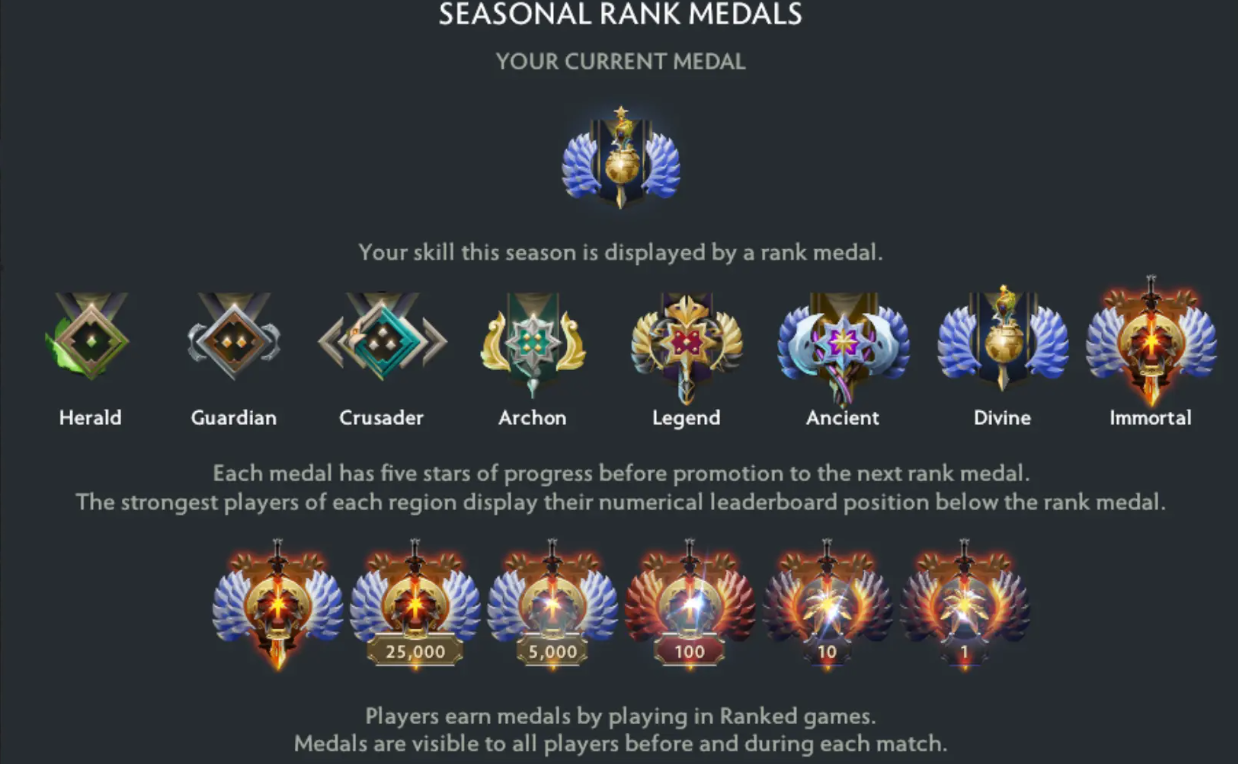
Rank is an indicator of your skill, which directly depends on how you play. The higher your win rate and the better your results, the cooler your rank will be. There are several main levels in Dota 2 – from Herald to Immortal.
Here’s what the rank hierarchy looks like:
-
Herald – green medal with one star
-
Guardian – brown medal with two stars
-
Crusader – turquoise medal with three stars
-
Archon – green and gold medal with a flower element and four stars
-
Legend – red and gold medal with five stars
-
Ancient – silver and purple medal with a flower
-
Divine – a striking emblem in the style of the Divine Rapier
-
Immortal – prestigious red and gold medal with an image of a sword
Stars and progression within a rank
Each rank is divided into five levels, which are represented by stars. These are like “micro-steps” to help you understand how close you are to the next rank.
Example: you leveled up Legend — you get one star. You raised your rating by ~150 MMR — another one is added. This continues up to five. After that, the next rating increase takes you to the Ancient rank with one star.
What is MMR in Dota 2
MMR (Matchmaking Rating) is your personal skill indicator that shows how well you play in ranked matches. The higher the number, the stronger the opponents and, accordingly, the more interesting the games. The rating is constantly changing: win a match – get about +25 points, lose – minus 25. It’s simple, but sometimes your nerves get the better of you.
The minimum MMR value is 1, but there is no ceiling! Theoretically, you can increase your rating by at least 15 thousand if you have enough time, patience and nerves of steel. And yes, the top players really do achieve cosmic numbers for which they are known throughout the community.
To ensure fair matchmaking, Dota 2 came up with a rank system – they are called medals. Each rank is divided into several levels, and in fact, this is a visual mark of your progress. Bronze, Silver, Legend, Divine – sounds cool, right? This system helps you find opponents of approximately the same level so that the games are interesting and fair. So MMR is not just a number, but your eSports business card. Want to raise it? You’ll have to learn, work on your mistakes, and, most importantly, not tilt after a couple of losses.
How MMR Works in Dota 2 and What It Means for Ranks
MMR (Matchmaking Rating) is a hidden numerical value assigned to each player and reflecting their current skill level in the game. Simply put, this is the indicator that determines who you will play with and against. The higher the MMR, the stronger your opponents, and the more prestigious the rank you can get.
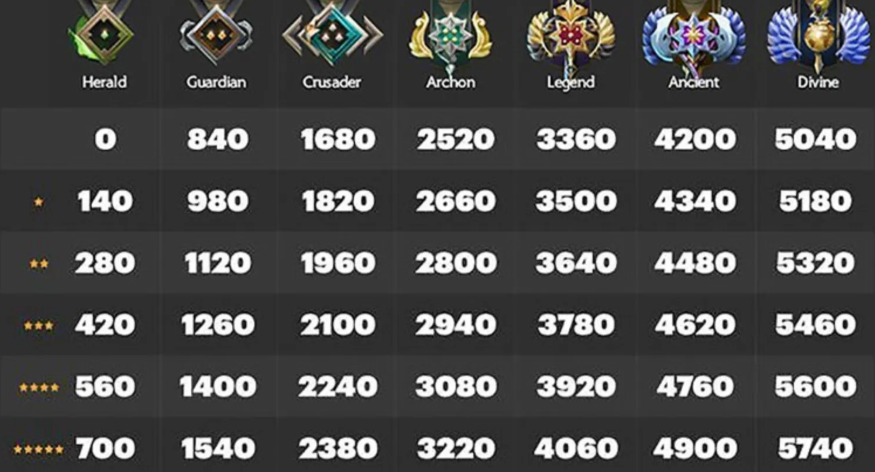
In Dota 2, the rating system divides players into ranks and subranks. This is done to make matches as fair and interesting as possible: you play with people of approximately your level, which means that victories are deserved, and losses are a reason to grow. Below is a rough table of ranks and their corresponding MMR:
-
Herald (Recruit) – 1-616 MMR
-
Guardian (Guardian) – 770-1386 MMR
-
Crusader (Knight) – 1540-2156 MMR
-
Archon (Hero) – 2310-2926 MMR
-
Legend – 3080-3696 MMR
-
Ancient (Master) – 3850-4466 MMR
-
Divine (Deity) – 4620-5420 MMR
-
Immortal (Titan) – 5600 MMR and above
Both solo and team games are taken into account up to the rank of “Ancient”, but from “Divine” onwards only individual rating is important. That is, to get to the top, you need to be able to pull it off yourself, and not just rely on your teammates. This point emphasizes the key role of personal skill: good team play is important, but without strong individual play, the path to the top is closed. Understanding how MMR works is not just theory. This metric directly affects your progress and matchmaking. It ensures a fair and competitive environment, where every step forward is the result of your skill, not chance.
100 hours in Dota 2: why is there a limit for the ranked mode
In Dota 2, newcomers are not allowed to immediately break into rating battles – there is a special restriction for this. Initially, players begin their journey without MMR and rank, which can be annoying for those who want to plunge into the competitive atmosphere as quickly as possible. However, the developers have provided protection for the rating mode from unprepared participants: to open access, you need to spend at least 100 hours of active play in regular matches. Moreover, only the time when you actually participate in the battle is taken into account, and not just standing in the menu.
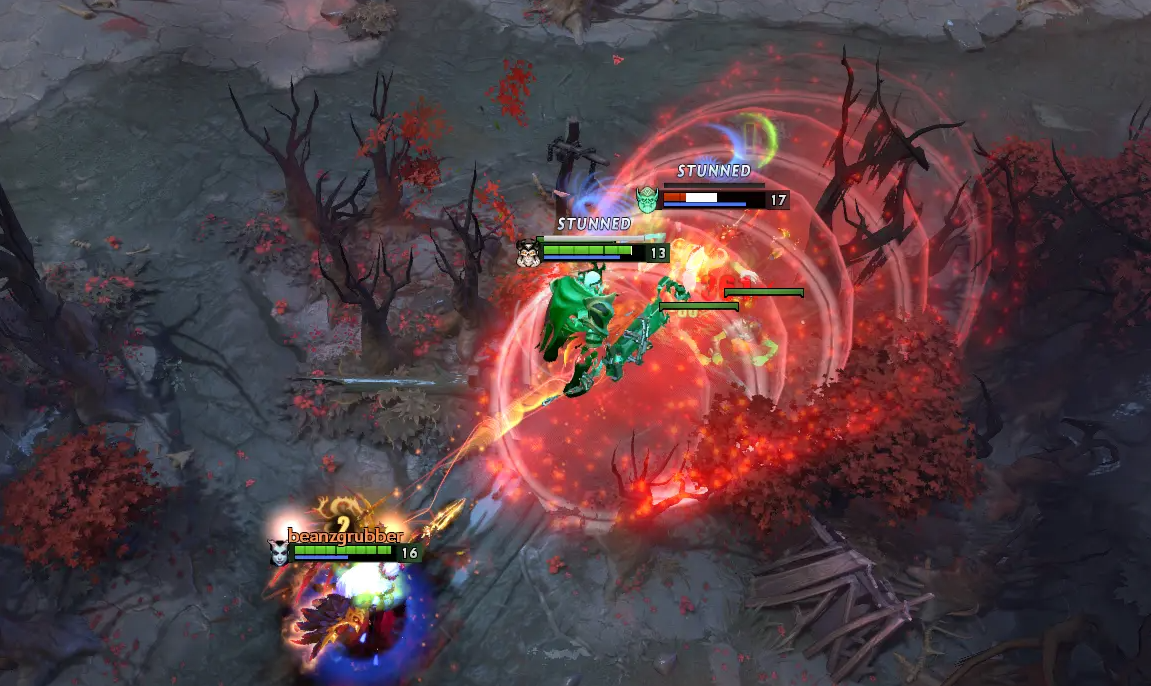
This system was introduced with one important goal – to prevent chaos in the rating selection and to ensure that calibration will begin only after the player gains basic experience and masters the mechanics of the game.
When the coveted mark of 100 hours is reached, the path to the rating mode is finally open. But there is another important stage ahead – calibration. It consists of a series of matches (usually from 10 to 50), based on the results of which the system analyzes your level of play. Your starting MMR depends on your wins, losses, and personal contribution to the team. After that, the matchmaker will try to put you on a team with opponents and allies of a similar level, so that each match is as fair and interesting as possible.
How to Check MMR Rating in Dota 2 – All Methods for Players
Let’s figure out how exactly to find out your MMR in Dota 2 and do it as simply as possible.
The first step is to launch the game client and open your profile directly from the main menu. Next, find the “Statistics” tab. A detailed table of your matches will open here, and in the upper right corner, your current MMR rating, which the system calculated based on your games, will be indicated.
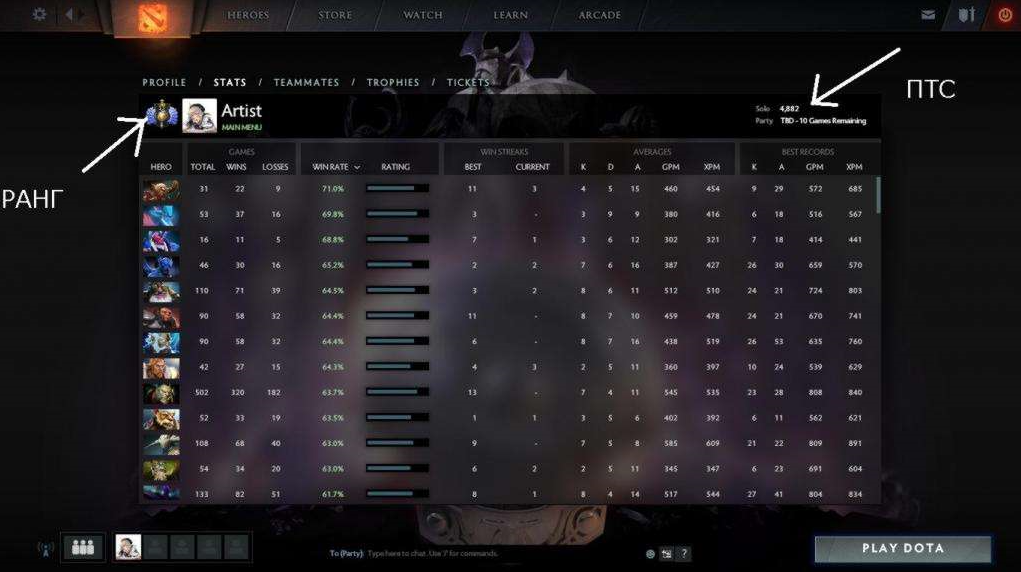
Now about how to make MMR visible to others. Go to your profile, click the “Edit” button (it is located in the upper right). In the menu that opens, there will be items “Single game rank” and “Group rank”. Just check the box next to them – and your rating will be available for viewing to everyone.
But what if you want to know the hidden MMR of another player? Here everything is a little trickier:
Open the profile of the player you are interested in and look at his match history.
Find a recent game and pay attention to the ratings of other participants (provided that they are not hidden). If all the values are hidden, you will have to check other matches.
Additionally, you can evaluate the level of play of his teammates – this will indirectly hint at the approximate rating of the player.
If you want to know what MMR the best players in the world are, go to the official Dota 2 website. There are rating tables for all regions: America, Europe, Southeast Asia and China. These lists contain data on 5,000 of the strongest players who participate in eSports tournaments. Updates occur every hour, so the information is always up-to-date.
Follow these ratings to understand how you are growing and compare your results with world professionals. Whether you are an ordinary enthusiast or aspiring to an eSports career, the ability to find and analyze such data will help take your gaming experience to the next level.
Dota 2 Calibration System: What Has Changed and How to Increase Your Rating
In Dota 2, the player’s skill assessment begins with ten qualification matches. The system carefully analyzes a wide range of indicators: gold and experience per minute (GPM and XPM), the amount of healing provided, total damage to enemies, damage to buildings, and many other important metrics. There is a strong opinion in the community: how a player plays these matches before calibration largely determines his starting MMR.
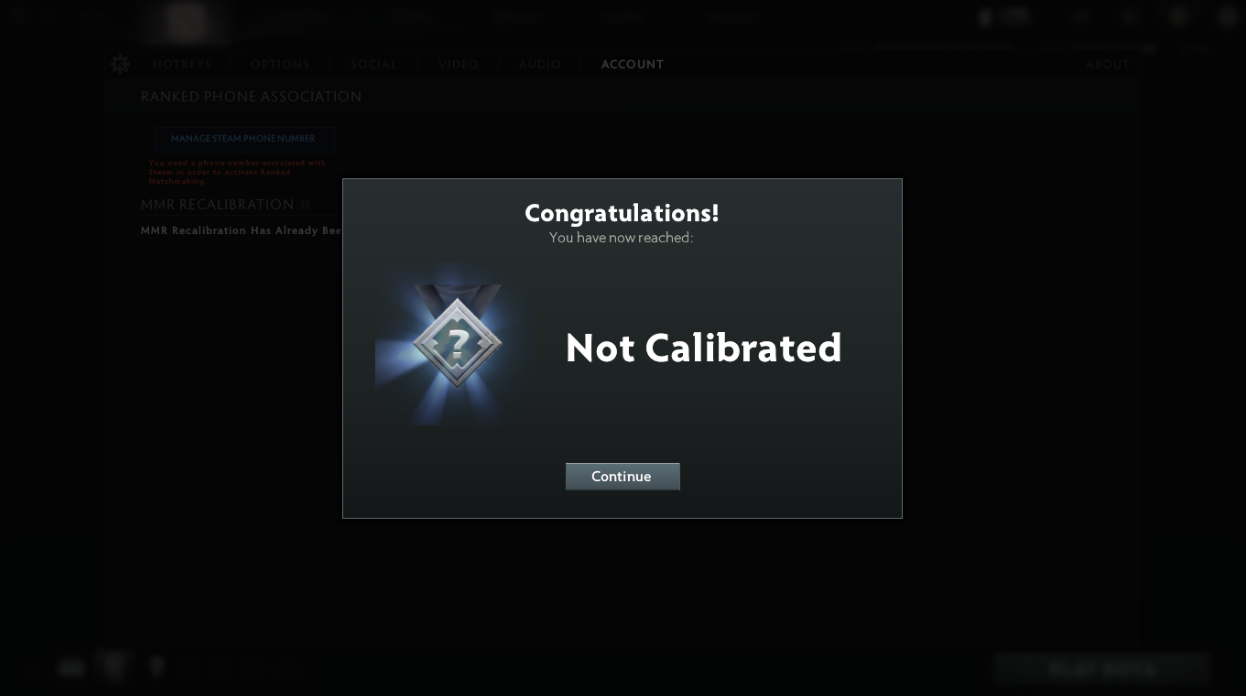
Back in 2019, there was a simple rule: to open calibration, you had to play at least 100 games on your account. Only after that did access to rating matches open, where the real battles for a position in the ladder began.
But already in 2020, Valve changed the system. Now players are required not by the number of games, but 100 hours of active gameplay. And it is important to understand: the time spent in the menu does not count. The counter only works when you are actually in combat, participating in matches and influencing the outcome.
MMR in Dota 2: Increase in maximum rating and new rules from Valve
Based on user analyses and experiments conducted over several years, the maximum rating in Dota 2 has seen considerable fluctuations. Initially, when the game was launched, this figure was set at 3500 MMR. By the year 2019, this number had increased to 4500 MMR. Notably, players who subscribed to Dota Plus had the opportunity to achieve ratings exceeding 5000 MMR after their calibration matches.
In the year 2020, Valve introduced a new system aimed at detecting smurf accounts and boosting practices. This development had a significant impact on gameplay dynamics. As a result, some players who performed exceptionally well in their calibration matches began reaching impressive MMR scores that exceeded 10000. This change highlighted the evolving nature of competitive play within the game.
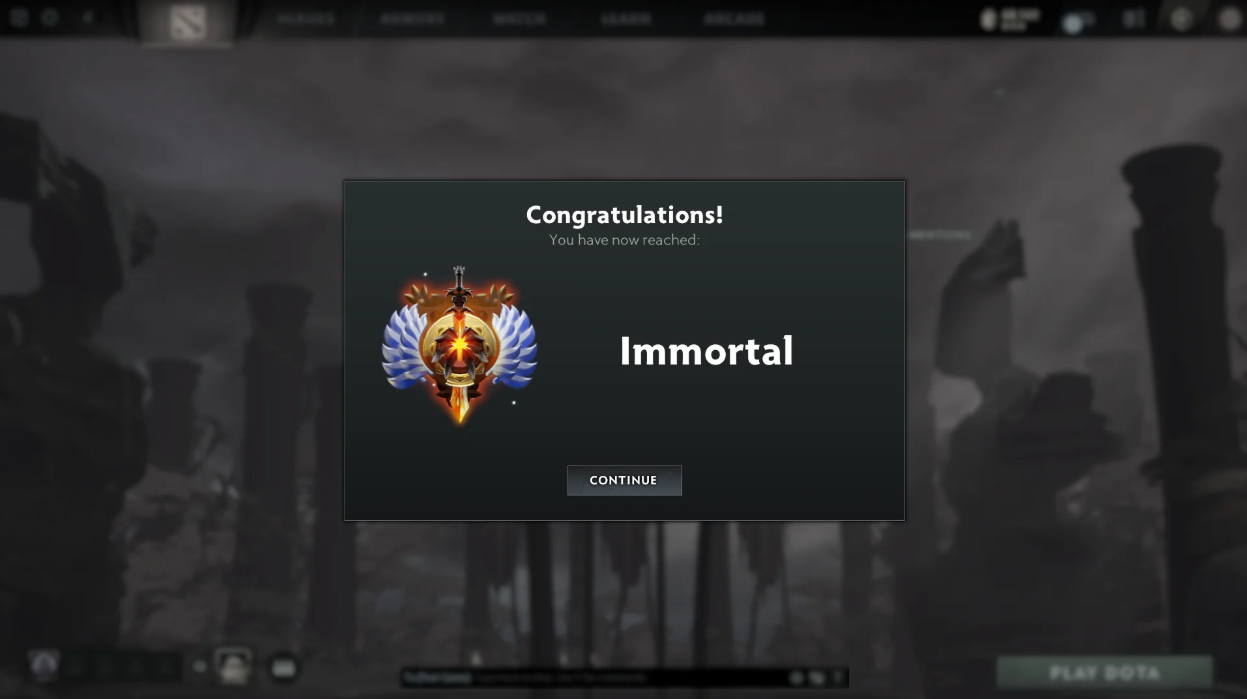
Today, the leaders of the European Dota 2 rating have exceeded the 16,000 MMR mark — a figure that only a few reach. Mostly, professional e-sportsmen are in the top. You can check the current list on the official Dota 2 website, but the exact rating number is not displayed there — only the nicknames and positions of the players are indicated.
At the moment, the top 5 strongest players in Europe look like this:
-
Nightfall
-
hadendisleycable
-
9x.skg0d
-
PARIVISION.DM
-
KS.Akame
How to Properly Calibrate Your Dota 2 Account for High MMR
To achieve a high MMR and effectively calibrate your Dota 2 account, it’s crucial to approach the gameplay with seriousness and focus. The matches you play prior to calibration will have a significant impact on your final rating points, so every game counts.
The primary metric for assessing your account after calibration is your win percentage. Your ultimate rank and MMR in Dota 2 will depend heavily on this figure, making it essential to secure victories. Individual performance stats, such as total value and damage output, also play an important role in how you are evaluated. Aim to showcase your best skills in those early matches to ensure a high-level calibration for your account, setting a strong foundation for future games.
What is 100% confidence in dota 2
The Dota 2 confidence metric at 100% is an important indicator that reflects the percentage of player wins in matches with so-called “high confidence”. Simply put, it shows how effectively you play in those games where the system has accurately determined your skill level.
To calculate this indicator, a whole set of data is taken into account: player and team ratings, opponent strength, as well as your personal statistics of wins and losses. The higher the percentage of wins in such matches, the more the overall confidence level in your profile grows. For example, if you win 9 out of 10 games with high confidence, the system will record approximately 90% confidence – this means that you consistently demonstrate high skill and confidently beat opponents, often stronger ones.
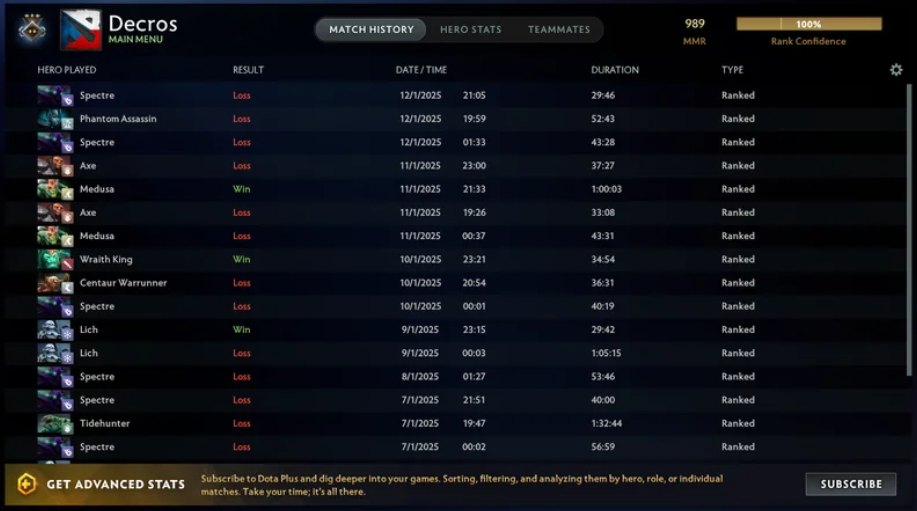
But it is important to understand: this percentage is not the only criterion for your game. It does not give a complete picture of skill. The overall level is also affected by your MMR, total number of games, hero statistics, participation in team battles and other metrics. They help to understand your style and efficiency better.
It is worth noting the connection between confidence and MMR. Usually, with high confidence, rating fluctuations become insignificant – within ±10-25 MMR per game. But with a low level of confidence, the spread can be much greater. This mechanism is designed so that the system selects the most honest opponents for you and maintains balance in matches.
An interesting point: confidence grows not only due to victories, but also through the system’s perception of your stability. When you play better and win more often, the selection gradually “trusts” your level and records the rating. When you reach 100% confidence, the game essentially says: “We know your skill exactly.” This opens the way to more stable matches at your level and gives you a chance to grow further, honing your skills.
Conclusion: understanding these subtleties helps players correctly assess their progress, adjust their strategy and work on their weaknesses. The higher your confidence, the more control you have over the results and the more stable growth in the rating.
How to Raise MMR in Dota 2: Working Tips for Winning and Rating Growth
In Dota 2, your rating (MMR) rises or falls almost symmetrically: win – plus about 25, lose – minus the same 25. And it seems that everything is simple: “If you want more rating – win.” But in practice, this is a whole science! Here are tips that will really help you win more often and enjoy the game.
-
Become the king of key roles. If you want to influence the game, take mid or carry. This does not mean that support is useless, but let’s be honest: at low and medium ratings, these are the positions that most often decide the outcome of the match. When you are in a role that can finish the game, you have the lever of victory in your hands.
-
Find “your” heroes and become a master. Don’t jump from hero to hero. Choose 3-4 characters that you really enjoy playing and pump them up. The better you know the hero, the easier it is to make the right decisions. And familiar heroes = confidence even in the most hellish fight.
-
Learn, but don’t turn it into boredom. Go to guides, streams, YouTube, watch how strong guys play. Life hack: when you watch a pro game, don’t just admire the highlights, think about why he did it that way. These tricks will save your game later.
-
Communicate, but without toxicity. In Dota, one silent person = minus half the team. Write or say simple things: “the enemy has no TP”, “in 10 seconds there will be a rune”. It seems like a trifle, but it is such moments that decide skirmishes. The main thing is not to turn the chat into a testing ground for toxic people, otherwise even victory will be bitter.
-
Train and don’t give up. Do you want to become really cool? You will have to play, make mistakes, bomb, but try again. Dota is a game of infinite progress. And yes, even after 5,000 hours you will still discover something new. But that’s what makes it so addictive.

How to Raise MMR in Dota 2: Rating Recalibration and Breaks in the Game for Better Results
Option one: Recalibration is a chance to reset your rating
In Dota 2, recalibration is not just a technical process, but an opportunity to re-prove your competence to the matchmaking system. Many players perceive it as a chance to show their real level of play if their current rating seems understated. However, do not forget: the result of recalibration can be unpredictable, and often the final MMR is lower than before the start. Therefore, approach this step consciously.
To pass recalibration, you need to play 10 calibration matches. The result is affected not only by the number of wins, but also by your individual efficiency: KDA (kills/deaths/assists), farm level, participation in team actions and even the pace of the game. The caliber of opponents is especially important: confident play against stronger opponents increases the chance of getting a rating increase.
Recalibration can be a great tool for players who are unhappy with their current position. But you should not consider it a magical way to instantly upgrade. It is much more important to constantly improve mechanics, study the meta and practice different roles. Regular practice and flexibility in strategy will make your growth stable, not one-time.
Option two: Break – how to reset your perception of the game
Sometimes the best way to get out of a stagnation is to just take a break. A break of 4-5 days can unexpectedly affect the selection algorithms. In CS:GO, this strategy has long been known, and in Dota 2 it also gives an effect. What to do with this time? Try a smurf account: an ideal tool for practicing new heroes and roles without putting pressure on the main rating.
I will share my personal experience. As a person working as a booster, I once left the game for two months. Before the break, I felt confident, but after a while I realized that I had lost some stability. After returning, MMR dropped by 35-40 units per match – the competition seemed tougher. This is natural: the meta changes, opponents are pumping up, and your skills are rusting.
However, this strategy has an advantage: smurf allows you to practice without stress. Focus on 3-4 heroes that you feel comfortable playing with and work on the mechanics. When you return to your main account, you will be mentally fresh and tactically savvy. This is not a quick way to gain rating, but it will definitely help restore confidence and quality of play.
Conclusion
Dota 2 boasts a unique rating system that evaluates player skill, making it a core aspect of Valve’s MOBA for over a decade. As in any competitive environment, the MMR system plays a key role in ensuring accurate matchmaking, which promotes fair and fun play. Carefully thought-out balance allows everyone to demonstrate their abilities. The VPEsport team wishes you great success and a speedy achievement of the prestigious Titan status!