To win a game of mahjong in Neverness to Everness, you’ll need to master the art of forming combinations of Pung, Kong, Straight, and Pair sets. A single game lasts about seven minutes—not fast, but not forever either. If you win, you can use your City Stamina to play Funs. A loss significantly stretches the time until it’s depleted.
Table of Contents
Where to play mahjong in Neverness to Everness?
The most accessible option is the Little Sparrow cafe in the Miguel district. Come and sit down at the table. Alternatively, you can buy a mahjong table as a piece of furniture and place it in your apartment. However, for a solo game, you’ll need at least three NPC neighbors.

The location determines the turn order. Against NPCs, you don’t have to worry about positioning. Then, you can either use automatic matchmaking or invite other Espers. For beginners, I recommend playing with NPCs—it’s safer. Important: Before inviting someone to Little Sparrow, level up your character’s connection level. When ready, click “Ready” in the lower right corner.
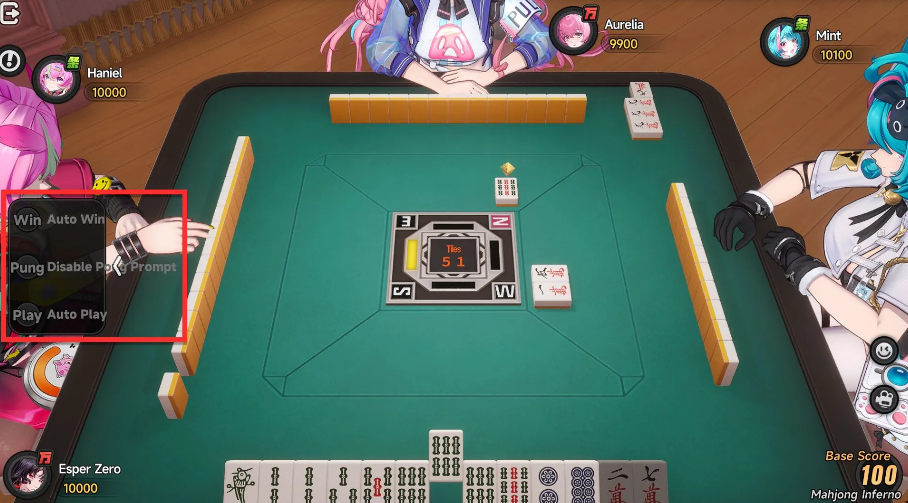
Match Start Rules and NTE Interface Settings
There are three buttons on the left. I recommend turning on “Victory” right away—it will automatically announce a win when a combination is formed. “Autoplay” is also useful at first, but it’s better to play manually to understand the mechanics.
“Pung” button: If you’re unsure of your actions, keep it off. It disables the Pung prompt, preventing unnecessary dialogue.
All Suits and Tile Values in NTE Mahjong
NTE Mahjong has three suits: numbers (hieroglyphs), circles (dots), and bamboo (sticks). Each suit contains the numbers 1 through 9. Circles and sticks are easily distinguished by their patterns. But the number tiles with hieroglyphs will require some Googling—you need to know the Chinese symbols by sight.
Each tile has exactly four copies. For example, four “Circle 1,” four “Circle 2,” and so on.
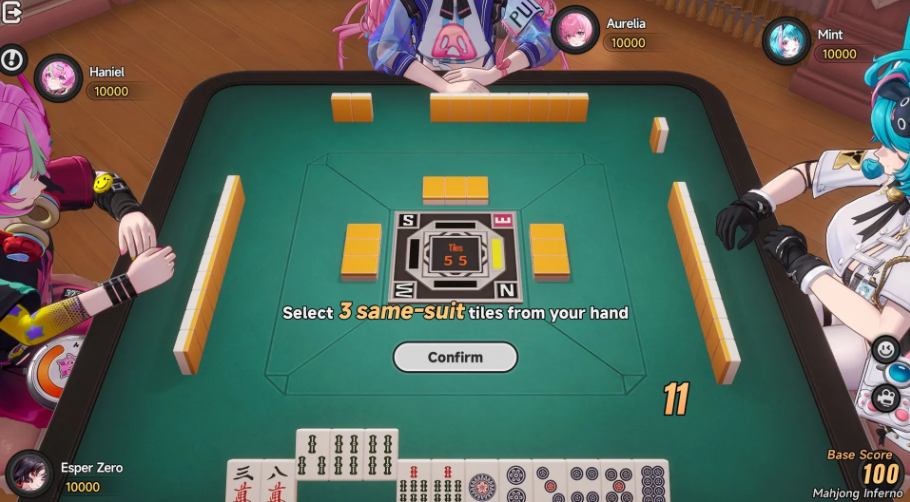
How do you discard and ban a suit?
You’ll start with three tiles of the same suit—you’ll have to give them to other players. Try not to discard matching or consecutive tiles. Then you’ll have to ban one suit. Why? Because a winning hand contains only one or two suits. A banned suit shouldn’t be in your hand.
-
Red—numbers/hieroglyphs
-
Yellow—circles/dots
-
Green—bamboo/sticks
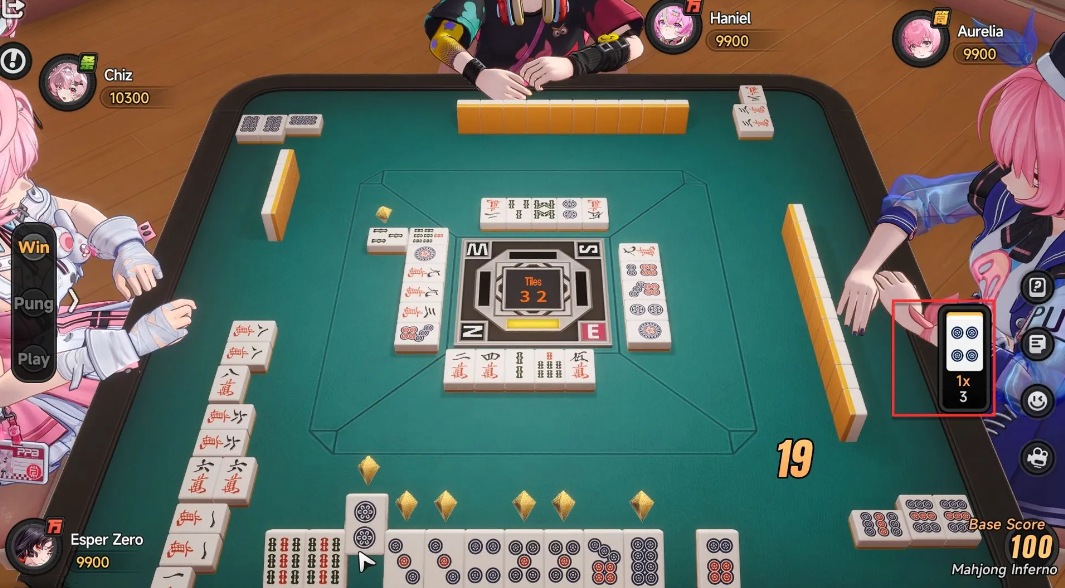
Choose the suit you have the least of. You’ll get rid of it faster. In the original screenshot, the player only has two number tiles—they banned the red numbers. The banned suit will be highlighted by a dark tile in your hand—a reminder that you must discard it. You can’t win with it, remember.
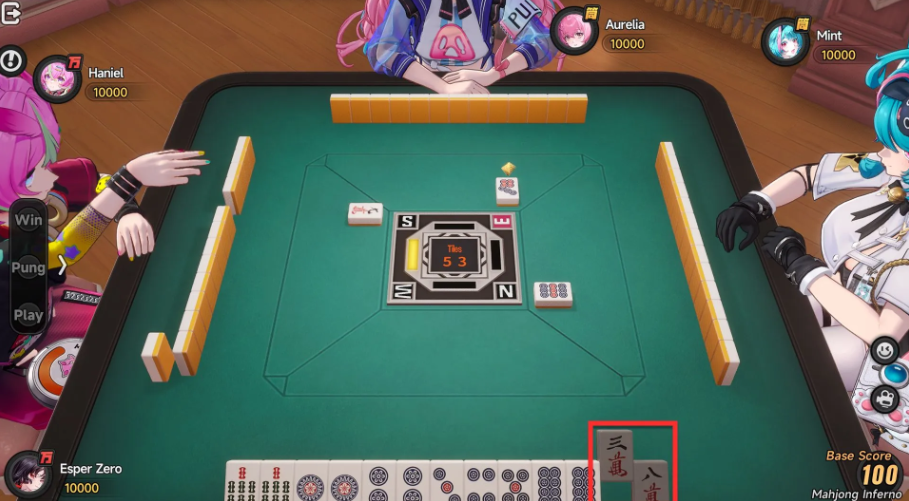
You can tell which suit they’ve banned from the other players’ avatars. Red is numbers, yellow is circles, and green is bamboo.
Now the game really begins.
How to form winning combinations in NTE Mahjong?
The goal of the game is to score the maximum points when all the tiles are taken. The scoring system can be daunting at first, but don’t rush. Let’s go over the basics.
Key terms: Pung, Kong, Straight, Pair, and Win. We’ll go over each one.
Forming a Pung Set of Three Identical Tiles
A Pung is three tiles of the same value and suit. Therefore, don’t discard paired tiles at the beginning. This will only help your opponents form a combination.
If someone else has a tile, and you already have two of the same kind in your hand, you can take it. This is the activation of Pung.
Three identical tiles already in your hand are also Pung. You don’t have to declare it right away; you don’t lose anything.
How do I activate an Open and Hidden Kong?
This one is trickier. Four copies of each tile is a reminder from the previous section. So the fourth will be the last one in the game. Hold on to three until someone discards the coveted one.
There are several types of Kong:
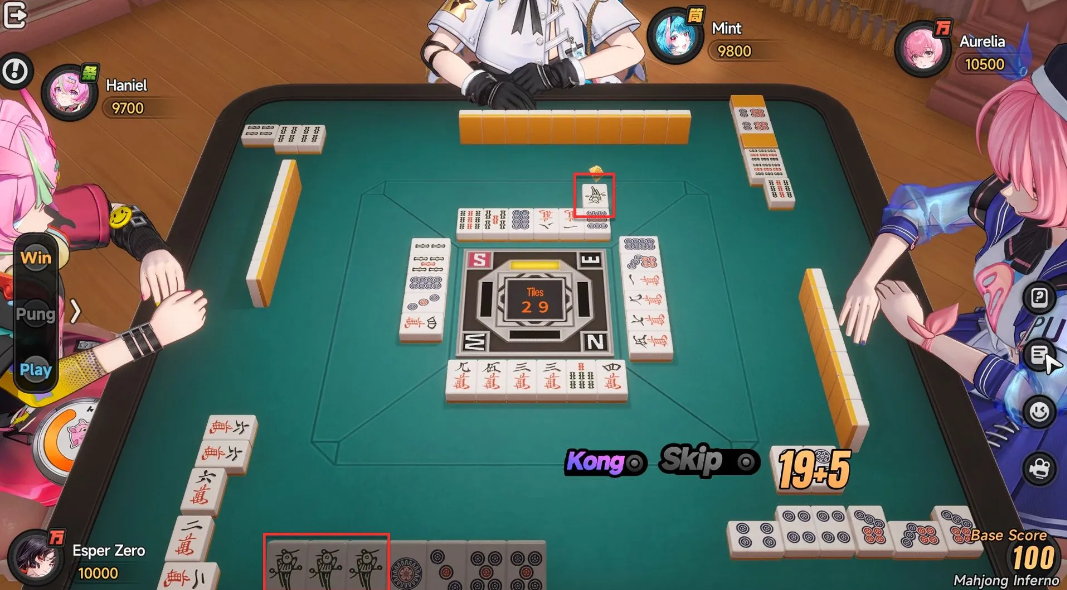
-
Open Kong from the discard pile: you take the opponent’s tile, gain +100 points, and the discarder loses -100.
-
Kong after Pung: you’ve already declared Pung, and then you draw a fourth tile. Then you get +300, and -100 for each opponent.
-
Important: you can’t take someone else’s discarded tile for Kong after Pung.
-
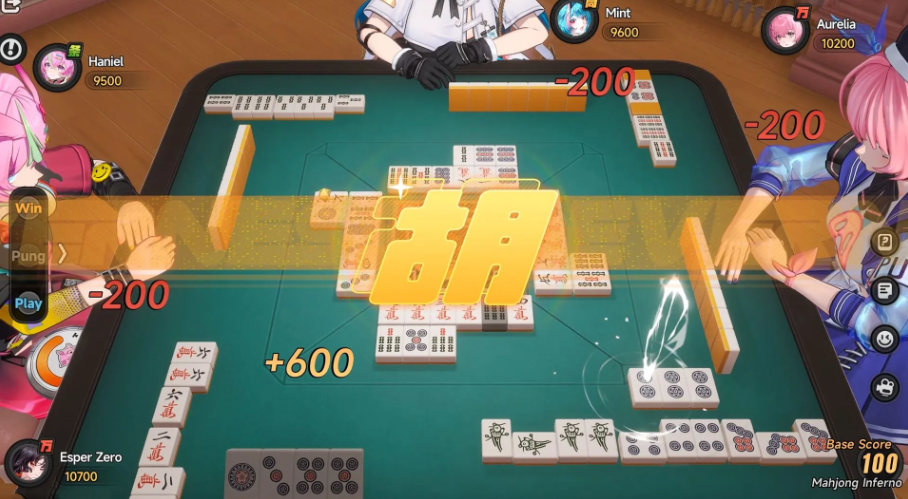
Hidden Kong: you have three of the same tile in your hand, and you draw a fourth tile, but you haven’t declared Pung yet. Activate the hidden Kong: +600 for you, -200 for everyone else.
Once you get the hang of it, you’ll realize that constantly chasing Pung and Kong isn’t necessary. But beginners should focus on them.
And another nice bonus: Kong can be declared even after activating Victory.
Rules for making consecutive sets of Straights
You can’t declare a Straight from the discard pile, but it helps you make a winning hand. You need three tiles of the same suit, in sequence.
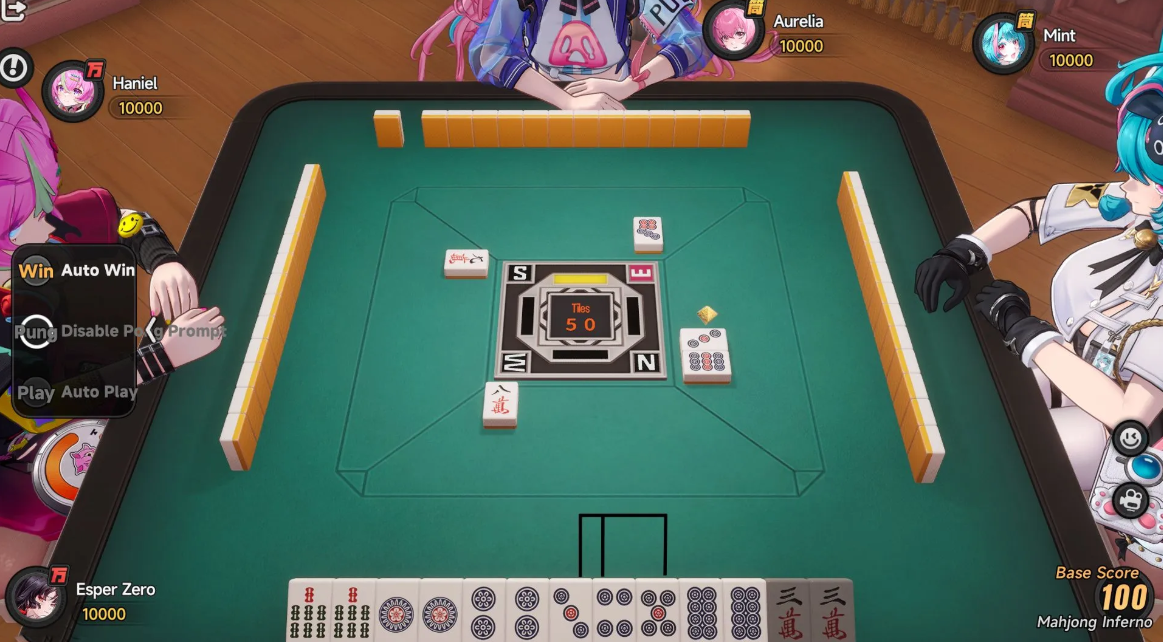
Examples:
-
Circle 1, Circle 2, Circle 3
-
Circle 2, Circle 3, Circle 4
-
Circle 3, Circle 4, Circle 5
Exactly three tiles. Not two, not four, not five. The same tile can’t be part of two different sequences. For example, if you only have one Circle 3, you’ll only make one of the three chains above.
But if there’s a duplicate, everything changes. For example, we have: Circle 1, Circle 2, Circle 2, Circle 3, Circle 3, Circle 4. From this set, we can form two groups: (1,2,3) and (2,3,4).
Why do we need the final Pair of tiles to win?
The easiest part. Two identical tiles are a Pair. In the original screenshots, there was a pair of Circle 1, a pair of Circle 2, a pair of Circle 8, and a pair of Bamboo 7.
Without a Pair, you can’t form a winning hand; that’s the basics.
Victory Declaration Conditions in the Neverness to Everness Minigame
We’ve mastered the basic combinations. Now the main thing is to understand the winning mechanism.
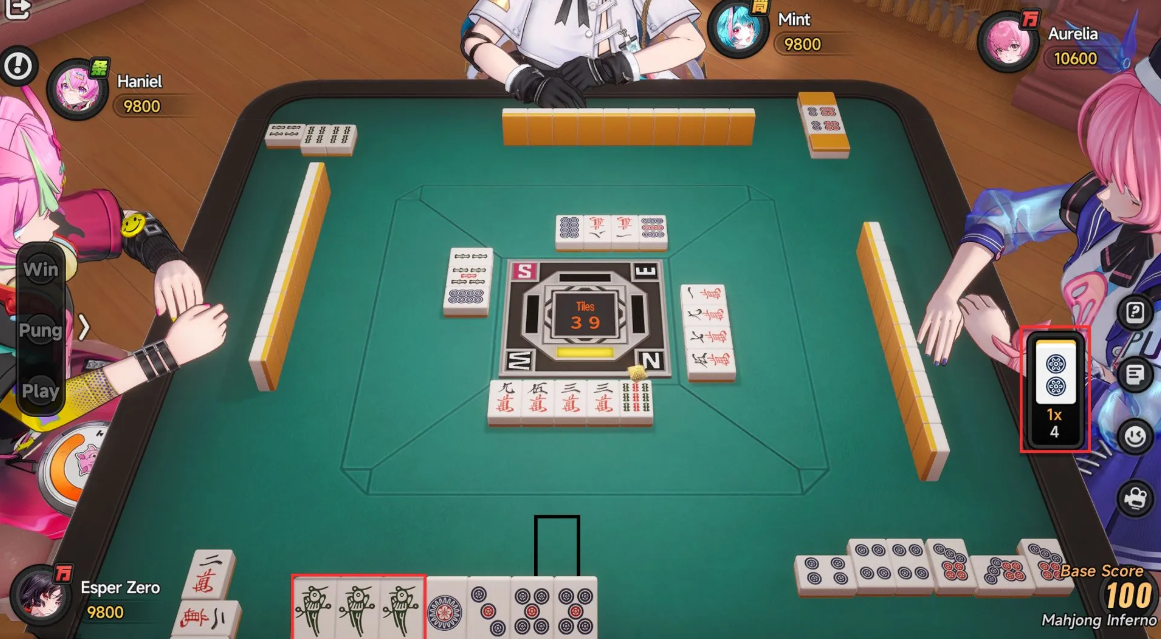
The conditions are strict, but simple: you need one Pair. All other tiles must form Pung, Kong, or Straight groups. No extra ones.
Example from the analysis. The player had 4 Pung Circles, 7 Pung Circles, and 1 Bamboo (also a Pung) in their hand, plus 1 Circle, 3 Circle, and 5 Circles as a Pair. All they needed was a 2 Circle to complete the 1-2-3 sequence. Sound familiar?
How do I use the golden arrows and interface hints?
When you’re one tile away from victory, the game gives you a hint. There’s a question mark icon on the right that will tell you exactly what’s missing. At the bottom of the hint is the number of such tiles remaining in the game. Important: the system won’t tell you if someone is holding the tile they want, only if it’s already been discarded or played.
Did you draw a tile that’s bringing you closer to victory? The game will highlight the tile you should discard with a golden diamond arrow. Let’s say you took Circle 5. You’re advised to discard Bamboo 9. You click on Bamboo 9 and see: you need Circle 2 to win. Convenient.
Tile discard options when completing multiple streets
If you’re completing multiple streets, there are many discard options. Let’s look at an example. Option A: Discard Circle 2. Then we win by taking Circle 4. Winning hand:
-
Pair of Bamboos 9
-
Circle 3-4-5 (twice – yes, the same sequence can be repeated if there are enough tiles)
-
Circle 6-7-8
Option B: Discard Circle 3. Change the structure:
-
Pair of Bamboos 9 or Pair of Circles 5
-
Pung Bamboos 9 or Pung Circles 5
-
Circle 2-3-4
-
Circle 6-7-8
Option C: Discard Circle 5. Then:
-
Pair of Bamboos 9
-
One of the straights: either Circle 1-2-3 or Circle 2-3-4
-
Plus Circle 3-4-5
-
Plus Circle 6-7-8
Option D: Discard Circle 8. Get:
-
Pair of Bamboos 9
-
Round 1-2-3 or 2-3-4
-
Round 3-4-5
-
Round 5-6-7
The main thing is not to get confused. The system will highlight all possible paths.
How to win a match through hidden straights without pungs?
You can win without declaring any Pungs or Kongs at all. Example: you only need a Bamboo 4. The hand looks like this:
-
Straight Bamboo 3-4-5
-
Pair of Bamboos 6
-
Pung Bamboos 9
-
Straight Round 3-4-5
-
Pung Rounds 5
By the way, note: the Round 5 in this hand can win. But if you decide to play it as a Hidden Kong, you’ll get a massive +600 points. The price? You’ll lose your winning combination. It’s up to you to decide: a stable win or a risky record.
Scoring and Reward System in NTE Mahjong
Winning is half the battle. In NTE (Neverness to Everness), the real game begins after you’ve formed a winning hand. The scoring system is more complex than it seems. The same combination of tiles can yield a paltry +100 or +2400—it all depends on how you drew the winning tile and how unobvious your combination was.
Is it worth the risk and collecting a Hidden Kong?
Earlier, I mentioned that a Hidden Kong gives +600 points—but it forces you to break your existing system. The question is: should you? The answer depends on the scoring table. Let’s take a look. The key point: whether you stole a discarded tile from a neighbor or quietly took it from the wall—the difference is enormous. Drawing it yourself usually multiplies the reward, but also imposes penalties on others.
Combo Value Table from Regular to Single-Color
Here’s how the points are distributed. Remember, there are a lot of numbers here. A normal hand (a mix of punts/Kongs, straights, and pairs, tiles 1-9)
-
Someone else’s discard: +100 to you, -100 to the discarder.
-
A draw of your own: +600 to you, -200 to each player.
The difference is significant. If you have the option to hold your cards until the last minute, it’s better to do so.
Losing after a Kong (someone declared a Kong, and you took their discarded tile)
-
+200 to you, -200 to the discarder.
This is situational, but the best option is to directly punish the player who decided to Kong.
All normal (excluding tiles 1 and 9)
-
Someone else’s discard: +200 to you, -200 to the discarder.
-
A draw of your own: +1200 to you, -400 to each player.
Building a hand without 1s and 9s is more difficult, but the reward is twice as high.
Winning after drawing a Kong (you draw a tile, declare a Kong, and the next tile wins)
-
+1200 to you, -400 to each player.
This is a real feat—it requires luck and calculation. But with one action, you clear half the board.
Pure Monocolor (all tiles of the same suit)
-
Someone else’s discard: +400 to you, -400 to the discarder.
-
Drawing on your own: +2400 to you, -800 to each player.
Get the sense of scale? 2400 points is practically a guaranteed victory at the end of the game, assuming you haven’t lost before.
All Pungs (no straights in the hand, only Pungs/Kongs and a pair)
-
Someone else’s discard: +400 to you, -400 to the discarder.
-
Independent draw: +2400 for you, -800 for each.
Same as single-color. By the way, no one is stopping you from combining “all pungs” and “pure single-color”—but then you’re either a mahjong god or cheating.
Multi-variant hand tactics for repeat wins
Here’s the interesting part. In NTE, you can declare a win and continue the game. If you hit the right tile again (either by drawing or stealing), you declare another win and get more points.
Example: in the screenshot above, if you hit Round 1, the player wins. If another Round 1 or even Round 4 occurs, you win again and get more points.
What does this mean in practice? You should strive not just for a winning hand, but for one with multiple “entries”—tiles that complete several different combinations. The winner is the one with the most points after all the tiles have been dealt, not the one who hit first. So, greed is justified here.
Tip: Practice making “all simples” or “all punts”—they give you a high base and leave room for repeat wins. A simple hand is too cheap, and a pure monocolor hand is long and risky. And yes, try to get the winning tile yourself. The difference between +100 and +600, as you can see, is colossal.
Top 5 Beginner Mistakes in Neverness to Everness Mahjong
Losses at the start aren’t a curse of randomness, but a simple misunderstanding of the mechanics. Most beginners make the same mistakes time and time again, giving away victory points to their opponents. We’ll examine five critical mistakes that ruin your game.
Why shouldn’t you break established chains at the start
The very first discard is incredibly costly. You’ve been dealt three tiles of the same suit, and what does a beginner do? That’s right, they mindlessly break future straights or pairs. Are you holding a Circle 3 and a Circle 4 in your hand? You already have the foundation for a 3-4-5 straight. Discarding part of this chain at the start is outright suicide. You’re eliminating yourself from the race. Strictly discard single, unconnected tiles. Complete pairs and chains are completely untouched.
The error of randomly banning a suit without analyzing the hand
Discarding a suit works as a brutal tactic. No formalities. The basic rule is: always ban the suit you have the least of in your starting hand. The faster you discard this garbage, the sooner you’ll assemble a viable setup. But no. Green players love to randomly poke or mindlessly copy their neighbors. The outcome is predictable. You’re stuck with four banned tiles until the midgame, literally playing against yourself every turn.
Why does a quick win from a reset yield few points?
Perhaps the most costly mistake. In this game, the final score decides, not the speed of the first click on the win button. A simple draw from someone else’s discard pile will yield a paltry +100 points. Are you happy? You shouldn’t be. While you’re sitting with pennies, your opponents keep drawing dice. They vacuum up Kongs, put together winning streaks, and easily outscore you. Keep your hand closed until the draw. Aim exclusively for a draw (tsumo). The difference is colossal: +600 points versus +100 for the exact same hand.
The danger of assembling single-entry combinations
Variation is key. If your final hand is waiting for exactly one specific tile, you’re at the mercy of blind luck. (This isn’t the most obvious choice for winning.) Top players intentionally build overlapping straights. Why? So that the hand can be completed by two or even three different tiles. A classic example: holding Circle 1-2 and Circle 3-4 simultaneously. Now both Circle 3 and Circle 5 are ideal for you. The number of entries doubles. The chances of winning the pot with a draw skyrocket.
Draining a winning ending to activate Kong
Hidden Kong is a tasty +600 point draw, but it completely ruins the structure. See four identical tiles? Your hand naturally reaches for the activation. Stop. First, see if you still have a working out after this move. Rule of thumb: first check for a viable final die, only then declare Kong. Otherwise, you’re trading a guaranteed win rate for attractive numbers (without actually winning).
Final Table of Penalties and Optimal Decisions in NTE
Continue reading: Complete Guide to All Currencies & Farming.