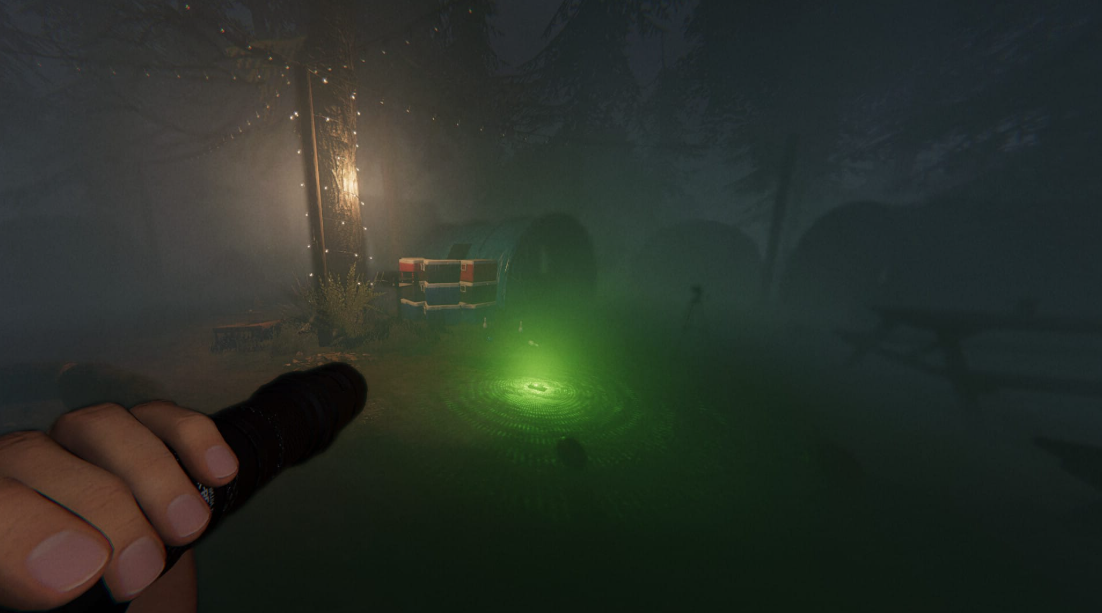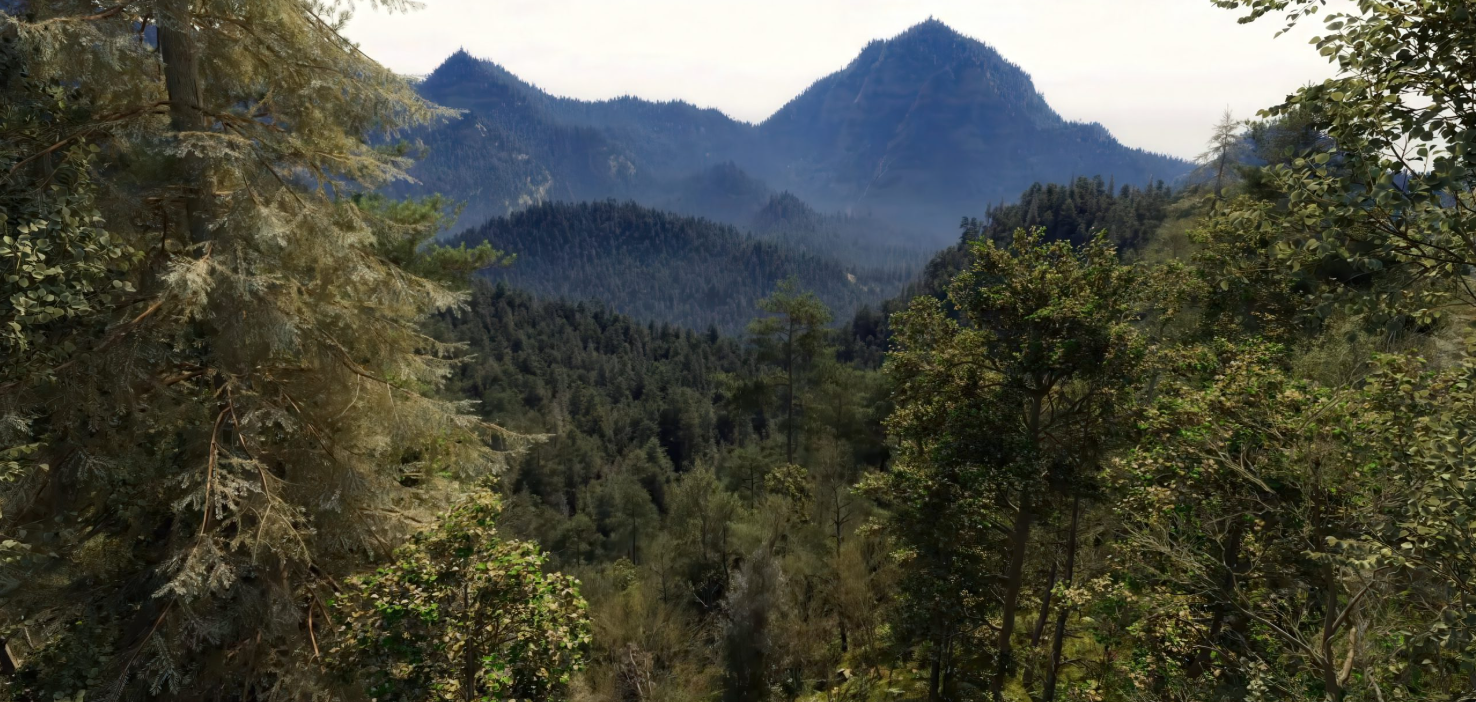
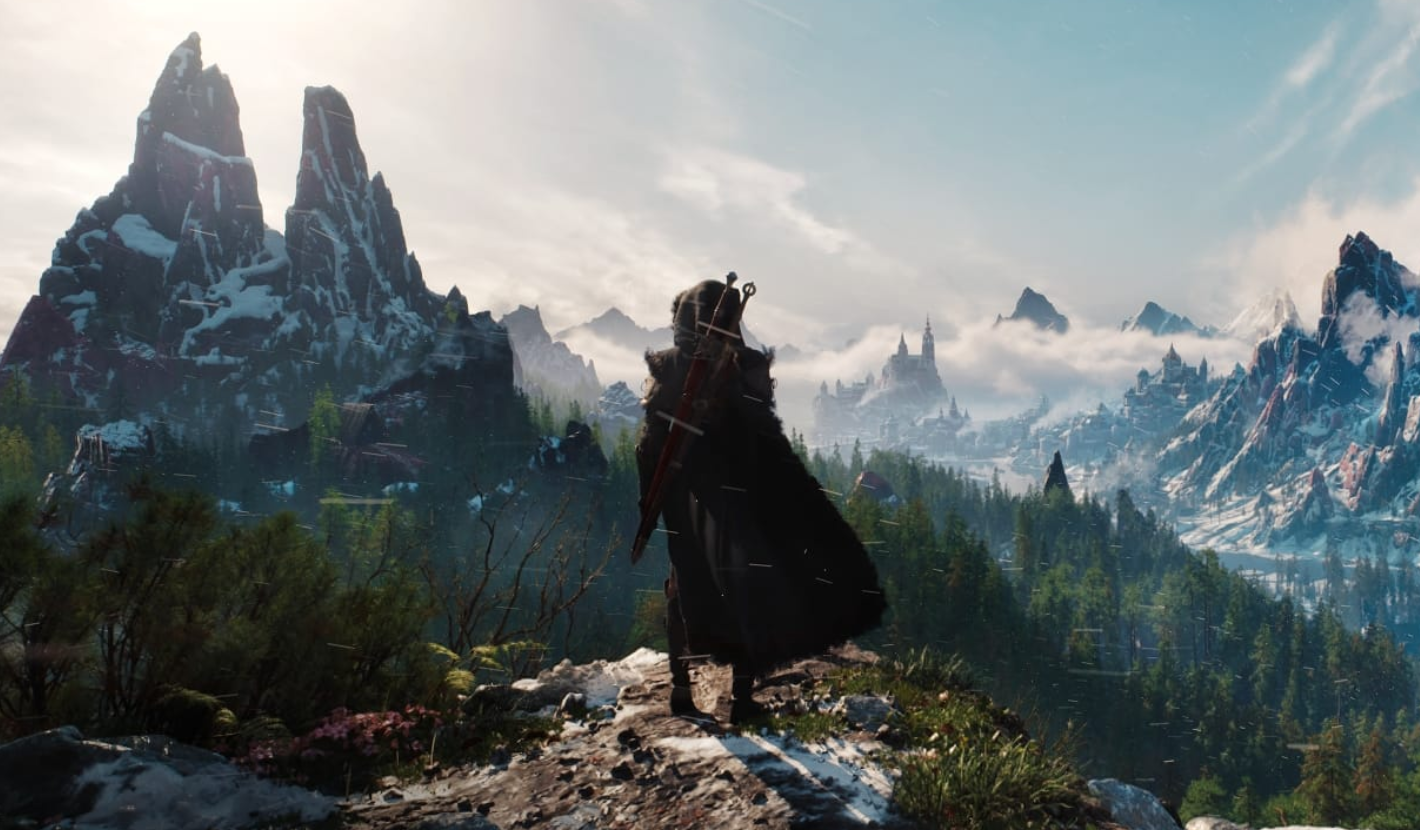
There was a real technical breakthrough at GDC 2026 — NVIDIA and CD Projekt RED officially introduced RTX Mega Geometry technology based on The Witcher 4. This is not just another graphics improvement, but a full-fledged rendering of a giant forest through ray tracing, which promises to bury the concept of “levels of detail” (LOD) forever.
The scale is amazing. On a 5 x 5 km map, the developers have placed about a million trees and 60 million pieces of vegetation — and all this is stored in video memory without annoying object loading (pop-in) right in front of the player’s eyes. Each large tree in The Witcher 4 now consists of 10 million polygons. Honest geometry has even reached pine needles. If you translate the entire scene into triangles, there will be more than 5 trillion of them — a figure that would have caused graphics engines of the previous generation to crumble.
Table of Contents
How does RTX Mega Geometry work in The Witcher 4?
Technologically, everything is more complicated than it seems at first glance. Each tree in the frame is animated independently, and lighting and shadows are calculated at the pixel level — this creates the most realistic effect of a living forest. To prevent video cards from burning out from such a load, NVIDIA has applied a multi-stage optimization system and opaque microcard technology (OMM). This allows you to maintain the extreme complexity of the geometry without clogging the video memory to capacity.
Performance on current hardware:
-
GeForce RTX 5090: Outputs about 80 FPS in 4K resolution (DLSS Quality is used with the original 1440p).
-
RTX 4070: Demonstrates decent 58 FPS at 1440p (upscaling from 960p).
The main work is done by specialized RT cores, which NVIDIA has been promoting since 2018 – back then, tracing seemed like a toy for film makers, but today it is cheating entire ecosystems in real time. DLSS here is responsible not only for the frame rate, but also for high-quality noise reduction.
AI algorithms alone are not enough — the main advantage of RTX Mega Geometry lies in how NVIDIA has redesigned the data approach inside the graphics card.
RTX Mega Geometry: technical analysis of SDK and clusterization
Simply put, RTX Mega Geometry is an advanced SDK from NVIDIA for DirectX 12, supplemented with specific NVAPI extensions for the needs of DXR. The main trick here is clustering: triangles are grouped into “bundles” from 64 to 1024 pieces, which are then assembled into hierarchical nodes. This structure allows you to speed up the assembly of BVH (hierarchy of limiting volumes) by almost 100 times. The process of updating data goes in batches directly to the GPU — this enormously offloads the central processor and video memory (VRAM).
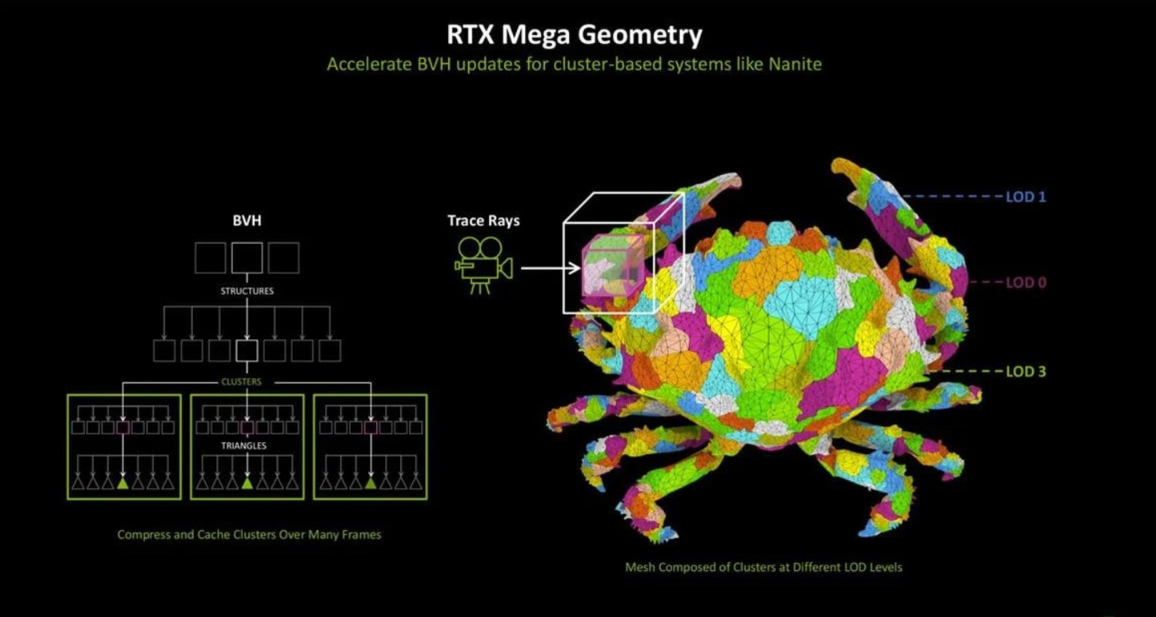
Opaque micro maps (OMM) are responsible for the realism of foliage in The Witcher 4, and Catmull-Clark adaptive tessellation ensures perfectly smooth surfaces. And most importantly, forget about LOD jumps. Thanks to the clusters, light beams can process trillions of polygons in real time. Judging by the demo version, the technology digests up to 5 trillion triangles at a 5×5 km location without a single hint of sudden appearance of objects (pop-in).
RTX Mega Geometry vs Nanite in Unreal Engine 5
The comparison suggests itself. The famous Nanite technology from UE5 is able to virtualize meshes on the fly, but as soon as it comes to heavy raytracing, problems begin. Even the latest Lumen in the 5.6 engine version does not always take out Nanite RT due to the need to constantly rebuild BVH.
RTX Mega Geometry beats the competitor in his own field here. Clustering from the “greens” reduces the load on video memory significantly, and hardware acceleration on the RT cores of the new RTX 50-series video cards provides a decisive advantage. In the test build of Witcher 4, running on a custom Unreal Engine 5.4 from NVIDIA engineers, the RTX 5090 graphics card produces a stable 80 FPS. For comparison, the standard Nanite is noticeably losing ground in similar scenes with full tracing.
The Open World of The Witcher 4: Immersion through Ray Tracing
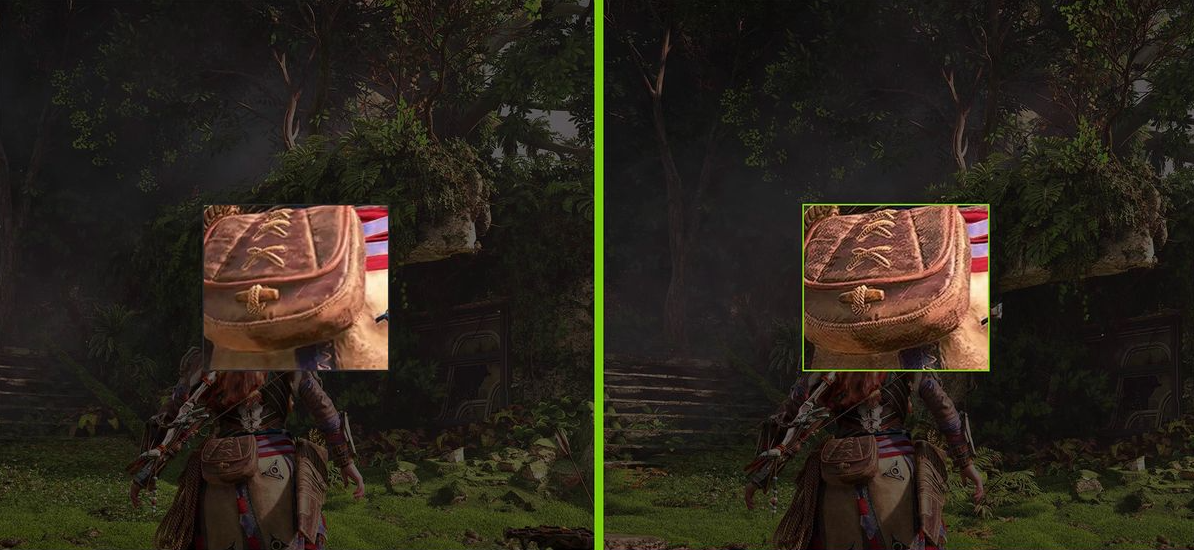
For open—world games, RTX Mega Geometry is a natural escape from visual debris. In the new Witcher, a million unique trees, each sporting 10 million polygons, animate completely independently. Shadows and global illumination (GI) from each individual needle are honest, not “painted”.
The level of immersion skyrockets: full Path Tracing in a dense thicket creates a living ecosystem where even the wind breaks branches as plausibly as possible. The image quality in the CD Projekt RED project is now as close as possible to classic rasterization in terms of speed — the difference on the flagship RTX 5090 is only an insignificant 1-1.5 ms.
The Witcher 4 System Requirements: RTX 4070 to RTX 5090
The analysis of the techno demo allows you to estimate what kind of hardware will be required for comfortable monster hunting. The demo “eats up” about 9 GB of video memory in total (of which 5 GB is spent purely on buffers and BVH), so RTX 4070 owners with their 12 GB of VRAM can still sleep peacefully — at 1440p resolution with DLSS enabled (upscaling from 960p), a completely playable framerate of 58 FPS is obtained.
However, for full-fledged 4K on ultra-settings in 2027, the alignment will be harsh:
-
GPU: GeForce RTX 5090 with 32 GB of video memory.
-
Processor: Intel Core i9-14900K or AMD Ryzen 7 7800X3D.
-
RAM: minimum 48 GB RAM.
-
Storage: 200 GB high-speed SSD.
Without the RTX 60 line, it will be difficult to get the most out of the game, and on the current RTX 4070 you will definitely have to compromise on RT effects.
The Future of RTX Mega Geometry: Alan Wake 2 and GTA 6
The Finns from Remedy became the pioneers — they have already updated Alan Wake 2 to support RTXMG, and the developers are praising the technology for incredibly detailed shadows in horror scenes. By 2027-2028, we expect the SDK to be widely implemented in the Unreal Engine version 5.6 and higher.
Apparently, Cyberpunk 2 and even GTA 6, with their mega forests and total re-racing, will be the main beneficiaries of this arms race. By the way, the upcoming RTX 60 series with GDDR7 memory should finally solve the problem of VRAM bottlenecks. The open worlds in games are finally evolving from scenery into full-fledged digital simulations.
Release date of The Witcher 4 and RTX 60 graphics cards
CD Projekt RED confirmed that the materials shown at the conference were taken straight from The Witcher 4, so it’s quite possible to judge future system requirements from the demo. RTX Mega Geometry technology will become an integral part of the final version of the game. The game itself should reach release in 2027.
The plans are ambitious, but there is a catch. Initially, the game’s release was supposed to coincide with the launch of NVIDIA’s RTX 60 video card line. However, recent data indicate a possible shortage of memory chips — because of this, the release of new GPUs may leave for 2028. It seems that at the start of The Witcher, gamers will have to squeeze all the juices out of the current generation of hardware. However, the leap from offline rendering in movies to an honest forest in games is worth it — progress cannot be stopped.