

For six years, Capcom kept this project under lock and key, and on April 17, 2026, Pragmata finally got to release. For a new intellectual property without a recognizable brand behind it, one million copies sold in 48 hours looks like an application for the status of the hit of the season. On Steam, the game is rated “Overwhelmingly Positive” with 94-96% positive reviews. The community has already managed to nickname the project “Dad Space” — for references to the aesthetics of Dead Space and for the story built around the relationship of the elder with the child.
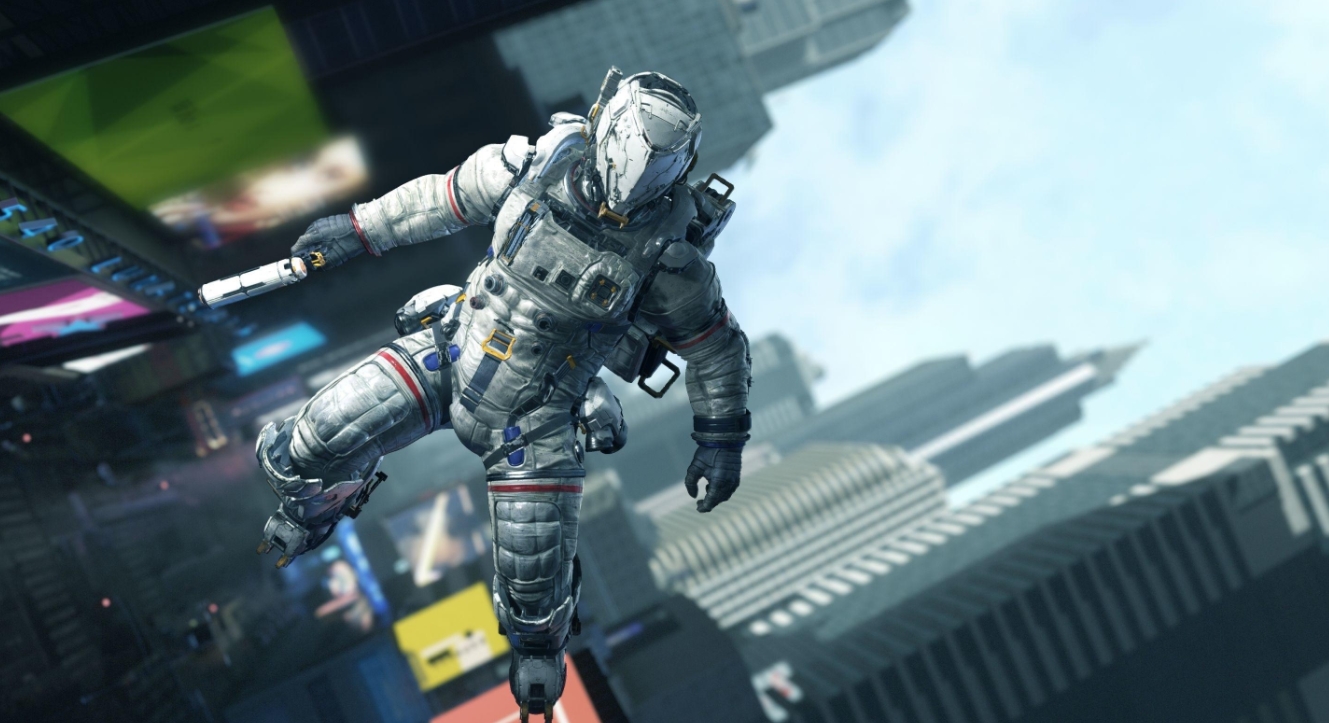
Capcom Pragmata is a third—person sci-fi action game set on an artificial intelligence-hijacked lunar station. The player controls Hugh Williams, a system auditor who has to get back to Earth in the company of an android girl named Diana. It sounds like a setting we’ve seen dozens of times, but the Pragmata game breaks the familiar by forcing you to simultaneously fire conventional weapons and play a real-time hacking mini-game.
In this review, we’ll look at everything in order: the release date and platforms, the plot and characters, the unique combat system, graphics on the RE Engine, system requirements, cost, strengths and weaknesses — and finally answer the main question: is it worth spending time and money on Pragmata right now.
Table of Contents
When Did Pragmata Come Out and on Which Platforms
The Pragmata release date is April 17, 2026. Initially, Capcom announced the release date for April 24, but a month and a half before the launch, it shifted the date a week earlier, retaining all pre-order bonuses as gifts for early purchase. The game is available on four platforms: PlayStation 5, Xbox Series X|S, Nintendo Switch 2 and PC via Steam. A separate nuance is that the version for the Nintendo Switch 2 in Japan and other Asian regions was released on April 24, a week later than the main launch.

The road to release turned out to be perhaps one of the most nerve-racking in Capcom’s history over the past decade. The Pragmata release date 2026 is the third announced date. The game was presented in June 2020 at the PlayStation 5 presentation: a short, mysterious trailer with an astronaut and a little girl against the backdrop of a destroyed lunar city. Initially, Capcom promised a release in 2022, then postponed it to 2023, and in the summer of 2023 announced an indefinite postponement. Two and a half years of silence — and only on the State of Play in June 2025, the game returned to the public field with a full gameplay trailer. The final date was announced at The Game Awards 2025. So the question of “when does Pragmata come out” is completely closed for Western players — it has already been released.
Pragmata Story: The Moon, Delphi Corporation and AI Uprising
The tie looks classic, but it quickly deviates from the patterns. Delphi Corporation has built the Cradle research station on the far side of the Moon, where a new mineral, lunafilament, is being mined. The material is almost magical: with the help of industrial 3D printers, anything from a residential building to living tissue can be “printed” from it. An AI manager named Idus monitors the base until the connection is cut off one day. A rapid reaction team led by Hugh Williams is being sent to investigate; Their ship, the Evrot, makes an emergency landing after a moonshake, and then everything goes according to the worst-case scenario.
Hugh gets separated from the group, gets seriously injured and comes to his senses already in the arms of a mysterious girl in white. She calls herself “Pragmata”. He gives her the name Diana himself, almost out of desperation. From that moment on, the station comes alive with hostility: service robots turn into killers, and the two heroes have to go through six sectors of the “Cradle” in search of a way home.
The best thing about the plot is not the events themselves, but the setting. The world of Pragmata is built around the concept of “hand-held AI-slop”: the lunar station is filled with holographic copies of terrestrial cities — from pieces of Manhattan to tropical gardens. And they’re all intentionally crooked. The taxi is fused into the sidewalk, the bus sticks out of the wall on the second floor, trees grow through office desks. Capcom artists emphasize in interviews that no neural networks were used to generate this world — all the “AI errors” were drawn manually. The technique works: you walk down the corridor and feel that the world around you is not real, but someone’s inept attempt to reproduce it.
The story has exactly one drawback, but it’s noticeable. The theme of artificial intelligence, replacing humans with machines, and corporate greed is all in the game, but it’s talked about in a straightforward way and without depth. In six years of development, the AI topic has gone from fresh to overheated, while Pragmata has remained at the level of “hinting at an important conversation.” By the end, the plot turns into a typical “capcom”: fast, functional, and straightforward.
Diana — The Android Girl and the Game’s Beating Heart
If the plot is Pragmata’s weak point, then Pragmata Diana is her undisputed main trump card. And this is just one of the rare cases when hype around a child partner is fully justified.
Diana Pragmata is not a “tipster-talker”, which is stamped by the dozens in the industry, and not a helpless NPC who needs to be dragged by the hand. She is a full—fledged second protagonist: with Hugh’s feet you walk around the base, and with her hands you literally hack everything alive and inanimate. In rare episodes, when the characters are separated, the combat system becomes defective, and this is physically felt.
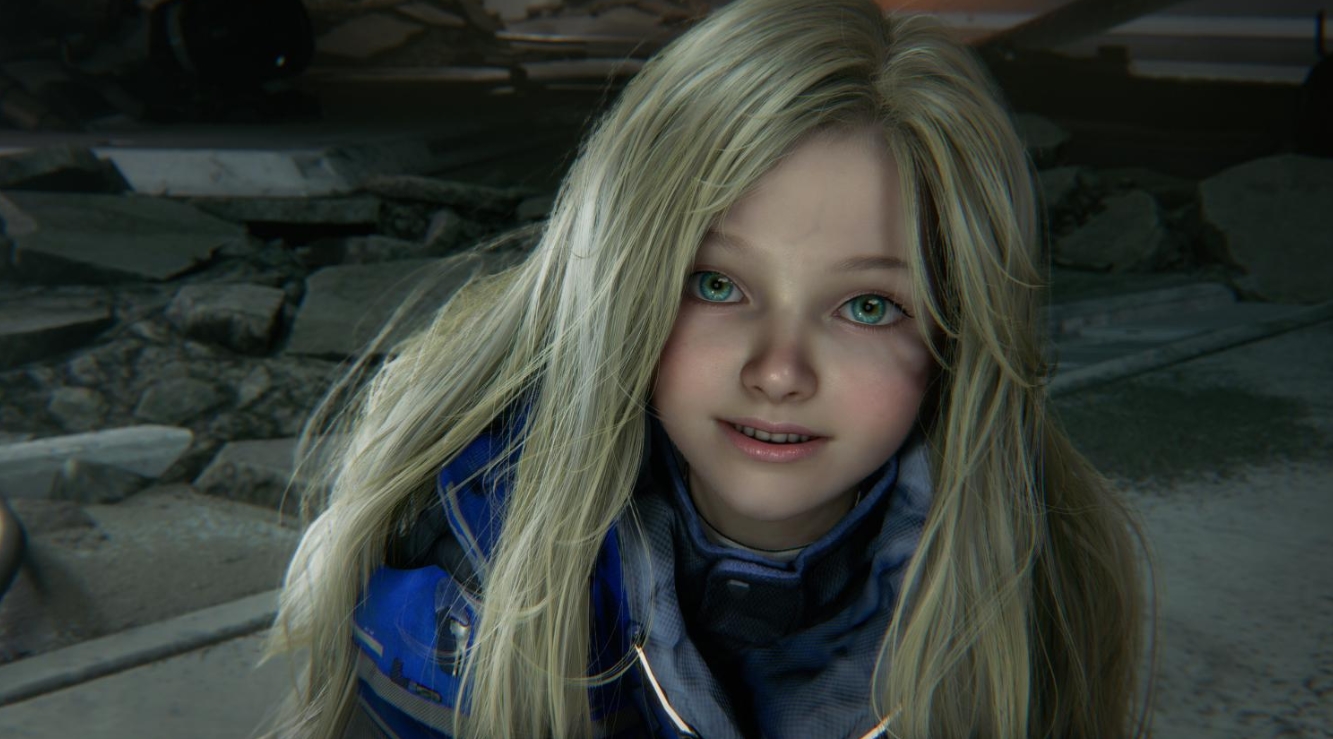
Visually, the Pragmata girl is a barefoot girl of about ten in a white dress, with big eyes and slightly mechanical movements. The references to Mega Man are not a fan theory, but an officially confirmed detail by Capcom. In an interview, the studio bluntly said: the visual similarity of Pragmata Mega Man is a deliberate homage to the cult series. The effect of the ominous valley is dosed: most of the time, Diana looks like a living child, but in some angles and intonations of voice actress Grace Saif, something machine—like suddenly slips through – and you get goosebumps.
The main strength is the chemistry between the characters. Unlike God of War (2018), where Kratos grumbles half the game and simply calls his son “kid,” Hugh accepts the Pragmata kid quickly and without drama. The nickname “Dad Space” grew out of these scenes — modest, everyday, without strain and moralizing. Diana asks Hugh about the Earth, teases him, and is embarrassed by her own fear. And it works better than any monologue.
Pragmata Gameplay: Shooting and Hacking at the Same Time
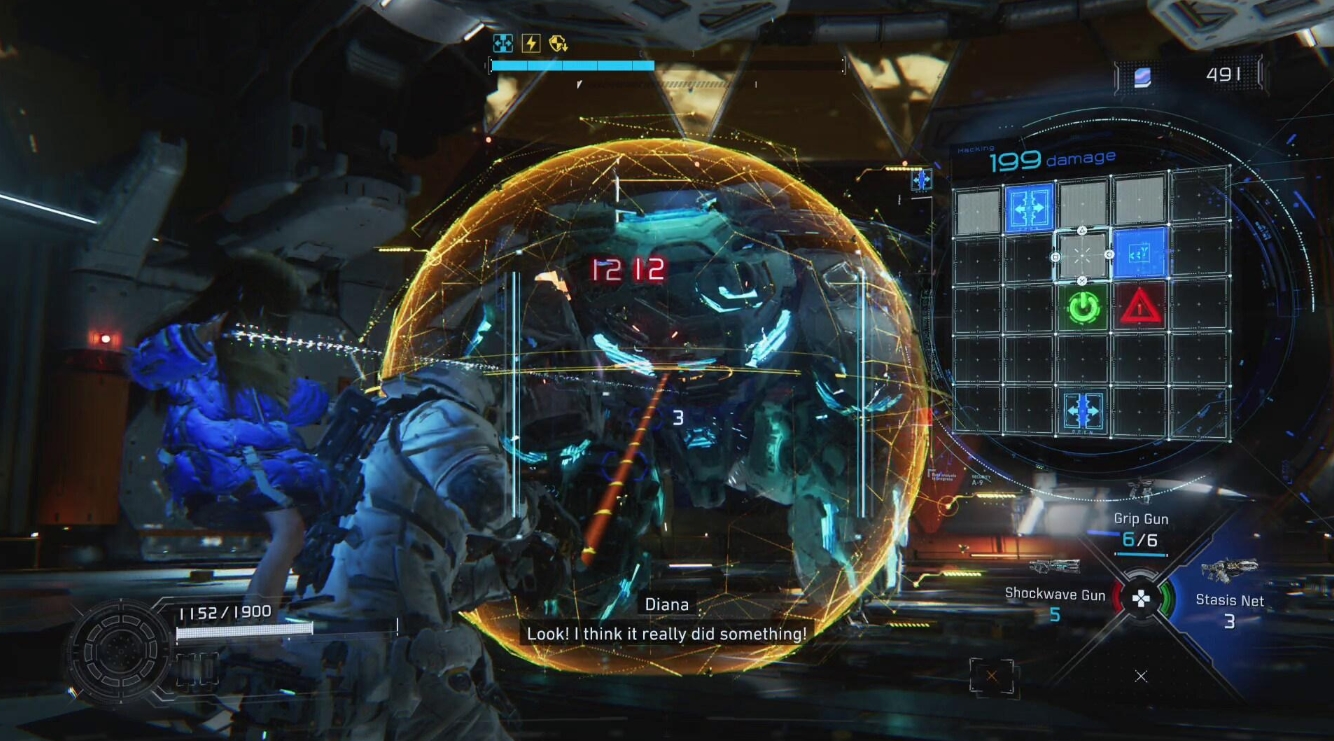
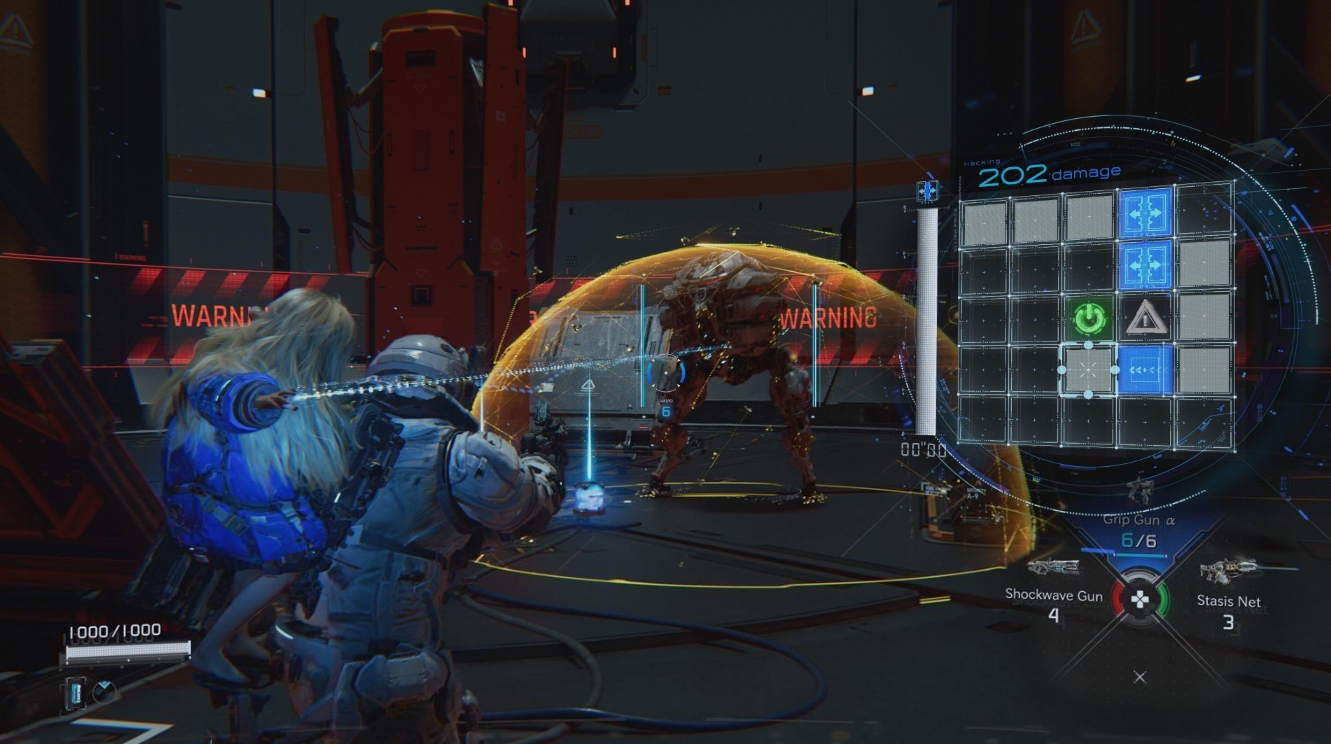
Now, about the main thing. Pragmata is built around one idea that sounds like a bad pitch and works like pure gold. Imagine: you aim at a robot, press the right mouse button, and a grid of cells appears on the right side of the screen. This is Diana’s hacking matrix. It has a starting point, a green finish line and bonus nodes scattered along the way — “Heating”, “Confusion”, “Healing”, “Stagger” and a dozen more effects. While Hugh’s left hand continues to shoot, his right hand — through the front buttons of the gamepad or the WASD keys on the keyboard — leads the “snake” from start to finish, collecting the necessary nodes. A successful hack reveals the enemy’s armor, and the collected effects turn the battle into a combo machine.
It sounds like a nervous breakdown for coordination. It works amazingly well. Capcom has perfectly measured the dose of difficulty: for the first couple of hours, the brain resists, then naturally decomposes the load into two streams. Critics have already called this the “Apache pilot effect”: one eye on the scope, the other on the dashboard, and over time this ceases to be a problem. Hacking is a little faster on the mouse and keyboard, and it’s easier to control dodging and weapon rotation with the gamepad. Both are working options.
Separately, I would like to praise the evasion. They have a soft souls-like principle sewn into them: a perfect dash at the last moment rewards a slow mo and a guaranteed critical slot. Not as hard as in Sekiro, but enough to turn the fights into a rhythmic dance. And Diana has an Overdrive Ultimate Protocol that accumulates from successful hacks. You can spend it on a powerful breakthrough of the boss’s armor, a massive stunning wave or chain hacking of several opponents at once. You’ll have a hard time in late fights without Overdrive.
The structure of the game consists of six sectors of the lunar base, and each is built according to the familiar “key—lock” formula. You look for the terminal, break down the door, go further, get into the arena, turn into a hidden corridor behind a Cube Token, go out to the boss. This is a return to the style of linear action games of the PS3 and Xbox 360 era — to Vanquish, to Binary Domain, to the first Dead Space. No open worlds, no radio towers, no icons of side activities that pollute the map. And that was really missing.
The main complaint is the repeatability in the second half. Closer to the fifth sector, you begin to recognize the arrangement of shelters at a glance, and the enemies cease to surprise. Capcom is trying to compensate for this with new hacking modules and fresh bosses, but fatigue is still coming. The short length saves you — it’s harder to get to burnout than in a typical thirty-hour title.
Weapons, Upgrades and Bosses
Hugh has six types of weapons in his arsenal, from a starter pistol with a six—round clip to an experimental laser cannon (which, by the way, is disappointing — Capcom clearly didn’t know how to balance it). Ammunition is always scarce, it takes a long time to reload, and this forces you to constantly change barrels: you fired a shotgun, finished off with a machine gun, picked up a grenade launcher from the corpse of an enemy. By the end, you perceive the arsenal not as your favorite weapon, but as a deck of cards that must be constantly shuffled.
Leveling is divided into two trees. Mods for Hugh — active and passive perks: Overclocked Weaponry accelerates the charging of alt-fire, other mods increase damage to weakened enemies, give overload shooting at low ammo, and so on. Diana’s hacking slots are a separate branch: the number of nodes per hack, the duration of the effects, the size and shape of the matrix. Pumping in only Hugh is a classic beginner’s trap: by the fourth sector, fights require complex combo hacks, and without a pumped-up Diana, you will simply be torn apart. There is only one resource — the lunafilament; it is spent in the Shelter hub through the Unit Printer terminal.
Bosses are the pinnacle of design. Each of the six is a huge multiphase monster with its own logic: first you open the armor plates, then you destroy the key nodes, then you survive in the rage phase. The huge industrial robot gardener in the greenhouse is more memorable than half of the plot scenes. And this is perhaps the main compliment to the combat system.
Graphics and RE Engine: How Pragmata Looks and Sounds
Pragmata runs on the RE Engine, Capcom’s proprietary engine, which we’ve seen in Resident Evil Village, Dragon’s Dogma 2, and Monster Hunter Wilds. Here he does his best: detailed lunar landscapes with correctly lowered gravity, the glare of spacesuits in reflections, convincing imitation of vacuum through muffled sound and separate lighting logic. The enemy robots are recognizable by their silhouette – at a glance it is clear who is flying, who is scattering mines, and who is breaking into close combat.
The art directorate is a separate achievement. The aesthetics of the “hand-made AI-slop” work as a stylistic nail: a taxi in asphalt, a bus out of a wall, a holographic forest through concrete. These are not bugs, this is a deliberate trick, and it adds to the general feeling that the moonbase is a broken simulator of someone else’s hand.
The soundtrack by composer Seo Kohei is muted, almost ambient, with bursts of orchestration in boss fights. Silence works best: in the empty corridors, only Hugh’s breathing and the slight rustle of Diana’s dress on his back can be heard, and the tension grows without musical pressure.
From technical complaints, the patch of the first day had to be released almost immediately, it closed the problems with downloading saves on PS5 and a couple of crashes on Switch 2. Frame Generation in DLSS 3 on Full HD noticeably soaps the picture — it is worth turning on only from 1440p and above. There is no full-fledged Russian voice acting: there are only English and Japanese tracks with translated subtitles and an interface. For a chamber story with constant dialogues, this is a significant loss — you have to read in battle, which sometimes slows down the pace.
Pragmata PC System Requirements
Now about the pragmatic one. On PC, the game is voracious and is clearly designed for hardware in 2023-2026. The operating system is Windows 11 with DirectX 12 only. RAM requires 16 GB already at a minimum, a 40 GB SSD is required; the game refuses to run on HDD in principle.
| Parameter | Minimum | Recommended |
|---|---|---|
| OS | 64-bit Windows 11 | 64-bit Windows 11 |
| CPU | Intel Core i5-8500 or AMD Ryzen 5 3500 | Intel Core i7-8700 or AMD Ryzen 5 5500 |
| Graphics | 6 GB GeForce GTX 1660 or 8 GB Radeon RX 5500 XT | 8 GB GeForce RTX 2060 Super or 8 GB Radeon RX 6600 |
| RAM | 16 GB | 16 GB |
| API | DirectX 12 | DirectX 12 |
| Internet | Broadband access | Broadband access |
| Drive | 40 GB of free space, preferably on an SSD | 40 GB of free space, preferably on an SSD |
| Notes | With the preset “Performance”, it is expected to be about 45 frames/s in 1080p. FPS can be slow in heavy scenes. | With the “Balance” preset, we expect about 60 frames/s in 1080p. FPS can be slow in heavy scenes. To enable ray tracing, you will need a 12 GB Radeon RX 6700 XT or a 12 GB GeForce RTX 3060. |
There are several important nuances. Full-fledged Path Tracing only works on the GeForce RTX 4000 and 5000 series; on the RTX 3000, it is formally enabled, but it sags in the slideshow. DLSS is integrated efficiently, with almost no artifacts. Processors with 4 cores pull at least with difficulty — Capcom actually focuses on 8-core CPUs. And again: run Sketchbook on your system before purchase. This is the only honest benchmark.
How Many Hours Is Pragmata and What’s After the Ending
The main Pragmata campaign runs in 10-12 hours on standard difficulty, if you walk in a straight line. With a full collection of collectibles — Dice Tokens, mini leveling cubes, audiologists, hidden Red Zones with increased rewards — the counter runs out at 15 o’clock. For a 2026 AAA action game, this is very compact, and here it’s an advantage, not a disadvantage: the game ends exactly when it should.
After the credits, the postgame “Unknown Signal” opens — a series of challenges with enhanced versions of bosses and special modifiers. During the passage, an item is given that opens a secret scene: it transparently hints that Hugh survived infection with a “dead filament” and was picked up by a friendly robot named Cabin. The application for a sequel is obvious. Plus, the classic New Game Plus with saved leveling and Lunatic Mode is a hardcore mode with reduced resources and doubled enemy damage. Some of the postgame content is required for 100% achievements, so platinum players won’t get bored.
Pragmata Price, Editions and Pre-Order Bonuses
The game has three editions. The Pragmata Standard Edition is a basic version for $69.99 on consoles and $59.99 on PCs (prices in the Kazakhstan region are about 21,999 / / 3,550 ₽). The Pragmata Deluxe Edition is 15-20% more expensive, and includes a Shelter Variety Pack with cosmetics for the Shelter hub, additional weapon modifiers, and alternative menu themes. The Pragmata Collector’s Edition was released in a limited edition in physical form only: A 20 cm high statue of Diana, a 120-page artbook, a two-CD soundtrack and a steel box. At auctions, it already goes for 1.5–2 denominations.
Pragmata pre-order bonus — and a purchase bonus in the first week of release — two costumes in the style of the Sengoku era: “Neo-Bushido” for Hugh and “Neo-kunoichi” for Diana. They look impressive, they don’t affect the gameplay. Owners of the Nintendo Switch 2 have access to a separate Pragmata amiibo, a Diana figurine, which, when scanned, gives out an additional pistol, a pack of recovery items, and an alternative costume skin in the game. The circulation of amiibo is limited — collectors should hurry up.
Pragmata Pros and Cons
In short, what Capcom did well, and where the rough edges remained.
Positive:
-
A unique combat system that you won’t find anywhere else
-
Hugh and Diana’s chemistry is one of the best duos of the game year
-
Excellent visual and art direction of “distorted AI”
-
Compact duration without fillers and “water”
-
No microtransactions, seasons, combat passes
-
Great bosses — everyone becomes an event
Minuses:
-
The plot starts with a strong bid, but is blown away by the finale
-
By the middle, the levels begin to repeat themselves in structure
-
The arsenal is limited, a few guns are frankly useless.
-
There is no Russian voice acting, only subtitles
-
High PC requirements for full-fledged ray tracing
-
There are few secondary characters — the game is chamber, sometimes you want real people
Is Pragmata Worth Playing: Final Verdict
In short, yes, Pragmata is worth your time.
It’s not a perfect game. The plot here is solid, but not amazing; the levels start to slip in the second half. But with a single bold idea – to make you shoot and solve a logical mini—game at the same time – Capcom has done something that almost no one else does in 2026: it has provided an original, unique gaming experience.
Who should definitely take it: fans of linear AA / AAA action games of the PS3 and Xbox 360 era; fans of the sci-fi genre; those who miss compact games for a couple of weekends; gamers tired of the service model with grind passes and seasons. If you remember why you loved Dead Space, Vanquish or Binary Domain, Pragmata will stand on the same shelf with them and will not shame anyone there.
Who better to pass by: fans of open worlds and hundreds of hours of gameplay; those looking for a heavy, tear—wringing drama in the spirit of The Last of Us; players who find it physically difficult to keep their attention on two processes at the same time – the hacking mechanics require this all the time.
Pragmata is one of the main surprises of 2026 and a real contender for The Game Awards nomination. And, perhaps, it is such games — short, bold, with their own face and without the desire to sell you something from above – that remind us why we still love video games in the first place. Capcom took the risk for six years in a row — and the risk paid off.
How to play Pragmata for free on Steam via VpeSports
Sometimes you don’t just want to launch another game, but really fall into the atmosphere — so that it would be a little strange, a little disturbing and at the same time wildly interesting. Pragmata is just about this feeling. There is no familiar “hero saves the world” here — on the contrary, it’s as if you find yourself in a strange, cold future where everything has already happened, and now you just have to figure out what exactly. Empty stations, dim lights, strange silence, and an android girl who clearly knows more than she’s letting on. And you walk next to her, gradually gathering a picture of what is happening.
The best part is that you don’t have to spend a lot of time to immerse yourself in all this. We made everything as simple and human as possible. You register on the website, log into your account, find the Get Access button at the beginning of the article, and then just a couple of steps. No problems, everything is fast and clear so that you can go straight to the game itself, rather than messing with the settings.
If you want to stay on topic, don’t miss updates, and generally be “inside the movement,” check out our Telegram channel. There are always new accounts, game news, patches, and sometimes just discussions where you can read other people’s impressions or share your own. If something doesn’t work or you have questions, you don’t have to figure it out alone. There is a detailed guide with explanations in human language, and if that’s not enough, you can just write to us. We are in touch and help normally, without formalities.