

Pathfinder: Kingmaker, released in 2018, quickly gained a reputation as a challenging project. On the one hand, it was the first video game based on the iconic Pathfinder desktop system and at the same time the debut of the Russian studio Owlcat Games. On the other hand, it was a large—scale, sometimes heavy RPG experiment that caused diametrically opposed emotions among the players. To start in such a difficult territory, the result was impressive: with a modest budget and a small development team, Kingmaker offered a truly epic scale, dozens of storylines, variable quests and a deeply developed role-playing system with classes, skills and tactical battles.
The game was literally immersive. Exploring locations, developing characters, party gameplay, and complex moral choices could keep you on the screen for weeks. The atmosphere of a classic isometric RPG inspired by Baldur’s Gate and Pathfinder tabletop format was felt in every detail — from the dialogues to the structure of the passage. However, the main problem of the project was hidden behind this depth: Owlcat Games clearly overestimated its production capabilities.
The studio decided to combine a traditional party RPG with a full-fledged kingdom management, where the player had to deal with economics, diplomacy, resource management and internal crises. On paper, the idea looked fresh, but in practice it made the gameplay harder and ruined the pace of the narrative. Instead of an organic plot development, the player was increasingly faced with routine, timers, and overloaded mechanics that turned an epic adventure into a drawn-out strategic marathon.
With the release of Pathfinder: Wrath of the Righteous, history has largely repeated itself. The second part has become even bigger, darker and more ambitious: the developers have added mythical development paths, complicated the combat system and made the plot more epic. It can be seen that Owlcat Games has taken into account some of the past mistakes — the interface has become more convenient, the campaign structure is more logical, and the narrative is more confident. Nevertheless, the familiar problems have not disappeared: overloaded mechanics, controversial design decisions and technical roughness are still making themselves felt.
And yet, despite all the flaws, Wrath of the Righteous, like Kingmaker, knows how to delay. This is the kind of CRPG that captures depth, freedom of choice, and a sense of a large, vibrant world. It’s just that at some point you want the fun of the passage to be clean and exciting — without constant tension, struggling with the interface and gritting your teeth from another unfinished element.
Table of Contents
Pathfinder: Wrath of the Righteous – Enhanced Edition Free Steam Account
If Pathfinder: Kingmaker has passed you by for some reason, this does not mean that the road to Wrath of the Righteous is closed. Yes, familiarization with the first part provides additional context and a couple of pleasant references, but the sequel is quite self-sufficient. As before, we are looking at a digital adaptation of the Pathfinder tabletop campaign of the same name, and connections to past history are limited to cameo appearances, mentions, and minor characters. The political intrigues of the Stolen Lands are a thing of the past — the new chapter of the saga unfolds in a much darker setting, on the ruins of the fallen state of Sarkoris.
Story, RPG System, and Mythic Paths in Pathfinder: Wrath of the Righteous
Once upon a time, these lands were wiped off the map due to the World Plague, a giant portal into the Abyss from where demons poured into the mortal world. For a hundred years, the neighboring kingdoms had been trying to contain the invasion by launching one crusade after another, but the endless armies of the Abyss had only been grinding away at the next expedition. As a result, they decided to isolate the ulcer — a chain of consecrated monuments was erected around it, forming a kind of magical quarantine. However, even this fragile defense system only lasted for the time being.
The illusion of calm collapses in the very first minutes when Descari, a demonic lord known as the Locust King, descends on the border town of Kenabres. His goal is simple: to desecrate the shrine and destroy the barrier, opening the way for the demons to the entire mainland. The only chance for salvation is the main character, a mysterious survivor with a mysterious wound in his chest. Caught in the epicenter of the disaster, the protagonist will not only have to recapture the city and rally the survivors, but also lead the Fifth Crusade — the last and possibly the final act of the hundred years’ war.
After the relatively mundane Kingmaker, where the emphasis was on intrigue, politics and enchanting conspiracies, such a plot looks almost classic: the chosen hero against absolute evil. However, for a CRPG inspired by the Infinity Engine era, there’s nothing wrong with that. Wrath of the Righteous consciously follows the canons of Baldur’s Gate, Icewind Dale, and Planescape: Torment. Everything here is familiar and old-school at home: a party of six characters, real-time battles with a tactical pause, voluminous dialogues, journeys through ruined lands and intricate dungeons. Without interactive surfaces, without spontaneous reactions and other fashionable solutions — pure, concentrated classics.
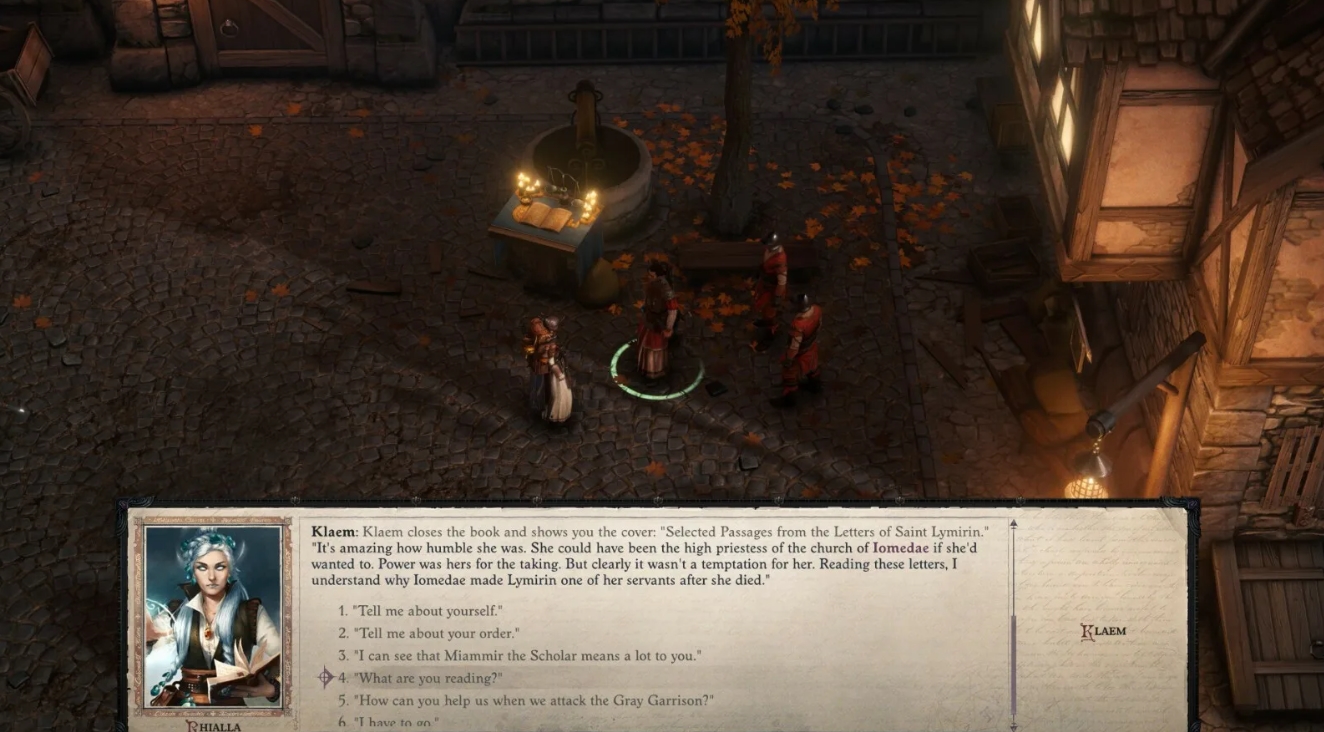
And for those who are confused by the radical course of Baldur’s Gate III led by Larian Studios, this is most likely great news. Wrath of the Righteous does not try to rethink the genre — it carefully preserves it and develops it in depth.
However, there is a nuance that immediately separates the Owlcat game from most other CRPGs, old and new. Wrath of the Righteous is based on the Pathfinder system — and it sets the tone for the entire gameplay. On the surface, it seems close to Dungeons & Dragons: d20 rolls, defense classes, skill checks, spell slots — everything is familiar. But this similarity is deceptive. If D&D became simpler and friendlier to beginners with each revision, Pathfinder always went the opposite way, focusing on those who like numbers, formulas and complex builds.
It feels like the difference between the current fifth edition of D&D and the first edition of Pathfinder is about the same as between plastic LEGO and an old metal construction kit: both allow you to assemble a house, but the approach and level of engagement are incomparable. Wrath of the Righteous requires attention, patience, and a willingness to figure things out—and rewards you handsomely for it.
The interface literally throws an avalanche of information at the player, but over time you get used to it. Although it’s still easier to forget that magicians need to manually prepare spells and monitor the book of spells, and the system does not forgive mistakes.
But in terms of the depth of the role-playing, Wrath of the Righteous is perhaps the closest digital RPG to the desktop source. Already at the start, 25 basic classes are available, and later prestigious options open up. There are five to seven subclasses inside each one, radically changing the style of the game. The scope for customization here is enormous. An alchemist, for example, can be a bomb thrower, a summoner, a support healer, or a mad vivisector who slashes monsters in close combat under the influence of his own mutagens.
Not all solutions are equally effective, the balance is sometimes lame, and some options seem secondary. But that’s the philosophy of Pathfinder: the same role can be implemented in a hundred different ways. Each build is a reflection of your tactics, preferences, and imagination. Personally, the role of the tank was not played by a paladin in heavy armor, but by a holy swordsman — a hybrid of a fighter and a magician without armor, but with illusions, protective charms and solid damage. And given multiclassism, it’s scary to imagine what combinations the community will get to.
At the same time, the game does not allow you to endlessly abuse the mechanics of rest. Yes, you need to rest to restore spells, health and relieve fatigue, but every night in infected regions increases demonic contamination, gradually eroding the characteristics of the squad. Even at the survival level, Wrath of the Righteous makes you think ahead.
Get it all without the cost! Use a free steam account with now.
And if all this doesn’t seem enough, mythical paths come on the scene — a key feature of the game. In the desktop version of Pathfinder, they were elite superclasses, almost divine in strength. The digital adaptation of Owlcat has gone further. The mythical path is not just a set of skills, but a full—fledged development branch that affects the plot, appearance, abilities, and even a character’s worldview. Angels shine with halos and punish demons with sacred fire, azathans receive chaotic “superpowers” and companion dragons, lychees raise fallen NPCs, and the trickster breaks the fourth wall altogether by playing with the very mechanics of throws.
Wrath of the Righteous’ Combat System: Difficulty, Balance, and a Failed Tutorial
Unfortunately, the overall impression of Wrath of the Righteous is noticeably spoiled by one system flaw: the game explains its own rules and nuances of role-playing mechanics extremely poorly. For those who have already passed Kingmaker or are familiar with the desktop Pathfinder, this will not be a serious problem — the basic principles, classes and interaction of effects are intuitive to them. But everyone else will have to regularly stumble upon questions that the game simply does not provide answers to. Wrath of the Righteous behaves as if a trained veteran is sitting on the other side of the screen, who is a priori obliged to understand formulas, statuses and hidden penalties.
Formally, the developers tried to lower the entry threshold: the game has an in-game encyclopedia, tooltips and help windows. But in practice, this information is provided fragmentally and superficially. It often feels like instead of learning, the player is being gently pushed to read the original Pathfinder rulebook — at least everything is set out consistently and in detail there. As a result, familiarity with mechanics turns not into a learning process, but into a method of trial and painful errors.
Because of this, the player has to constantly and carefully study the characteristics of opponents. Attempts to act blindly almost always end up with wasted spells, perks, and precious seconds in battle. And this is critical, because Wrath of the Righteous is primarily a game about battles. You spend the lion’s share of your time fighting: diplomacy and alternative conflict resolution methods rarely work in the crusade against demons.
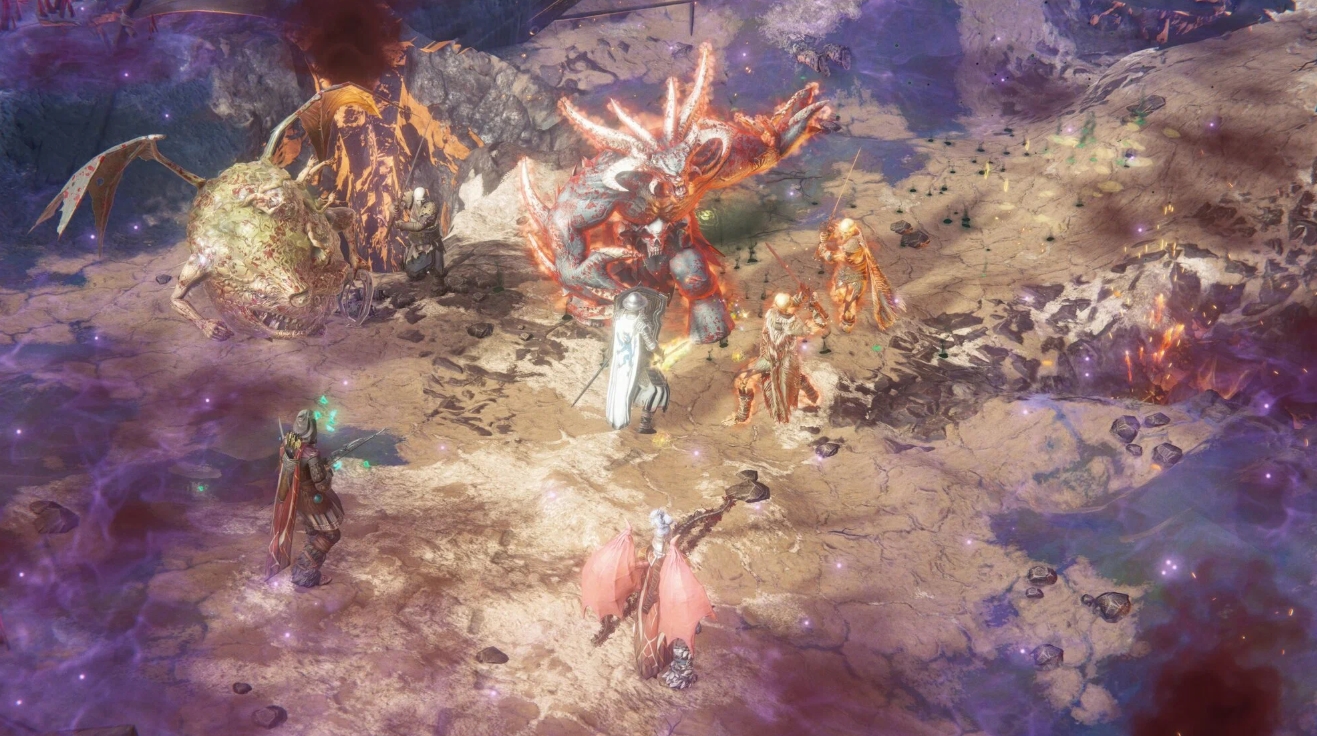
The combat system itself is quite classic by the standards of isometric RPGs: micromanagement of the party, positioning, flanking attacks, buffs and debuffs. But at the same time, it feels rich and varied. Due to skills, spells, equipment, and synergies, the player always has a choice of tactical approach. At the best moments, key battles and dungeons turn into real tactical puzzles, where success depends on preparation and understanding of the system.
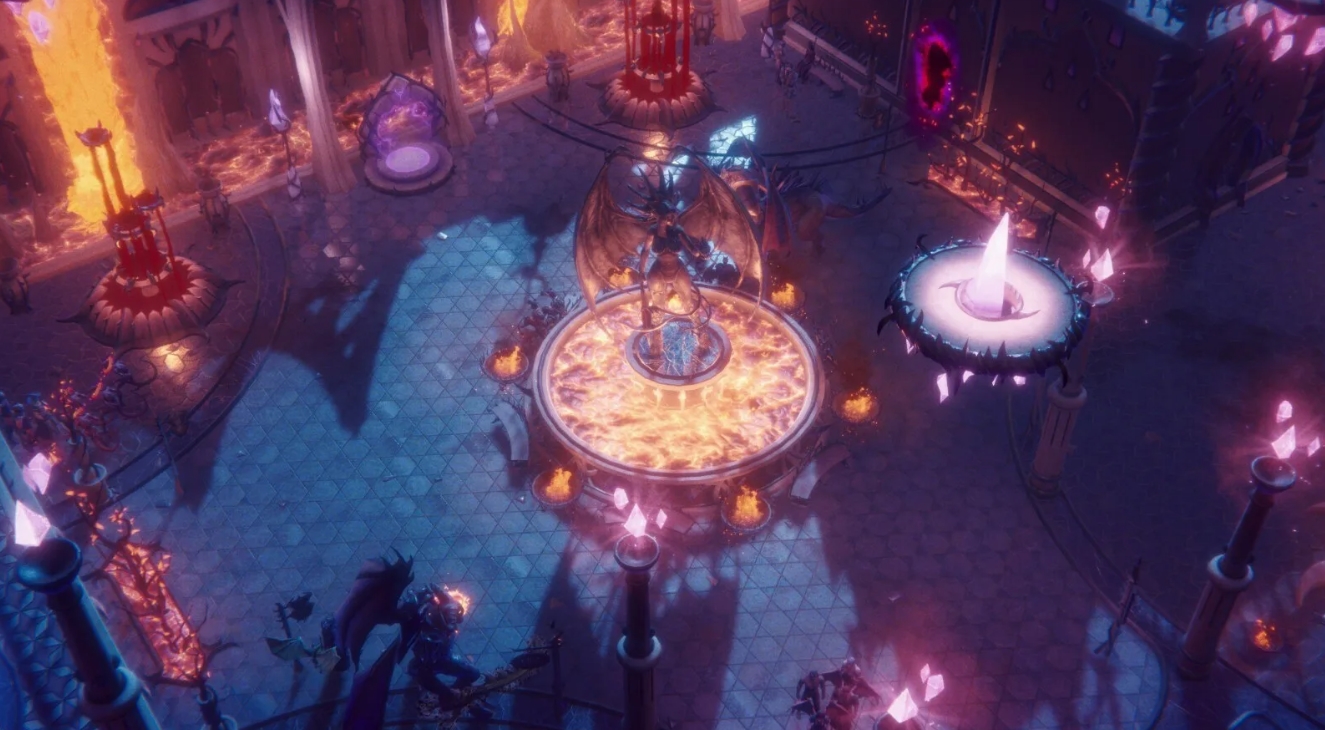
The problem is that at its worst, Wrath of the Righteous feels like a game that punishes you for not knowing the rules that you didn’t even know existed. This is most often reflected in small but critical details:
-
Penalties for ranged characters attacking enemies bound in melee, which are removed with only one highly specialized perk;
-
Innate resistance to magic in demons, which makes spellcasters almost useless without “punching” leveling;
-
There are different types of negative effects, such as disease and sickness, which are considered fundamentally different conditions and require separate countermeasures, despite the similar description.
Such nuances don’t just complicate the gameplay — they break the sense of fairness and predictability of battles.
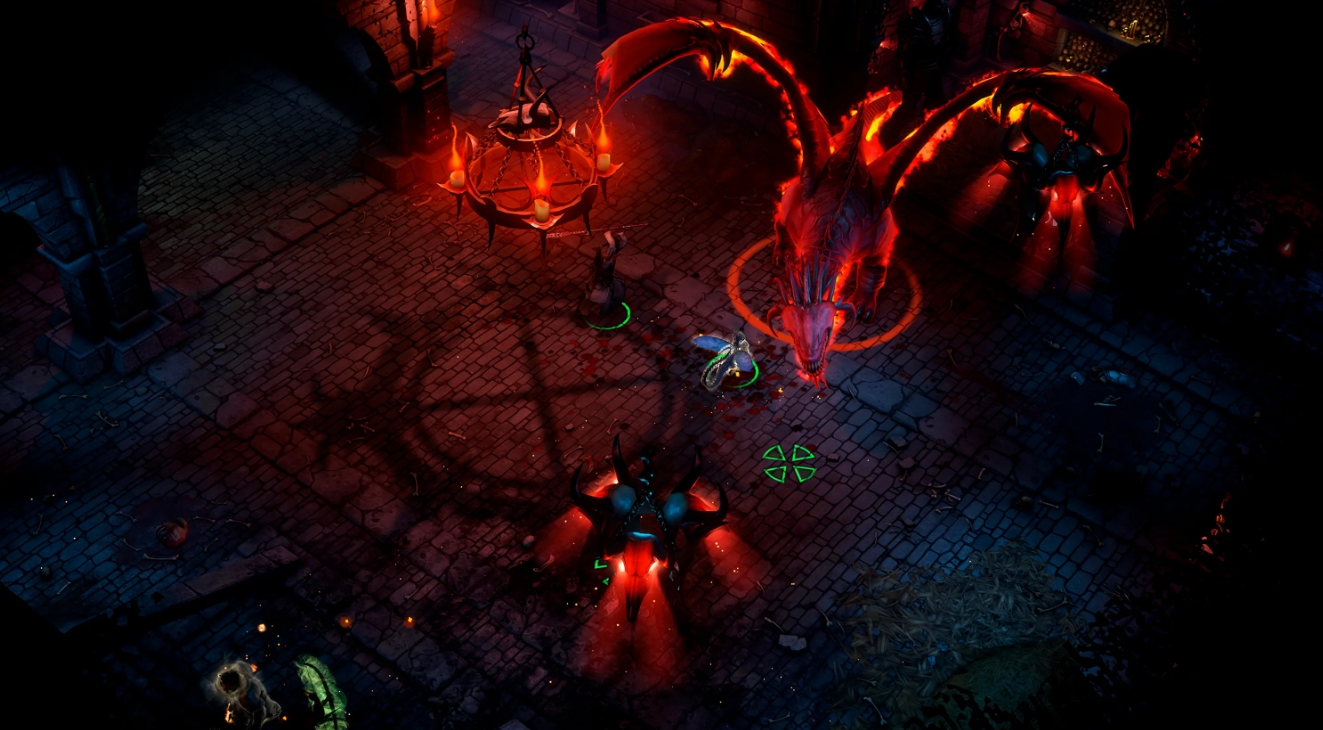
The situation is aggravated by the visual chaos on the screen. In the midst of a battle, effects, animations, and interface elements overlap, making it difficult to keep track of what is happening. Fortunately, Wrath of the Righteous allows you to switch from real-time combat to turn-based mode at any time. In difficult encounters, this is literally a lifesaver — especially when maximum concentration and precise calculation of actions are required.
All these details are especially noticeable because the battles here really require tension. Even on standard difficulty, the game underestimates the characteristics of opponents by default — and it does it for a reason. The outcome of a battle is often decided by a single critical hit or miss. One unprepared spell can turn an ordinary skirmish into a hopeless situation, and vice versa. This has its own charm: the system encourages planning and a thoughtful approach. But at the same time, serious balance problems are being revealed.
Yes, Wrath of the Righteous is not as broken as Kingmaker at the start, but the distortions are still noticeable. Most quests can be completed by a party of almost any composition, without delving deeply into optimization. And then suddenly the game throws up a sharp and unjustified jump in difficulty — a battle clearly designed for a perfectly assembled group with an accurate selection of skills and perks. If you entrust the pumping of companions to automation, it turns out an unpleasant thing: you probably won’t have an “optimal party”.
As a result, the player is faced with a choice without good options: either return to the base and manually rebuild the builds, or temporarily reduce the difficulty. To Owlcat Games’ credit, the settings system allows you to fine—tune the parameters, from damage to AI behavior. But in an amicable way, there is nothing to praise here: the developers have provided a crutch for a problem that ideally should not have existed at all.
In many ways, this feeling arises because Wrath of the Righteous resembles a tabletop campaign without a live wizard. In a classic role-playing game, the host can always soften the rough edges, adjust the difficulty, or help the group not get stuck. It also gives the impression that the campaign is led by a strict and indifferent master. He doesn’t care if the players enjoy themselves — it’s just important that all the rules are followed literally, and deviations from the “book” are not allowed.
Someone will surely like this hardcore and principled approach. But for me personally, it has become one of the main sources of frustration — especially in those moments when random battles on the global map put the squad in such a losing position that all that remains is to grin and load the save.
Wrath of the Righteous’s Scale: Crusade, Pacing, and Implementation Challenges
Another feature that makes Wrath of the Righteous stand out from other CRPGs is its scale. Owlcat Games has once again decided to combine a classic role-playing game with a more “top-level” control system. If in Kingmaker the player was engaged in the development of the kingdom and urban planning, then here he is given a much more pretentious role — commander of the crusade. It sounds impressive, but in practice there are not so many differences. There is still the need to return to headquarters regularly, sort out accumulated cases and make management decisions through simple dialog boxes. Only now there are almost no skill checks: it is enough to choose an answer option and the event is considered closed.
However, crusade management also has a strong side. It creates the feeling of a living world that exists independently of the player. As you travel through the ruined lands and fight demons, the Commander’s headquarters is bustling with life. Officials, generals, religious leaders, knights, and ordinary residents are constantly addressing their concerns. Some situations are presented with irony, others are frighteningly mundane. The quartermaster complains about the poor supply of the army, the field commander complains about the decline in morale, desertion and internal conflicts. The line with the foreign policy adviser is particularly memorable: the crusade turns out to be such an important factor that neighboring powers are trying to use it in their own palace intrigues. And even if you don’t care about their games, disagreement with the “official line” threatens diplomatic scandals.
Unfortunately, outside of these rare successful plot episodes, global management is still more distracting than enriching gameplay. Yes, compared to Kingmaker, there is less bureaucracy, and the game does not punish for small delays in completing quests. But the core of the problem has not gone away. No matter how serious the moral dilemmas may seem, their consequences almost always boil down to dry figures — abstract indicators of the crusade and lists of available troops. It is extremely rare to see real changes in the world, which is why many decisions feel like a formality.

And then the troops themselves take the stage. The demonic threat must be suppressed not only in story missions, but also on the global map — in turn-based army battles. And that’s where Wrath of the Righteous finally loses its pace. The battles look like an extremely simplified version of Heroes of Might and Magic V: no sieges, almost no tactics, minimum strategic decisions. No normal auto-combat, no depth — just collect more units and methodically clear demonic clusters, occasionally capturing forts. Of course, it would be naive to expect a full-fledged wargame on top of an RPG, but the result is still disappointing. The mechanics can be placed under AI control, but in this case it is easy to skip some of the optional content. In an amicable way, this element should either be brought to mind or completely eliminated — the game is already not too careful about the player’s time.
Yet the paradox is that, in general, this excessive scale works for the atmosphere rather than harms it. Wrath of the Righteous is a truly gigantic RPG, even by the standards of the genre. A prologue in a besieged city alone can take ten hours to complete unhurriedly, and when the military campaign unfolds in full force, even Dragon Age: Origins begins to seem compact. But this scale is justified: the plot develops slowly, but each of its turns feels significant, and the key turns are really surprising. The companions are described in detail and convincingly, and the long timekeeping allows them to reveal themselves without haste. Most of the central conflicts get a full—fledged climax, and important questions get clear answers.
Yes, the story is full of second-rate fantasy cliches, but it’s incredibly difficult to break away from it. I spent almost two weeks in the game, not out of professional duty, but out of sincere interest — a rare compliment for such a heavyweight CRPG.
At the same time, the feeling of tightness still does not disappear. Wrath of the Righteous could have been shortened by thirty hours without losing any quality. Moreover, it is in the final acts that the game begins to significantly sag. The flow of plot revelations dries up, surprises end, and the routine stretches longer than it should. By the end, minor inconveniences that I didn’t pay attention to before begin to seriously annoy. Why can’t you control armies directly from the fortress? Why put up with loading screens every time? Why can’t the camera on the global map be moved away or at least accelerated?
The only really bright spot of the final chapters is one special location, about which it is better not to say anything superfluous. Interpreted by Owlcat Games, it looks impressive and is able to reawaken the feeling of discovery.
And, of course, it is impossible not to mention the technical condition. If you expected that the experience of Kingmaker and a long testing period would rid the sequel of old sores, you will have to be disappointed. There are still many bugs in the release version of Wrath of the Righteous, including critical ones. Broken quest triggers, collision errors, malfunctioning scripts, broken abilities, and even entire classes, hotkeys that ignore clicks, stubs instead of text — almost a complete set of problems is collected here. Fortunately, there are few crashes on the desktop, but optimization leaves much to be desired: FPS can jump from a stable 144 to frankly obscene values, accompanied by microfreezes. In an ideal world, the game could use at least another six months of polishing.
Bottom Line: Is Pathfinder: Wrath of the Righteous Worth Playing?
Pathfinder: Wrath of the Righteous is a deliberately old—fashioned, large-scale and fascinating role-playing game that can both delight and annoy. It can easily become one of the best CRPGs of recent years for fans of hardcore systems, thoughtful gameplay and unhurried passing. At the same time, for less patient players, the Owlcat Games project risks becoming a clear example of why even the wildest creative ambitions need strict limits and editing.
The game requires the player’s time, attention, and willingness to put up with rough edges. If you are familiar with the format of classic isometric RPGs, real-time battles with tactical pause, and the complex Pathfinder role-playing system, Wrath of the Righteous can provide dozens or even hundreds of hours of intense adventure. Otherwise, it’s better to start exploring the series with Pathfinder: Kingmaker: if you like the first part, the sequel will almost certainly hit the target. And if not, it may be worth waiting for the next patches, which will slightly smooth out the sharp corners.
Pros
-
deep Pathfinder role-playing system with rich character customization and variable builds;
-
A tactical pause combat system that requires planning and understanding of the mechanics;
-
though secondary, it’s a solidly assembled plot with epic scope and memorable moments;
-
high-quality literary texts, lively dialogues and well-written companions;
-
a huge amount of content, designed for a long and thorough passage.
Cons
-
noticeable balance issues, especially in the later stages of the game;
-
excessive lengthening, which causes the pace of passage to the final to noticeably sag;
-
a weak explanation of the rules and mechanics, raising the entry threshold for beginners;
-
an expressionless crusade management that distracts rather than complements the gameplay;
-
a large number of bugs and technical flaws, as well as optimization problems.
Pathfinder: Wrath of the Righteous System Requirements
Pathfinder: Wrath of the Righteous
How to play Pathfinder: Wrath of the Righteous for free on Steam via VpeSports
Pathfinder: Wrath of the Righteous is a game where it’s easy to stay longer than planned. At first, you just go in to see what the story is, and after a few hours you are already making decisions on which the fate of entire nations depends. The demonic invasion feels not like a background, but like constant pressure: allies doubt, enemies do not forgive mistakes, and the power you receive beckons and scares at the same time. This is not just an RPG about battles — it’s a long, sometimes difficult path, where the game constantly asks: “Who are you ready to become for the sake of victory?”. And you can start this journey completely free of charge.
We have done everything to ensure that entering the game does not turn into a quest more difficult than the crusade itself. No confusing instructions or unnecessary steps — you just create an account on the site, log in and return to the top of the page. There is a “GET AN ACCOUNT” button, which begins your introduction to Pathfinder: Wrath of the Righteous. After that, you immediately get access to the game and can safely immerse yourself in the story without being distracted by technical details.
If you want to feel like you’re not alone on this journey, we have a Telegram channel for players. This is a place where new accounts appear, updates and patches are discussed, impressions are shared and difficult decisions in the plot are argued. And if something suddenly doesn’t work out or you have any questions, you can always look at the detailed guide for the free launch or write to the chat – real people will answer and help you figure it out without formalities and dry templates.