

In 2026, Call to Arms – Gates of Hell: Ostfront is no longer just a niche strategy for fans of the “old school”, but a full—fledged benchmark of hardcore RTS about the Second World War. Originally released in 2021 as an independent project from Ledwire Studios, the game does not require a basic Call to Arms and confidently exists on its own, developing through updates and DLC like Finest Hour.
Over the years, the project has managed to form a dedicated community and gain a foothold on Steam with a Very Positive rating, which is not an accidental indicator for such a complex and demanding game. Ostfront is not about fast skating rinks and spectacular explosions for show. This is a game for those who want to feel the tension of the Eastern Front, where every decision can cost not only a unit, but the entire operation.
If you are familiar with tank duels of the T-34 level against the Tiger, positional battles, engineering training and the feeling of a real war, rather than its glossy version, you have most likely already come to the right place.
Table of Contents
Why does the gameplay of Ostfront feel like a real war, not a strategy?
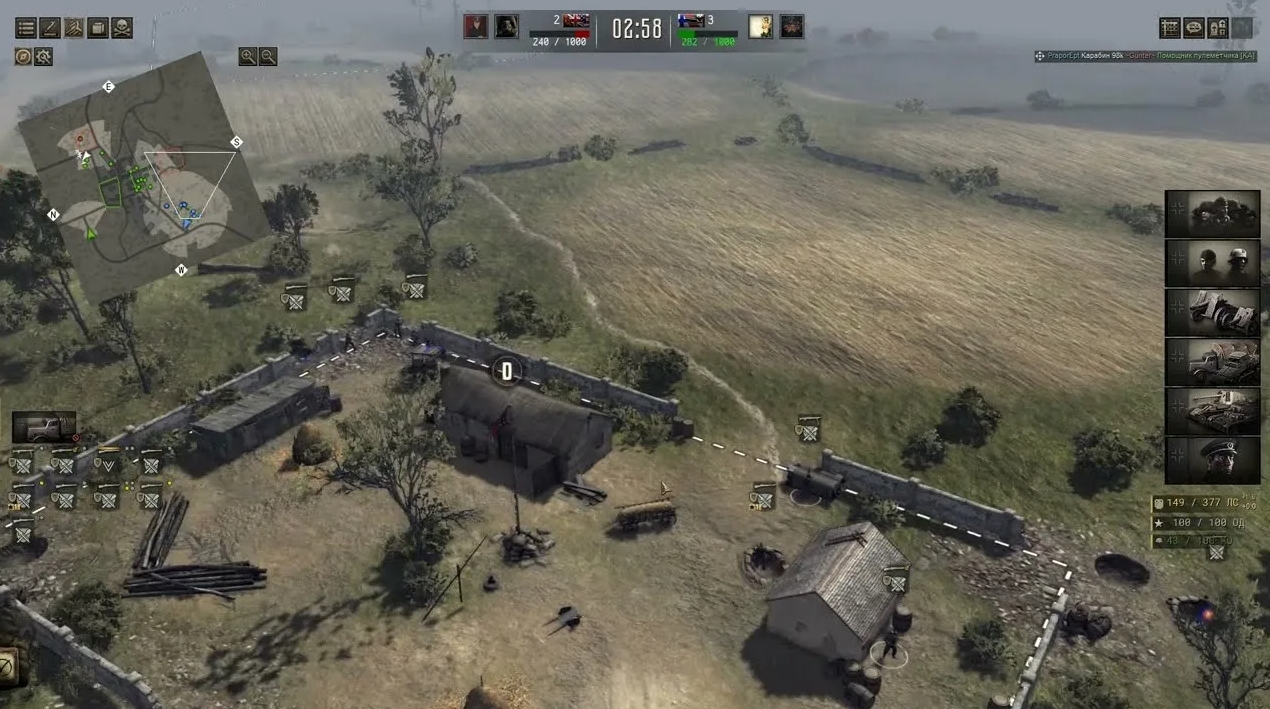
It becomes clear from the first minutes: Gates of Hell is not going to adapt to the player. There is no “soft entry” here — the game literally throws you into the mud, snow and chaos of the front. But that’s what makes it unique.
The main thing that distinguishes Ostfront is the depth of mechanics. The ballistics here are not conditional: the projectile actually calculates the trajectory, takes into account the distance, the angle of impact and the type of armor. A shot in the forehead of a Tiger from a weak cannon is almost a guaranteed ricochet. But if you go into the flank and break through the board, the situation changes dramatically.
And it’s not just about the “health of technology.” The damage is distributed by modules: you can knock out a caterpillar, set fire to an engine, or destroy the crew, leaving the tank formally intact, but useless. At such moments, you begin to think not as a player, but as a commander.
The moral system deserves special attention. The infantry here are not soulless units. Under heavy fire, soldiers may panic, retreat, or simply refuse to follow orders. Sometimes one well-thrown smoke or artillery salvo decides the outcome of a battle more than a numerical advantage.
Engineering is another layer that strongly influences gameplay. You can:
-
Build trenches and fortifications right during the battle
-
Set minefields and traps
-
Use smoke screens for maneuvers
-
Destroy buildings, turning them into shelters or vice versa — into ruins
And all this works not as a decorative element, but as a full-fledged tactical tool.
One of the game’s greatest strengths is the ability to switch between control modes. At any time, you can switch from the classic RTS camera to controlling a separate unit from the first or third person. And this is not a gimmick, but a really useful mechanic. For example, by personally controlling a PT gun, you can more accurately target vulnerable areas of tanks.
The modes are also not limited to a single campaign. The game has:
-
A historical campaign with dozens of missions and the possibility of co-op
-
Dynamic Conquest mode, where you gradually build up your army and resources
-
Multiplayer and PvE up to 4v4 with doctrines and stages of war
Conquest is especially catchy because each party develops in its own way. But without mods, it can start repeating itself — we’ll talk about this later.
Separately, it is worth noting the scale of the content. More than 250 units, including legendary vehicles like the T-34, Panther, IS-2 and Tiger, various types of infantry, artillery, aviation and even off-map strikes. At the same time, each piece of equipment feels unique — there is no feeling that you are just “spamming tanks”.
And, perhaps most importantly, the game does not forgive mistakes. Here, you can’t mindlessly send a squad forward and count on success. Any attack requires preparation: reconnaissance, suppression, and competent positioning. This makes every victory truly deserved.
The Eastern front that you feel: visual and atmosphere
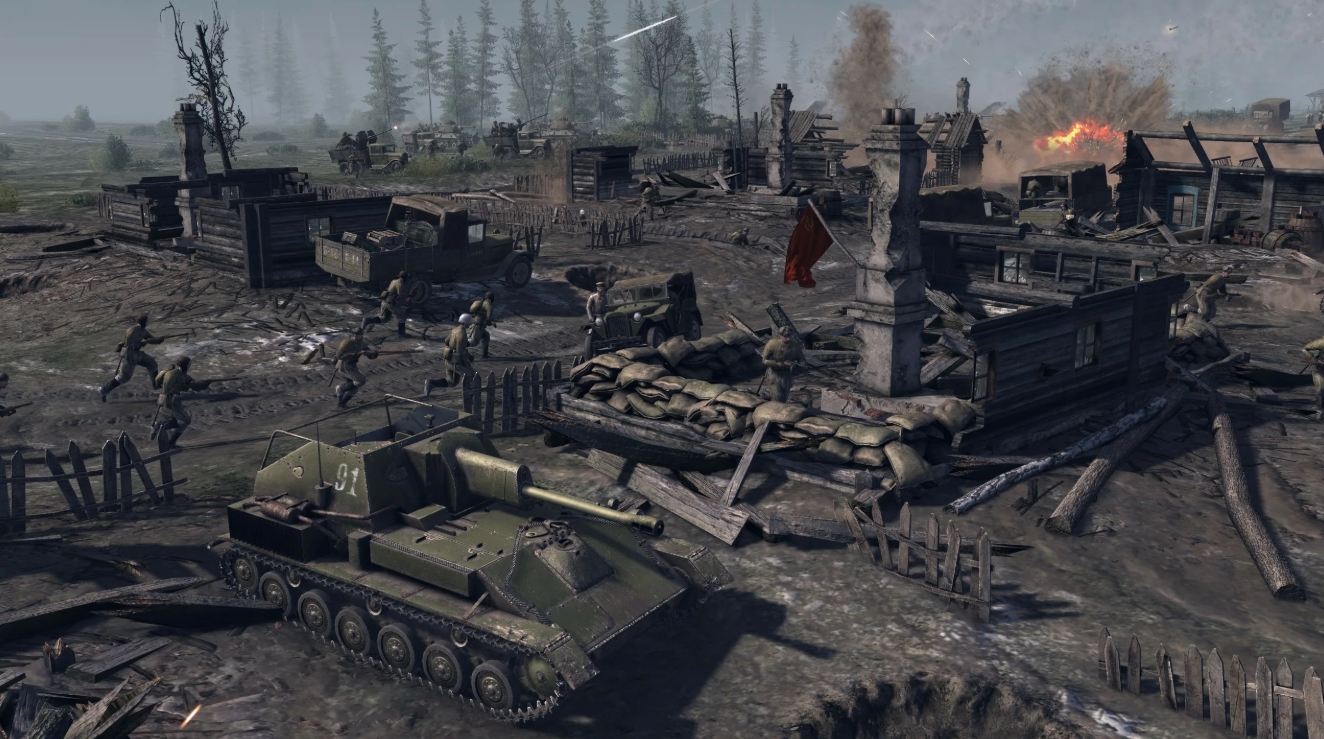
Graphically, Ostfront does not try to compete with modern AAA projects, but relies on something else — the atmosphere. The GEM2 engine does an excellent job of dealing with destruction: buildings crumble under shelling, the ground explodes from hits, and machinery leaves footprints in the snow and mud.
Winter maps are a special treat. A white field through which tracks of caterpillars make their way, smoke from burning machinery and sparse trees create a feeling of cold, ruthless war. And when a snowstorm begins, visibility drops, and the fight turns into a chaotic clash — the atmosphere reaches its peak.
Sound is another strong element. The shots feel heavy, the artillery rattles so that you involuntarily want to duck, and the soldiers’ remarks in Russian and German add authenticity. At some point, you catch yourself thinking that you’re just listening to the fight without even looking at the screen.
It is through such details that the game conveys the feeling of the Eastern Front of 1941-1945 — not heroic, but harsh and sometimes merciless.
Where is the line between story and game balance?
Ostfront strives for maximum historical accuracy, and this is evident in literally everything: from armor characteristics to ammunition types. Many of the operations in the campaign are based on real events, and the equipment behaves as it should within the historical context.
But, as in any game, there were compromises. Sometimes the balance requires simplifications. For example, certain units may be slightly “stronger” or “weaker” than in reality in order to maintain playability.
At the same time, for beginners, the game may seem excessively tough. There is no usual “learning” that will explain everything. You learn through mistakes — and sometimes it’s painful.
If we compare:
-
With Men of War, Ostfront feels like a deeper and more modern version of it.
-
With Company of Heroes 3, there’s less cinematography, but more realism.
-
With War Thunder, it’s closer in terms of attention to technology, but with full-fledged RTS gameplay
As a result, the game confidently occupies its niche: not for everyone, but for its audience it is almost ideal.
Strengths and weaknesses of the game today
Positive:
-
The deepest and most honest realism of the Second World War
-
Huge replayability due to mods, Conquest and multiplayer
-
Constant developer support and new DLCs
-
Frequent discounts make the game very affordable
Minuses:
-
Very high entry threshold — the game does not explain itself
-
Demanding hardware, especially in large-scale battles
-
Conquest can get boring without custom modifications
Some users prefer free steam accounts with games to test performance before buying anything.
Call to Arms – Gates of Hell: Ostfront System Requirements for PC
| Specification | Minimum Requirements | Recommended Requirements |
|---|---|---|
| Operating System | 64-bit Windows 7 / 8 / 10 / 11 | 64-bit Windows 10 |
| Processor | Not specified | AMD Ryzen 7 3700X |
| Memory (RAM) | 16 GB RAM | 32 GB RAM |
| Graphics | NVIDIA GTX 1070 or AMD RX 5600 | NVIDIA RTX 2070 or AMD RX 6600 |
| DirectX | Version 11 | Version 12 |
| Storage | 80 GB available space | 80 GB available space (SSD recommended) |
| Sound Card | DirectX 11 compatible | DirectX 12 compatible |
| Network | — | Broadband internet connection |
| Additional Notes | SSD and stable internet recommended for smoother gameplay | SSD and high-speed internet required for best performance |
Is it worth playing Gates of Hell: Ostfront in 2026
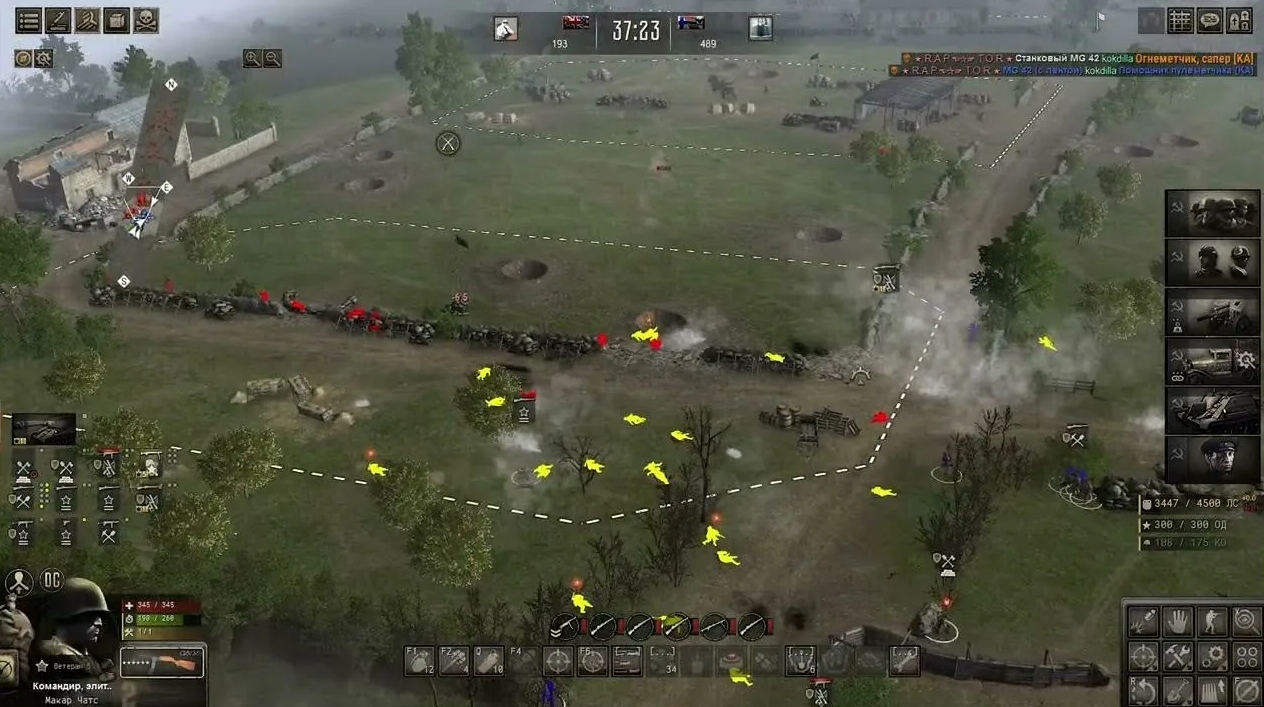
In short, yes, but with reservations. This is not a game that you will enter “for the evening.” It takes time, attention, and a willingness to learn. But if you are ready to invest, the return will be appropriate.
My score is 8.7/10.
This game is definitely suitable for those who grew up on Men of War or are just looking for the most in-depth RTS about the Second World War. There’s everything here: tactics, tension, variation.
But if you prefer more arcade strategies where you can relax and “chase units”, Ostfront may seem too heavy.
The best option is to take it at a discount. In this case, it’s almost a must-buy for fans of the genre.
Why Ostfront doesn’t lose its relevance and what’s next
Despite its age, Gates of Hell: Ostfront continues to live and develop. The community is actively creating mods that expand the content and add new scenarios. The developers, in turn, do not abandon the project and regularly release updates.
New DLCs and improvements are expected on the horizon of 2026+, which can further deepen the gameplay and expand the time frame or fronts.
And, perhaps, this is the main secret of the game — it does not try to be “modern” in the usual sense. She just stays true to her idea: to show the war as it was—complicated, slow, brutal, and demanding thinking.
And as long as there are players who appreciate just such an experience, Ostfront will remain one of the best RTS about the Second World War.
How to play Call to Arms – Gates of Hell: Ostfront for free on Steam via VpeSports
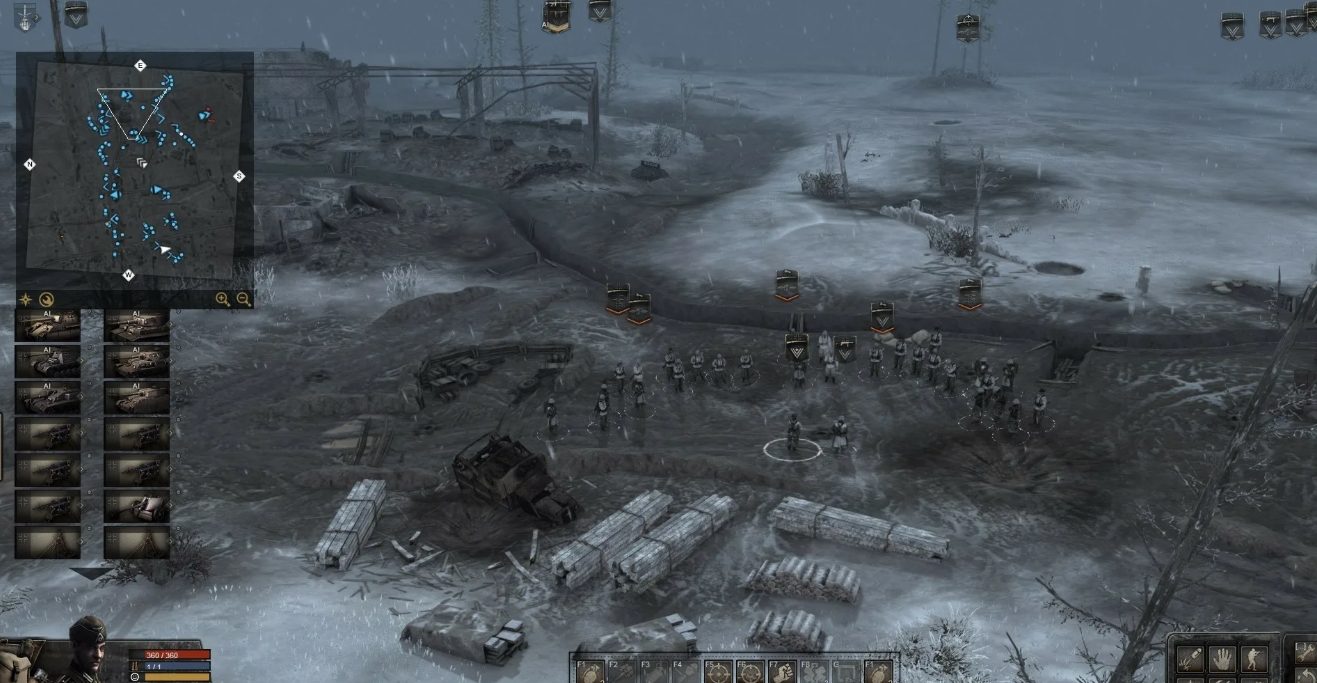
Sometimes you don’t just want to “launch a strategy”, but really feel how it all was — with a heavy sky above your head, the hum of technology and constant tension, when every second can turn everything around. Call to Arms – Gates of Hell: Ostfront gives exactly this feeling. There is no feeling of playing “on the lawn” here — you are constantly on your toes, watching every soldier, worrying about the equipment, catching yourself thinking that you are starting to act more cautiously, as if something really depends on it. And at some point, you’re not just playing anymore — you’re inside this story.
The atmosphere is especially catchy. These snow—covered fields, destroyed villages, sudden shootouts – everything looks like you are watching a live front, not a set of units on the screen. Sometimes you even catch yourself pausing: you just watch the fight unfold and think how intense and beautiful it all is at the same time in its tough, honest presentation.
And here’s the nice thing — you don’t have to waste time dancing with a tambourine to get it all going. We have already made everything as simple and human as possible. You register on the website, log into your account, go back to the beginning of the article and click GET AN ACCOUNT. Then everything goes quickly and without unnecessary headaches — just a few steps, and you’re ready to go to the front.
If you want to stay on topic and keep up to date with everything new, it’s better to take a look at our Telegram. There are always fresh accounts, news, updates, and just live communication. You can ask any question, discuss tactics, or share your experience — no one will leave you unanswered. And if something doesn’t work out, there is always a detailed guide with explanations or a chat where they can help you figure it out without too much effort.