

Metroidvanias are appearing so frequently these days that it’s hard to surprise anyone with this genre. Players have become more demanding: for a project to hook them, it needs to offer something special—be it fresh mechanics or a unique visual presentation. Spanish studio The Game Kitchen focused on atmosphere and art design.
The Seville-based team had previously released the mystical point-and-click adventure The Last Door, meaning the developers had some experience. But with Blasphemous, they decided to take things much further. Work on the game began in November 2016, and a year later, The Game Kitchen launched on Kickstarter. The campaign was a triumph: the studio raised almost six times its $50,000 goal. The concept and dark visual style resonated so well with the audience that the project immediately became the center of attention.
Blasphemous’s uniqueness lies in its subtle connection to the history and culture of its native region. Spanish legends, the spirit of Seville, and even echoes of Francisco Goya’s works are intertwined with the game’s dark surrealism. This is done so skillfully that a casual player might miss the cultural references, simply mistaking the events for the authors’ original, yet dark, fantasies.
However, beauty and symbolism are only part of the picture. Blasphemous is rooted in suffering. It torments the protagonist, the doomed characters encountered along the way, and, of course, the player themselves. This is a game that offers no slack and demands persistence, turning every encounter and every discovery into a challenge.
Table of Contents
Blasphemous Free Steam Account
The grim lands of Cvstodia (or, to believe the stylized Latin spelling, Cvstodia) evoke a sense of pain and atonement from the very first moment. There is no joy here, no one lives in peace. All inhabitants suffer—and all for the sake of atoning for the sins of His Holiness Escribar. The Miracle once severely punished him: his body was burned, and the ashes settled within the walls of a majestic cathedral. But the story did not end with death. Years later, mutilated souls rose from the ashes, including Escribar himself, and they returned far more maddened and bloodthirsty than in life.
Against this backdrop of darkness, a hero emerges, capable of defying endless suffering. The Penitent One—a silent warrior and the sole survivor of the Brotherhood of Silent Sorrow. He took a vow of silence and now bears a difficult mission: to navigate through grief and rid Cvstodia of eternal pain.
But don’t expect the story to be revealed in simple words. In Blasphemous, lore is imparted in bits and pieces—through object descriptions (sometimes even the remains of bodies) and occasional dialogue. However, the characters’ conversations are even more confusing: they mumble about guilt, repentance, and sin, leaving the player to piece together these puzzles.
The Penitent One’s appearance deserves special attention. His mask and tall conical cap are no accident. This headdress is called a “caperote.” Its history dates back to the Middle Ages: initially, it was worn by flagellants, self-flagellationists demonstrating their repentance. Later, capirotes became a symbol of shame in Spain during the Inquisition—those condemned to execution were carried out in them. Even today, such caps are used during religious processions during Holy Week. Thus, the developers imbued the character with a deep connection to Spanish history and culture.

The creators’ reverence for the past is also evident in the bosses’ designs. For example, the giant scorched head of the abbess is inspired by the true Seville legend of the noblewoman Maria Coronel. To escape the passion of King Pedro the Cruel, the girl doused her face with boiling oil—precisely in the monastery where part of the game’s events unfold.
There’s always something exciting in a free account in steam.
There are other examples. The bearded, three-faced woman seems a figment of fantasy, but her roots lie in the story of Saint Wilgefortis, the daughter of the Portuguese king. To avoid marriage to a hated suitor, she prayed to God to make her ugly—and He granted her a beard. The suitor abstained, but her father, unforgiving of her insolence, sentenced his daughter to crucifixion. This tragic legend also finds its place in Blasphemous, once again emphasizing that the local horrors are born not only of the imagination but also of real myths.
Blasphemous is more than just a violent game. It’s a story woven from religious symbols, medieval legends, and terrifying tales. That’s what makes its world feel so alive and frighteningly real.
Combat system and hero development in Blasphemous
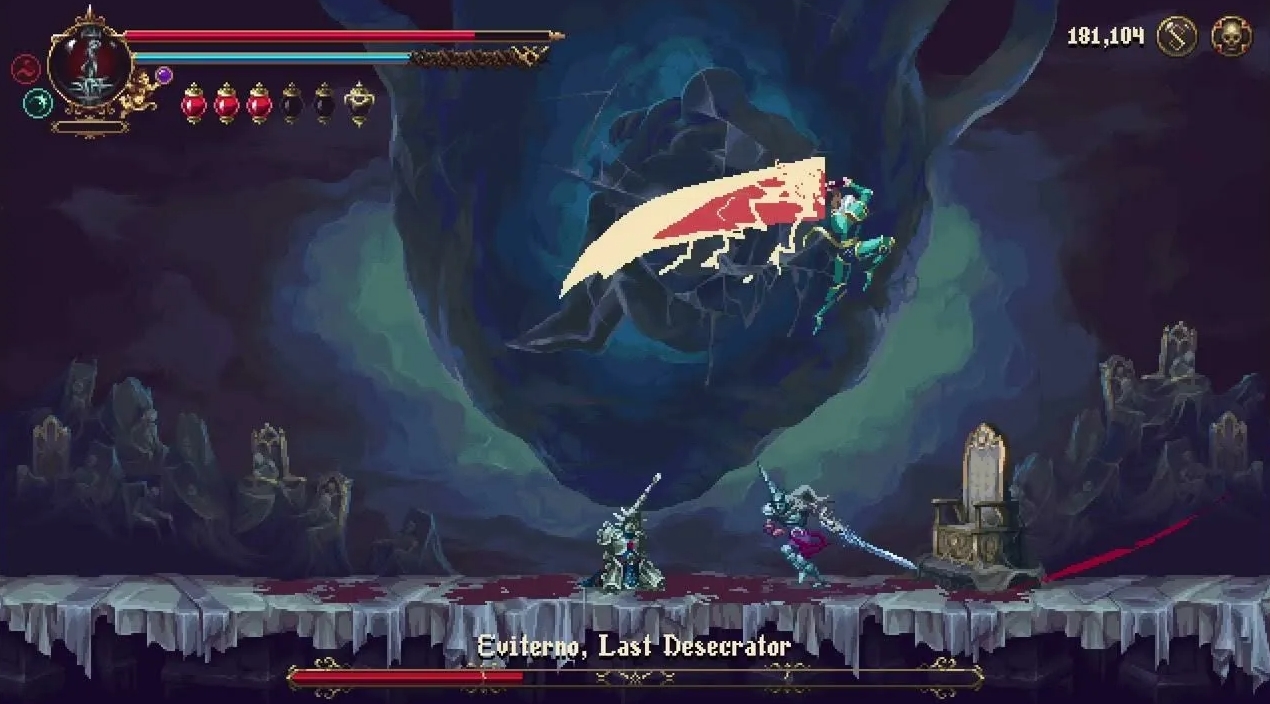
The Penitent One’s first major challenge in Blasphemous is the boss encounter. It’s here that the player must learn to properly use dodges and dashes. These skills become the foundation of survival, as the game will repeatedly force them to be honed until they become second nature. A little later, another important mechanic—parrying—is unlocked. If you parry a sword strike at the right moment, the hero not only blocks the attack but also responds with a powerful counterattack, inflicting significant damage. The game doesn’t have the usual stamina, but mindlessly rushing through enemies isn’t an option either—each new dash requires a short respite.
Simply swinging a blade is ineffective here. Enemies in Blasphemous are varied and require a specific approach. Some are easier to defeat with a precise parry, others with an attack from behind, but there are also those with a stone sarcophagus attached to their back, turning their rear into an impenetrable fortress. Some enemies don’t engage in direct combat, preferring to summon minions or set traps, such as knocking over cauldrons of scalding potions. Each encounter feels different and keeps the experience fresh.
When a hero dies, a Fragment of Guilt remains at the scene of their death. It’s worth picking it up, as the more of these fragments scattered throughout the world, the more your Fervor meter—the game’s equivalent of mana—is affected. Without Fervor, you won’t be able to freely use abilities or accumulate Tears of Atonement, which drop from defeated enemies.

Tears act as currency. They can be spent on refilling healing flasks at blood fountains, purchasing rare goods, or enhancing abilities. The hero’s main blade, Mea Culpa, grows in power as you discover special altars. These altars also unlock new moves, such as a bloody boomerang, a powerful sliding attack, or a devastating finishing blow in a three-attack combo.
You can’t change weapons or armor in Blasphemous—except perhaps their color. However, the developers didn’t leave the Penitent One without customization options. During your travels, you can find beads that provide small bonuses: expanding your Fervor meter, increasing your poison resistance, or increasing resistance to other types of damage. These beads are strung onto prayer beads and can be changed at any time, depending on your playstyle and situation. However, the Mea Culpa core can only be changed at a shrine. These modifications not only enhance your blade but also have side effects. For example, you can gain the ability to steal health from enemies, but in exchange, healing flasks will restore significantly less health. While this sounds tempting, it actually becomes a true test of survival.
Blasphemous gameplay
Blasphemous is a classic Metroidvania where every step feels like a challenge. A vast map stretches out before the player, full of branching routes, secret rooms, and shortcuts. Want to discover all the secrets? Then be prepared to test every wall with your sword—there are plenty of hidden passages here, and His Holiness will wait. Many areas require special items: without them, you won’t see hanging vines to cling to, or bloody platforms that fold into bridges.
Jumps and traps are an integral part of Blasphemous. But while in other Metroidvanias they’re a source of pleasure, here they can be frustrating. Spikes kill instantly, and they’re often more terrifying than any enemy. Understanding quickly comes: you need to press the jump button literally half a step above the abyss. But even knowing this, you can’t always reach the platform. There’s no way to adjust your trajectory, and every miss is guaranteed death. Falling from one screen to another is particularly puzzling. If the hero doesn’t have the required item, they simply die—even though there’s no fall damage within the same screen. This seems a bit outlandish for a Metroidvania, especially considering that in Bloodstained: Ritual of the Night, Miriam calmly fell tens of meters without any problems.
Blasphemous certainly has a way of motivating exploration. As a reward for backtracking, the game generously drops collectibles hidden in nooks and crannies. Along the way, you have to run errands for NPCs, trying to figure out what exactly they want. But disappointment immediately sets in: there are only five teleportation points on the entire map. The thought of having to run through hordes of enemies and deadly traps again for a tiny quest quickly discourages any return.

The map is also a bit of a letdown: you can’t zoom in or leave a note. Forgot where a key character or a mysterious door was? You’ll have to comb through everything manually again or consult a walkthrough. Reaching the “correct” ending on your own is practically impossible—without hints, it’s akin to a miracle.
Side quests are controversial. Sometimes you sincerely try to help a character, but they still end up dying—and it seems better not to interfere. Quests are easy to fail: fail to bring an item in time or show up without it—consider it all in vain. For example, if you don’t bring a thimbleful of oil to a suffering person, they’ll freeze, and the path to the secret cave will remain blocked. There are also bugs. The hero can get stuck in textures if they’re hanging off a platform, and then only a rollback to the last shrine can save them. The opposite can also happen: the boss suddenly loses interest in the player and freezes, completely ceasing to attack. Sometimes this seems like a gift from fate, but more often than not, it ruins the atmosphere.
There’s plenty of ambiguity. Touching an enemy sometimes drains health, sometimes not; hits can pass through the character harmlessly. On the one hand, it’s satisfying when someone accidentally “misses” you. On the other, it’s incredibly annoying when a character misses a platform they were supposed to land on. Moments like these in Blasphemous are truly infuriating, but they’re precisely what makes the game so memorable.
Blasphemous’ visual style
Blasphemous’s visual aesthetic is endlessly dazzling. Compared to the recent Dark Devotion, it immediately seems crude and unpolished, though at first glance it also looks impressive. The difference lies in the details. In Blasphemous, the artists poured their heart and soul into every detail: backdrops become veritable paintings, and even the most simple enemies convey the grim spirit of a tormented Middle Ages.

The music is equally impressive. The soundtrack sounds as if it was written with not only gameplay in mind, but also with the goal of immersing the player in the atmosphere. The guitar strums are reminiscent of classic Diablo themes, and in places, the instrumental melodies give way to an unsettling ambient score. At such moments, the game seems to breathe down your neck: oppressive silence is interrupted by distant screams, and you feel truly uneasy.
The language the characters speak is a whole other story. High-flown phrases, heavy turns of phrase, and ancient expressions fit perfectly with the game’s aesthetic. The Russian translation strives to be faithful to the original and retain that flourish rarely encountered in everyday speech. But there are some missteps. For example, the location “The Sleeping Canvases” was translated as “Sleeping Sails.” Except there are no sails there—instead, the space is filled with paintings, some of which come to life right before your eyes. In English, the word “canvas” can indeed mean both “sail” and “canvas,” but in this case, the translators missed the mark.
Pros and cons of Blasphemous
Blasphemous isn’t just a game, it’s a true work of art, inspired by the culture and legends of Seville. Here, medieval myths intertwine with religious imagery, brought to life in every character, enemy, and location. It’s a dark Metroidvania where suffering and cruelty reign supreme: bloody finishers, an oppressive atmosphere, and even small details like the way the hero uses healing phials. He doesn’t simply drink from them—he smashes the vessel against his mask, smears the thick, scarlet liquid, and crosses himself, heightening the sense of tragedy.

But behind all this artistic depth lie technical problems. While bugs can still be patched, it’s unlikely the developers will fully address the issues with tight jumps or the deadly spikes that instantly punish the player. It seems as if the words “May your heart be sad,” spoken by the characters in the game, are addressed not only to the silent Penitent One, but to everyone who dares to embark on this journey.
Blasphemous’ Strengths
-
Visual aesthetics: from the location design to the detailed characters.
-
A soundtrack that perfectly supports the atmosphere of suffering and mysticism.
-
Rich lore, closely tied to Spain’s historical past.
-
Boss battles that require skill and give a feeling of true victory.
Weaknesses
-
Bugs that caused some players to lose progress.
-
Unfriendly platforming, where every jump can be fatal.
-
Exhausting backtracking due to the small number of teleportation points.
Blasphemous System Requirements
Blasphemous System Requirements
How to play Blasphemous for free on Steam via VpeSports
Blasphemous isn’t just a game, it’s a true pilgrimage into a dark and cruel world where faith is intertwined with pain and despair. From the very first minute, you find yourself in the role of the Silent Penitent, a warrior doomed to bear the weight of others’ and your own sins. Ruined cathedrals, bleeding statues, endless corridors filled with suffering—everything around you resembles a nightmare you can’t escape.
What makes the game special is its sincerity. Each battle isn’t just a test of your reflexes, but a true test of your character. You’ll fall again and again, but each time you’ll rise again to continue. And that’s where the magic of Blasphemous lies: in the stubborn pursuit of redemption. The gothic pixel graphics are captivating—as if each ruin breathes its own terrible history, and every step on the stone slabs sounds like a prayer.
We’ve made sure you don’t have to fiddle with lengthy setup. Simply register on our website, log in to your profile, and Blasphemous will be waiting for you with ready-made instructions, even with a free Steam account. All that’s left to do is grab your weapon and set out on a journey where every encounter brings you closer to answering the questions the game poses to every player.
Your impressions matter. When you’ve completed your journey, tell us what struck you most—the dark atmosphere, the merciless bosses, or perhaps the strange sense of relief after each challenging battle. We review all reviews manually, and once your comment is approved, your login information will be emailed to you.
To stay up-to-date on new updates, subscribe to our Telegram channel. There, we share the latest accounts, patches, news, and even chat with players who, like you, have decided to embark on this journey. And if you run into any difficulties, you can always check out the “How to Play for Free – Complete Guide” section or contact us in the chat – we’ll be happy to answer and help.