

The new indie hit, which broke into the list of the most notable Steam projects and the Xbox Game Pass library, at first glance seems like a funny parody — as if SpongeBob suddenly found himself in the dark universe of Dark Souls. But behind the bright shell lies a full-fledged Souls-like experiment, which surprises much more than you can imagine. The creators really managed to capture the very atmosphere of trials, where every battle requires attention, and any wrong move can cost victory.
Table of Contents
Another Crab’s Treasure Free Steam Account
The Dark Souls series, created by Hidetaka Miyazaki, has long ceased to be just a successful project — it has become a cultural landmark around which a whole subgenre has grown. It was she who set the formula for hardcore action-RPG, where the world seems to breathe heavily and unevenly, and the hero is just a tiny spark trying to change something in a crumbling fantasy space. Over time, this turned into an unspoken agreement between developers and fans of the genre: if you call a game Souls-like, be kind — give it honest, heavy gameplay, an atmosphere of doom and a story that the player collects bit by bit. Experiments are possible, but fans feel fake instantly. The emotional tone, the rhythm of the battle, the feeling of loneliness in a vast world are too important things to throw away.
And against this background, Another Crab’s Treasure appears — a game that at first seems like a joke. An underwater adventure about a cute hermit crab? Seriously? Where is the dark fantasy, where are the monsters of nightmares, where are the smoldering flames of a dying world? At first glance, nowhere. Everything is shining, shimmering, smiling. It seems like you’re being invited for a light, almost cartoon—like walk-something in the spirit of SpongeBob SquarePants. But if you look closely, it becomes clear that the developers are not joking at all. This is a real Souls-like, just hidden under a bright, good-natured shell.
I would like to call this game “friendly deception”. The first half hour is almost a comedic performance: The Shark of Capitalism with ostentatious importance deprives Krill of his only home, a small shell. Everything happens so pathetically, as if she is fulfilling the will of the local “duchess of laguna”, and at the same time demonstrates how absurd the world can be, living by strange rules. Krill, a simple, naive, but unexpectedly resilient hero, sets out to restore justice. After such an introduction, it’s easy to believe that there’s a good fairy tale ahead.
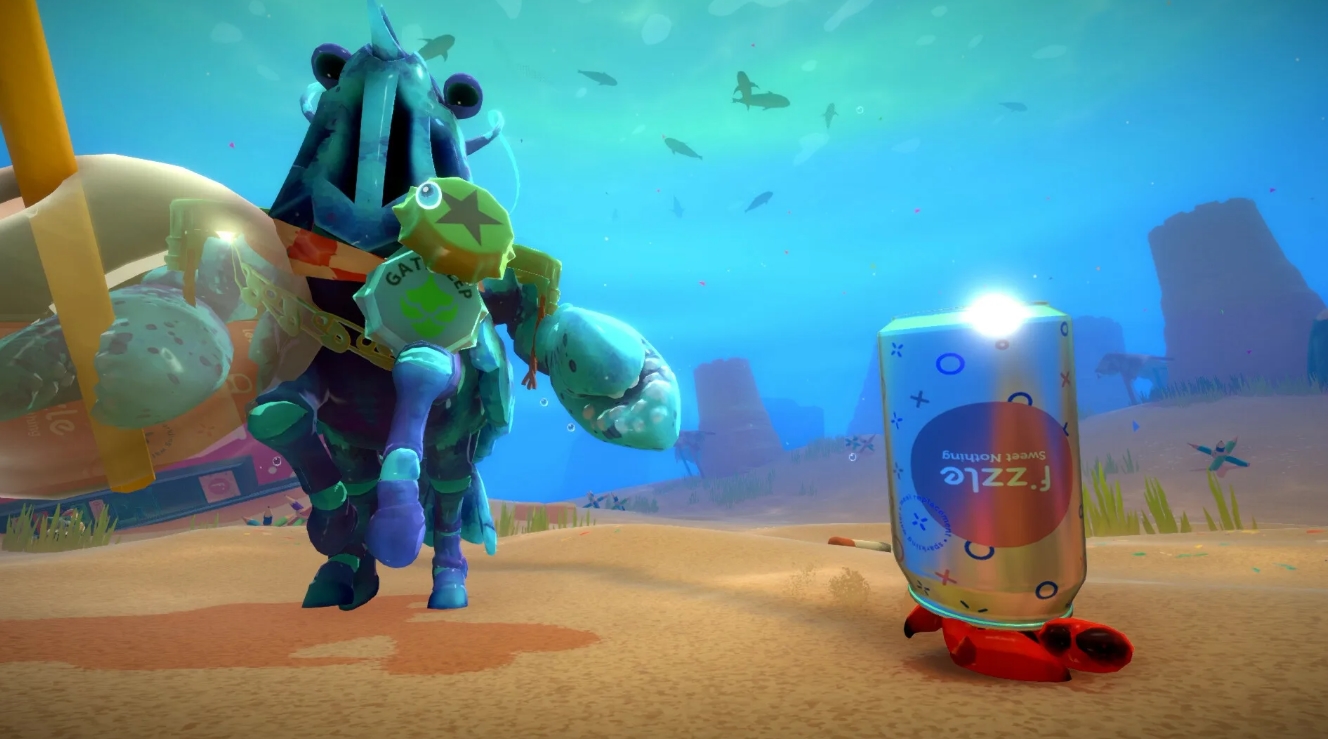
However, the intonation changes step by step. The first cracks appear through the jokes — and suddenly it turns out that the underwater kingdom is no better than gloomy fantasy worlds: it is also experiencing decline. With each new enemy, with each location, it feels like you’re reading the diary of a civilization that has nothing left to lose. The atmosphere thickens, bright colors are filled with shades of hopelessness. It is this contrast of fun and dark that makes the passage so unusual and truly emotional.
What is most striking about Another Crab’s Treasure is the courage of the authors to talk about serious things without turning the game into a boring lecture. Capitalism, environmental disasters, microplastics, ocean pollution are topics that people usually prefer to turn away from in order not to “spoil the mood.” Here, they are woven into the plot so naturally that they feel like a part of the world, rather than an edifying insert. Sometimes the dialogue and scenes sound bitter—really bitter-but that’s the essence of good satire.: She smiles, saying words that make you feel cold inside.
Create the ultimate game library with just one account steam free.
Another Crab’s Treasure’s Plot and Combat System
The plot of Another Crab’s Treasure plays with the player’s expectations from the very beginning. Formally, this is a familiar Souls-like story about a collapsing world where the hero is forced to confront chaos. But the authors turned this template inside out: instead of gloomy castles and cursed knights, we find ourselves in a bright underwater landscape, reminiscent of a children’s collage book, in which every element – from shells to plastic debris — carries a hidden meaning. And the deeper you go through this dazzling ocean, the clearer it becomes that this is not a fairy tale at all, but a parable carefully hidden under the water about a world that has long been teetering on the edge.
Interestingly, the creators did not soften the genre traditions. They left the same honest, unforgiving gameplay. No indulgences, no lightweight “for everyone” mode — just a direct warning: if it’s difficult, reduce the difficulty, but the game will still test your endurance. Even at the “story” level, fights can take you by surprise, especially if you’re used to more relaxed adventures.
The Krill’s first weapon, a fork found in the sand, would like to be seen as a symbol of its own fragility. A small hermit crab, armed with an object that is normally used for lunch, goes into battle with much larger creatures. There’s something touching about this: he’s not a fantasy hero, but an ordinary ocean dweller who defends himself as best he can.
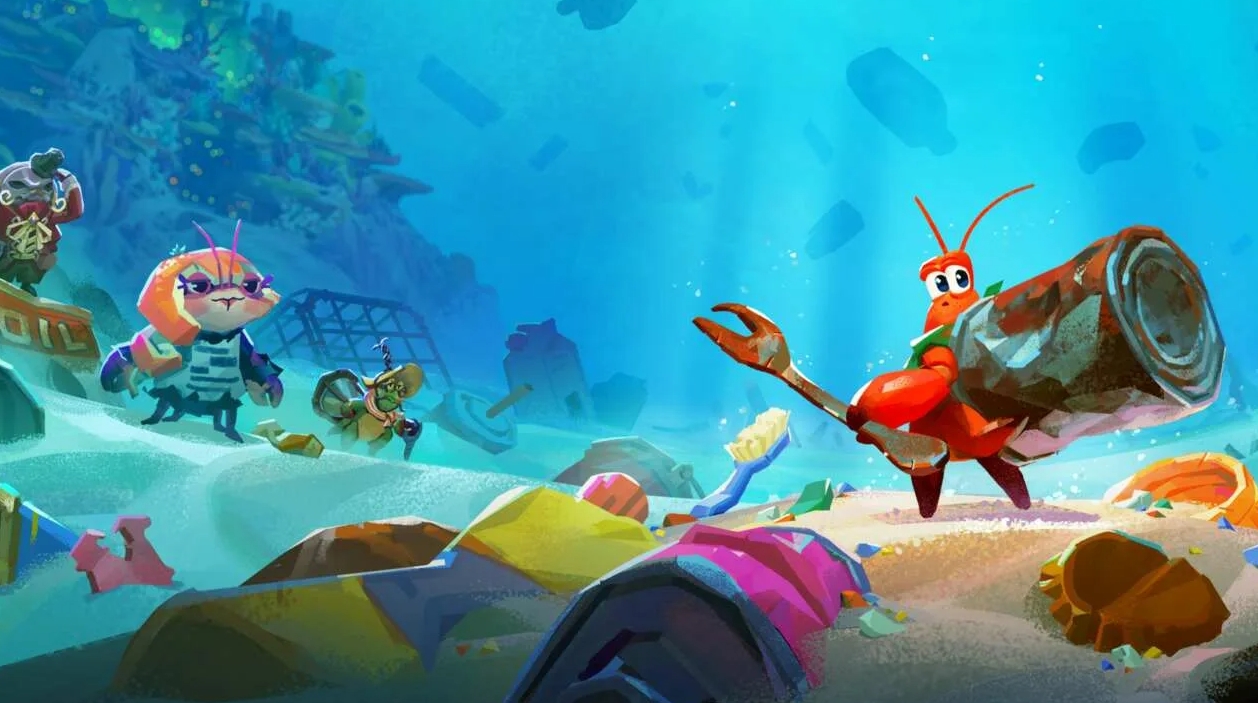
But the game is not limited to the primitive “poking with a fork”. Over time, the combat system begins to blossom like a coral reef. Krill discovers armor shells made from garbage that humans throw into the ocean. And here the authors find a surprisingly subtle solution: they turn real environmental problems into the basis of game mechanics. It’s ironic, painful, and truly honest.
To show how diverse the game can become thanks to the shells, it is worth highlighting the main types of “armor” that change the style of combat:
-
Cans — release bubbles and allow you to attack from a distance.
-
Ink cartridges — create a cloud that hides Krill from enemies.
-
Light bulbs — illuminate dark areas and help you navigate.
Each shell gives you the feeling that the world under water lives by its own logic, and every item found can become part of your tactics. Over time, choosing the right armor turns into a ritual before going to a new location.
But even the best shell does not guarantee safety. The enemies are hitting fiercely and hard. Therefore, it is important to dodge in time, parry blows and understand the behavior of opponents. Each encounter is a small duel of character, where not only skill is important, but also patience.
The further the Krill progresses, the more clearly the pumping system is revealed. Having gained access to three unique development paths, the player begins to feel the real depth of the mechanics. The battles are becoming more dynamic and varied, and the victories are getting tastier. This is the moment when the game gives an emotional outburst familiar to all fans of the genre.
Boss battles cause especially strong emotions. These are not just opponents — they are mini-performances with their own rhythm. To win, you have to watch, adjust, study weaknesses and suffer defeats. But when victory does come, it feels almost physical — as if you yourself have taken a step forward. Fortunately, the respawn points are located next to the arenas, which saves unnecessary suffering.
However, closer to the finale, repeatability begins to be felt. Some types of enemies return in slightly modified form — more durable, of a different color, but still the same in essence. Novelty gives way to routine a little bit, and it takes the heat off a little bit. But even at such moments, the game continues to hold the attention with its atmosphere and unusual world.
Game currency
If by this point you still haven’t learned how to “read” the opponent’s intentions — to distinguish between warning movements, catch the intonation of his attacks and understand when to jump away and when it’s better to hide — the game very quickly ceases to be perceived as an exciting adventure. It turns into a real torture, especially if you continue to thoughtlessly kill enemies or go into battle insufficiently pumped. At medium to high difficulty levels, death becomes painful not only emotionally, but it takes away all the accumulated experience, and you reappear at the point of rebirth, as if someone pressed rewind. At this point, Another Crab’s Treasure is particularly reminiscent of the classic Souls-like: we used to collect souls, now we collect microplastics, but the price of error remains equally harsh.
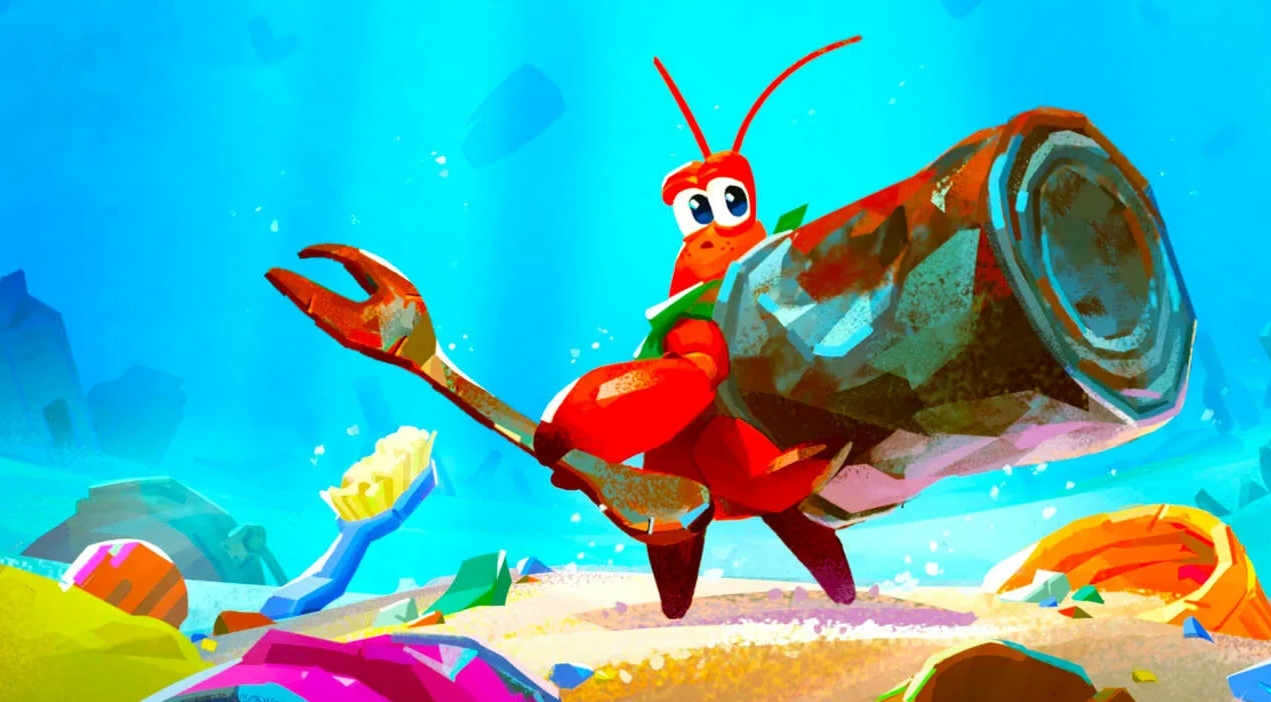
This microplastic is not just a local loot, but a small metaphor. It symbolizes both game progress and how the world handles its own mistakes. The collected particles can be spent as currency: boost health, increase resistance, increase attack power, or develop magical abilities. Alternatively, you can direct resources to useful things like new shells and “clings” that not only change the characteristics of Krill, but also force you to look at its path differently. Each improvement feels like an almost personal victory: you see how the little cancer becomes stronger, more resilient, more confident.
It is the storyline and the combat system that are the two pillars on which the whole game rests. Everything else so far looks like a space in which the authors have not yet had time to work on the details. The semi-open world in which Krill travels seems large-scale only at first glance. In fact, we have a series of bright, but rather linear locations in front of us. The hero is given freedom of movement, but more often he finds himself in a pre-prepared corridor, where he can turn off except for additional resources. There are no side quests or characters that would bring the world to life — just a beautiful space that lacks something.
Map and level design
The level design sometimes lets you down. Sometimes the game literally throws you into uncertainty: you stand at a fork in the road and don’t know where to go next — up, down, forward or backward. At such moments, you especially begin to dream of a normal card. But the map here is so formal that it rather resembles an illustration “for show.” It shows only the approximate position of Krill, without helping with orientation, route finding, or understanding the structure of the world.
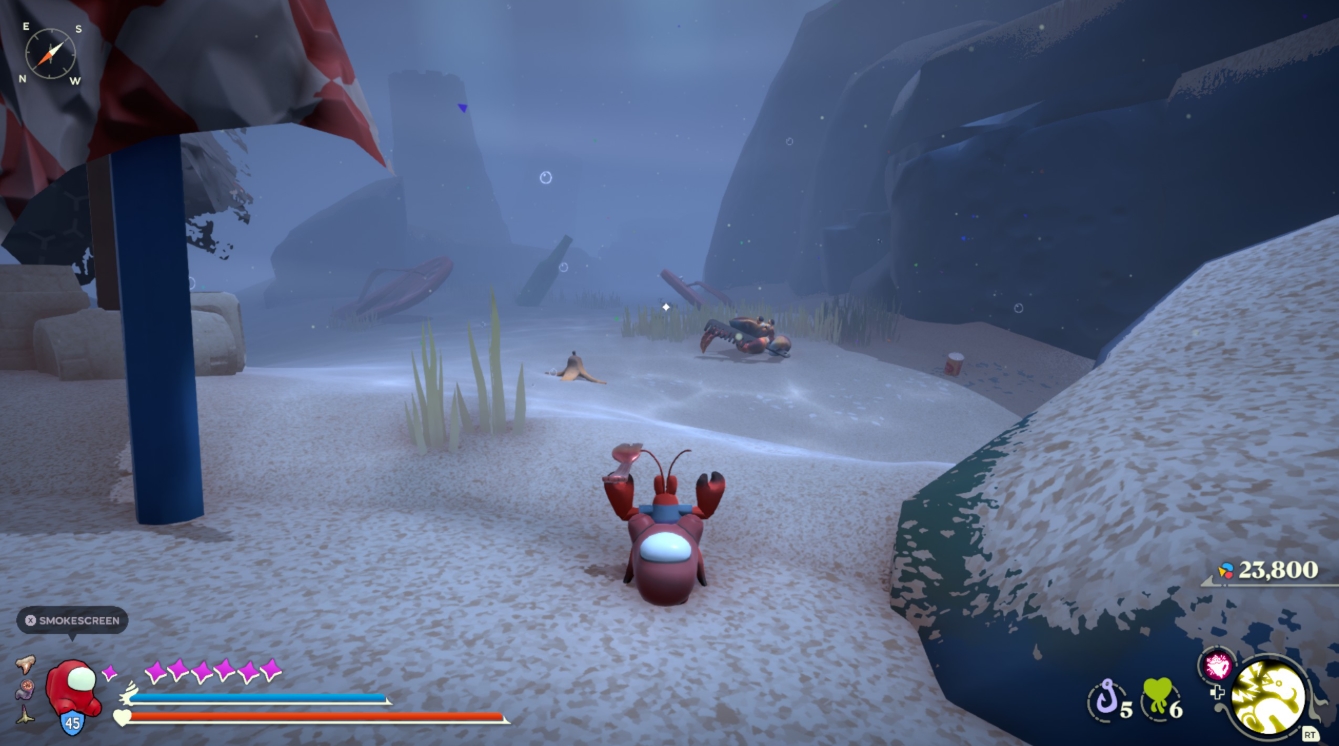
To describe more precisely what it lacks, it is easier to identify the main problems of the map:
-
It does not convey the verticality of the levels and the complexity of their geometry.
-
It does not mark important landmarks, points of interest and real ways of promotion.
-
It does not help to return to the desired route after a fall or accidental deviation.
The platforming also turned out to be heterogeneous. In some places, it feels cheerful and organically fits into the rhythm of exploring the world, but in others it turns into a test of nerves. Krill falls into the abyss over and over again, and you — along with him — return to the same point, hoping that this time everything will work out. At such moments, you begin to realize how important the balance between complexity and comfort is—and how easy it is to break it.
And yet, despite the roughness, Another Crab’s Treasure has a rare charm. She is sincere, naive in some places, but very human. There is not only mechanics inside her, but also a feeling — the feeling of a small creature that stubbornly goes forward, even when the world around it is collapsing. I want to forgive her a lot for that. And it’s this humanity that the developers have put into Krill’s story that makes the game truly memorable.
Pros and cons of Another Crab’s Treasure
Another Crab’s Treasure leaves behind a surprisingly contradictory feeling. The game seems to be torn between genres: on the one hand, its vibrant world, story scenes and charismatic characters create the impression of an easy adventure, almost a cartoon journey along the seabed. But as soon as it comes to gameplay, it becomes clear that this is not a relaxing action game at all, but a harsh test in the spirit of classic Souls-like projects. And this dissonance can both make you fall in love and scare you away.
If the developers had limited themselves to just a few elements of the genre and made them softer, Another Crab’s Treasure could have been safely recommended to a wide audience as an unusual, stylish and kind adventure. But the authors chose a different path: they immersed the player in a hardcore experience with challenging battles, a demanding evasion system, tight timings, and tangible punishment for each death. Therefore, the game does not work as an adventure, but as an honest and uncompromising Souls-like — not adapting to the player, but requiring patience and skill.
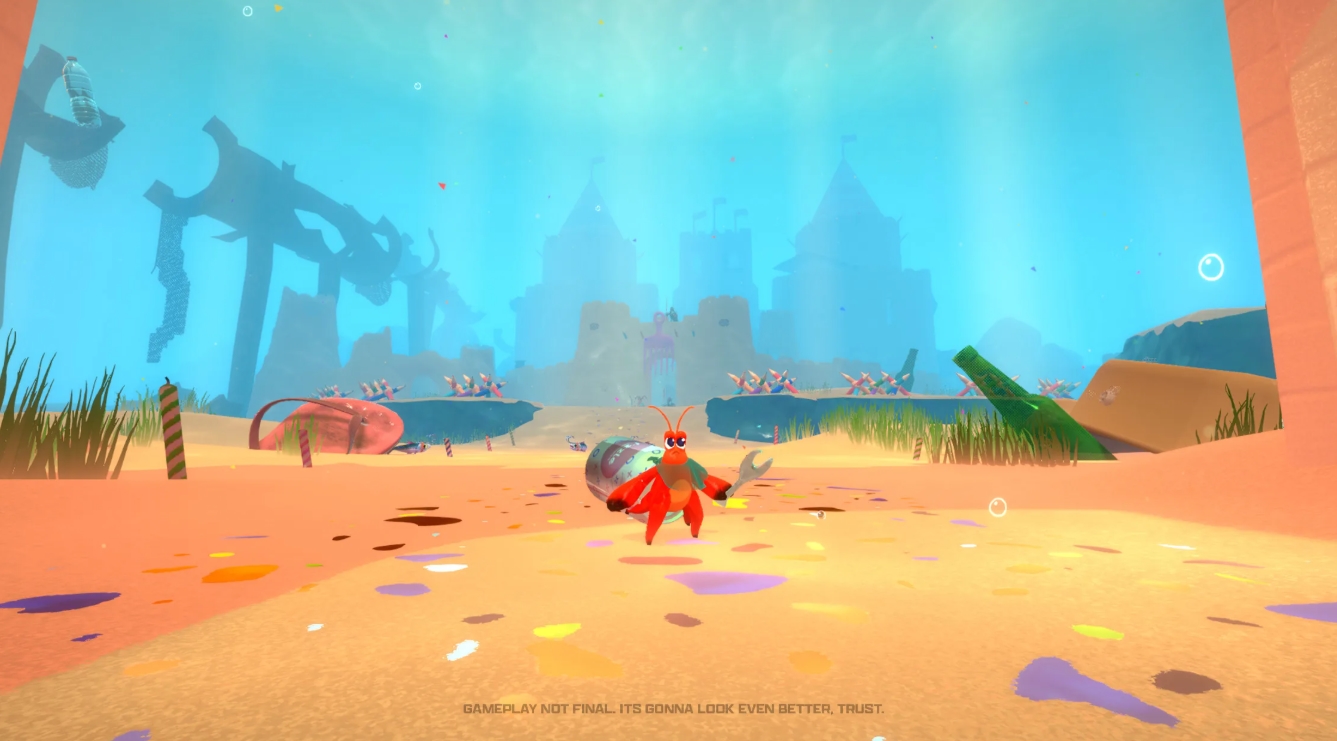
In terms of genre, the game is really impressive. It has everything that Souls-like fans love about combat mechanics: a high level of difficulty, lots of interesting bosses, tactical battles, character leveling, and a microplastic collection system that serves as an analog of souls. The developers should be given credit for the implementation of these elements — they did them efficiently, deeply and with respect for the genre. But will you like this structure? The answer depends on how prepared you are for regular defeats and constant learning through pain.
The rest of the problems are not critical, but they spoil the overall impression. Weak platforming, confusing level design, poor map — all this creates the feeling that the game has not received the amount of attention it deserves outside the combat system. If you appreciate challenging games, love the genre itself, and are willing to accept its strict rules, Another Crab’s Treasure can be a real discovery. If you have come for an easy adventure, even the minimum level of difficulty can become an insurmountable wall.
Pros
-
A deep and unexpectedly touching story
-
Witty, lively dialogues
-
Memorable characters
-
Atmospheric and beautiful underwater world
-
Interesting, non-standard combat system
Cons
-
Clunky and sometimes annoying platforming
-
Weak implementation of the map, which makes it difficult to navigate
-
Insufficiently elaborated design of some levels
-
Recurring enemies are closer to the finale
-
Monotonous battles in the later stages of the passage
Another Crab’s Treasure System Requirements
| Minimum OS: Windows 10 (64-bit) | Recommended OS: Windows 11 (64-bit) |
| CPU: Any 2.5 GHz dual-core processor or better | CPU: 3.2 GHz quad-core processor or higher |
| Memory: At least 4 GB RAM | Memory: 8 GB RAM or more |
| Graphics: NVIDIA GTX 970 or any comparable GPU | Graphics: GTX 1060 / AMD RX 580 or above |
| DirectX: Version 10 compatible | DirectX: Version 11 or later |
| Storage: 6 GB available disk space | Storage: SSD preferred for smoother gameplay |
| Sound: Any standard PC sound device | Sound: Compatible audio hardware |
How to play Another Crab’s Treasure for free on Steam via VpeSports
Sometimes it seems that the world around you is too noisy — and then you really want to go somewhere deeper, to a place where there is peace and quiet, where you can only hear the soft whispering of the waves. In Another Crab’s Treasure, this feeling becomes almost real: you find yourself on the seabed with Krill, a small crab who is desperately trying to get his stolen shell back and accidentally gets involved in a story much bigger than his own problems. Here, every grain of sand seems to preserve the memory of old civilizations, and every new “armor” found is a small hope that you can still do it.
We have tried to make sure that the beginning of this journey does not distract you with unnecessary troubles. Simple registration — and you already have a detailed guide that explains everything in a calm, human language: what to click, where to go, how to make the game come to life on the screen. It’s like a friend is sharing his experience, not a faceless instruction. You just choose a shell, feel its weight, and go ahead, towards the depths, where the Krill is waiting for your first step.
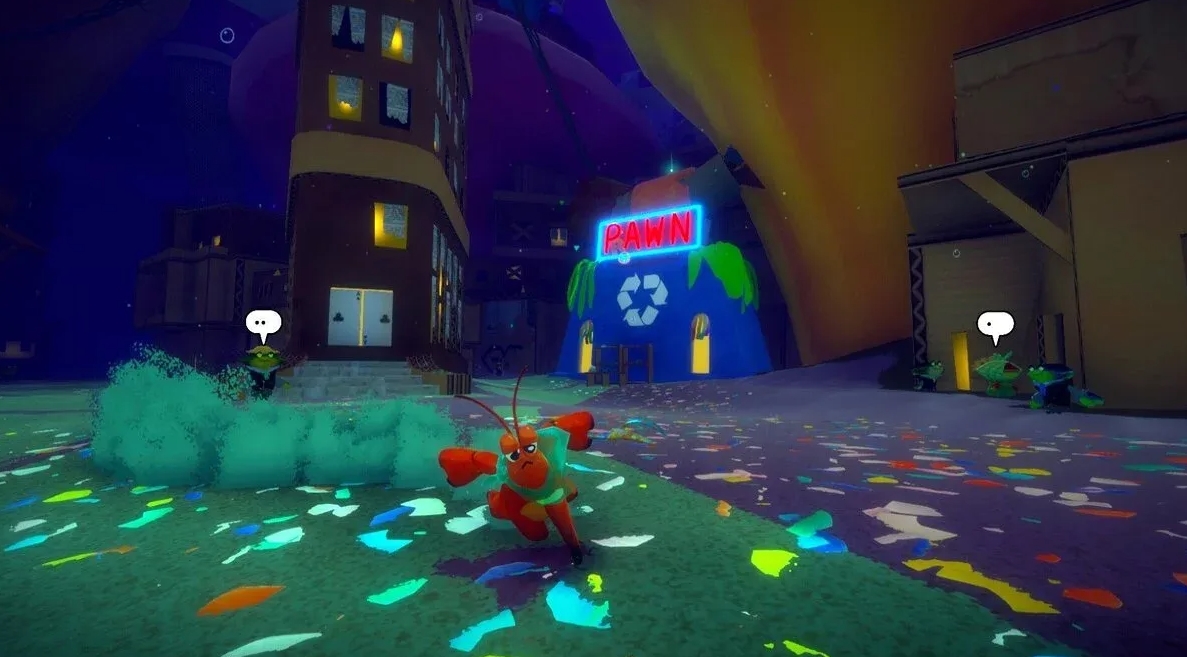
When you’ve gone through a couple of locations, defeated several predators, or just lingered at the unusual sea sunsets, tell us what it’s like to be a tiny hero in a vast ocean. We read each story carefully, but sometimes it takes a little time to publish — it’s okay, so the moderators just give themselves a minute to capture the mood of your comment. When the review is accepted, the email will quietly pop up in your inbox.
And if you want to stay closer to the events of the underwater world, visit our Telegram channel. There are sometimes real discussions, news about updates, and interesting discoveries that players share with each other. And if you suddenly get confused or don’t understand something, know that in the section with the full guide we have collected all the most useful things, and in the chat there is always someone who will tell you the way – like a lighthouse for a lost crab.