

It’s probably hard to find a person who hasn’t heard of the legendary three digits — 911. This number has long been a symbol of emergency assistance: we see it in movies, books, computer games. The hero noticed something suspicious? He dials 911. Is there a robbery going on somewhere? Alas, Spider-Man won’t appear in this universe, but the operator on duty will definitely answer. Even if we’re talking about a kitten stuck in a tree, we still know which number will save the situation.
And, frankly speaking, it was only a matter of time before someone decided to turn this process into a separate game. And so it happened: on the Steam showcase, among the “hot new releases”, you can find a project with a direct and telling name — 911 Operator.
But how exciting can the work of an emergency service dispatcher be — we’ll try to figure it out now. So don’t hang up and stay with us.
Table of Contents
911 Operator Free Steam Account
It’s hard not to notice that the project had a rather modest budget. If you look at the game’s Kickstarter page, you can see that the publisher managed to raise about 37,924 Canadian dollars, which in terms of money was about 28 thousand US dollars. And, frankly, I doubt that this entire amount went exclusively to the development itself. The campaign was launched not by Jutsu Games, but by the publisher PlayWay, so some of the funds probably went to marketing.
And this limited budget is felt literally from the first minutes. Even the main menu reveals a lack of resources: simple buttons, an unsightly interface, music that simply breaks off after finishing and immediately starts again – without a smooth transition. I’m not picking on the little things, but just noting: the developers really worked with minimal capabilities. But is it worth turning a blind eye to the flaws because of this? At first, I was leaning towards this lenient approach, until I compared the price of 911 Operator on Steam with This Is the Police. And here’s the surprise: they cost almost the same. After that, it became obvious to me that comparing them head-on is more than fair.
Now about the modes. 911 Operator has three options: “unique situations”, “single city” and “casual mode”. On paper, it sounds good, but in fact, the differences between them are small.
There is no storyline in the usual sense. In all modes, the goal is the same: successfully complete shifts without allowing your reputation to fall. In “unique situations”, after several completed shifts, you are transferred to a new city. There are six of them: from Kapolei and Albuquerque to New York and Washington. The differences are only in small things like the set of equipment, but in general, the differences between the megalopolises are not felt.
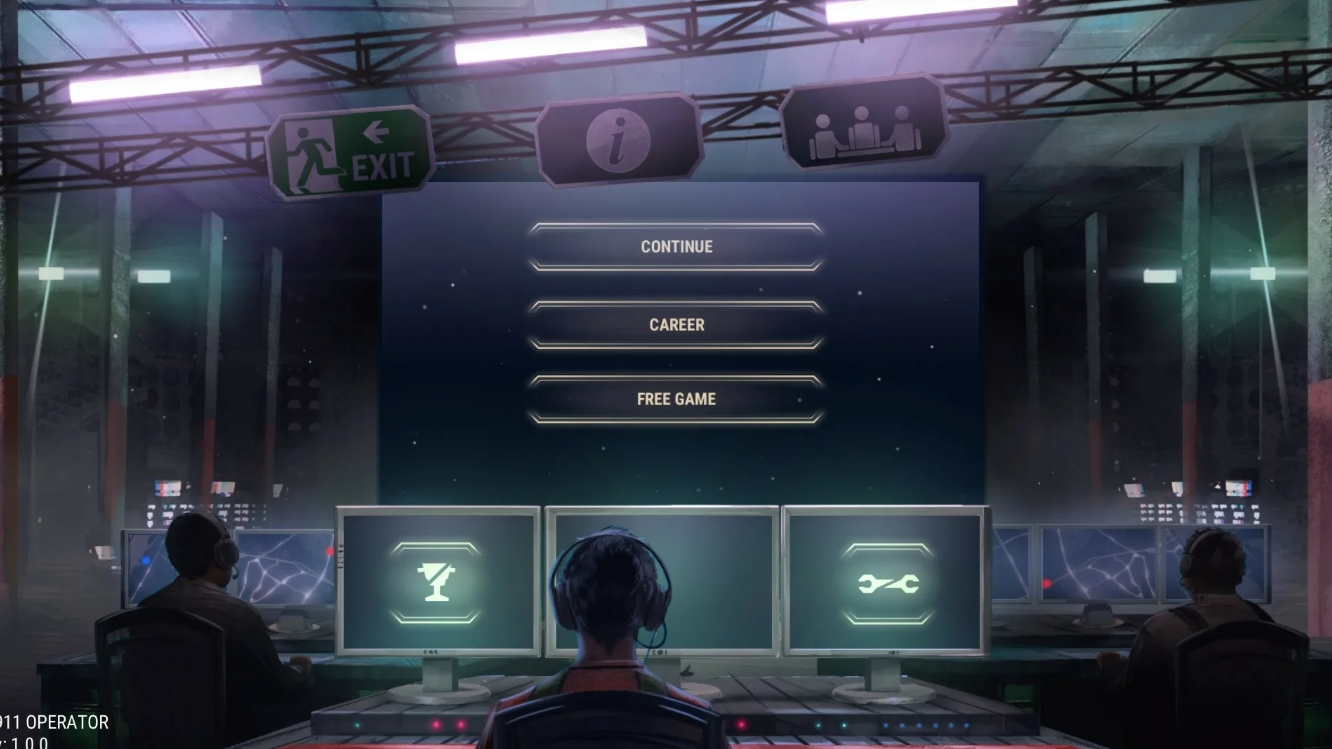
“One City” is practically the same mode, only without resetting progress. All events take place in a pre-selected settlement, and for the first time there is at least some element of long-term management: you can develop crews, buy equipment and monitor finances. If “unique events” are a kind of training course, then “one city” is closer to a full-fledged campaign.
Well, “casual mode” is the same model, but with increased difficulty. Shifts are longer, there are more calls, and to open new cities you need to earn reputation points. The problem is that there is still no new content: there are more calls, but they most often repeat familiar scenarios.
There is also “free play” with the ability to choose a map of any city, including outside the United States. But I was unable to try this option – the game stubbornly did not want to connect to the servers. Maybe this is a local problem, or maybe this mode has already been disabled.
In the end, it becomes clear: all the modes in 911 Operator are variations on the same theme, with minor modifications that hardly change the feeling of the process. For comparison: This Is the Police offered an entire story campaign for 18-20 hours, with cutscenes, voice acting and elements of non-linearity, and also an endless mode on top. Against this background, 911 Operator looks frankly poor. And even if we forget about competitors, three modes, where one takes 4-5 hours, and the other two feel like slightly tweaked copies of the first, are unlikely to hold attention for long.
Full games, zero fees – just a steam free account.
911 Operator Gameplay
Since the game lacks a clear plot and a variety of modes, one could hope that the gameplay would pull the situation out and compensate for all the gaps. On paper, it looked exactly like that: a lot of decisions, dynamics, interesting challenges. But in practice, everything turned out to be much more prosaic. No matter what map or difficulty is, the basis is always the same task: to work out as many emergency calls as possible, while trying to earn reputation and money. That’s it. The whole cycle revolves around this.
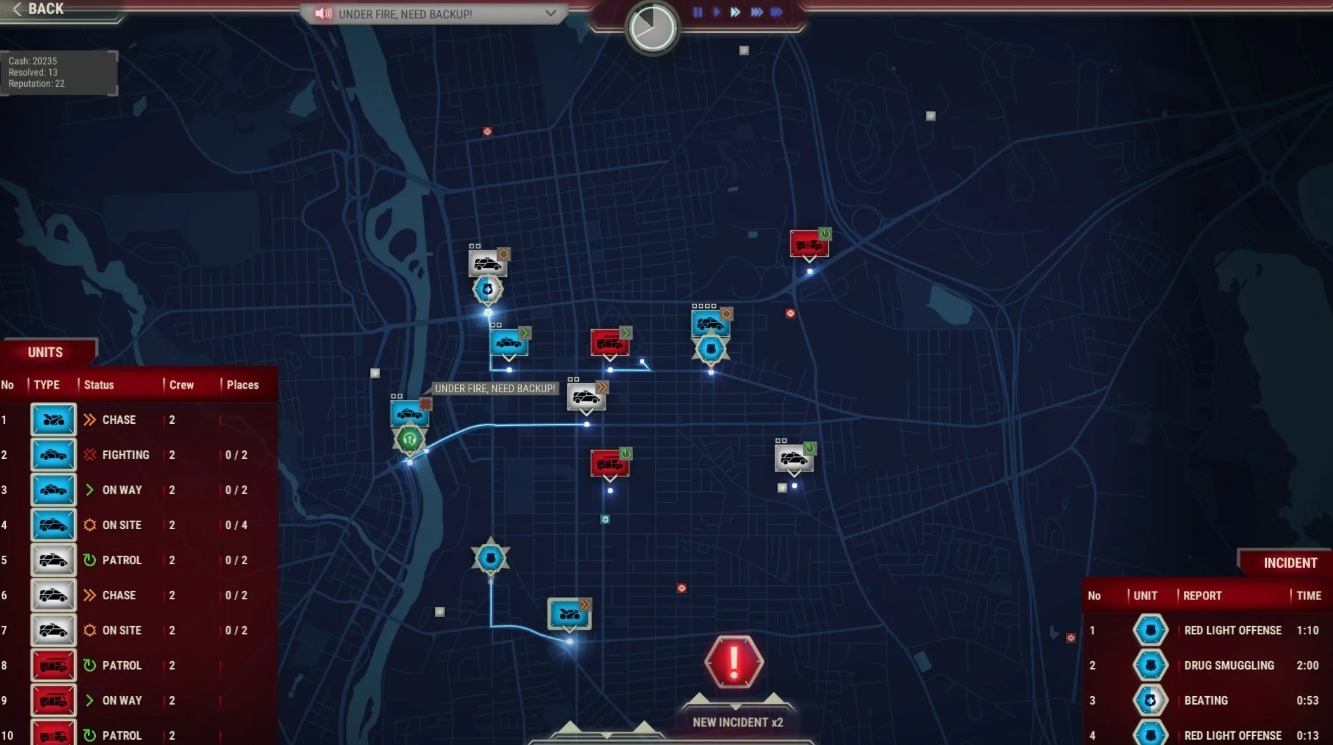
After starting a new game, the first thing that opens is the squad management screen. Here we spend the accumulated money on hiring employees, buying equipment and gear, and then form our teams. And here the game finally offers a choice – three classes: police, firefighters and medics. Each has its own key parameters. For cops, this is accuracy and working with suspects, for medics – the speed of providing assistance, for firefighters – technical skills. There are also general indicators: how quickly they cope with fires, how they conduct searches or do technical work. Even driving is a separate characteristic: the higher it is, the faster the car gets to the call point.
Of course, each character is different from the other: one can be a master in medicine, another in driving. The idea is simple: you need to assemble balanced squads that will not only get there quickly, but also effectively sort out the incident at the scene. But you will have to pay for the best indicators – the salaries of specialists are higher. An interesting point: there are “main” characteristics that are always at hand, and there are secondary ones – like “wounded” or “seriously wounded”. They are hidden behind an icon and are visible only when you hover over them. The difference between employees is minimal, and there is too much fuss with comparison, so ultimately there is simply no point in monitoring them.
We’ve dealt with the personnel – now the equipment. Each character has two slots. Police officers can carry pistols, rifles or terminals that speed up the arrest process. On paper, there is a shotgun, but in practice, it is only found on the New York map, in a single copy. Medics are given devices for continuous cardiac massage, and firefighters are armed with masks that protect against smoke. There are also universal items – first aid kits, bulletproof vests, toolboxes, fire extinguishers. Bulletproof vests are especially important: if an employee is wounded, he can be out for several shifts, and in the worst case, die.
But the most expensive pleasure in the game is transport. The police have motorcycles, cars, vans, helicopters and even … horses. Yes, it sounds unusual, but the practical benefit of a horse raises questions: it is slower than a motorcycle, costs a little less, but there is almost no gain. Theoretically, a horse is more effective off-road, but on the map it is difficult to understand where it begins, and the difference in speed is almost impossible to notice. As a result, most often the choice is obvious – you take a motorcycle and do not suffer.
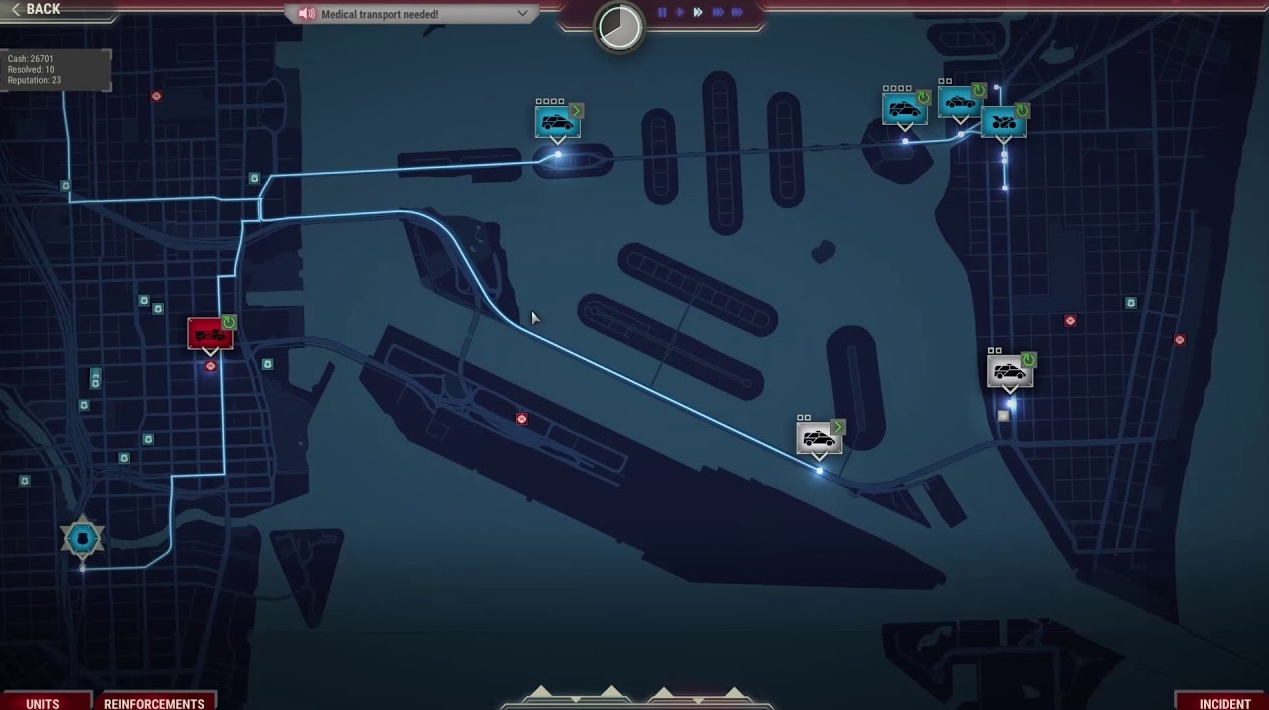
For doctors and firefighters, transport is more logical. Ambulances, helicopters, pickup trucks, fire trucks — everything is pretty familiar. Although there are some oddities here too. For example, an ambulance and a “medical transport” cost the same, travel the same, but the latter transports one more patient. Formally, they say that the “ambulance” has a bonus to the speed of doctors, but in real conditions it is almost imperceptible, so there is no practical sense in buying it.
Before the start of the shift, you can distribute the crews on the map. This function really helps — the correct distribution allows you to respond faster to calls that arise in different parts of the city.
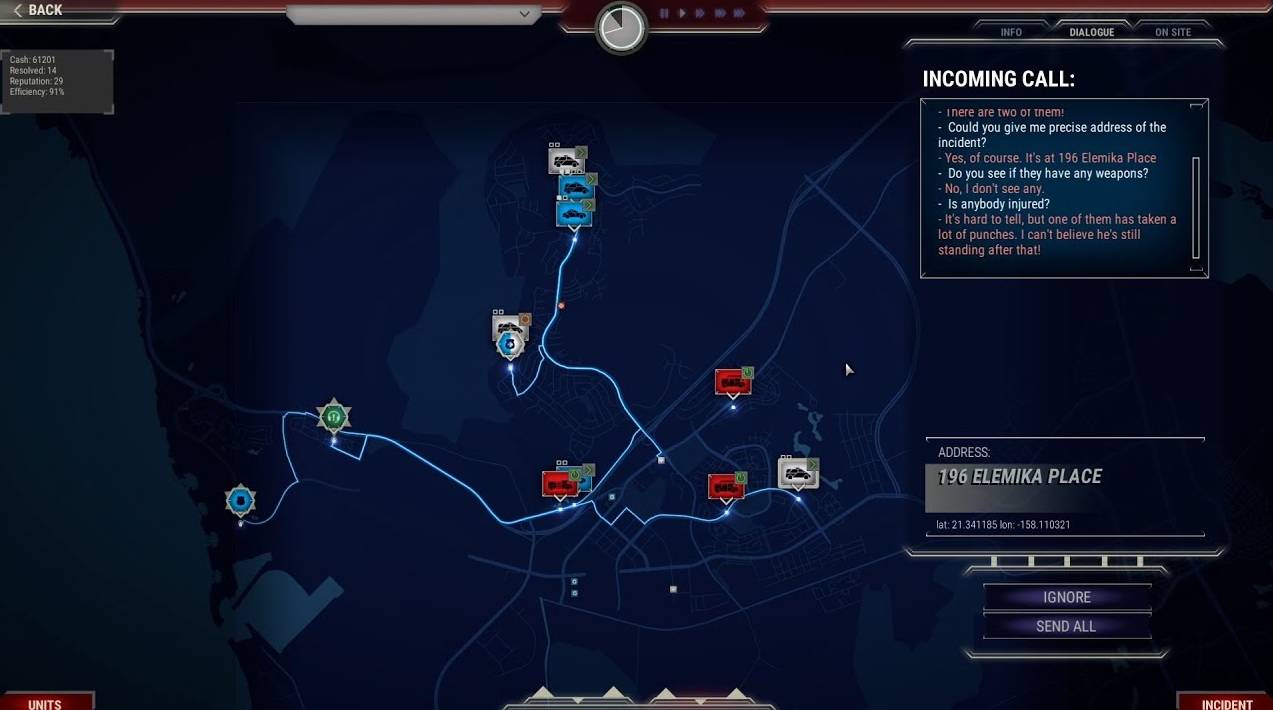
The map itself is a simplified model of the city, on which incident icons appear from time to time. By clicking on them, you can either send a squad or ignore the call. This mechanic could provide scope for interesting solutions — for example, like in This Is the Police, where there were false calls, and the player had to decide for himself whether to spend resources. Unfortunately, 911 Operator does not have such depth. The calls can be ignored, but in most cases they are simply the same, so after a while you react to everything without thinking.
Calls to 911 Simulator
Calls in 911 Simulator are small stories, which are perhaps the heart of the game. Each new signal to the emergency services turns into a mini-scene: you pick up the phone and hear someone complaining about a neighbor who took a parking space, someone talking about a sharp pain in the stomach, and another panicking about a kitchen cabinet on fire. And it is up to you to decide whether this is a real emergency or a false alarm. Make a mistake with the decision – and a reputation penalty is guaranteed. Sometimes you can cope without sending teams: it is enough to correctly tell the caller what to do. But if you give the wrong advice, the consequences will be much worse: you will have to waste time on additional crews and lose reputation points.
The strong point of the game is the voice acting. Calls are not presented in dry text, but as lively stories with voices and background noise. Hear the sound of a car driving away? It means the witness is not lying. Is someone shouting and swearing in the next room? This is also part of the overall picture, which helps you understand how serious the situation is. It’s just a shame that such finds are not used often.
There is practically no music in the game – except for the main soundtrack. But the silence is replaced by radio conversations. Yes, the crews’ lines are repeated and do not differ in variety, but still create the feeling that you are really commanding living people, and not figures on the map.
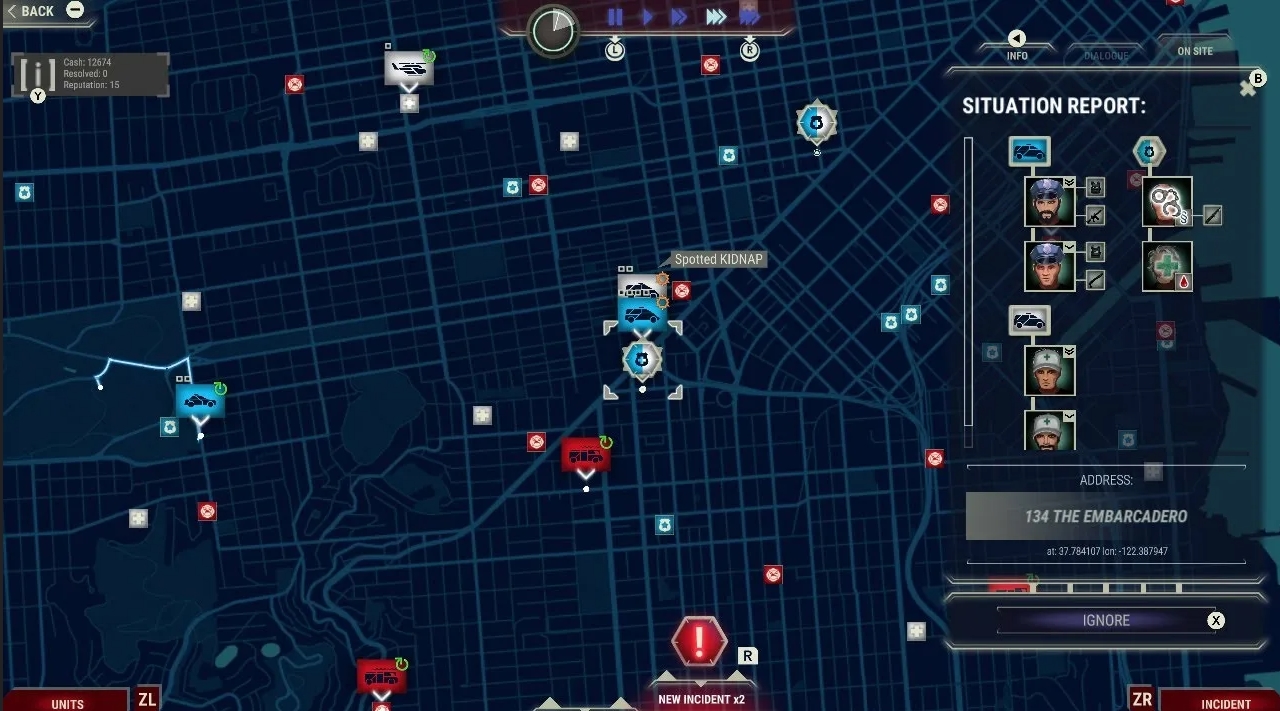
Let’s say you have determined that the call is serious. The next step is to decide who exactly to send. In most cases, the incident icon suggests the right squad. But often you have to think one step ahead. For example, during a robbery, it is worth sending not only the police, but also an ambulance – after all, there is a risk of collision and injuries. Doing so in advance saved time. It should be taken into account that after the call, the teams return to the base: medics – to the hospital with the victims, the police – to the station with the detainees. All this takes time, and if you delay, you may not have time for new tasks.
It is important to remember: events on the map do not wait for you forever. If you ignore an incident for a long time, it will disappear, and with it, your reputation points. Moreover, different situations have different “lives”. A heart attack requires an immediate reaction, but a minor accident can wait. This approach seems to keep you on your toes, forcing you to constantly prioritize, but in reality the system is not too complex and does not provide the level of challenge you expect.
And here we come to the main problem of the game – low difficulty. Even despite the four levels that the developers have provided, there is no real challenge. Yes, in “harder” modes, shifts become longer, penalties for overtime are more noticeable, the pause disappears, and there are more incidents. But even with this, it is almost impossible to fail: reputation rarely drops, and there is always enough money. A real puzzle appears only during rare major events like earthquakes or terrorist attacks. At such moments, the map is filled with dozens of calls, and you have to quickly decide what is more important: defusing a bomb, evacuating people, or sending out patrols on minor matters. But such moments occur only a few times throughout the entire campaign, and therefore the depth that could have become the main advantage of the game remains unrealized.
Pros and Cons of 911 Simulator
So, what do we have as a result? 911 Simulator can hardly be called a failed game — it is quite capable of keeping you busy for several evenings, for about 5-6 hours, while you try out different modes and observe the unusual gameplay. But the main drawback is obvious: there is catastrophically little content here, and those mechanics that are present feel more like “drafts” than ideas that have been polished to a shine.
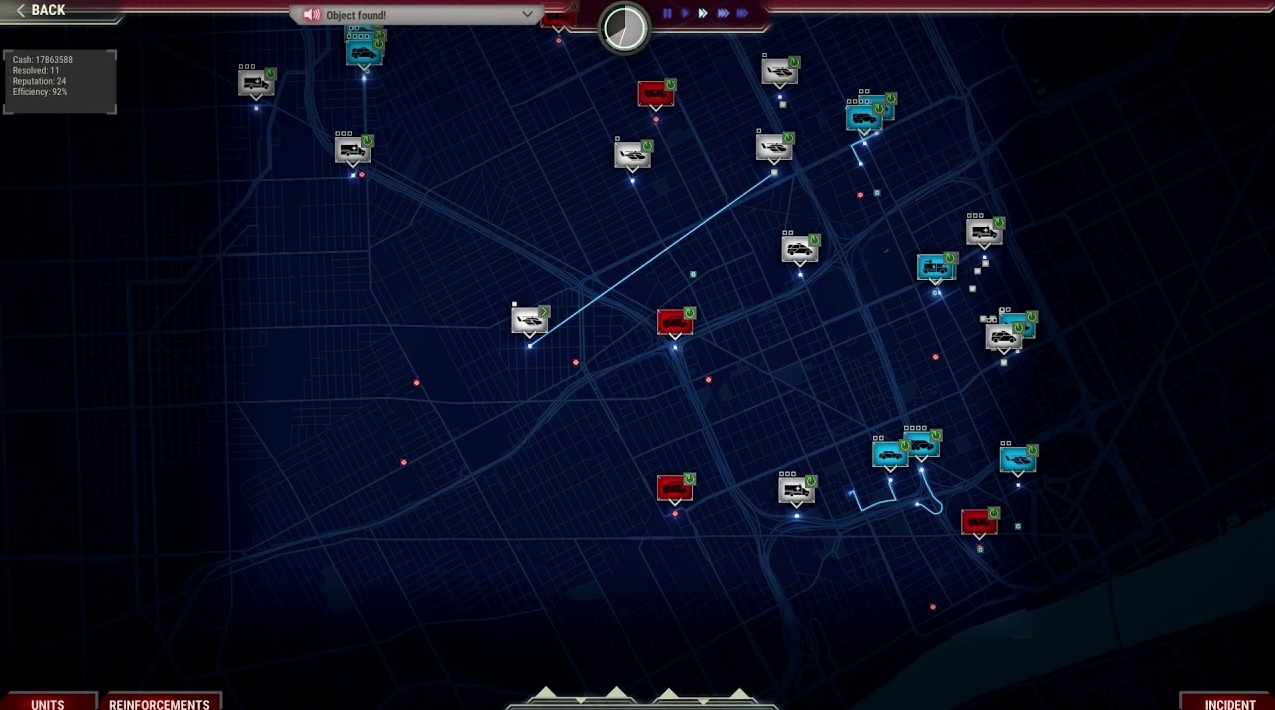
The idea of the project is really strong. It could have turned into a full-fledged and exciting game if the developers had made a solid story campaign with a rich set of situations. Imagine: you are constantly making difficult decisions, trying to be everywhere, balancing between time, reputation and finances. Ideally, it could have looked like this:
-
a greater number of diverse challenges,
-
the development of events depending on your decisions,
-
the need to balance between resources and time,
-
a constant feeling of pressure and responsibility.
Such a scenario would make 911 Simulator a truly engaging experience.
911 Operator System Requirements
911 Operator PC Requirements
How to play 911 Operator for free on Steam via VpeSports
Imagine sitting in a quiet room, the phone resting on your desk, when suddenly it rings. On the other end — fear, panic, someone begging you to help. In 911 Operator, you’re the one who has to keep calm when everything around is falling apart. Fires, robberies, heart attacks, car crashes — they won’t wait. Every second counts, and your decisions shape who gets another chance at life.
Unlike most games, this isn’t about epic landscapes or fighting mythical beasts. It’s about real people and their fragile moments. One call might sound routine, while the next leaves your heart racing. You’ll guide paramedics through crowded streets, direct police to dangerous situations, and sometimes make choices that stay with you long after you quit the game. That’s the beauty and the weight of being the voice that answers when someone dials 911.
We’ve made the path into this experience as simple as possible. No complicated setups, no wasted hours. Just register on our site, log in, and you’ll get everything you need to launch 911 Operator right away. And yes, if you prefer, it can even be done with a free steam account — making your first shift as a dispatcher only a few clicks away.
After your first night on duty, share your story with us. Tell others what it felt like to hold someone’s fate in your hands, to hear their relief when help arrived. Your impressions matter, and once your review is approved, you’ll get the login details straight to your inbox.
To keep the pulse of the community alive, we invite you to join our Telegram channel. That’s where you’ll find fresh accounts, updates, news, and discussions with people who know exactly what it’s like to manage chaos on the other side of the line. And if you’re ever stuck or unsure how to get started, our complete guide will walk you through every step, while live chat support is always ready to help.