Meccha Chameleon is a casual multiplayer hide-and-seek game developed by Japanese indie developer lemorion_1224 with contributions from Haganeiro. It was released on June 10, 2026, exclusively on PC via Steam. By the 26th day after launch, sales had reached 15 million copies—at a price of $5.99 (290 rubles).
For comparison, Cyberpunk 2077 lost out to the indie hit in the charts during the height of the Steam summer sale. According to Alinea Analytics, by June 30, Meccha Chameleon had surpassed EA Sports FC 26 (9.1 million) and Resident Evil Requiem (7.5 million). This is despite the game being available only on one platform, while its competitors are launching on multiple platforms.
However, these numbers only tell the surface. Why did the game take off? And most importantly, how do you play it without getting caught in the first minute? We’ll explore the mechanics, modes, patches, and stealth tactics that guides don’t cover.
Table of Contents
What is Meccha Chameleon, and what’s the secret to its virality?
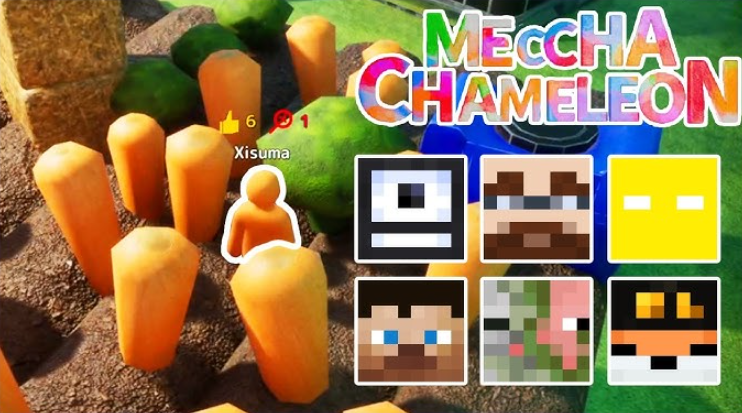
Meccha Chameleon operates on an asymmetrical PvP model: players are divided into two factions—Lurkers (chameleons) and Seekers. At the start of a round, chameleons appear as white, bipedal characters. Their task is to find a position and, using the built-in drawing tool, change their body color to blend into the environment, literally to the point of complete invisibility.
Seekers, meanwhile, must identify hidden enemies within a limited time—analyzing shadows, shades, and even the slightest irregularities in the pattern. The main difference from classic Prop Hunts like Garry’s Mod is that you can’t simply adopt the shape of an object. You must manually select the color, texture, and pose—and do it in a way that will deflect even the most discerning hunter.
The game was developed in just two months. A single developer—and a phenomenon that attracted over 231,000 concurrent players at its peak. The secret to its virality lies in the simplicity of the rules and the endless variety of disguises. Every match is unique: maps, textures, lighting, poses—and there’s always the chance to come up with a hidden secret that no one will ever discover.
Therefore, the developer doesn’t forget to thank the community. At the 7 million-copy mark, a themed Japanese map was added to the game. A collaboration with a famous Japanese star is currently in development—an announcement is promised next week.
How to Play Meccha Chameleon: Camouflage Tips for Beginners
The core mechanic of survival is the eyedropper tool. Activated by the spacebar, it copies not only the hue but also the physical properties of an object, such as roughness, shine, and texture. The eyedropper is what turns a mediocre camouflage into perfection.
Top 3 Beginner Mistakes
-
Mistake #1: Choosing a color by eye. Without the eyedropper, you’re a blank spot on a colorful background. Always use the eyedropper, even if it seems like “this will do.”
-
Mistake #2: Static posture. Applying makeup isn’t enough—you need to find the right pose: curl up, lie down, or press yourself against a surface. Chameleons can also create clones (up to two) and change the character’s size.
-
Mistake #3: Obvious locations. Experienced camouflage players hide in plain sight—near key objects, where they’re least likely to be checked.
Best hiding spots on basic maps
On the Indoor Country map, it’s recommended to slip between the rows of vending machines, simulating an extra shelf full of goods. In the suburban complex, blend in with the textures of a decorative cow: hunters often shoot past you, mistaking you for part of the decor. Hiding near the ceiling and hiding behind the large hanging pipes is one of the safest hiding spots in the game.
All game modes: from Standard to Infection
Meccha Chameleon features three modes based on the classic hide-and-seek concept.
-
Standard mode is a classic. Chameleons hold out until the timer runs out, and Seekers catch everyone. The best choice for new groups, it works with 2 to 10 players.
-
Infection: Captured fugitives defect to the Seekers. The Hunter team grows as the round progresses, putting pressure on the Survivors. It opens at 6+ players.
-
Double Match: Teams swap roles during a single battle. Everyone gets to experience both sides of the fence. Ideal for an even number of players.
The room capacity is 2-10 players according to official recommendations, but with a strong connection, more is possible.
2026 Patches: What’s Added and What’s Broken
The developer supports the game with regular updates.
-
2.3.0 (June 29): Seekers now have an ammo limit: 1 is consumed on a miss, 1 is restored on a hit. If all Hunters run out of ammo, the Chameleons win automatically.
-
2.2.0 (June 28): Furniture randomization has been introduced on the “Mansion” map, making it impossible to remember stashes. The plan is to expand this to all maps. Added 1.4x and 1.7x zoom sizes for the “Cube” character.
-
2.1.0 (June 27): The “The Backrooms” map has been reworked, and the 3D eyedropper has been improved.
-
2.0.0 (June 26): Clones have been added (up to 2). Clones count towards the “blind spot” counter—if a clone is destroyed, the main body is also destroyed.
Summary Table: Meccha Chameleon by the Numbers
The game hasn’t been announced for consoles yet. But with sales like these, it’s just a matter of time. In the meantime, download Steam, grab your eyedropper, and learn to disappear. Just don’t stand out.