
Judging by the first pre-release test, Halo’s transition to Unreal Engine 5 has proven a complete disaster. NVIDIA’s flagship graphics card is performing at a level that can only be described as a fiasco, while portable consoles are on the brink of extinction.
Less than two months remain until the release of the updated Halo: Campaign Evolved, but the first technical analyses based on preview versions of the project are already painting a highly mixed picture. By abandoning its own Slipspace engine in favor of Unreal Engine 5, Halo Studios (formerly 343 Industries) risked everything—and so far, it seems the gamble has not paid off.
Table of Contents
Testing Halo on the RTX 5090 and PC
Enthusiasts and technical specialists from Digital Foundry have already thoroughly tested the project on high-end hardware, and the conclusions are disappointing. On a PC with a no-compromise configuration (AMD Ryzen 9 9950X 3D CPU and NVIDIA RTX 5090 GPU), the game ran at 1440p resolution on Ultra settings with NVIDIA DLAA enabled—that is, without any scaling. The result? Halo: Campaign Evolved spent most of its time hovering between 90 and 100 frames per second, reaching the coveted 120 FPS only in confined, enclosed spaces.
Considering this is the most powerful consumer GPU on the market, this result looks frankly weak. Yes, the official system requirements recommend an RTX 4080 for a stable 60 FPS at 4K, but the preliminary numbers clearly suggest that scaling technologies like DLSS, FSR, or XeSS will be optional, if not strictly necessary, even for owners of high-end configurations.
Official PC System Requirements for Halo
The developers at Halo Studios took a thorough approach to the official system requirements, dividing them into four profiles. While this seems logical on paper, real-world hardware benchmarks cast doubt on these figures. Here what the official game datasheet looks like:
The table is based on the official developer specifications.

In fact, we see that even the RTX 5090 does not provide a stable 120 FPS at 1440p, which seriously questions the possibility of comfortable gaming at high monitor refresh rates. Interestingly, the situation is paradoxically better on consoles.
Halo Optimization and Performance on Xbox Series X
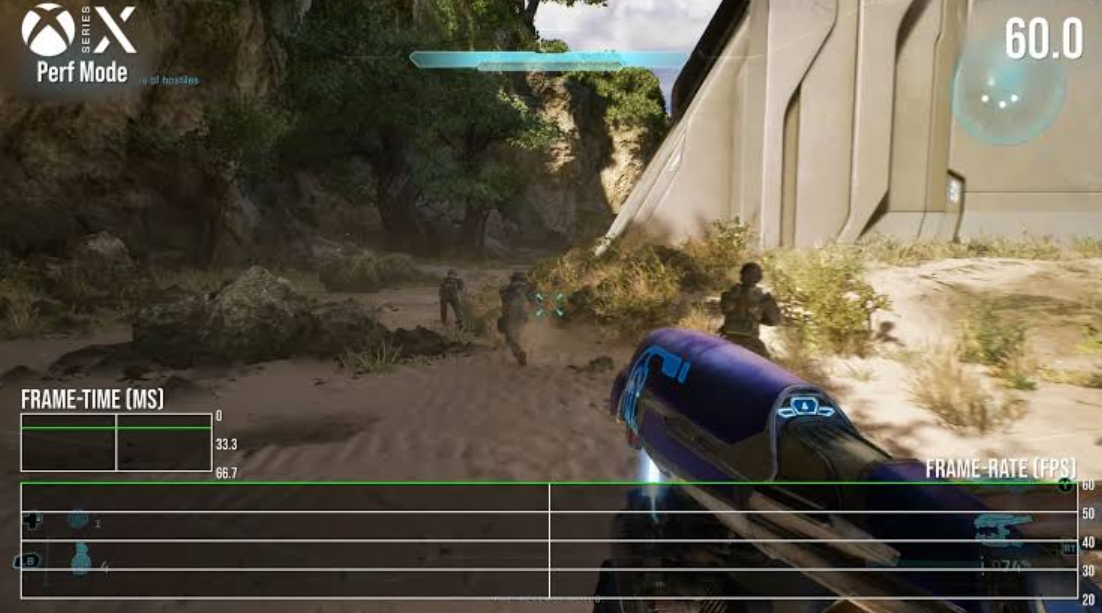
While the PC version raises questions, the version for Microsoft’s flagship console demonstrates exemplary stability. On Xbox Series X, in Performance Mode (the only mode available in the demo), the game runs at a nearly flawless 60 frames per second. This is achieved thanks to the advanced dynamic resolution scaling system, which typically hovers around 1080p.
Digital Foundry particularly highlights the developers’ clever solution: reducing the quality of transparency effects during the most demanding moments. This trick allows for saving precious performance without significantly impacting visuals. It is worth noting that the version for the weaker Xbox Series S has not yet been properly optimized and made available for testing—owners of that console will need to be patient.
Halo Performance on Steam Deck and Portable PCs
The situation is completely different, and even alarming, in the portable market. Tests conducted on the ROG Ally X showed that even at the lowest graphics settings, the game currently runs between 30 and 40 frames per second. Experts are pessimistic about the performance of even weaker devices, such as the Steam Deck. Maintaining a stable 30 frames per second on Valve’s portal could prove nearly impossible.
Part of the problem lies in the version of the Unreal Engine being used. Since the game is based on an older version of the engine, it cannot take advantage of the latest advancements. Specifically, this concerns the special Lumen global illumination mode, introduced in Unreal Engine 5.8. This mode is designed to ensure the coveted 60 frames per second even on low-end hardware, including portable consoles like the Nintendo Switch 2.
Optimization Issues with Remakes on Unreal Engine 5
The situation with Halo: Campaign Evolved is not an isolated incident, but a wake-up call for the entire industry. It perfectly illustrates the main problem with modern remakes. It would seem, why reinvent the wheel when you can take a powerful, modern engine and slap a beautiful wrapper on old, proven mechanics? In reality, we get the opposite effect, and here why.
First, developers often blindly rely on UE5’s out-of-the-box solutions. This is convenient, cheap, and cheerful, but it leads to the creation of “uniform assets” and a lack of distinctive style. The result is a game that is technically modern, but lacks soul and uniqueness.
A much more serious problem is the “transfer” of old games to new platforms. Level concepts, design, and logic, which were honed for older, much less resource-intensive engines, begin to conflict with modern technology. For example, the vast open areas of the classic Halo: Combat Evolved were revolutionary for their time, but now they are becoming an unbearable burden for UE5.
The Impact of Lumen and Nanite Technologies on FPS
Initially, they could mask loading times or serve as tactical pauses. Today, the engine struggles to calculate global illumination (Lumen) and geometry (Nanite) on these vast but sparse environments, wasting performance.

Graphics and Visual Clarity Issues
Bungie veteran Niles Sankey has already publicly pointed out that the typical graphics created by Epic’s engine can degrade tactical readability—one of the central elements of the original. In the pursuit of photorealism, gameplay clarity is lost when enemies blend into the cluttered environment.
Optimization Budget: The developers do not budget enough time for manual performance polishing. They hope UE5 will do everything itself, but experience shows that without deep profiling and fine-tuning, the engine becomes synonymous with stuttering and poor optimization. The result is a paradox: remakes on UE5 often perform worse than the originals on older hardware. Halo: Campaign Evolved is just the latest example of this rule.
Halo: Campaign Evolved is scheduled for release on July 28th for PC, PlayStation 5, Xbox Series S|X, and Game Pass. Halo Studios has until then to polish its creation, but so far, the picture is not looking so rosy.