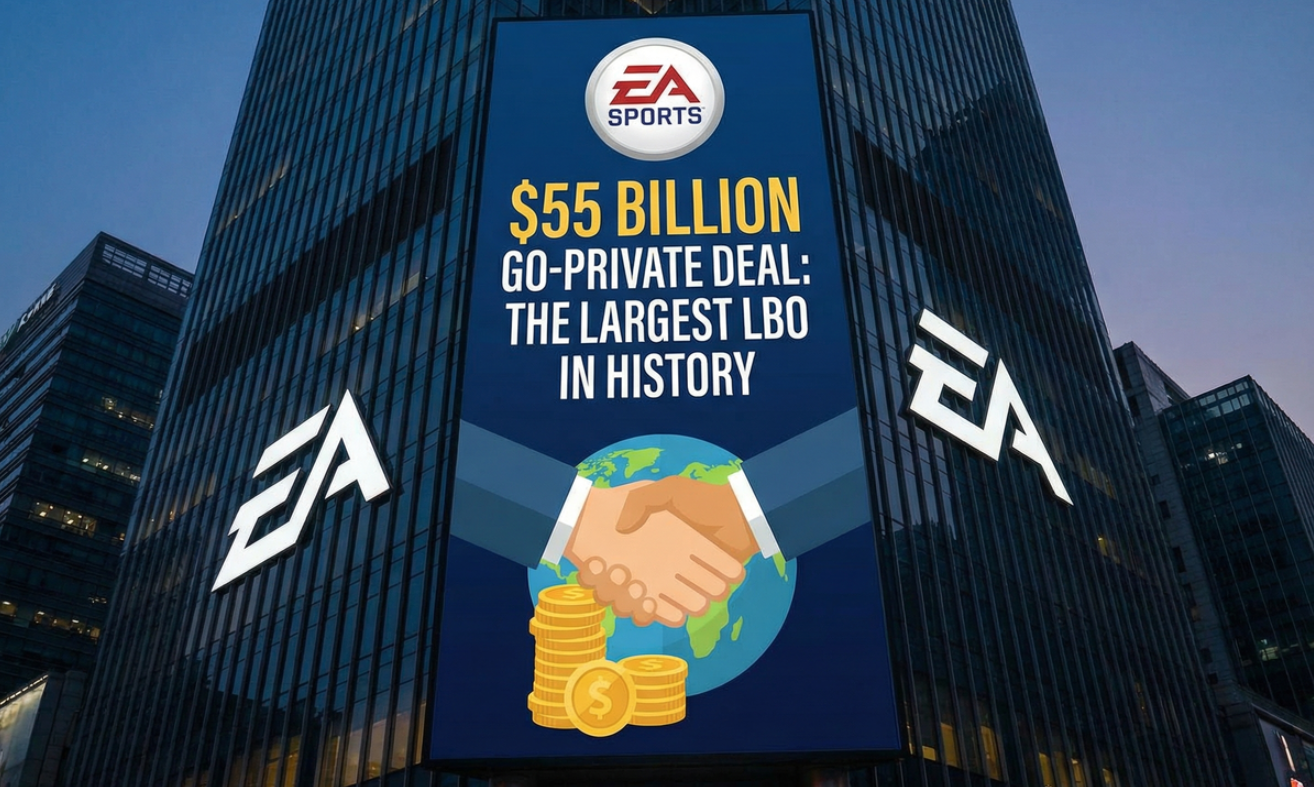
Electronic Arts has received all necessary regulatory approvals to complete the $55 billion transaction. If the remaining technical conditions are met, on August 4, 2026, approximately at the close of trading, the publisher will be controlled by a consortium led by the Public Investment Fund (PIF), leave the NASDAQ, and become a private company. Andrew Wilson will retain his position as CEO.
This completes one of the largest corporate transactions in the history of the gaming industry. While most players won’t immediately notice the changes, for Electronic Arts itself, it marks the beginning of a new phase of development, one that is being built without the obligations of the public market.
Table of Contents
What does EA’s exit from the stock exchange and transition to a private company mean?
After the completion of the transaction, Electronic Arts will cease to be a public company. Its shares will be delisted from the NASDAQ, and shareholders will receive cash compensation under the terms of the transaction. The Public Investment Fund of Saudi Arabia will become the majority owner, owning 93.7% of the company.
For players, this primarily means a change in the corporate model, not the gaming services. EA will continue to release games, support existing projects, and develop its studios. Management will also remain the same: Andrew Wilson will continue to lead the company, and its headquarters will remain in Redwood City, California.
The main difference with a private company is that Electronic Arts will no longer have to publish quarterly financial reports or regularly disclose information to shareholders. This provides more freedom for long-term decisions, but also makes the business less transparent to outside observers.
However, the deal also has a financial component. The acquisition is partially financed with debt, leaving the company with approximately $20 billion in debt. Therefore, analysts are closely monitoring how effectively the new management will be able to complete the integration without major internal changes.
Who now owns EA and how much is the deal worth?
The buyer is a consortium of investors led by the Public Investment Fund (PIF). Silver Lake and Affinity Partners, Jared Kushner’s investment firm, are also participating.

Key deal parameters:
This is the largest leveraged buyout (LBO) in history by value. Among gaming companies, the deal is second only to Microsoft’s $75.4 billion acquisition of Activision Blizzard.
Why was the closing date pushed back and what happens next?
The deal was initially expected to close significantly earlier. At various stages, deadlines as late as July 2026 were mentioned, but the process was delayed due to obtaining the necessary regulatory approvals.
One of the final milestones was approval by the European Commission on July 23, 2026. Following this, the company announced that all key regulatory approvals had been received, and closing is expected on August 4, 2026, near the close of trading, subject to the satisfaction of the remaining standard closing conditions.
At the same time, uncertainty remains around Electronic Arts. Specifically, BioWare employees previously expressed concerns about a possible restructuring following the change in ownership. To date, no official announcements regarding layoffs have been made, so such reports remain employee concerns rather than confirmed by management decisions.
For players, the short-term impact will likely be minimal. Games, services, and existing projects will continue to operate as usual. More significant changes may emerge later, when the new owner determines Electronic Arts’ long-term development strategy as a private company.