ArenaNet has finally lifted the veil of secrecy on Guild Wars 3. Fresh from Summer Game Fest 2026, news has excited the fan community: the sequel will take place a thousand years before the original Guild Wars, during the so-called Golden Age of Orr. Players will become the Guardians of the Vale, an order that has lost its former influence, but it is they who will protect magical spirits from greedy industrialists. The PC and PS5 release is scheduled for 2028, and beta testing is rumored to begin soon—in the fall of 2027. No subscription, no battle passes, and no “second job”—that is how the developers describe their philosophy.
Table of Contents
Golden Age of Orr and Story Features of Guild Wars 3
The time jump in Guild Wars 3 is a complete reimagining of the entire series mythology, not just another marketing ploy. Orr, a dead, parched wasteland in Guild Wars 2, is a flourishing magical metropolis in the new game, where the gods have not yet turned their backs on mortals. ArenaNet researchers explicitly call this period the “golden age” of human civilization: magic flows freely, Ancient Dragons slumber peacefully, and cities are crowned with majestic towers and temples.
The story design relies on contrast: instead of the usual post-apocalypse, we are shown an era of abundance, which, as we know from the chronology, will inevitably lead to catastrophe. Lead writer Aaron Linde emphasizes that players will witness a rise followed by decline—and this creates a tragic depth rarely seen in MMORPGs. Orr buildings, architecture, and magical landscapes are created with extensive reference to the concept art of the earlier games, but completely reimagined for modern technology.
The Valeguard Faction History and Loss of Influence in Orr
The game central faction, the Valeguard, takes its name from the Vale, unique magical spirits that inhabit Orr. These spirits are a vital part of the ecosystem: their presence directly maintains the balance of magic in the region. The Valeguard was founded after the goddesses Melandru and Dwayne granted mortals the ability to create signites—magical gems that store recorded spells. The order was the first to master this technology, but over time, its mission—protecting the spirits—came into conflict with the interests of the growing guilds.
By the start of the game, the Valeguard development has already been interrupted: society considers them a relic, and their rituals archaic. Players must not simply join a powerful order, but rather revive it from the ashes, literally gathering knowledge and allies bit by bit. It is a bold narrative move—instead of giving the player strength from the start, ArenaNet offers a period of weakness and gradual recovery.
Magical Artifacts Signites and the Economy of Tyria
In the world of Guild Wars 3, Signites have become a universal asset: they are used as currency, a strategic resource, and a weapon of war. Created from pure magic, they allow any spell to be sealed into a crystal, which can be used by anyone—even non-mages. This innovation has revolutionized the economy of Tyria: Signites are now sold, traded, and hoarded like gold. Guilds, trading houses, and even individual adventurers pursue rare specimens, and the black market is literally teeming with counterfeits.
But there is a flip side to this coin. Mass production of Signites depletes Orr magical power, and the Vale begins to disappear. This is where the main conflict arises: the Guardians of Vale see the Signites as a threat, while their opponents see them as a ticket to the future. ArenaNet masterfully crafts this dilemma, offering no clear answer—it is up to the player to decide which path is right.
The Maevenwright Industrialists as Main Enemies in the Game
If the Vale Guardians are the guardians of tradition, the Maevenwrights are the rationalist industrialists. Led by charismatic leaders, the guild believes that Orr magical resources should be harnessed for progress, not left lying idle. They build factories, extract magic from the earth, and transform signites into mass-market commodities. Their ideology is simple: the development of civilization requires sacrifice, and nature is nothing more than raw material.
The conflict between the two factions goes far beyond the struggle between “good and evil.” The Maevenwrights outshine the Vale Guardians in organization and resources, offering jobs and technology to the people, while the Vale Guardians seem detached from reality. The game will show us the prelude to a true war—for magic, for the future, and for the soul of Tyria itself. Incidentally, the developers hinted that choosing a side will affect not only the story but also the available skills and even the world appearance—so the moral dilemma here has real gameplay weight.
Guild Wars 3 Combat System and Seeker Mount
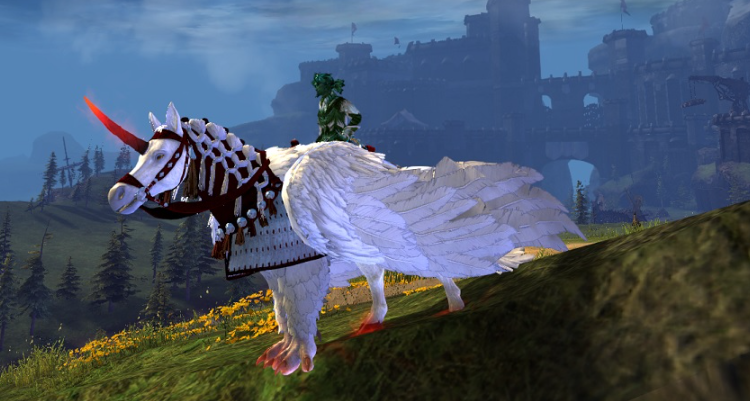
But lore is only half the battle. The main question is: how do you play it? For the first time in the series history, ArenaNet has completely redesigned the combat mechanics, emphasizing action and mobility. Each player receives a companion—a spirit mount named Seeker. It acts as a mount; it is also your tactical partner. While moving, you build momentum, which can be spent on enhanced attacks or defensive abilities. The more dynamic your tempo in combat, the more powerful your strikes—the game literally rewards constant movement.
Combat is built around positioning: dodging, dashing, jumping from platforms—and all of this is seamlessly integrated with traditional profession skills. The system is said to work equally well on both gamepad and keyboard, and the developers meticulously tuned the response so that every hit feels weighty. It is already safe to assume that PvP battles will be far more spectacular than in previous installments, and PvE raids will require not just skill rotation, but coordinated movement across the entire group.
Guild Wars 3 Release Date Platforms and Monetization
Official announcement at Summer Game Fest 2026 – the release date has not yet been revealed, but information has leaked that the game will be released in 2028 on PC (Steam, Epic) and, for the first time in the series history, on PlayStation 5. Xbox Series X/S are not listed as target platforms at launch, but a port is possible later. Beta testing is tentatively scheduled to begin in the fall of 2027 – applications are already open on the official website.
Monetization is buy-to-play, with no monthly subscription or battle passes. The developers emphasized that they do not want to turn the game into a “second job,” so all purchases for real money are cosmetics and perks (additional inventory slots, skin changes, and the like). No pay-to-win—this is a tribute to long-time fans and an attempt to attract a new audience tired of endless paywalls.
Key Takeaways from ArenaNet Guild Wars 3 Announcement
The golden age of Orr, the rift between conservationists and industrialists, a new combat system, and fair monetization—Guild Wars 3 looks like ArenaNet most ambitious project in ten years. The developers promise another expansion that will completely redefine the genre, where respect for the player time goes hand in hand with a deep storyline and modern gameplay. All that is left is to wait for the beta and hope that the promises become reality—in the meantime, you can add the game to your wishlist and start discussing your favorite professions in the comments.