
Tech breakdowns rarely turn into praise. A typical Digital Foundry analysis is a list of trade-offs: resolution drops here, shadows get cut there, the image turns soft just to keep frame rates stable. With Assassin’s Creed Black Flag Resynced, it played out differently. The outlet tested the remake across every current-gen console and found little to complain about. Even the budget Xbox Series S — usually the weak link in any multiplatform release — is holding onto technology that other consoles treat as a top-tier privilege.
This isn’t luck or a fluke of the engine. Ubisoft had already admitted it squeezed everything it could out of the current console generation, and Digital Foundry’s breakdown is essentially independent confirmation of that claim, backed by numbers and graphs.
Table of Contents
What Digital Foundry Found on PS5 and Xbox Series X
Digital Foundry’s engineers ran the remake through the full lineup of modern consoles — Xbox Series X, Xbox Series S, PlayStation 5, and PlayStation 5 Pro — and concluded that Ubisoft managed to optimize the game well across every platform.
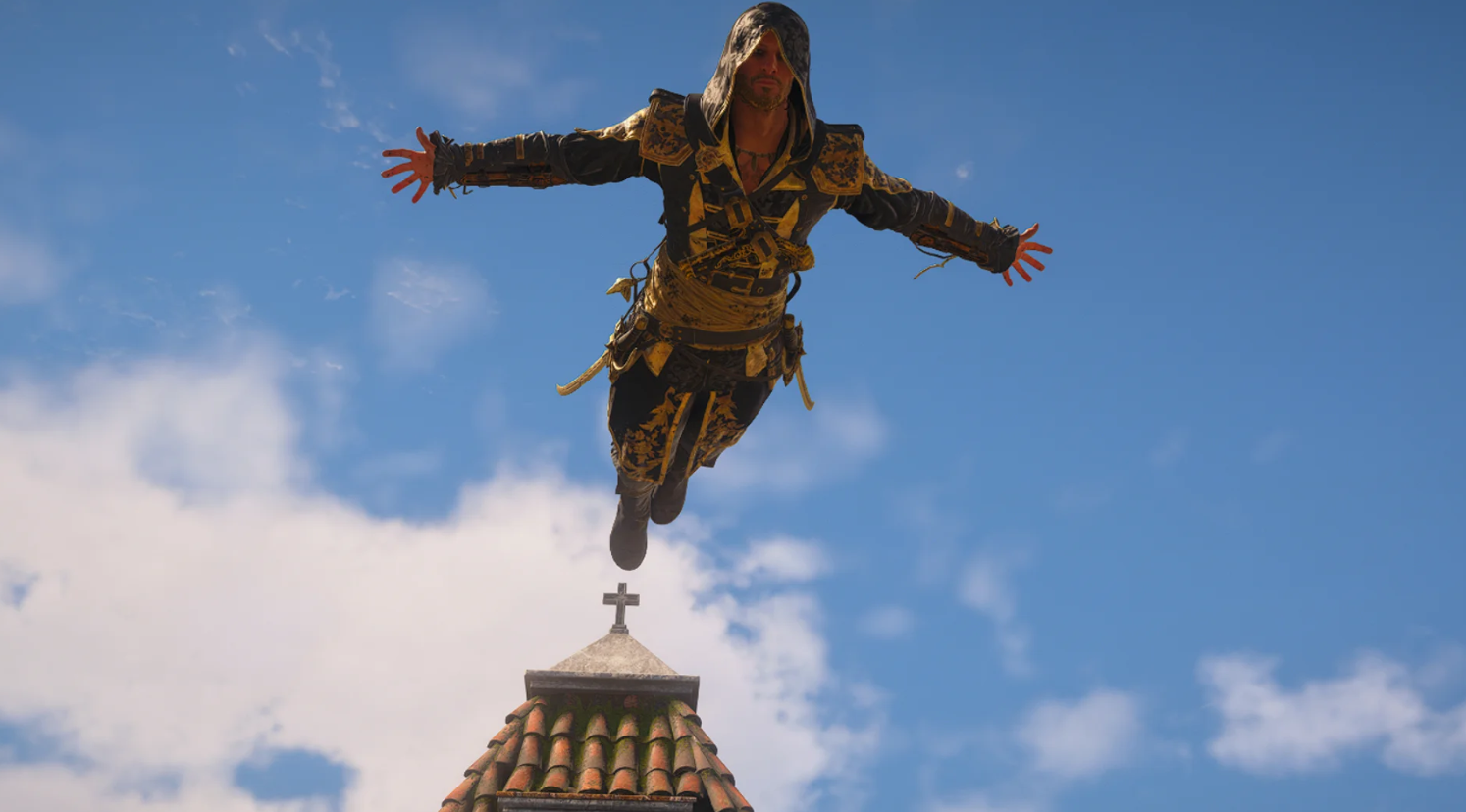
On the higher-end consoles, Xbox Series X and base PlayStation 5, three graphics presets are available:
-
Quality Mode — 30 fps, with ray-traced reflections plus Ray Traced Global Illumination (RTGI);
-
Performance Mode — 60 fps, though full RT reflections are swapped for lighter screen-space reflections to hit the higher frame rate;
-
Balanced Mode — a middle ground between visuals and smoothness, built for displays with a higher refresh rate.
For a game built around naval combat and boarding actions, this lineup isn’t just a checkbox feature. Water reflections here aren’t cosmetic — the Caribbean in this remake is thoroughly built around RT effects, which is exactly why switching to Performance Mode feels more noticeable than it does in the studio’s other titles.
Why Xbox Series S Surprised Even the Skeptics
Usually, the weaker console of the current generation is where developers cut technology first — ray tracing is typically the first casualty. Black Flag Resynced takes a different approach.
Xbox Series S offers a single graphics mode, locked at 30 fps — and that mode still retains RTGI. This is a case where the compromise hits resolution rather than technology: the image on Series S is less sharp, hair rendering is simplified, and the picture looks a touch softer overall. But the overall visual language of the game remains recognizably intact, not a stripped-down copy.
For Xbox Series S owners, that’s a meaningful practical takeaway: there’s no need to choose between “playing something that looks good” and “playing on weaker hardware” — the core visual identity of the game (lighting, shadows, global illumination) is preserved.
Ubisoft’s Technical Director Explains How They Pulled Off This Optimization
In an interview with Digital Foundry, Ubisoft technical director Nicolas Lopez said the team squeezed practically everything PlayStation 5 is capable of. According to him, getting a more impressive picture out of the current console generation will be extremely difficult going forward — any real visual leap in the studio’s next project will require either new hardware or a massive optimization effort.
One of the biggest technical hurdles the team ran into was dynamic resolution. When it dropped too low, micropolygon-based geometry started causing models to flicker. Developers had to raise the minimum rendering resolution threshold to eliminate visual artifacts and keep the image stable across every platform — a decision that directly shaped the smoothness Digital Foundry ended up measuring.
An interesting detail: the developers said their custom ray tracing system was partly inspired by id Software’s work, referencing the new Doom’s fully ray-traced renderer. The difference is that in Black Flag Resynced, ray tracing can still be manually disabled — an important option for players running weaker PC hardware.
PS5 Pro Modes: What Changes With More Powerful Hardware
The PlayStation 5 Pro version deserves special attention — this is where the generational gap is felt most clearly. Pro offers the same three modes, but with extended ray tracing across all of them:
| Mode | Target FPS | Resolution | Ray Tracing |
|---|---|---|---|
| Performance | 60 fps | 2160p (PSSR 2.0 upscale) | Extended (RTGI + reflections) |
| Balanced | 40 fps | 2160p (PSSR 2.0 upscale) | Extended |
| Quality | 30 fps | 2160p (PSSR 2.0 upscale) | Extended |
The key difference with the Pro version is that even its 60 fps Performance Mode doesn’t sacrifice RT reflections, unlike on base PS5 and Xbox Series X. Multiple outlets independently noted that PS5 Pro’s Performance Mode delivers visuals roughly on par with base PS5’s Quality Mode — at double the frame rate.
Pro owners also get an added bonus: improved hair rendering based on physically simulated individual strands instead of standard texture cards. Edward Kenway gets this treatment in every mode, and during cutscenes, all characters in frame benefit from it regardless of which preset is selected.

Which Mode Should You Choose on Each Platform?
The short version: it comes down to whether smooth boarding actions and sailing matter more to you, or maximum detail in water and lighting.
-
PS5 / Xbox Series X, prioritizing smoothness — go with Performance Mode. Yes, RT reflections are swapped for screen-space alternatives, but a locked 60 fps matters a lot more during active naval combat and boarding sequences.
-
PS5 / Xbox Series X, prioritizing visuals — Quality Mode with full ray tracing is worth it if you play at a slower pace and want to soak in the sunsets over the Caribbean.
-
Xbox Series S — there’s no choice to make, and there’s no need to worry either: RTGI is intact, you’re just trading some sharpness and simplified hair rendering.
-
PS5 Pro — consider Balanced Mode at 40 fps if you have a 120Hz-capable display: the visual difference versus 30 fps is nearly imperceptible, while the smoothness gain is substantial. For standard 60Hz TVs, Performance Mode makes more sense — extended ray tracing is retained here too.
What This Means for Players and What Comes Next
A technically solid multiplatform release is the exception, not the rule, which is exactly why Digital Foundry’s breakdown is worth treating as more than just another tech review — it’s a case study. Ubisoft demonstrated that optimizing for weaker hardware (Xbox Series S, in this case) doesn’t have to mean cutting standout technology like ray tracing. It just takes careful balancing of resolution and detail.
The practical takeaway for players is simple: whichever console you plan to play the remake on, you’re not getting shortchanged — the differences come down to sharpness and frame rate, not the underlying quality of lighting and graphics. And the technical director’s comment that the current console generation has been squeezed for “practically everything” is worth keeping in mind: the next major technical leap for the series will likely have to wait for new hardware — or a serious mid-generation refresh of the consoles we have now.