

When you see Call of the Sea for the first time, you think that everything is clear: a beautiful tropical island, an investigation, a bit of mysticism. But after an hour you realize that the game skillfully uses this simplicity as a screen. It hides a story that suddenly hits you in the gut in the finale — especially if you still read all the notes and took your time with the passage.
The Spanish studio Out of the Blue Games released Call of the Sea in December 2020. The game was released on Xbox Series X|S and PC, later reached PS4/PS5, and received a VR version in 2023. The publisher is Raw Fury, known for supporting small author projects. The budget is clearly not AAA, but the ambitions are definitely above average.
Table of Contents
What is Call of the Sea: genre, atmosphere and first impressions
Formally, it is a first—person adventure puzzle game with elements of a walking simulator. The action takes place in 1934: the main character Nora Everhart goes to an unnamed Pacific island near Tahiti to find her missing husband, Harry, who went there with an expedition in search of a cure for his wife’s mysterious illness.
For the first twenty minutes, the game creates the feeling of a vibrant, almost idyllic adventure: lush jungles, ancient ruins, warm colors. This works as a deliberate contrast — the further you move around the island, the more the atmosphere darkens. The game is inspired by By Howard Lovecraft, but this is not a horror movie or “another cultist shooter.” Here, Lovecraftism is more about mood and mythology, rather than monsters.
Nora was voiced by Cissy Jones is the actress that many have come to love for her role as Delilah in Firewatch. And this is no coincidence: in the spirit of Call of the Sea, loneliness, personal drama, dialogues with oneself, and exploring space as a way to process pain are the closest to Firewatch.
The plot of Call of the Sea: more than meets the eye
Retelling the plot without spoilers is difficult, but it is important to understand: the story here is the main asset. The developers build a narrative based on the onion principle: each of the six chapters removes another layer, changing the angle of perception of events.
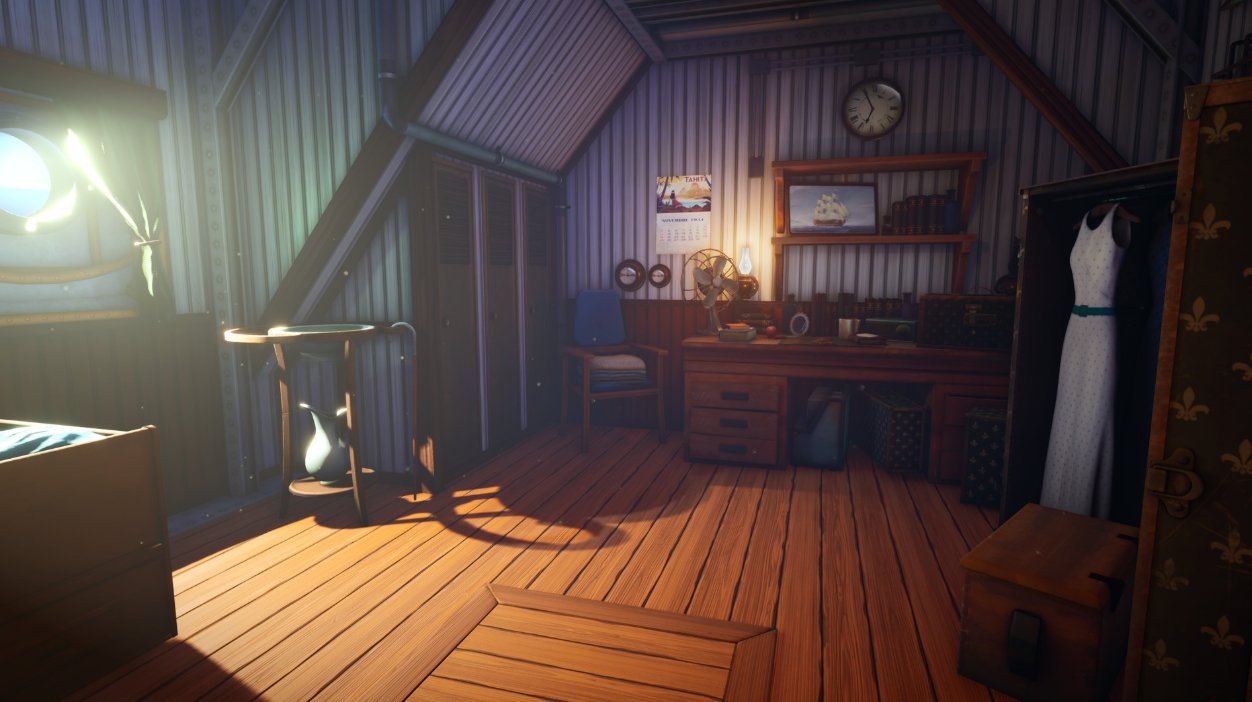
Nora arrives on the island and literally follows in her husband’s footsteps— literally. She finds the expedition camp, notes, photographs, and personal belongings of the team members. It gradually becomes clear that the island is inhabited (or rather, was inhabited) by a mysterious race of creatures that left behind complex mechanisms and symbols. What happened to them? What happened to the expedition? Why did Harry stop writing?
The ending is ambiguous and allows for different interpretations, which is rare for games of this scale. The authors are not afraid to give the player space for their own conclusions.
The main weakness of the narrative is the way it is presented. The authors clearly prefer to tell rather than show. In each location, there are two or three notes waiting for you in the tent, another one at the box, and something taped on the wall. There is not much text and it is informative, but the intensity of this technique begins to tire by the middle of the game. At the same time, Nora comments on each piece of paper she finds out loud — sometimes it creates the right intonation, sometimes it just makes it difficult to read.
Gameplay and structure: six chapters, six types of puzzles
The game is divided into six full-fledged chapters plus a final one devoid of riddles. Each chapter is a separate area of the island with its own visual theme, a set of puzzles and a portion of the plot. The passage takes 4-6 hours , depending on the pace and desire to read all the texts.
The mechanics are standard for the genre: explore the location, collect clues, solve puzzles, open the way to the next zone. The key feature is Nora’s diary: it automatically captures all the important details, symbols and diagrams as they are discovered. This eliminates the need to take notes by hand, which is far from the norm in the puzzle genre.
Most puzzles are based on the logic of “find a clue → apply it to the mechanism.” It works well: the solutions are mostly honest and don’t require random iteration. However, in a couple of places, the developers have clearly overdone it — and it is these puzzles that generate the majority of search queries such as “call of the sea organ puzzle solution”.
The most difficult and famous puzzles of Call of the Sea
| The puzzle | Chapter | The essence | Why is it difficult |
|---|---|---|---|
| The Bridge (Bridge Puzzle) | 1 | Arrange the totem symbols in the correct order | You need to understand the logic of the “stack” of symbols: fish → sea → mountains → birds → sun |
| Lenses (Lens Aligner) | 2 | Burn out a pattern of black spots on the lens | The hints are in the mine — they are easy to miss |
| The Tidal Organ | 3–4 | Set up a tidal organ using water levels | A multi-stage task that requires information from multiple sources |
| Constellations | 5 | Activate floor symbols in the correct order | Three doors, three different combinations — it’s easy to get confused in the sequence |
Lens Aligner Puzzle Guide: First, find and activate three symbols with black substance in the mine (pit with stairs in the hut area). Nora will draw three patterns in her diary. Then return to the lens device and reproduce the desired black dots on the 5×5 grid. The size of each dot is adjusted using the “+” and “—” buttons.
Organ Puzzle Guide: The organ is controlled by tidal mechanisms. It is necessary to find the wall markers of the water level in the lower part of the zone — Nora will enter them in the diary — and then adjust the organ so that the diamond of the pointer coincides with the desired symbol. After activation, a bridge appears.
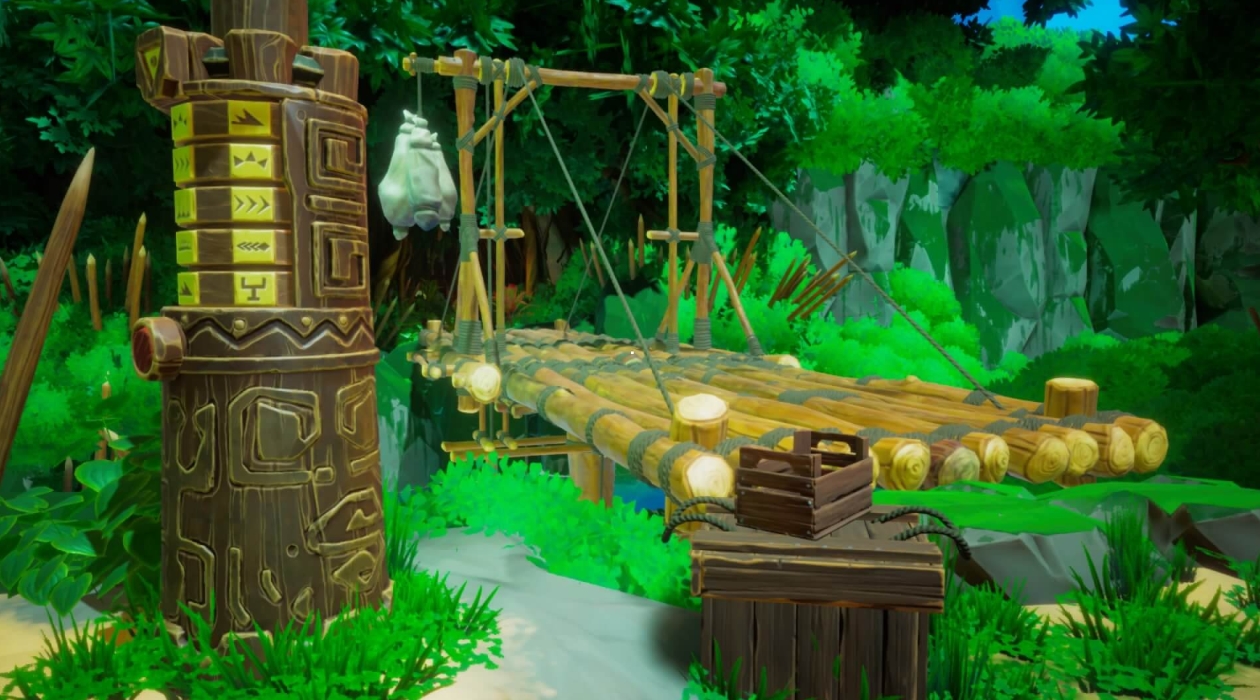
Bridge Puzzle Guide (Chapter 1): Find four red totems in the starting area and draw them. The order of symbols on the mechanism is from bottom to top: fish, sea, mountains, birds, sun. It is this kind of “stack” that opens the bridge.
Explore premium content using our free steam accounts with games.
Visual style and technical aspect
Call of the Sea looks intentionally unrealistic: saturated, almost watercolor colors, simplified shapes, soft light. This artistic solution works — the game looks beautiful and does not become obsolete as quickly as photorealistic projects. Tropical jungles, flooded ruins, a night sky full of stars — each location is made with attention to detail.
Technically, everything is modest, but stable. No serious bugs were recorded at the time of release. Performance on all declared platforms is no problem.
PC system requirements (minimum):
-
OS: Windows 10
-
CPU: Intel Core i5-4590 / AMD FX 8350
-
RAM: 8 GB
-
GPU: NVIDIA GTX 970 / AMD Radeon R9 290
Achievements and trophies of Call of the Sea: a complete list of types
On Steam and on consoles, Call of the Sea offers 34 achievements/trophies. They are divided into several categories:
-
Plot points — are given for completing each chapter automatically; it is impossible to skip
-
Collectible — for finding all the hidden notes and items in each zone
-
For the choices — in the final, the game offers a choice: stay with Harry or leave; both endings give separate trophies
-
High—speed – passing in a certain time (relevant for speedrunners)
The platinum/100% trophy requires: to complete the game twice (for the sake of two final selections), collect all the notes in each chapter. It will take about 8-10 hours to complete the 100% test.
The Council: Take your time in the first playthrough — thoroughly search every location. Many notes are hidden around corners or in hard-to-spot corners.
Comparison with similar games: who is Call of the Sea suitable for
If you’re looking for games similar to Call of the Sea, then here’s an honest comparison:
| The game | The similarity | The difference |
|---|---|---|
| Firewatch | Loneliness, personal story, voice of an actress | More dialogues, open world, no puzzles |
| Myst / Obduction | Logic puzzles, island exploration | More complicated, less narrative |
| The Witness | First-person island puzzles | Much more complicated, with almost no story |
| Abzû | The atmosphere, the mystique of the ocean | No puzzles, more meditative |
| Subnautica | Pacific theme, research | Survival, an open world, a completely different scale |
| Heaven’s Vault | Narrative, an archaeological mystery, the 1930s | More RPG elements, non-linearity |
Call of the Sea is closest to Firewatch in spirit and to Obduction in mechanics, but easier than both. This is probably the best entry point into the genre for those who want to try an adventure puzzle game, but are afraid to get stuck on the first puzzle.
Criticism and weaknesses: what is annoying
Despite the general sympathy of critics, Call of the Sea has real problems that cannot be hushed up.
Oversaturation of text in locations. Five or six notes in one small area is a lot even for those who don’t mind reading-heavy games. Some of the information is duplicated or presented too bluntly, leaving no room for interpretation.
Nora’s obsessive comments. The main character pronounces almost every action. If you try to read the note you found, and at the same time you hear several remarks about the obvious, it ruins the immersion.
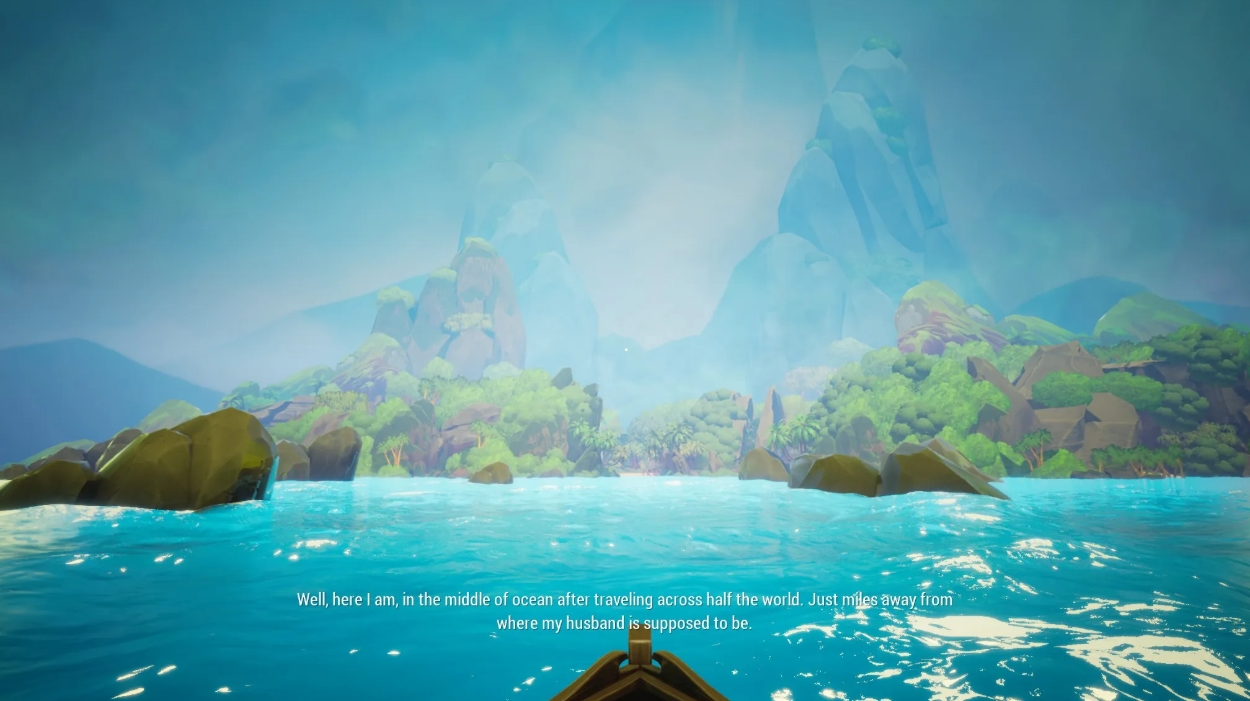
A short film. Five hours is a fair amount of time for an indie game at that price, but the story clearly could have gone deeper. Some lines remain outlined rather than expanded.
The logic of the world. Critical thinking needs to be disabled here. Why do complex mechanisms work on a long-abandoned island? Why are the mechanisms so… specific at all? The game does not offer a clear explanation, and this will be a problem for some of the audience.
A separate voice is the author of the review, who rated Call of the Sea much tougher than most: According to him, the game starts off well, but towards the middle it turns into one of the most boring adventure experiences. This opinion is in the minority, but it reflects the real risk: if you don’t get the story, the gameplay itself won’t hold you back.
Bottom line: is it worth playing Call of the Sea
Call of the Sea is not a game for everyone, and she knows it. If you are waiting for action, challenging puzzles of The Witness level, or a lengthy walkthrough, disappointment is guaranteed. But if you’re looking for an atmospheric story for the evening, where the quality of the narrative is more important than the mechanics, and the visual style is more important than the polygons, this is a very good choice.
The game benefits primarily from the ending: it’s unexpected, emotionally accurate, and leaves an aftertaste. There are few such endings in indie adventure games.
To whom we recommend: for Firewatch fans, those who haven’t played Myst but want to try the genre, and anyone interested in Lovecraftian aesthetics without horror.
To whom we do not recommend: players who need mechanical depth, replayability, or at least six hours without replays in a single playthrough.
How to play Call of the Sea for free on Steam via VpeSports
There are games that don’t let go long after the end credits. Call of the Sea is exactly like that. You take on the role of Nora, a woman with an incurable disease and the only hope is to find her husband, who disappeared without a trace on a remote Pacific island. But the further you move along the paths of this strange place, the more clearly you realize that the island lives by its own laws, and solving the mystery may be scarier than the disease itself. The atmosphere here is thick, almost tangible — a Lovecraftian world where every find raises new questions, and the landscapes are so beautiful that sometimes you just stop and look. You can try it all for free, and we’ve already taken care of everything.
You won’t be required to make any unnecessary movements. You register on the website, log into your personal account, and there is either a ready—made Steam account or a simple launch instruction. We deliberately made the process as short as possible, because we understand that we want to play, not deal with technical wilds. So in just a few minutes you will already be standing on the shore and listening to the sound of the waves.
And finally, our Telegram channel exists for a reason. There’s live chat, fresh accounts, up-to-date patches, and game news. If something goes wrong or you have any questions, take a look at the “How to play for free – full guide” section or just write to the chat. Let’s help you figure it out.