

Wild Terra 2: New Lands tests players not with a dragon or a difficult boss, but with a request to make something slightly more advanced than a stone axe. In a conventional MMORPG, you simply press a button, wait for a timer to finish, and collect the completed item. Here, you first have to find the raw materials, process them at several workstations, prepare the necessary tools, stock up on food, and avoid ruining valuable resources because your crafting skill is still too low.
This production chain contains both the greatest strength and the biggest weakness of Wild Terra 2. The game creates a convincing sense of manual labor and gradually allows you to turn an empty plot of land into a functioning estate. However, every new level of craftsmanship demands more repetitive work. If you enjoy growing crops, tanning hides, and building complicated production chains, an entire evening can disappear without you noticing. If you expect fast battles and constant rewards from an MMORPG, your patience may run out within the first few hours.
This is not another theme-park MMO built around a linear campaign. Wild Terra 2 is a niche medieval sandbox MMORPG created by the small team at Juvty Worlds. The game received its full release on November 10, 2022, and the developers have continued to support it with fixes, events, and additional content. According to the official website, the project is currently maintained by a team of only four people. Its limited resources are sometimes obvious, but so is the consistency of the developers’ original vision.
Table of Contents
What Is Wild Terra 2: New Lands and How Does Its Gameplay Work?
In spirit, Wild Terra 2 has more in common with Ultima Online and old-school online sandboxes than with World of Warcraft or a modern story-driven MMORPG. The game does not declare your character a chosen hero, nor does it lead you through an endless sequence of marked quests. You are expected to set most of your own goals: build a home, master blacksmithing, tame an animal, become wealthy through trade, or prepare for an expedition into dangerous territory.
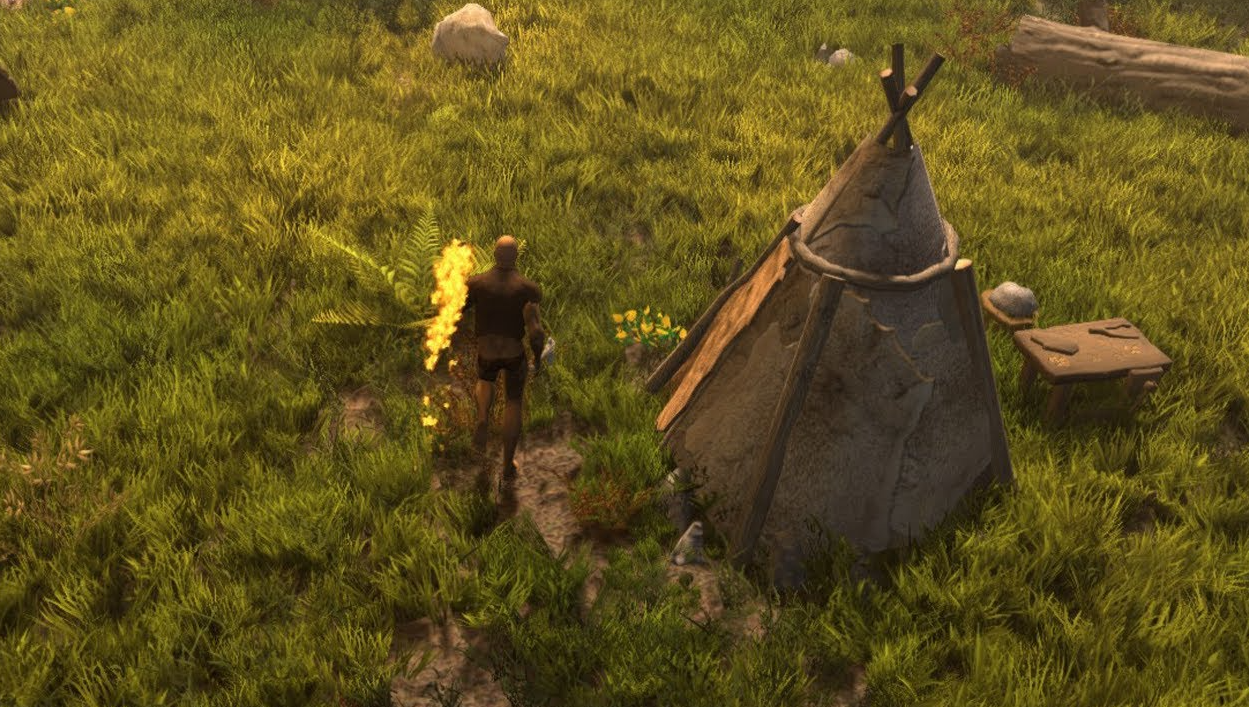
The opening hours resemble a traditional survival game. Your character gathers stones and branches, makes primitive tools, hunts animals, cooks food, and searches for a suitable place to settle. Over time, this familiar gameplay loop develops into a full MMORPG with player settlements, an economy, professional specialization, dungeons, and territorial conflicts.
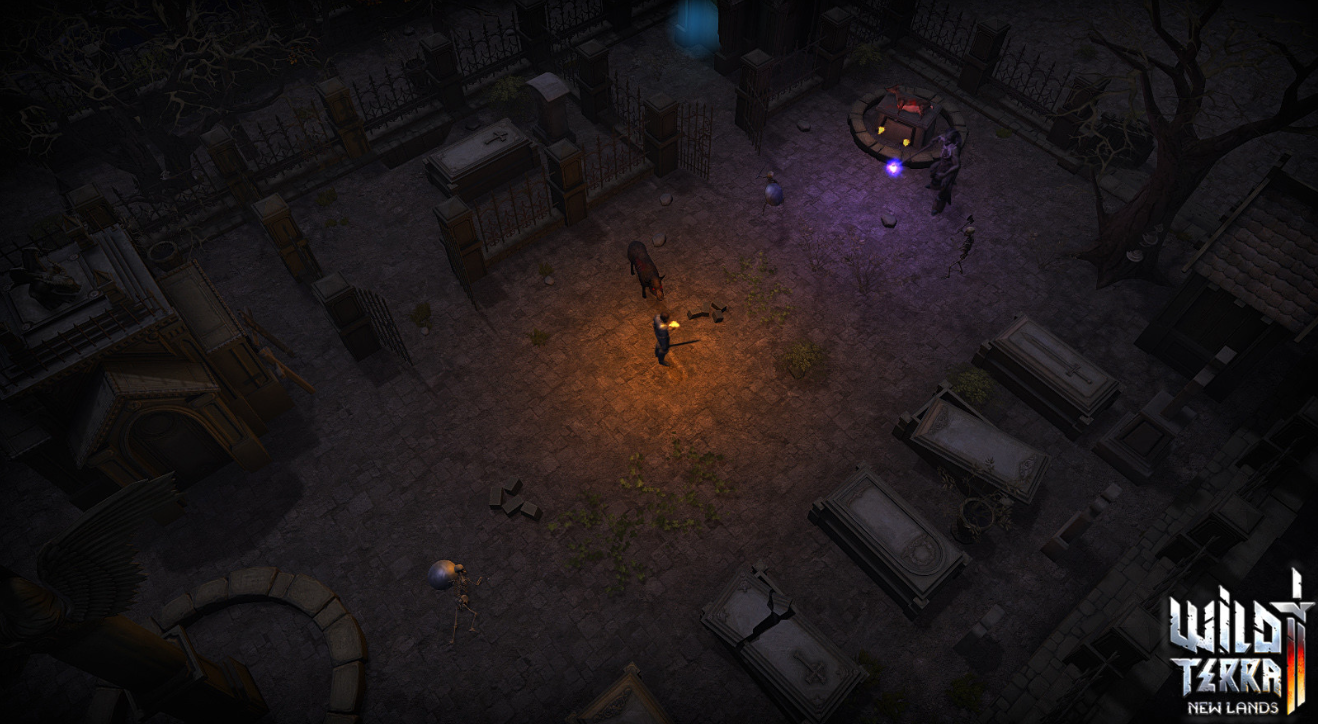
The main activities in Wild Terra 2 include:
-
gathering wood, ore, plants, and other resources;
-
hunting, fishing, farming, and cooking;
-
building and expanding a personal estate;
-
crafting weapons, armor, tools, and furniture;
-
trading and cooperating with other craftsmen;
-
exploring islands, caves, and dungeons;
-
fighting regular enemies and powerful bosses;
-
taming animals and training combat pets;
-
participating in PvP and guild activities.
The story is not the driving force behind Wild Terra 2. Adventures emerge naturally from situations such as finding rare materials, meeting another player, failing a dangerous expedition, or finally completing an advanced workshop. This approach requires initiative. If you always need a quest marker pointing toward the next objective, the world may feel empty. Players who enjoy self-directed progression, however, receive a degree of freedom that large modern MMORPGs rarely provide.
Crafting and Professions Are the Strongest Parts of Wild Terra 2
Crafting is not a secondary activity included merely to produce a few consumable items. It forms the foundation of the game world, connecting resource gathering, construction, food, equipment, and trade. Players can become builders, blacksmiths, farmers, leatherworkers, alchemists, fishermen, bakers, healers, jewelers, or merchants. There is no formal restriction preventing one character from learning several professions, but mastering everything at once is extremely difficult.
Skills improve through use. Cutting down trees develops the relevant ability. Making tools advances your crafting expertise. Fighting with a particular weapon unlocks abilities associated with it. There is no traditional class selection: your character’s role is defined by equipped items, weapons, and developed skills.
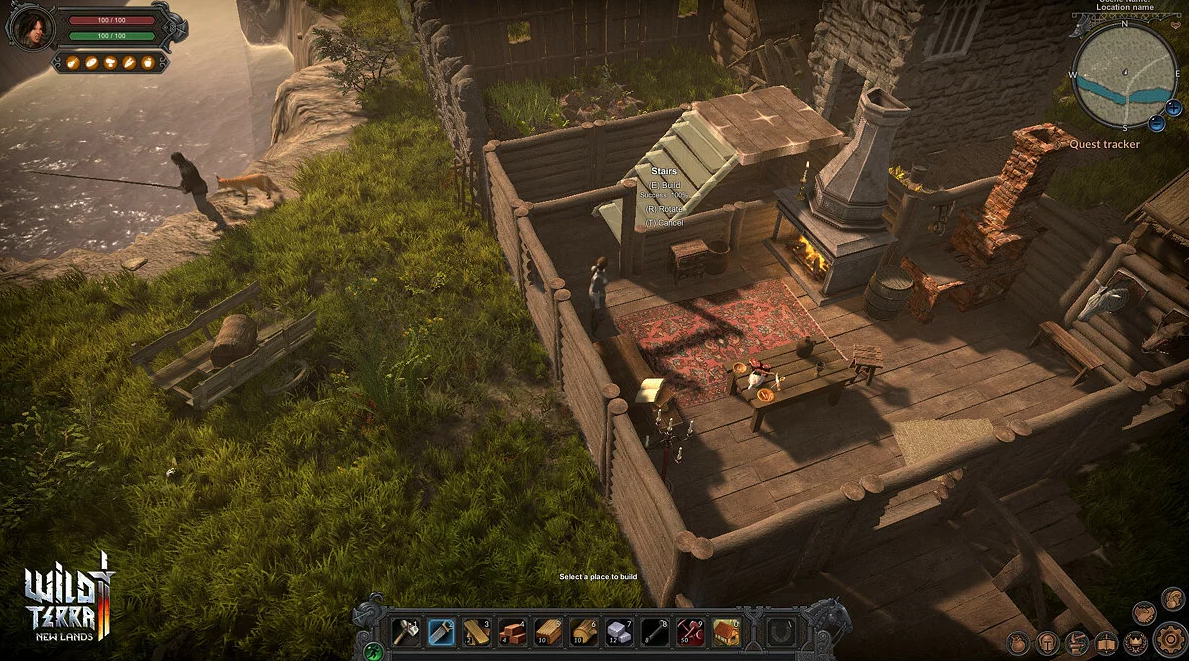
The more advanced an item becomes, the longer its production chain grows. Leather must be processed, ore needs to be smelted, and construction materials require specialized workstations. Simply bringing raw resources to a workbench is not enough. You must understand the correct sequence of operations and maintain the infrastructure of your estate. Some crafting attempts can also fail, especially when the character’s relevant skill is not sufficiently developed.
This system gives every item a sense of value. A good sword does not feel like a random image pulled from a treasure chest, but like the result of work performed by gatherers and skilled craftsmen. At the same time, crafting becomes the game’s primary source of grinding. Progress requires large quantities of materials and repeated completion of similar tasks. Wild Terra 2 rewards patience, but it makes little effort to disguise its routine behind flashy prizes.
Building a Home and Expanding Your Dominium
To claim a plot of land, the player must place a Dominium, the central structure of a personal estate. Within its boundaries, you can construct housing, storage buildings, production stations, farming facilities, defenses, and decorations. The territory can be expanded gradually, although every improvement requires another substantial investment of resources.
Construction works well as a visual representation of progression. At first, the estate contains little more than a basic bed, a campfire, and several simple workstations. Dozens of hours later, it can become an organized production center where every station and storage chest has a specific purpose. A house in Wild Terra 2 is useful rather than purely decorative.
The land ownership system also encourages social play. Other characters can work within a territory, while larger communities can divide professions between members and supply workshops more efficiently. A solo player has to maintain far more production systems without outside help.
The developers have also implemented a method of clearing abandoned buildings from the world. When an owner remains inactive for an extended period, the estate does not permanently occupy valuable land. Objects associated with the Dominium can be restored after the player returns, although a new place for the settlement may need to be found. For a persistent online world, this is a sensible compromise between protecting player progress and keeping land available.
Survival, Food, and Exploration
Wild Terra 2 pays more attention to food than most MMORPGs. A character cannot rely indefinitely on carrying a stack of the same roasted meat. Different food categories affect separate nourishment values, while a varied diet improves stamina recovery and overall efficiency.
The system initially appears excessive, but it gradually becomes part of the wider economy. Hunting provides meat and hides, farming supplies vegetables and grain, and gathering produces fruit and useful plants. Fishermen, farmers, and cooks have a genuine role because prepared food is needed before long resource-gathering trips or dangerous expeditions.
The world feels comfortable and atmospheric thanks to its isometric perspective, quiet natural locations, weather effects, and environmental audio. Safety quickly disappears once you move beyond settled territory, however. Valuable materials require players to travel farther from home and explore caves, islands, and more dangerous regions. Ships, mounts, and other forms of transportation eventually make longer journeys easier.
Exploration is not packed with enough unique encounters to exist independently from character progression. The primary reasons to travel are resources, enemies, and access to the next stage of a profession. Players expecting a world filled with narrative discoveries and carefully scripted quests may find its content limited.
Combat, Weapons, and PvE Content
Wild Terra 2 uses a classless, non-target combat system. Your role depends on the item in your hands, whether it is a sword, spear, bow, hammer, or even a working tool. Different weapon types provide their own active and passive abilities, meaning that changing equipment affects both character statistics and combat style.
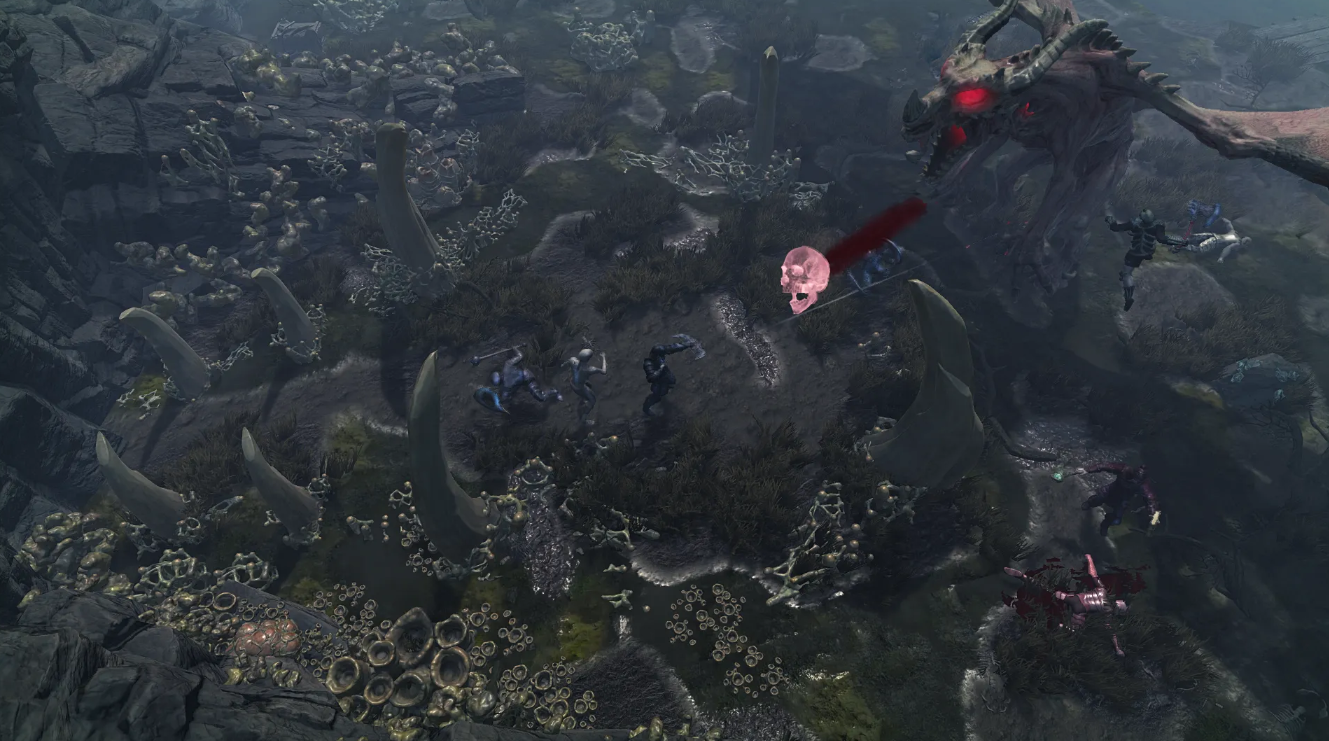
PvE content includes common creatures, stronger enemies, caves, dungeons, and large bosses. Dungeon difficulty can scale, while high-level expeditions are designed for prepared characters and organized groups. Combat gives a practical purpose to equipment, potions, food, and trained pets.
Fighting is less polished than crafting, however. Animations and attacks lack responsiveness, while dangerous enemy abilities are not always communicated clearly. Older reviews also criticized desynchronization, stuns, and the questionable balance of ranged weapons. Wild Terra 2 has received numerous fixes since launch, so it would be unfair to present every early technical problem as permanent. Nevertheless, the fundamental heaviness of combat remains. It is a functional system, but not a reason to install the game solely for its action.
PvE or PvP: Can You Play Without Fighting Other Players?
PvP has long been one of the most controversial parts of Wild Terra 2. The world is divided into territories with different levels of danger, and the consequences of defeat depend on the current zone and server rules. When searching for rare materials, players risk encountering better-equipped opponents and losing some of their collected resources.
The main problem with open-world PvP is familiar from other small MMORPGs. An experienced group can control valuable locations, while a limited server population makes every hostile encounter especially significant. For some players, this danger transforms an ordinary mining trip into an exciting adventure. For others, it can erase several hours of peaceful gathering.
Dedicated PvE servers have become an important reason to consider the game. In December 2025, for example, the developers opened an accelerated North American PvE server where loot, resource acquisition, and progression were doubled. Worlds like this make Wild Terra 2 significantly friendlier to builders and craftsmen who do not want to participate in open PvP.
You should still study the rules of a particular server before creating a character. Progression speed, economy, regional location, and the consequences of death may differ.
| Game Element | What Works Well | What May Put Players Off |
|---|---|---|
| Crafting | Deep production chains and meaningful professions | Repetitive tasks and extensive resource gathering |
| Construction | A useful estate with workshops, farming, and storage | Expanding the territory requires considerable time and resources |
| PvE | Dungeons, bosses, hunting, and animal taming | Combat is less polished than the crafting systems |
| PvP | Risk makes resource expeditions more exciting | Players may lose loot, while large groups have an advantage |
| Solo Play | You can develop a home and chosen profession at your own pace | Specialization and cooperation become more efficient later |
| World and Atmosphere | Comfortable isometric presentation and convincing medieval life | Limited story content and few scripted events |
Can You Play Wild Terra 2 Solo?
You can begin Wild Terra 2 and spend a considerable amount of time playing without a permanent group. Gathering, hunting, farming, construction, and much of the crafting system are accessible to solo players. Choosing a PvE server also removes the risk of being attacked while collecting resources.
However, the game is designed around interdependent professions. The more advanced your estate becomes, the more intermediate materials and specialized skills it requires. Attempting to become an expert blacksmith, leatherworker, builder, farmer, and alchemist at the same time turns progression into a marathon. Purchasing components from other players or joining a settlement significantly reduces the amount of repetitive work.
The social aspect is not limited to group combat. Even ordering an item from another craftsman can produce a small story: you have to find the right specialist, negotiate a price, and deliver the materials. This is where the concept of a player-controlled world works best. The effectiveness of the system depends heavily on the population of your chosen server, however. In a quiet world, the necessary specialist or item may simply be unavailable.
Technical Condition, Graphics, and System Requirements
Visually, Wild Terra 2 does not attempt to compete with big-budget MMORPGs. Its strength is consistency: the isometric camera, dense vegetation, small settlements, and warm medieval atmosphere fit together naturally. Character models and animations look less impressive than the environments, while the character creator offers relatively little freedom.
The interface contains numerous recipes, skills, and statistics, so it can feel overcrowded at first. Learning the game is also complicated by the fact that some information has to be obtained from community guides or the official Wiki. Old-school players may consider this part of the appeal, but newcomers will need time to adjust.
The official Wild Terra 2 system requirements remain modest:
| Component | Minimum Requirements | Recommended Requirements |
|---|---|---|
| Operating System | Windows 10, 64-bit | Windows 10, 64-bit |
| Processor | Intel Core i5 or AMD Phenom II X4 at 2.5 GHz | Intel Core i7 or AMD Phenom II X6 at 3.5 GHz |
| Memory | 4 GB RAM | 8 GB RAM |
| Graphics | GeForce GTX 460, Radeon HD 5850, or Intel HD 4600 | GeForce GTX 660 or Radeon HD 6970 |
| DirectX | Version 11 | Version 11 |
| Storage | 5 GB available space | 5 GB available space |
| Internet | Broadband internet connection | Broadband internet connection |
Despite the low system requirements, online performance does not depend solely on your computer. Distance from the server and current server load are particularly noticeable during non-target combat, where positioning and timely movement matter.
How Wild Terra 2 Differs From Albion Online and Other Sandbox MMORPGs
Comparisons with Albion Online are inevitable. Both games use an isometric camera, classless progression, player-driven economies, and dangerous PvP territories. Albion Online is considerably faster, more competitive, and more heavily focused on large-scale conflicts between guilds. Wild Terra 2 is slower and more intimate, paying greater attention to the everyday aspects of medieval life, including nutrition, material processing, farming, and maintaining a personal estate.
The game differs from survival titles such as Valheim through its persistent servers and community economy. Producing an item matters not only to the owner of a base: the result can be sold, exchanged, or used to develop a larger settlement. This design also creates a dependence on the active population of the server.
For this reason, Wild Terra 2 is better described as an MMORPG for players who enjoy crafting and gradual progression, rather than as a lower-budget version of Albion Online. It cannot offer the same scale of PvP warfare, but it provides a more detailed representation of a character’s working life.
Is Wild Terra 2: New Lands Worth Playing in 2026?
Wild Terra 2 is worth considering if the process matters more to you than the final reward. The game convincingly presents the journey from a person holding a primitive tool to the owner of a fully developed workshop. Crafting, construction, specialization, and the economy are connected parts of one system rather than isolated menus.
It cannot be recommended to every MMORPG fan, however. Progression is slow, combat feels heavy, the story is almost nonexistent, and the overall experience depends greatly on the chosen server and its active population. The mixed user reviews on Steam reflect this conflict well: some players discover an unusually deep sandbox, while others see excessive grinding and a general lack of polish.
The ideal player is someone patient who enjoys setting personal goals, developing a profession, and watching a small plot of land become a prosperous estate. Having friends helps, although joining an existing community is another option. Players interested in a quieter experience should choose a PvE server and check its rules, region, and current population before beginning.
Wild Terra 2 does not try to please everyone, and that is precisely why it maintains a distinct identity. It is rough, slow, and occasionally exhausting, but its crafting systems create a sense of labor and ownership that is rarely found in larger and more convenient games. If building a medieval life from the ground up sounds more appealing than completing another chain of quests, New Lands can keep you occupied for a very long time.