The Riot Games esports department decided to finally achieve predictability by rolling out a crazy triple-elimination format for the opening VCT 2026 tournaments. This innovation, by the way, will affect absolutely all international leagues. Now 12 teams in each region will have a hard time: to get out of the event, you need to manage to lose as many as three matches. To be honest, this approach to VCT Kickoff is an attempt to add stability to the chaos of the beginning of the season, but it seems to raise a lot of new questions from both fans and the pro players themselves.
Table of Contents
Advantages of the Triple Elimination format in Valorant
The developers, must agree, have been trying for a couple of years to reward teams for stability — just remember the introduction of championship points in 2024. A format with a triple chance of error is, in fact, a logical continuation of the strategy.
-
Stability: Teams will have to sweat in the upper, middle and lower grids to pick up a slot at the Masters in Santiago.
-
Adaptation: At the beginning of 2026, the lineups of almost all have been updated, plus new maps and agent edits.
-
The right to make mistakes: The triple selection gives teams the opportunity to fix strategies right during the tournament, without crashing out after a couple of unsuccessful cards.
Jacob “Valyn” Batio from G2 Esports, in an interview with Esports Insider, noted that he likes this idea. According to him, this will help send the really strongest teams to the first Masters of the year, and not those who were just lucky in one series. His teammate Andrej ‘babybay’ Francisty, however, added ironically that three grand final matches were already some kind of “doping” for the viewer.
The impact of the triple elimination system on broadcast coverage
For us, ordinary viewers, along the way, this means tons of content. More matches means more wild comebacks, personal dramas and new confrontations. From a business point of view, Riot Games is generally in chocolate.
-
Partners: The expanded schedule gives commercial sponsors many times more airtime.
-
Statistics: Viewing hours and peak online in all four regions will obviously go into space due to the length of the tournament.
-
Plots: The probability that some dark horse will get through all the thorns to the top is now higher.
Apparently, we are waiting for the longest and most intense start of the season in the history of Valorant. The tournament in Chile will be the culmination of this marathon. We organized an announcement — now we just have to wait to see if the players will burn out from so many waitresses.
Features of preparing pro players for the VCT 2026 marathon
The endless VCT race has turned the competitive Valorant into a real obstacle course, where roasters have been fighting for weeks, in fact, for wear and tear. Esports players, I must say, are already trumpeting total exhaustion, while coaches are frantically reshaping the training process — the task of getting the most out of people and not breaking them is more acute than ever. The Triple Elimination format, by the way, only adds fuel to the fire, forcing teams to literally survive from the very first minutes on the server.

The problem of emotional burnout in esports
Professionals at Valorant catch tilt and exhaustion not because of one-time drains, but because of a whole layer of factors: here you have ten-hour “factory” workouts, eternal flights, and nightly demos. By the way, an ex-NAVI player once admitted that after a major event, he couldn’t touch the devices for three days, his hands were just shaking. Statistics generally look creepy: about 60% of pro players suffer from insomnia, which, by the way, is a direct blow to aim and decision-making in clutches.
In order not to go down the drain, organizations have begun to implement “digital detox” — Team Liquid, for example, forces guys to completely turn off their gadgets for 48 hours once a month, sending them hiking or just into a deep sleep. The result is that productivity in practice soars by 30%, which is quite powerful. The scheme is simple: after playing for 6 hours, go for an hour walk, and at 23:00 be kind enough to go to bed, such rules really save you from mental collapse.
Valorant League Fatigue Statistics
During VCT 2025, representatives of Sentinels and Gen.G has repeatedly complained on social media that after Stage 1 they turned into shadows of themselves — the schedule with games every other day, along the way, leaves no chance of regen at all. One of the newcomers to the EMEA region honestly gave out: “I didn’t sleep for three days, jerked off friezes, and eventually flooded the rink because of the wildest tilt.” The body gives up first — the eyes are red, the back “falls off”, and the click rate drops by 20%, judging by the measurements.
Clubs are now changing the vector: instead of endless slamming into the monitor, short but extremely tough sessions of 4 hours each, where VOD reviews relate only to critical jambs. Fnatic, by the way, went even further and introduced the rotation of the Valorant squad, when the substitutes replace the base in training. This, in fact, reduces the workload by a quarter and allows you to keep a fresh look at peaks and strategies.
Psychological pressure and mental health of teams
The Triple Elimination system in VCT means that almost everyone leaves the group — three misfires, and you go home to pack your bags. This kind of pressure breaks the psyche, because any map feels like the final of an international, and the haight of fans on social networks only finishes off the survivors. Psychologists, by the way, see a sharp increase in anxiety before important boost matches, where the value of victory is off the charts.
Note to the coaches: ten-minute meditation before the game through the same Headspace actually reduces cortisol by 15%, tested. The guys from Paper Rex love this method — after a five-day marathon, they managed to maintain 80% accuracy in duels, which is impressive. Another hack is team “therapeutic” sessions once a week, where you can dump all the accumulated negativity without fear of being judged.
VCT Team Preparation: new rules of the game
The evolution of VCT training goes from dumb grind to intelligent resource management. Instead of 12-hour shifts, microcycles are now in fashion: we plow for 3 days, rest for 2 days with an emphasis on mental health. The rotation of the Valorant team has become a base — in the Pacific region, many keep 8 people each, shuffling them into roles so that no one burns out ahead of time.
This approach is bearing fruit: LOUD has risen by 4 positions in the ladder after the introduction of shifts, and the stress level in the team has doubled, according to anonymous surveys.
| Preparation Aspect | Old Approach | New VCT 2025 Approach |
|---|---|---|
| Training | 10 hours per day without breaks | 6+ hours with detox / recovery blocks |
| Roster | Fixed 5-player lineup | Rotation of 7–8 players |
| Recovery | Ignored | Sleep tracking + physical training |
| Analysis | Full VOD reviews | Error-only reviews (20 minutes) |
| Triple Elimination | Panic response | Early-stage pressure simulations |
The role of substitutions and rotation of the squad to win the tournament
Flexible rotations of the Valorant line—up are the only way through the Triple Elimination sieve, where one mistake does not mean the end of the road. 100 Thieves is experimenting with all its might, changing profile duelists to flex players on unloading days to give rest to the main controllers. The advantages are obvious: fresh ideas appear in the strategy book, and the risks are reduced to zero — after all, the bench is always in good shape and ready to break into battle.
Disadvantages and risks of the Triple Elimination format in the VCT season
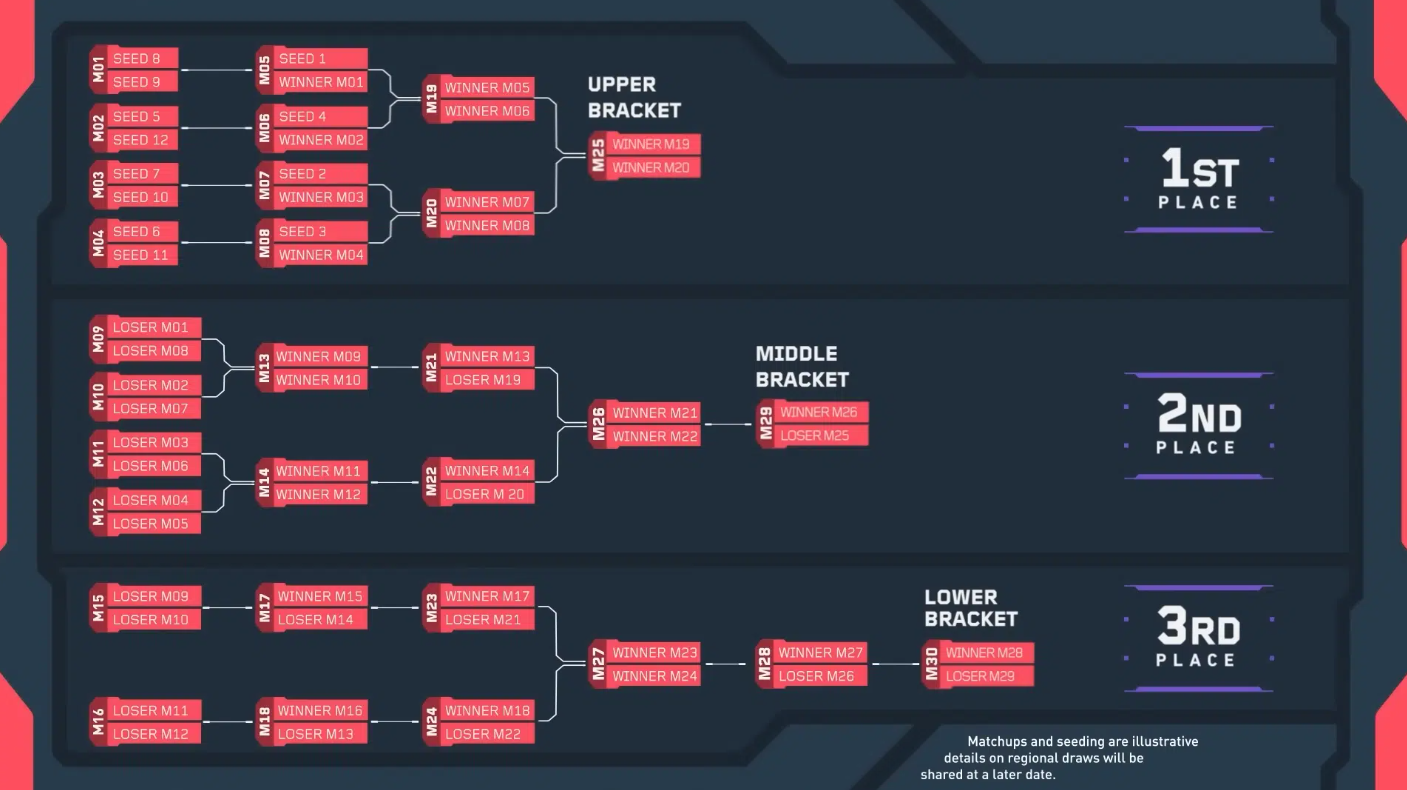
Riot Games, the publisher, decided to test the strength of esports players by rolling out a triple-elimination system at the VCT 2026 launch events. And here’s the most interesting thing: with all the advantages for the competitive process, this format is a real puzzle, which is much more complicated than the usual Double-Elimination grids. By the way, the advent of the “mid bracket” can make match tracking a living hell if you don’t have a clear infographic at hand. The teams will migrate between levels so often that you can’t figure out who’s playing with whom without a glass, that’s a fact.
Forecast of views and analysis of audience interest in the event
For fans who are used to watching Valorant in all regions at once, the news is, frankly, frightening.
-
Figures: In total, exactly 120 games will be played at VCT Kickoff in EMEA, the Americas, China and the Pacific region.
-
Problem: Viewers, along the way, simply won’t take out such a volume and will start choosing only top-end signage.
-
Risks: Popular tags will collect cash, and tier-2 team matches risk being left with an empty chatroulette – it’s unfair, really.
By the way, Riot Games promised to cram regular rest breaks into the schedule, but the issue of player fatigue is still up in the air. Imagine a situation: a team flies into the final of the top bracket, loses, falls into the mid bracket, misfires again – and now they are forced to play three tough Best—of-5 series in a row in three days. It’s clear that it’s almost impossible to produce a top—of-the-line performance in this mode – it’s just exhaustion.
The opinion of professional players about the new Riot Games system
Andrey “babybay” Francisti, by the way, highlighted the darkest side of this venture. He wonders what if the team goes through all the finals, loses them, and ends up going nowhere at all? — This is the most ruthless part of the system. — Such a scenario would be the worst nightmare for any pro. — But otherwise, the format looks cheerful and charming.
Results of the Triple Elimination grid implementation in the 2026 season
In general, a triple—elimination grid is probably a step in the right direction. The advantages outweigh here, because the squads will get more practice and will be able to get in shape before the rest of the season. Recall that VCT Kickoff will determine three lucky winners from each region who will fly to the first VALORANT Masters. The tournament, by the way, will take place from February 28 to March 15, and the broadcasts, as usual, will be played on Twitch and YouTube. Let’s see what this will lead to — it sounds ambitious so far, but it’s very risky.