Imagine a large number of hard drives with a capacity of more than 250 TB — that’s how much historical content the esports giant Team Liquid decided to transfer to the Walrus Foundation platform. By the way, the organization itself officially announced this, apparently deciding to sort out its digital blockages once and for all.
Table of Contents
Archive of Team Liquid in the Sui blockchain and storage of 250 TB of data
This massive data set includes match records from recent years, tons of behind-the-scenes footage, exclusive photos, and a bunch of old media files that used to just gather dust on servers. The main purpose of this maneuver is, in truth, banal convenience: the organization wants access to the library to be instant, and the preservation of content to be eternal.
By the way, Team Liquid has clearly embarked on a large-scale modernization of its internal “kitchen”. According to the club’s representatives, the new system should remove operational crutches and simplify the lives of employees around the world — now it will be much faster to pull the necessary video from the archive and put it into action, which, in principle, is logical for a business of this scale.
Walrus technology and decentralized file storage
Basically, Walrus is a decentralized data storage platform that has been raised on the Sui blockchain. The developers position it as an ultra-fast solution for working with huge amounts of information. Sophisticated availability confirmation and CDN delivery networks are used — this, by the way, is critical for the download speed of content anywhere in the world.
According to the Walrus technical documents, all files are encoded and distributed to different nodes when uploaded, and the metadata is tightly embedded in the Sui blockchain. Admittedly, the system looks promising: storage volumes can be tokenized and linked to applications not only on Sui, but also on Ethereum or Solana networks.
An interesting point is that Team Liquid preferred to keep silent about the financial details of the deal. It is also unclear whether they will upload absolutely all new content there in the future — we will find out later along the way.
Technical Hacking: the RedStuff algorithm and Walrus Fault Tolerance
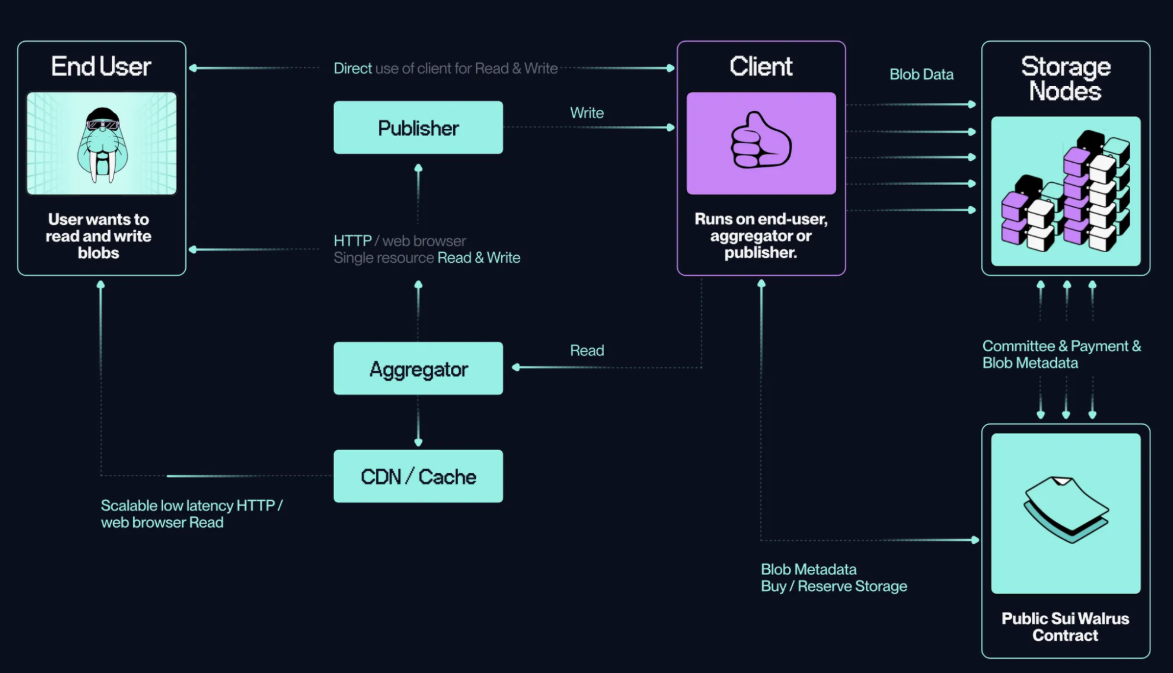
Walrus is a decentralized data storage platform on the Sui blockchain, tailored for real—world operation, rather than laboratory circuits. It is based on the RedStuff algorithm, which solves the old problem of distributed storage.: how to scale and maintain data availability when nodes fail and the network lives its own life.
Instead of coarse replication, Walrus uses erasure coding. The files are split into fragments, distributed across storage nodes, and remain available as long as the system can withstand the specified failure threshold. No magic, no advertising promises, just calculation and engineering discipline. Below, we’ll look at how RedStuff works in detail and how it benefits from the usual approaches.
How erasure coding works in RedStuff
RedStuff uses a two-dimensional encoding scheme. The initial data blob is first divided into f+1 main sliver fragments. Then each of them is split into 2f+1 more secondary fragments. The output is a matrix where either f+1 primary or 2f+1 secondary elements are sufficient for data recovery.
The replication factor is kept in the range of 4–5x. This is a level comparable to AWS or Google Cloud cloud storage, but without a centralized point of control. Everything is mundane with mathematics here: basic XOR operations, without heavy calculations and unnecessary CPU load.
Fragments are distributed between storage nodes. The system calmly survives the failure of up to a third of nodes, including Byzantine faults. Data recovery requires O(B/N) traffic per node, where B is the blob size and N is the number of nodes in the network. For clarity: a 1 GB file decomposed into 100 nodes will require about 10 MB of traffic to restore one node. Classic erasure coding pulls the entire blob in such a situation.
Data availability and error correction
The availability of data in Walrus is confirmed in advance. The proofs of availability integrated into the Sui are used. The publisher generates metadata and PoA, after which the storage nodes sign a storage commitment. This removes the uncertainty at the stage of data publication.
Error correction mechanisms are built into RedStuff itself. Secondary encoding layers allow you to repair losses locally, without completely reconstructing the source file. If you thought that decentralized storage was just a bunch of servers in different countries, then I hasten to upset you, everything is much more complicated. In truth, checking whether files are actually in place in Walrus is implemented via an asynchronous protocol with random calls — this allows nodes to prove the presence of data fragments with logarithmic costs, without downloading the entire volume at all.
Smart Contracts and Tokenization: The Magic of Sui
In the Sui stack, by the way, everything is tied to objects. Blobs and the storage capacity itself are now tokenized, so they can be directly embedded into smart contracts, ranging from wild DeFi scenarios to storing colossal datasets for training neural networks.
By the way, this is what the security database looks like in this system.:
Encryption at will: Walrus, apparently, does not pry into your secrets — the client encrypts the information himself before uploading, and the network stores opaque blobs.
Total control: Hashes and signatures in Sui metadata, in fact, prevent anyone from imperceptibly replacing data or somehow interfering with the process.
Migration without pain: When the composition of nodes changes, RedStuff technology reduces the cost of data migration — this is, frankly, a salvation for live networks.
Why does it really work?
Instead of making endless copies, as in the old schemes, new nodes pull up fragments from their neighbors at minimal cost – this is critical when network participants are constantly coming and going. In fact, such an architecture is ideal for scenarios where downtime is simply unacceptable: NFT storage, media data, video CDN, or distributed pipelines for AI.
Logically, Walrus is not trying to become the answer to all the questions of the universe at once. The developers apparently focused on a specific pain — to make the data available and supported for an adequate price, while respecting understandable compromises.
Sponsorship contracts of Team Liquid with Blacklyte and Duelbits

In general, this move happened against the background of a very vigorous activity of the club in the transfer and sponsorship markets. Only in recent months have the “liquid” managed to:
-
Form an official alliance with the Blacklyte brand;
-
Signing a sponsorship deal with Duelbits is a pretty high—profile case;
-
Announce a partnership with Sword of Justice.
As a result, Team Liquid explicitly states that they are looking forward to the next stages of development. They continue to pour resources into infrastructure in order to export their growing appetites on the global stage — and, frankly, this looks like a very competent dominance strategy.