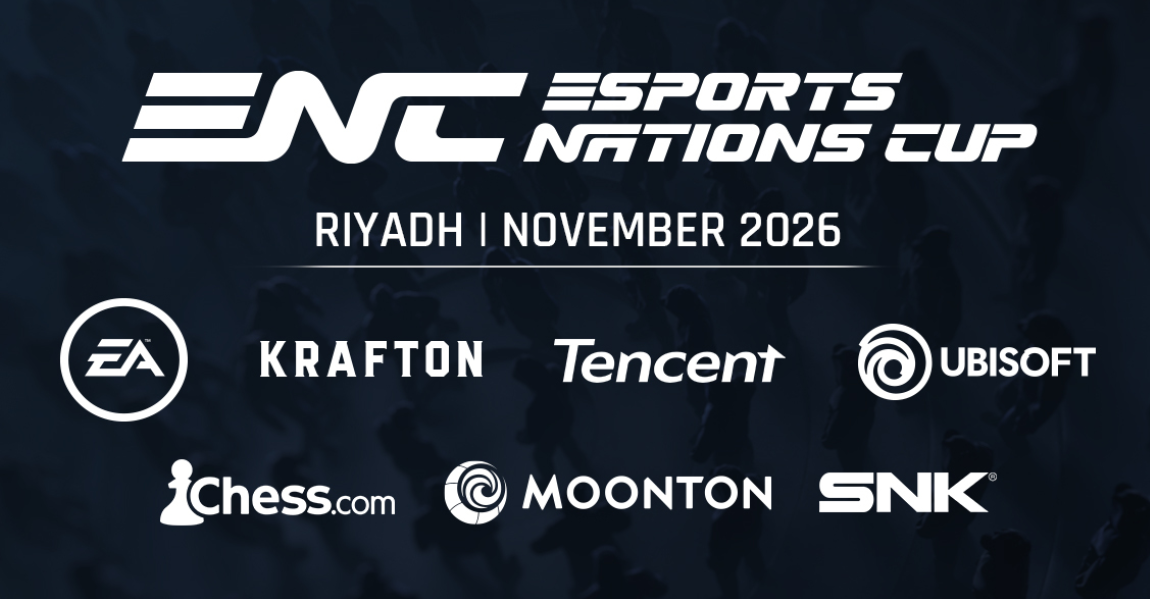
The Esports World Cup Foundation (EWCF) has put its cards on the table, revealing the structure of the Esports Nations Cup (ENC) 2026. This is not just another commercial event, but an attempt by Saudi Arabia to create a full-fledged analogue of the Olympic Games, where the country’s flag stands in the foreground, not the club’s logo.
Table of Contents
Where and when will the battle begin
The tournament starts in November 2026 in Riyadh. The organizers plan a two-year cycle: after the debut, ENC will travel to different cities of the world every two years. The inaugural season features 16 disciplines selected with the participation of industry giants like Tencent, Ubisoft and MOONTON Games.
Math of slots and a hard filter of compositions
The grid of participants is formed according to the 50/50 principle in order to cut off random people and give a chance to talents from regions with poorly developed infrastructure5.
-
Direct invitations (50%): they are issued based on the national rating for the current season. If the country’s players consistently took the top at the majors, the national team goes to Riyadh automatically.
-
Open qualifications (50%): regional online chopping for everyone, where only skill and current forma7 decide.
Key insight: EWCF has imposed a direct ban on the use of ready-made club roasters. The situation when a conditional T1 or FaZe Clan team appears under the tag is excluded. The players are required to represent different organizations, which forces the coaches to look for new bonds and chemistry between yesterday’s rivals.
Scale and economy
In team games, from 24 to 48 teams per discipline will meet, and in solo tournaments the limit has been expanded to 128 participants. The rules of representation are strict: one national team and a maximum of two singles players from one country.
| Parameter | Implementation Conditions |
|---|---|
| Game guarantee | Minimum of 3 matches in the final stage (protection from first-round elimination) |
| Prize distribution | Standardized payouts for equivalent placements across all disciplines |
| Participants | 16 teams; from 24 up to 128 slots depending on the format |
What does this give to the industry
The ban on club roasters and guaranteed payments to all finalists create the ground for long-term investments from national associations and ministries of sports. For viewers, this means the end of the dominance of a couple of super clubs and the transition to a format where national identity and the ability to assemble a “hodgepodge” of top talents become decisive factors for victory.

A detailed list of games and an accurate schedule of qualifiers will appear in the coming weeks. The project looks like a powerful lever for the legalization of esports at the state level around the world.
Anti-cheat and hybrid hubs: How technology is changing the rules of the qualifications game
Fair play in esports is not a matter of ethics, but the foundation for the survival of discipline, especially in conditions of open qualifications, where the activity of violators is traditionally off the scale. Modern security systems have evolved to the level of deep driver analysis, which allows you to cut off kernel-level cheats even at the stage of their launch. Unlike outdated tools, which can take hours to block accounts, the new solutions work according to a predictive model, providing accuracy of up to 95% without false alarms.
The technological stack of protection and network infrastructure
The effectiveness of anti-cheats today is based on a combination of biometrics and hardware identification. For example, FACEIT-based systems analyze the HWID and the unique keystroke rhythm, which makes it almost impossible to bypass the ban.
In parallel with the protection, the issue of ping is acute. The solution is hybrid hubs that combine powerful hardware and AI to manage traffic:
AI predictor of lags: the system calculates peak loads on communication nodes in advance and transfers gaming sessions to free servers in automatic mode.
Zero delays: according to the test results, a stable connection without lags is provided in 99% of gaming situations.
End-to-end security: Built-in machine learning algorithms are trained on data from past tournaments, calculating abnormal player behavior even before committing a critical violation.
For professional players, such an infrastructure is complemented by software that automatically configures network settings for a specific event, eliminating the human factor and technical failures.
| Technology | Impact on the Tournament |
|---|---|
| Kernel-level scanning | Instant blocking of unauthorized third-party software |
| Biometric analysis | Identification of the real player behind the monitor |
| Session automation | Guaranteed latency below 10 ms |