Picture a tool that, instead of the usual “here’s a guide, just do this,” tells you flat out: “in this case, I’m basically useless.” That’s exactly how a new AI-powered Minecraft project behaves — and that kind of honesty is rare even in serious software, let alone game mods.
The project is called optifarm, and it tackles a problem as old as the sandbox itself: how to lay out blocks on a farm to squeeze out the maximum yield from the smallest footprint. The difference between this and a thousand YouTube guides is that optifarm doesn’t just recommend a layout — it proves it’s the best one.
Table of Contents
What Is Optifarm and Why Someone Built an AI Farm Planner for Minecraft
The tool’s creator, a developer going by Serranegra, released the project as open source on GitHub. The concept is refreshingly simple: the player feeds the system information about the terrain and the desired crop, and in return gets back an optimal block layout — along with mathematical proof that nothing better exists.
For anyone who’s already built farms by hand, this changes the whole approach. Until now, optimal farm layouts in Minecraft relied on community guides, time-tested patterns, and gut feeling. Now there’s a tool that skips tradition entirely and just calculates.
Technically, the engine behind the scenes isn’t a neural network in the usual sense — it’s a constraint solver, specifically Google’s OR-Tools CP-SAT model. That’s the same class of algorithm used for scheduling, logistics, and industrial resource allocation. Here, the object of optimization just happens to be a sugar cane patch.
How the Farm Optimization Model Works: A Constrained Coverage Problem
To understand why this isn’t just marketing spin but genuine math, it helps to look at the mechanics behind sugar cane — the crop Serranegra uses to demonstrate the tool.
The game rules are simple:
-
sugar cane only grows on a block adjacent to water;
-
a single water block can feed up to four neighboring tiles;
-
water and crop tiles compete for the same physical space.
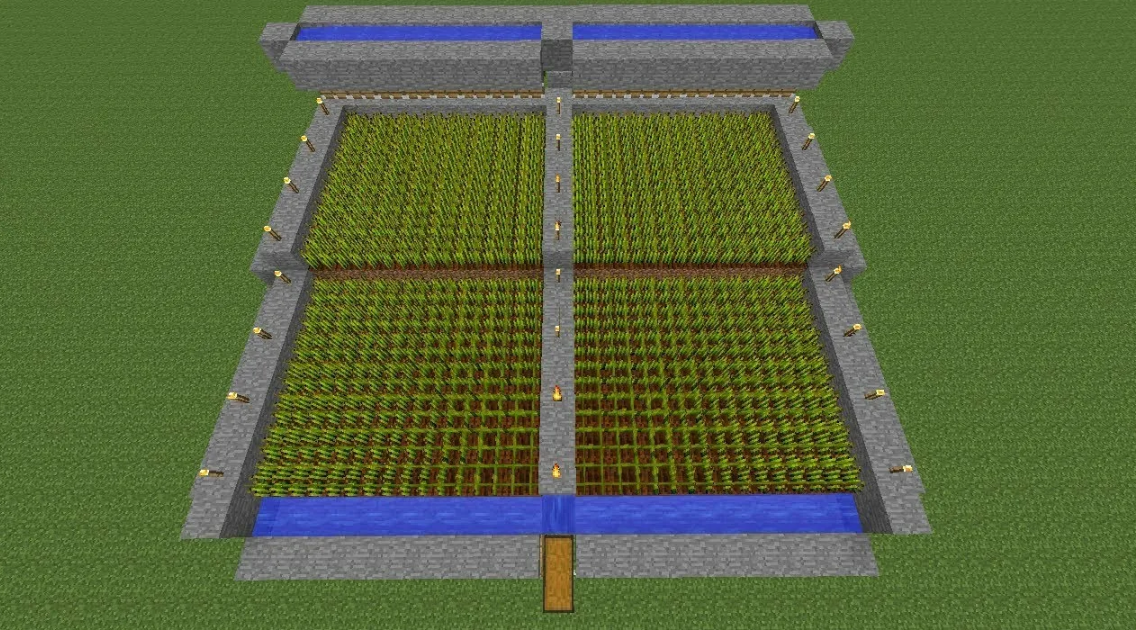
That adds up to a classic coverage problem with conflicting resources: place the minimum amount of water needed to service the maximum number of crop tiles, without wasting land. The human brain tends to solve this kind of puzzle intuitively — and usually sub-optimally, which is exactly why players have relied on the familiar “water strip” pattern for years.
CP-SAT translates these rules into a system of variables and constraints, then searches the solution space far more thoroughly than a human ever could — while proving that no better arrangement is mathematically possible.
Traditional vs. AI-Optimized Sugar Cane Farm Layout
| Metric | Traditional Layout (Water Strips) | Optifarm Layout |
|---|---|---|
| Cane yield per plot | 54 units | 61 units |
| Land utilization | 66.7% | 75.3% |
| Efficiency gain | — | ~13% |
| Proof of optimality | No | Yes |
A 13% gain might sound modest on a single plot, but scale it up to an industrial farm processing hundreds of blocks per hour, and it becomes a meaningful production boost — without a single extra click.
Does the AI Optimization Actually Work for Every Crop in Minecraft
This is where things get genuinely interesting — and where the project earns its credibility. Serranegra doesn’t try to sell the tool as a universal fix for all farming in the game. Quite the opposite: the results openly show where the tool’s usefulness ends.
The spread across crops looks like this:
-
Sugar cane — a solid win, roughly 13% better land-use efficiency.
-
Cactus — the gain is nearly zero; there’s not much left to optimize.
-
Wheat — no gain at all; standard planting patterns are already close to ideal.
That’s a fundamentally different pitch than most farming guides and mod reviews, which tend to promise “better farm efficiency” across the board without breaking down where that efficiency actually exists. Optifarm instead shows a table with an honest “+0.0%” wherever there’s nothing to gain — and that, oddly enough, is the project’s biggest strength: it doesn’t waste your time chasing improvements that aren’t there.
Is It Worth Rebuilding Your Sugar Cane Farm Around the New Layout
If you’re farming sugar cane at scale — for sugar, paper, rockets, or straight-up trading — a 13% improvement in land use for the same amount of water investment is a legitimate reason to switch, especially on large builds where the numbers scale into the dozens or hundreds of tiles.
It’s worth rebuilding if:
-
you’re running a large automated sugar cane farm with redstone harvesting;
-
space is genuinely limited, like in an underground or floating build;
-
you’re on a server where resource efficiency actually matters for the economy.
It’s probably not worth the effort if:
-
you’ve only got a small cane patch for personal use;
-
you’re farming cactus or wheat, where the difference is negligible;
-
aesthetics matter more to you than squeezing out the last percentage point of efficiency.
Where to Get the Tool and How to Use It
Optifarm’s source code is publicly available in an open repository on GitHub — the project is free and open, meaning anyone with basic programming skills can, in theory, extend or modify it. The barrier to entry is higher than average, though: the tool is built for technically inclined players comfortable with Python and constraint-solver problem setups, not for someone who just wants to copy-paste a ready-made schematic.
For everyone else, the project is still useful even without running any code. The published layout diagram itself is instructive — it demonstrates a core principle for building denser farms by hand: every water block should be working to serve as many neighboring tiles as possible.
What This Means for Players and Where Farm Automation in Minecraft Is Headed
Tools like optifarm are a symptom of a broader trend: the Minecraft community is increasingly reaching for serious computational methods in places that used to be governed purely by trial and error. The same thing already happened with redstone contraptions and farm-timing optimization — now the same rigor is arriving at something as mundane as crop layout.
That said, it’s worth not overstating the scale of the shift. Optifarm doesn’t rewrite the game or hand anyone an unfair advantage — it simply calculates faster and more precisely than a human can, in the specific cases where the problem is genuinely mathematical. For wheat and cactus, where there’s no gain to be found, no AI is going to replace what players have already figured out intuitively over 15 years of the game’s existence.
For anyone building farms seriously, the takeaway is simple: before copying the next “best layout” you find online, it’s worth asking whether there’s actual proof it’s the best — or if it just looks good. Optifarm is one of the first tools to answer that question with math instead of opinion.