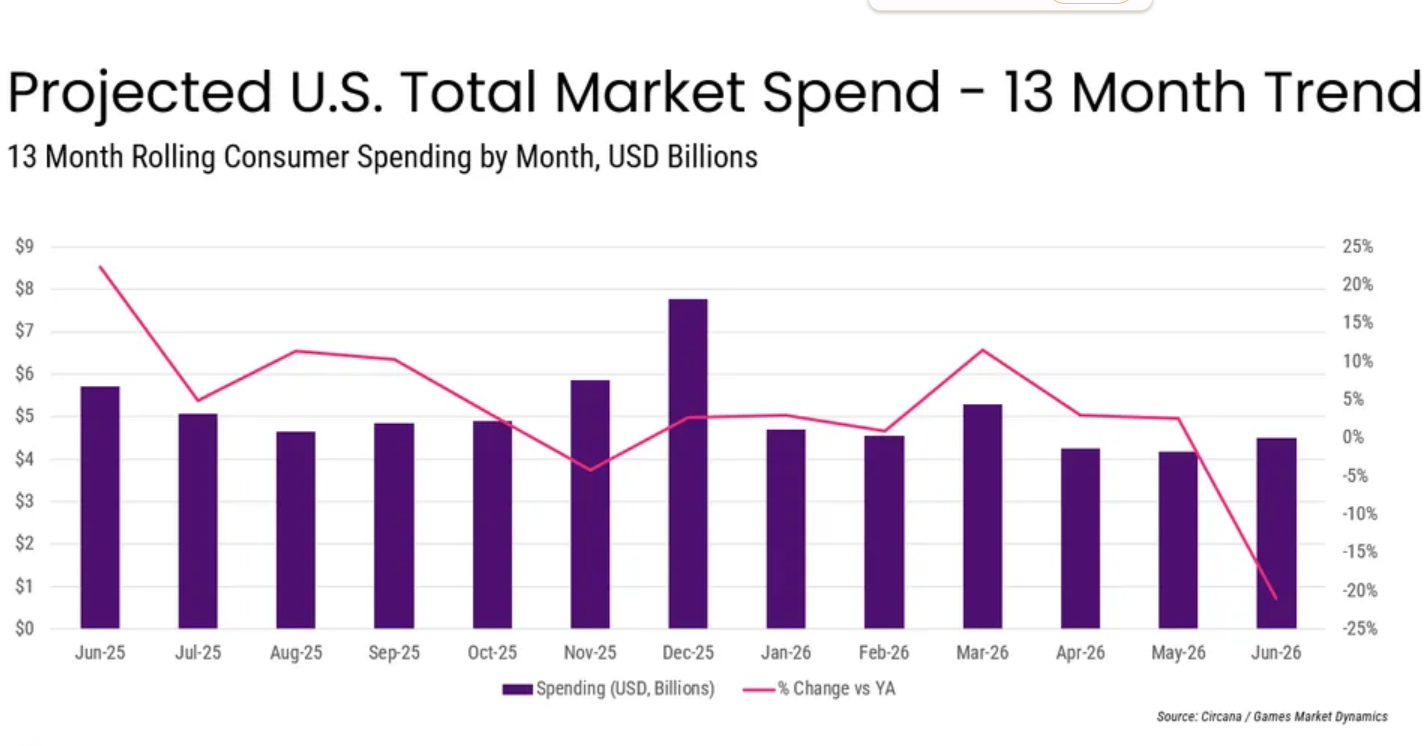
American video game spending in June fell 21% year-on-year to $4.5 billion. Console sales plummeted 62%, with subscriptions (up 7%) the only growth segment. Data from analytics firm Circana clearly demonstrates that the market isn’t in crisis, but is experiencing a significant statistical anomaly associated with the launch of the Nintendo Switch 2 last year.
Table of Contents
Key US Gaming Industry Figures for June
Total American spending on gaming software, subscriptions, consoles, and accessories amounted to $4.5 billion (approximately 360 billion rubles at the exchange rate of 80). This is significantly lower than last year’s $5.7 billion. But the most dramatic clue lies in the structure of the decline.
The hardware segment plummeted 62% to $383 million (30.6 billion rubles). By comparison, this figure reached $1 billion in June 2025. The reason is simple: exactly one year ago, on June 5th, sales of the Nintendo Switch 2 launched, and the market was swept up in excitement. Now, the high base effect is making itself felt. Accessory sales fell by 21% ($232 million), while content spending (games, DLC, subscriptions) fell by 12% ($3.88 billion).
Meanwhile, for the first half of 2026, the lag compared to last year’s schedule is only 1% – $27.5 billion versus $27.8 billion. The market is settling into a new rhythm, and the June slump is more the exception than the rule.
The Impact of Nintendo Switch 2 Sales on Market Performance
The Switch 2’s June 2025 launch was a record-breaking one, with Americans spending $1 billion on consoles in just one month. Current Switch 2 sales have fallen 79% from that peak, but the console remains a bestseller in both dollar and unit sales. In its first year, 5.9 million units were sold in the US—the second-highest total in history, behind only the original Switch.
Circana analyst Matt Piscatella points out that without the Switch 2, the market would have shown a much more modest decline. So, it’s too early to panic—this exceeds normal seasonal fluctuations but doesn’t indicate a systemic decline.
Console Sales: Switch 2, PlayStation 5, and Xbox Series
In June, the Switch 2 took first place in revenue and units sold. The PlayStation 5, with sales down 19% year-over-year, is in second place. Meanwhile, the Xbox Series X|S unexpectedly more than doubled, despite last year’s base being extremely low. It’s worth being careful here: a doubling—from ~50,000 to ~123,000 units—looks impressive, but it doesn’t change the fact that Microsoft is still far behind.
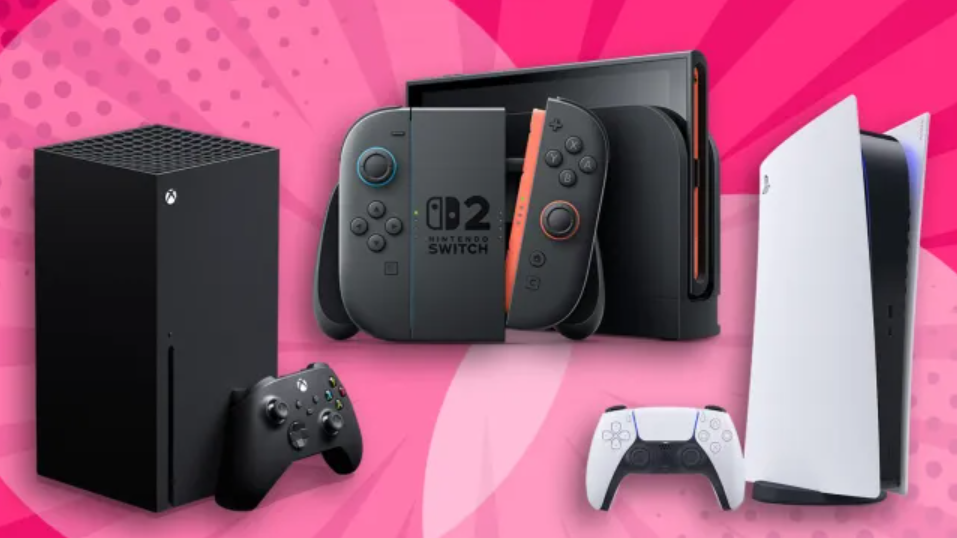
According to Install Base estimates, the Switch 2 sold around 348,000 units in June, the PS5 sold approximately 169,000, and the Xbox Series sold around 123,000. The battle for second place continues, but for now, the Japanese console is unrivaled.
Top 10 Best Selling Games of June 2026 in the US
The list is topped by new releases and proven franchises. Circana’s Top 10:
Note: Physical versions are gradually disappearing from the charts—the digital share on PS5 has already reached 85%, and this is a game-changer for retailers.
Growth of Game Subscriptions and Digital Sales
The only category that showed positive growth was game subscriptions. Their volume grew by 7% year-over-year. Meanwhile, all other segments, including mobile games, were in the red. This suggests that the access model is becoming more attractive to users than one-time purchases, especially in a volatile economy.
Video Game Market Development Results for the First Half
Despite the June collapse, the half-year results look encouraging. $27.5 billion is only 1% less than for the same period in 2025. This means that the remaining five months compensated for June’s decline. The market is adjusting to a new reality, where major releases are unevenly distributed, and hype around a single console can distort the statistics.
Gaming Industry Development Forecast and the Release of GTA 6
The industry’s main hope here is GTA 6. Circana predicts that Rockstar’s release will bring the industry $62.8 billion in revenue for all of 2026, representing a 3% increase compared to 2025. This is an ambitious scenario, but it’s entirely realistic given the level of anticipation.
Three notable titles are already releasing in July: Assassin’s Creed Black Flag Resynced (a remake of the pirate adventure) on July 9th; Splatoon Raiders, a Switch exclusive, on July 23rd; and Halo: Campaign Evolved, a reimagining of the classic campaign, on July 28th. These releases are designed to stimulate consumer demand and reverse the negative trend.
At the same time, it’s important to consider the rise in console prices: the PS5 now costs $649.99, while the Xbox is up to $800. This could curb demand, especially in the hardware segment. However, if GTA 6 is released on time, many will be willing to shell out the extra cash.
Results and Prospects for the American Gaming Market
The June figures aren’t a death sentence, but a reflection of the calendar effect. The US gaming industry continues to grow year-on-year, just at a different pace. Subscriptions are gaining momentum, digital is displacing physical platforms, and new consoles and hits are setting the trend. The coming months will test this trend, but the foundation remains strong.
It’s clear that the decline is localized, and the long-term development strategy (services, ecosystems, multiplatform) is working. So get your wallets ready—the second half of 2026 promises to be exciting.