

There are games that immediately try to impress with scale, graphics, or loud story scenes. And there are projects that act differently — they just quietly drag on. Parkitect is just one of those. You launch it without any special expectations, thinking that this is another simulator of the construction of an amusement park… and then suddenly you find yourself rebuilding the tracks for two hours because visitors started complaining about the queues.
My first acquaintance with Parkitect started quite calmly. Several carousels, a couple of food stalls, neat paths. Everything looks cute and almost carefree. But literally after a while, the game begins to show its character. It turns out that building a park is only half the battle. It’s much more difficult to make it work like a real system.
The guests start complaining about the prices. Garbage is appearing somewhere. One of the rides suddenly breaks down. The store remains without products. And now, instead of relaxed construction, you gradually turn into a manager who is trying to keep a huge entertainment machine under control.
And this is where Parkitect reveals itself best.
Table of Contents
What is this game and what is its main idea
Parkitect is an economic simulator and construction sandbox where the player creates their own amusement park. And although at first glance everything looks quite familiar for the genre, the game quickly shows that it is much deeper than it seems.
The basic idea here is simple: to build a park that people like and makes a profit. But in practice, this turns into a whole chain of decisions, where every little thing begins to play a role.
For example, guests don’t just walk around the park. They react to the environment, pay attention to queues, evaluate prices, look at the scenery, and can even discuss among themselves how much they liked a particular attraction.
And that’s when you start to realize that Parkitect is not just a construction game. This is a game about the organization of space and human flow.
In order for the park to work, you need to consider many things:
-
how conveniently are the attractions located
-
where are the main streams of visitors
-
are there enough food and drink shops
-
are the queues too long
The game gradually teaches you to look at the park as a living organism. If a problem appears somewhere, it almost always affects other parts of the system.
And it’s this effect that makes Parkitect surprisingly addictive.
Gaming has never been this easy! Claim your free steam account with and start!
Parkitect Gameplay — how to build a successful park
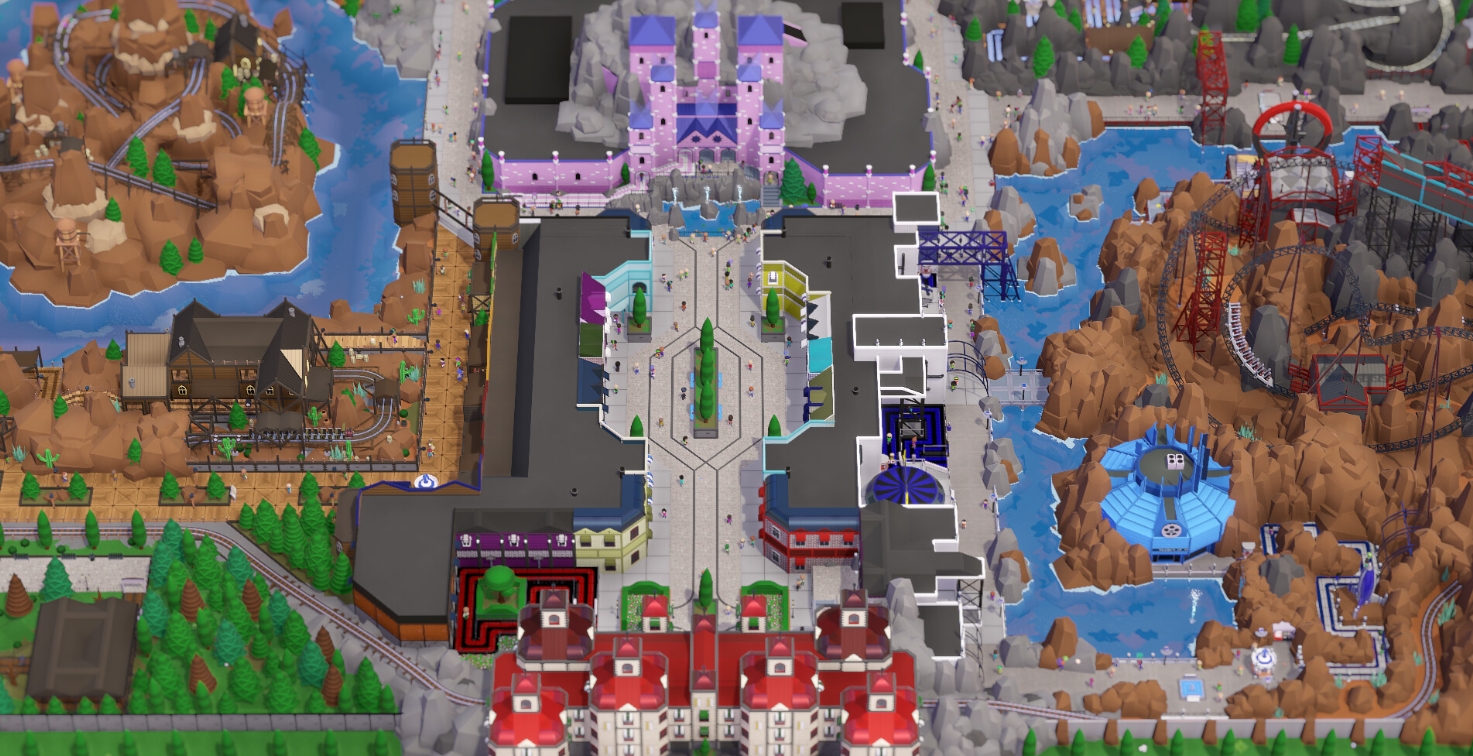
To describe the gameplay briefly, Parkitect is a constant balance between creativity and management.
On the one hand, the game gives you a lot of freedom to build. You can experiment with design, create beautiful areas, build unusual attractions and decorate the park as you like.
On the other hand, there is a pretty serious economic system behind all this. And if you ignore it, the park will start making losses very quickly.
Over time, the park begins to live its own life. Visitors come in droves, employees run around the territory, mechanics fix rides, and the player has to monitor dozens of processes simultaneously.
And it’s at moments like this that you begin to realize how thoughtful this game turned out to be.
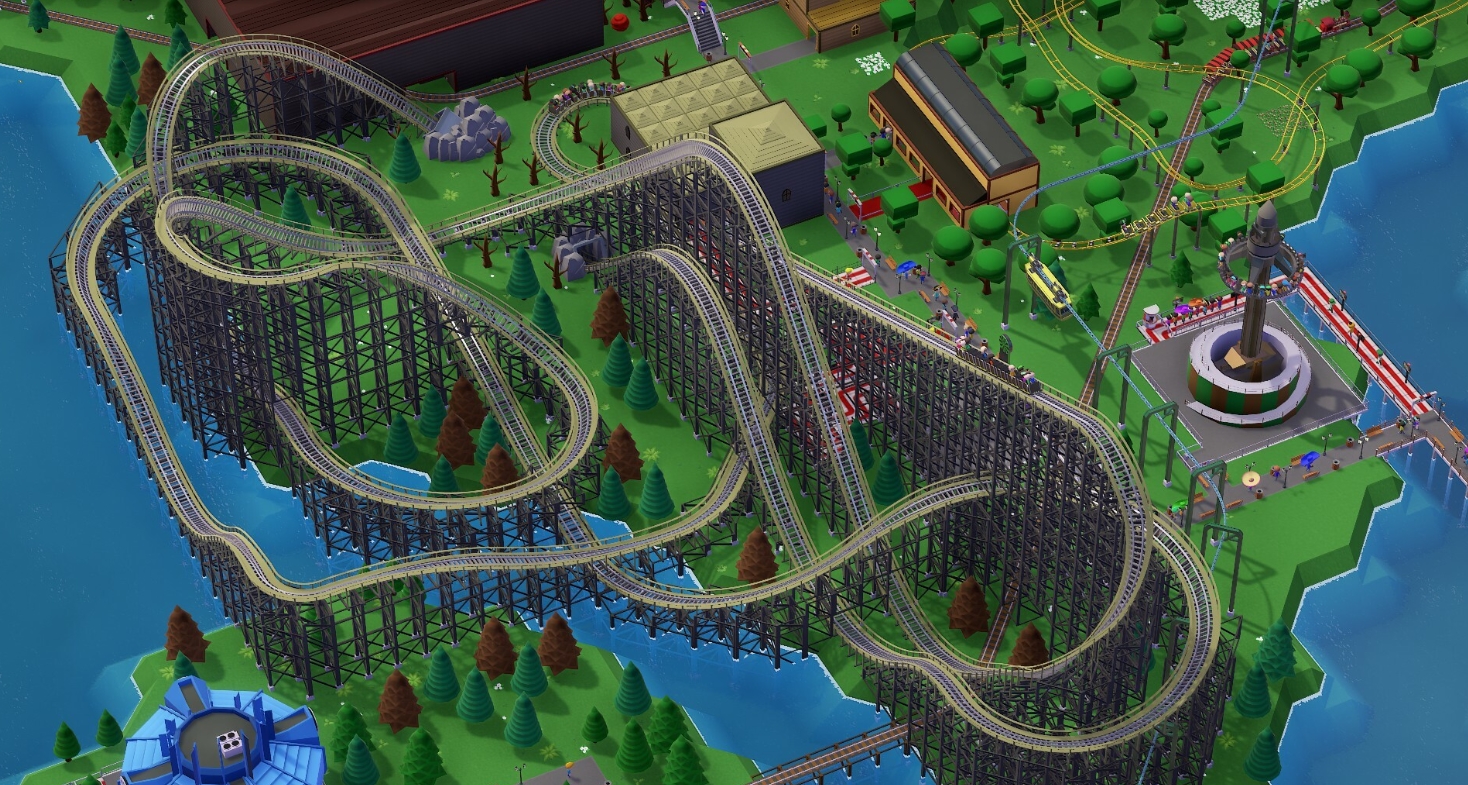
Amusement park construction and roller coaster design
One of the most enjoyable parts of Parkitect is, of course, building rides. And especially the creation of your own roller coasters.
The game provides a fairly flexible constructor that allows you to literally manually plot the route of the future attraction. Climbs, sharp turns, loops, long descents — everything can be customized to your liking.
Sometimes this process turns into real creativity. You sit and think: what if you make a long ascent, and then a sharp descent right through the decorative arch? Or run a track over the tracks so that visitors can watch the cars pass by?
But Parkitect does not allow you to completely relax. After the construction is completed, you need to test the attraction, and sometimes it turns out that it turned out to be too extreme.
At such moments, the game honestly reports that the level of fear among visitors is off the charts. And we have to go back to editing the route.
This creates a very pleasant balance between fantasy and realism.
During the construction process, you can experiment with different elements:
-
height of ascents and speed of descents
-
sharp turns and turns
-
decorative objects around the track
-
theme design of the attraction
And when the next design finally starts working perfectly, there is a very pleasant feeling — as if you really created something unique.
Personnel and economic management of the park
If construction brings creative pleasure, then park management is already a full—fledged strategy.
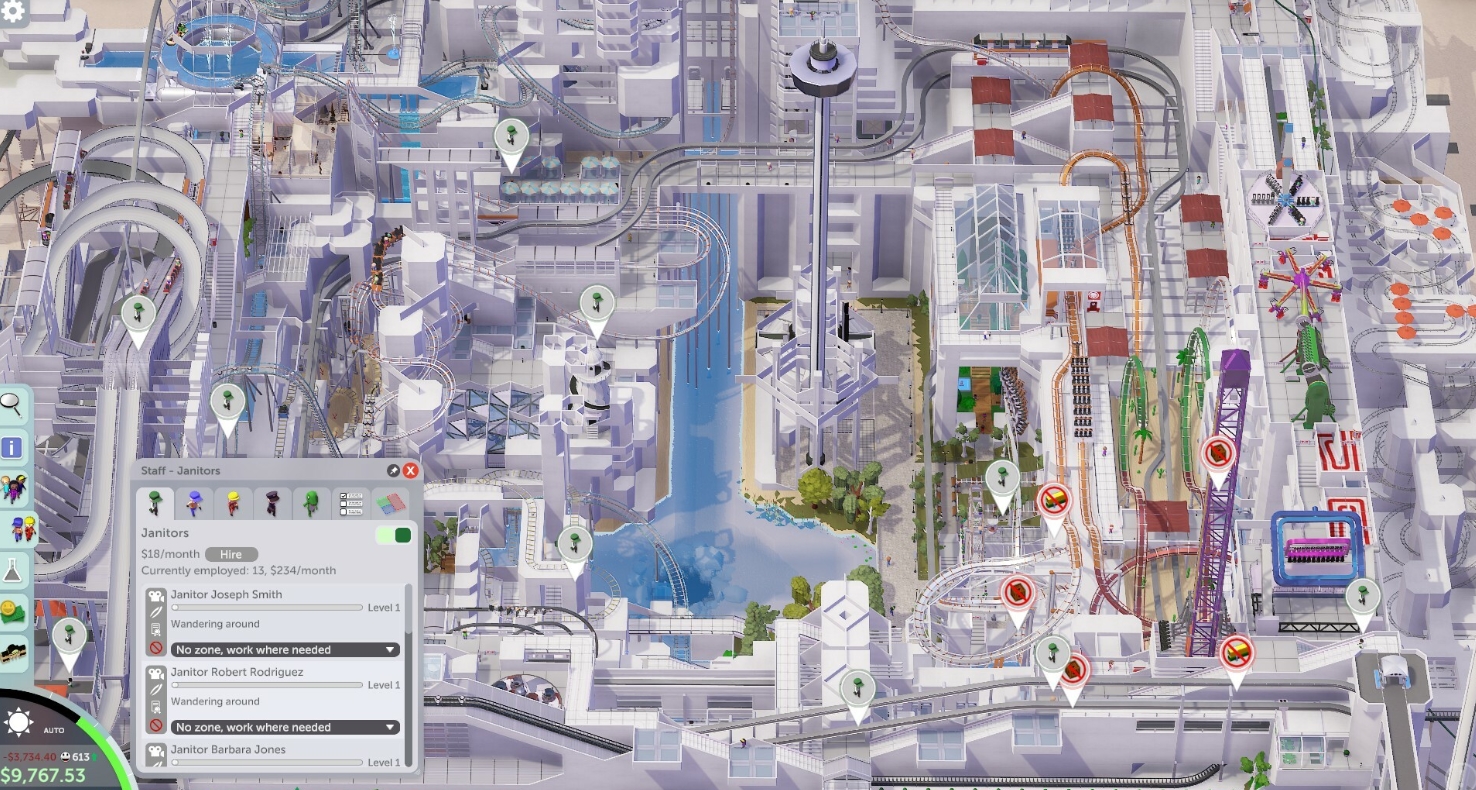
At Parkitect, it quickly becomes clear that the park cannot operate on its own. We need a team of employees who maintain order and ensure the operation of all systems.
There are several types of workers in the game, and each performs its own role:
-
cleaners keep the area clean
-
mechanics maintain the rides
-
vendors work in stores
-
security helps maintain order
At first it seems that everything is simple. But as the fleet grows, personnel management becomes more difficult. It is necessary to properly allocate work areas, monitor the workload of employees and hire new employees on time.
In addition, Parkitect offers a fairly flexible economic system. The player can adjust prices for almost everything: entrance tickets, rides, food and drinks.
Sometimes you have to literally play with numbers to find a balance. Tickets are too cheap — the park is overflowing and queues appear. Too expensive — the visitors start to leave.
And at such moments, you begin to feel like not just a builder, but a real amusement park manager.
Parkitect features that make the game unique
There are quite a few projects in the genre of amusement park simulators, but Parkitect stands out for several unusual mechanics.
These details are not immediately obvious, but they make the game much deeper.
Logistics system and hidden service areas
One of the most interesting features of Parkitect is its logistics system. And it is she who distinguishes the game from many other simulators.
The fact is that the stores here do not receive the goods automatically. They need to be delivered from the warehouse.
This means that the player has to think of a separate infrastructure for the staff. It is necessary to build warehouses, service lanes and hidden areas so that employees can transport goods.
It is important to remember that visitors should not see the backstage area of the park. Therefore, it is necessary to hide technical areas behind walls, decorations, or even create entire service corridors.
Over time, the park begins to divide into two parts:
-
public, where visitors walk
-
office, where employees work
This adds amazing depth to the game. Sometimes it is necessary to completely revise the layout in order to improve logistics.
And when everything starts working perfectly, there is a very pleasant feeling — as if you are really running a real amusement park.
Parks editor and creative opportunities
Another strong point of Parkitect is the opportunities for creativity.
The construction editor here turned out to be much more flexible than one might expect. The player can combine dozens of different objects: walls, roofs, decorative elements, plants, lighting and themed decorations.
Thanks to this, the park is gradually turning into a unique space.
Someone is building atmospheric European squares. Someone is creating futuristic zones. And some players even turn the park into whole mini-cities.
The game encourages neat design. Beautifully designed areas increase the satisfaction of guests, which means they directly affect the economy of the park.
Here are a few things that are particularly enjoyable to create in Parkitect:
-
themed areas with unique architecture
-
decorative entrance areas
-
complicated queues with decorations
-
beautiful recreation areas for visitors
And sometimes you can catch yourself putting up lanterns and trees for half an hour, just because you want to make the park even more cozy.
Graphics, atmosphere and game style
If you look at the Parkitect screenshots, you might think that the game looks pretty simple. There is no photorealism or complex graphic effects.
But in motion, the visual style works surprisingly well.
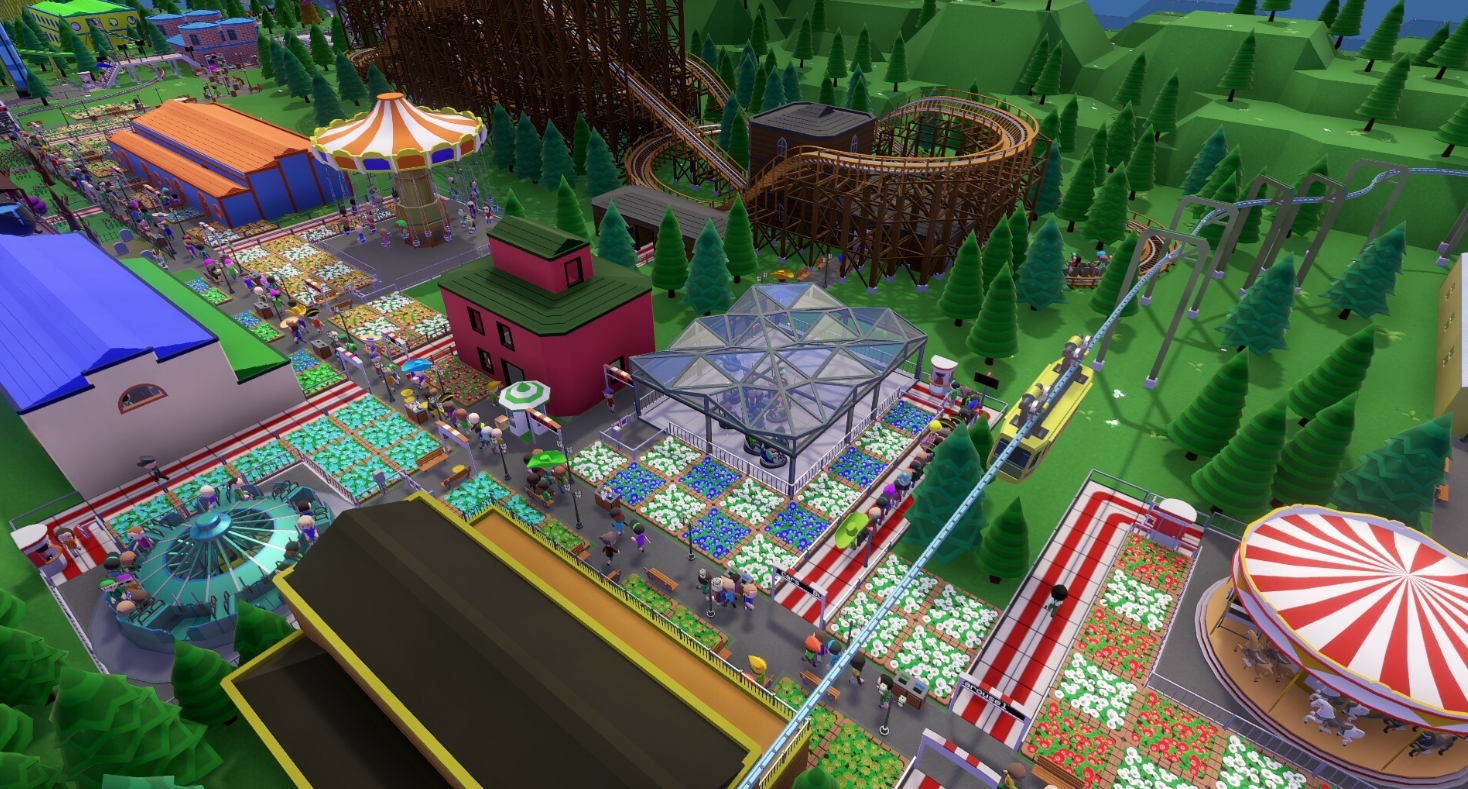
Bright colors, neat patterns and light cartooning create a very pleasant atmosphere. The park looks lively and cozy, and dozens of strolling visitors add to the feeling of a real place.
Sometimes it’s interesting to just stop the camera and see how people behave on the territory. Someone is rushing to the attraction, someone is buying ice cream, and someone is standing in line and discussing a ride on the roller coaster.
Music also perfectly supports the mood of the game. She is calm and unobtrusive, ideal for long gaming sessions.
And the interface pleasantly surprises with its convenience. Even when the park grows to a huge size, it remains quite comfortable to manage it.
Is it worth playing Parkitect today
Despite the fact that Parkitect was released several years ago, the game is still one of the best amusement park construction simulators on PC.
She doesn’t try to surprise with high-profile innovations. Instead, the developers focused on making a thoughtful, deep, and user-friendly game.
The result is a project that easily drags on for dozens of hours.
Parkitect will especially appeal to those who:
-
loves economic simulators
-
misses classic typhoons
-
enjoys building
-
likes to watch how the created system starts working
Yes, the game is not perfect. It may seem to some that the graphics are too simple, and the pace of development is a little slow.
But if you give Parkitect a chance and spend a few hours in it, it becomes clear why it has such a loyal audience.
This is one of those rare games where you can just quietly build, experiment and watch as a noisy, lively amusement park gradually appears from an empty piece of land.
And to be honest, sometimes we just don’t have enough games like this.
Parkitect System Requirements for PC
| System Component | Minimum Specs | Recommended Specs |
|---|---|---|
| Operating System | Windows 7 or newer | Windows 7 or later |
| Processor | Intel Core i3 running at 2.3 GHz (or similar CPU) | Intel Core i5 3.0 GHz or equivalent processor |
| Memory | 4 GB RAM | 6 GB RAM |
| Graphics | GPU with Shader Model 3.0 support (drivers not older than ~2016) | Dedicated graphics card released after 2015 |
| DirectX | DirectX 10 compatible | DirectX 11 |
| Disk Space | 2 GB of available storage | 2 GB free space |
| Additional Notes | The game will run on these specs, but performance may be limited. | Ensure your graphics drivers are updated for the best experience. |
How to play Parkitect for free on Steam via VpeSports
There are games that require full concentration: challenging battles, intense missions, constant pressure. And there are projects that, on the contrary, allow you to exhale a little and just do something pleasant. Parkitect belongs precisely to the second category. This is a calm and rather thoughtful amusement park simulator, where everything starts with an empty area and a few ideas about what this place could become. At first, there are simple tracks and a couple of small rides. Then new zones, more complex slides, shops and decorations are added. Gradually, the park begins to live its own life: people are walking, discussing rides, someone is happy about a successful ride on the slides, and someone is looking for the nearest food stall. And at some point you find yourself just looking at all this and thinking how to make the park even more interesting. The good news is that you can get to know this game for free.
We tried not to complicate the process of getting the game. There are no long instructions or confusing actions here. You just need to register on our website and log in to your account. After that, go back to the beginning of the article — there will be a GET AN ACCOUNT button. By clicking it, you will see further steps that will help you get an account with the game. The whole procedure takes very little time, so you don’t have to wait long — you can quickly get to the most interesting part, that is, to build your own park.
If you want to keep up to date with new accounts, updates and just news from the gaming industry, you can take a look at our Telegram channel. There we periodically share up-to-date information and discuss different games. And if something suddenly turns out to be unclear – for example, you have questions about getting an account or launching a game — you can open the “How to Play for Free — Complete Guide” section. It describes in detail how everything works. Well, if you still have questions after that, you can always write to the chat — they usually help you figure it out pretty quickly.