

Create your own medical center and try yourself in several roles at once — from a talented doctor to a visionary architect and a strict manager. Project Hospital offers a deep simulator of hospital construction and management, where every decision affects the efficiency of the clinic and the quality of patient treatment. This is a single-player game in which strategy is closely intertwined with the realistic management of a medical facility, creating an exciting experience for those who appreciate thoughtful mechanics and an atmosphere of development.
The project is distributed using a one—time purchase model, and the developer is Oxymoron Games Studio, a team known for attention to detail, complex gameplay, and careful system design. Thanks to this, the game pleases with stable optimization, a thoughtful interface and the opportunity to focus on the creative process of designing a clinic without being distracted by microtransactions.
Table of Contents
Project Hospital Free Steam Account
It’s been a long time since I’ve returned to games that resemble classic Sims with their cozy construction and routine management. But fate decided otherwise — and literally pushed my face into Project Hospital, forcing me to plunge back into the world of simulation, room layout and endless micromanagement. And it’s worth removing unnecessary prejudices right away: despite the set of flaws and controversial decisions, we have a very good simulator of a clinic of different scales and specializations. Although, to be honest, you can find more convenient and polished competitors in the genre.
If you’ve ever played at least the first The Sims, the basics of gameplay will seem almost native. The developers were significantly inspired by the interface of that series: the familiar statistics panels, time speed control, construction menu, purchase and hiring staff. Getting used to the basic tools is easy, and it makes the first steps easier. But it’s important to make a correction here: understanding the interface does not mean that you can immediately build a working hospital with thoughtful logistics. The construction process here is punctuated by restrictions, nuances of the equipment location and the load on the departments — all this affects the atmosphere and the rhythm of passage.

Sometimes the game is able to surprise not with mechanics, but with strange technical antics. During my training, the waiting room came to life once, the toilet functioned normally, but the doctor’s office refused to work at all, despite an hour of attempts to resuscitate it. It was saved only by deleting the room and buying a ready—made template – fortunately, such an option is provided. It was this case that made me think: Project Hospital does not always correctly determine the purpose of subjects and sometimes gets “confused” trying to figure out where a newly hired doctor should work. And this is not a single technical detail, but a feeling that accompanies the player in the first hours of mastering — so later I will explain why such situations develop.
Turn boring days into epic ones with an account steam free.
Game mechanics in Project Hospital
Usually, in hospital simulators, everything is arranged as transparently as possible: if some office or equipment is not functioning, the game generously highlights the problem with color and hints that it’s time to buy the right item – whether it’s a bedside table in the ward or a wall defibrillator. But in my case, Project Hospital decided to play the silent game. There were no prompts, no warnings, and no matter how many tables, chairs, analyzers, or computers I set up, the office remained completely dead. It feels like the system has simply refused to recognize objects and the logic of their placement.
However, behind the cracks of the mechanics here lies a much more welcoming game. The developers have provided an easy way out — any problem room can be instantly replaced with a ready-made, already working template. And in general, the management of the clinic is intuitive: the model of behavior of doctors resembles the same Sims. If you do not take the management into your own hands, the staff themselves makes diagnoses, prescribes treatment and performs procedures. But this is where the skill system comes into play: each employee has a specialization and a starting level of experience. If there is a green intern working in the department, do not be surprised if he makes a mistake with the diagnosis or misses the deterioration of the patient’s condition. Fortunately, insurance is provided in the project — and this smooths out the sharp corners of the gameplay a little.
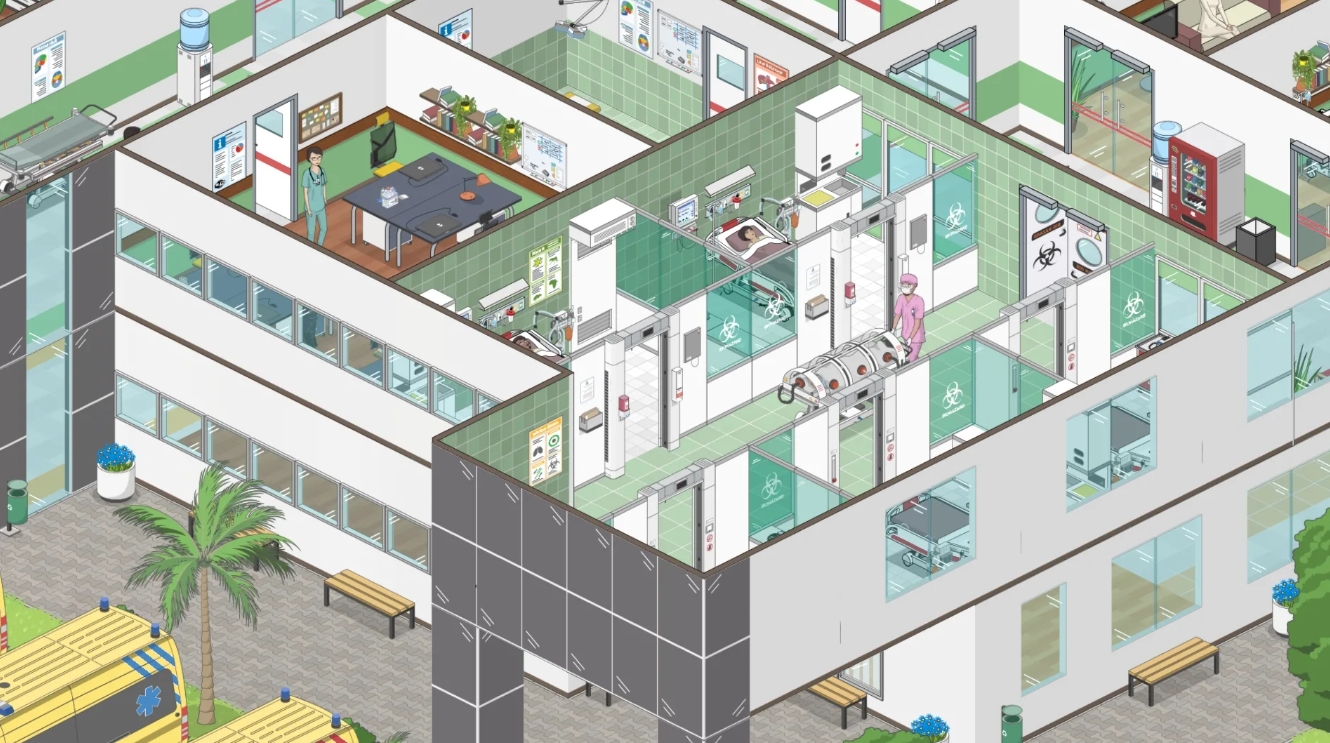
Let’s move on to construction, because it sets the atmosphere and the rhythm of the passage. For a fairly modest price by the standards of modern games, Project Hospital provides a titanic set of decorative and functional elements: dozens of walls, doors, colors of coatings, windows, as well as entire catalogs of medical equipment. Plus, a lot of household details — from coffee makers to boilers and plumbing — all this allows you to realize almost any architectural fantasy within the framework of a hospital theme. The freedom of creativity is limited only by the size of the map, and even then only conditionally.
Audio accompaniment is traditional for the genre: simulators rarely delight with bright soundtracks, and this is no exception. However, music does not hurt the ear and gently supports the atmosphere of managing your own clinic — that’s all it takes. The visual part is more complicated. As someone who is somewhat familiar with painting, I can say that the style of drawing does not always harmonize with the serious topic of medicine. But it’s more of an individual perception. Another thing is much more alarming — with its light graphics and small spaces, the game remains unexpectedly resource-intensive, sometimes even in the menu. However, if your computer is even slightly superior to the old Celeron, you probably won’t feel any particular discomfort.
Gameplay Project Hospital
Well, it’s time to move from superficial impressions to a detailed analysis and carefully “sort out” each key element of Project Hospital. This will help to avoid chaos at the start and build an effective clinic faster, without wasting time on guesswork and experiments.
In order for your medical facility to start functioning at all, you need a minimum set of rooms: a waiting room, a toilet and a doctor’s office. Plus, hire at least one employee. These conditions have been fulfilled, and the hospital is officially considered operational. However, there is a nuance that beginners often forget about: the doors. The absence of a doorway instantly nullifies all the work done — patients simply will not be able to physically enter.

After the launch, the flow of clients will depend on the size of your clinic. The more spacious the building is and the more competently you organize its structure, the more patients you can receive in one game day. And this directly affects income, development, and the pace of progress. At first, visitors come with simple ailments — fever, minor inflammations, and mild pain. But the more serious the diseases, the higher the requirements for equipment and specializations. For complex cases, additional rooms, advanced technology such as MRI or ECG, and expanded departments will be needed.
What does it take for the clinic to start working:
-
waiting room;
-
toilet;
-
doctor’s office;
-
at least one employee;
-
doors installed correctly;
-
access to basic diagnostic items.
As the clinic grows, so does the need for staff. New doctors often come with poor training — interns easily make mistakes in diagnoses and make mistakes. To minimize risks and improve the quality of treatment, it is enough to appoint an experienced specialist as the head of the department. Such a professional works as a reliable mentor, monitoring the work of colleagues and increasing their efficiency. As a result, you not only speed up the service, but also receive much more income for the treatment of severe cases. Don’t forget about night shifts either: the game allows the clinic to work around the clock, which is especially important when the workload is high.
When the hospital outgrows the status of a small medical center and acquires a full-fledged surgery, the time will come to expand the infrastructure. In particular, ambulances will have to be purchased in order to promptly deliver patients with serious injuries and emergency conditions. This adds realism to the gameplay and allows you to adapt the clinic to a real hospital model.
And here’s what’s important: Project Hospital is the most thoughtful and realistic medical simulator I’ve ever seen. There is no caricature humor, absurd diagnoses or cartoon characters, as in a number of popular analogues. The game relies on thoughtful management, flexible construction, strict logic and clear simulation of processes. Yes, the interface is addictive in places, but the overall depth compensates for these roughnesses. And thanks to the three training stages, you can understand all the systems in just 15-20 minutes.
The main campaign is short, and after a couple of hours you will find a full-fledged sandbox mode where you can build your dream clinic without restrictions and enjoy the slow but exciting development of your own hospital.
Project Hospital System Requirements
| Minimum Setup | Optimal Setup |
|---|---|
| Operating System: Windows 7 (64-bit) | Operating System: Windows 10 (64-bit) |
| CPU: Intel Core i3-3210 or AMD Ryzen 3 1200 | CPU: Intel Core i5-6600K or AMD Ryzen 3 3300X |
| RAM: 4 GB system memory | RAM: 8 GB system memory |
| GPU: Intel HD Graphics 4000 (integrated) | GPU: NVIDIA GeForce GTX 1050 or AMD Radeon RX 460 |
| Disk Space Required: 1 GB free | Disk Space Required: 1 GB free |
| Recommended Resolution: 1280×720 | Recommended Resolution: Full HD 1920×1080 (24″ monitor) |
How to play Project Hospital for free on Steam via VpeSports
In Project Hospital, everything starts not with loud fanfare or chasing the enemy, but with the quiet sound of the door opening to your future medical center. It’s like you’re entering a space where every little thing matters: how will you arrange the equipment, who will you entrust with the first appointment, will you have time to notice an alarming symptom in the patient’s medical history, who nervously adjusts his jacket, waiting for an appointment with the doctor. At some point, you find yourself worrying about virtual people as much as you do about real people. And it is at this moment that the game ceases to be a game, turning into a real experience of care and responsibility.
We’ve made it so that the first step to your “hospital story” is as simple as greeting you at the front desk. You create an account, log into your personal account, and Project Hospital is already neatly prepared for you: with instructions, startup tips, and even the opportunity to get a free Steam account. All without too much fuss, without dozens of settings and complicated schemes. You’re just moving from reality to a world where you’re the one making the decisions.
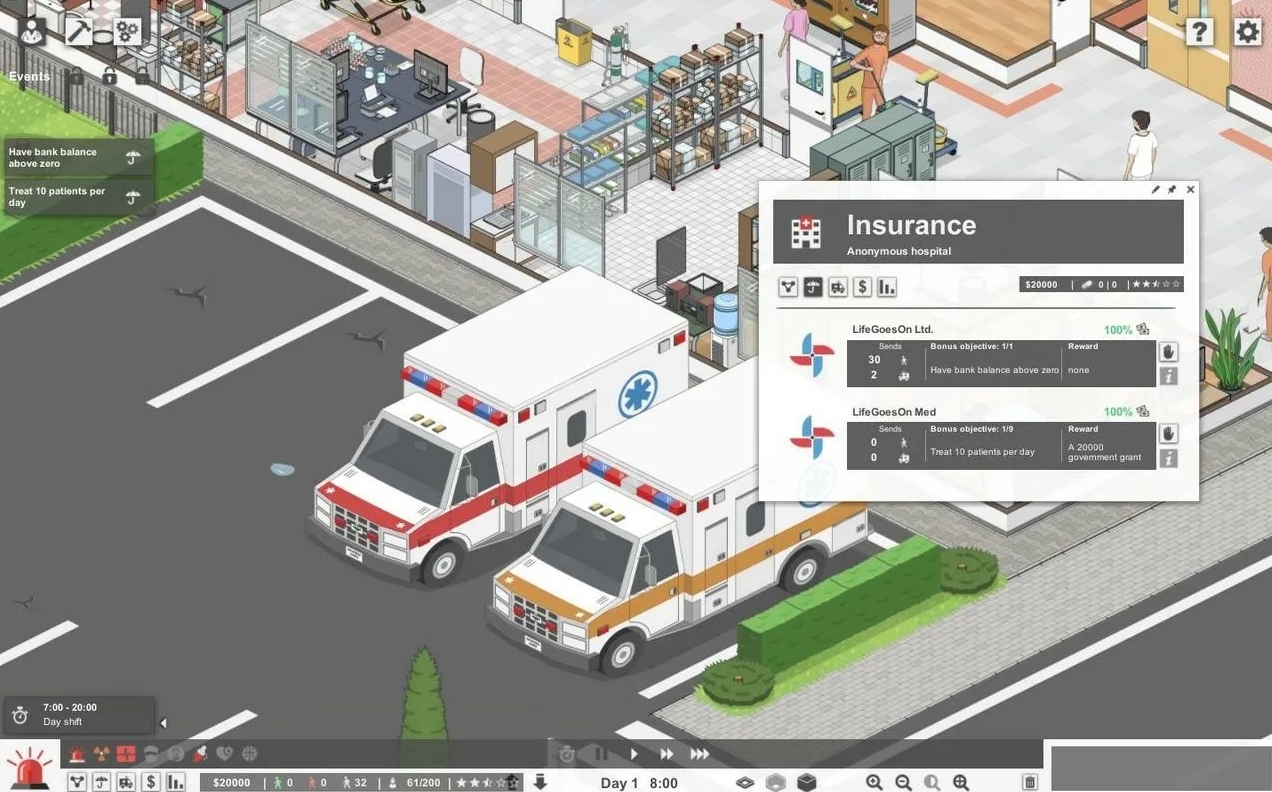
When you conduct your first checkups, feel the rhythm of your small medical facility come to life, and notice that you are beginning to understand your patients without words, it is very important for us to hear your opinion. We carefully check each review, because for us it’s not just a text — it’s the feedback of a real person. If for some reason the comment did not appear immediately, try to change the wording a little. As soon as it is approved, an email with the necessary information will be sent to your email address.
To stay in touch with other “clinic administrators”, keep track of new accounts, patches, useful tips and discuss interesting cases, join our Telegram channel. There is a special atmosphere there — a mixture of professional excitement, light humor and goodwill. And if it gets difficult or something raises questions, our detailed guide “How to play for free” contains all the tips, and the support chat is always open. We respond honestly, warmly, and with a sincere desire to help, because we understand that every good doctor begins with treating people well, even in the game.