
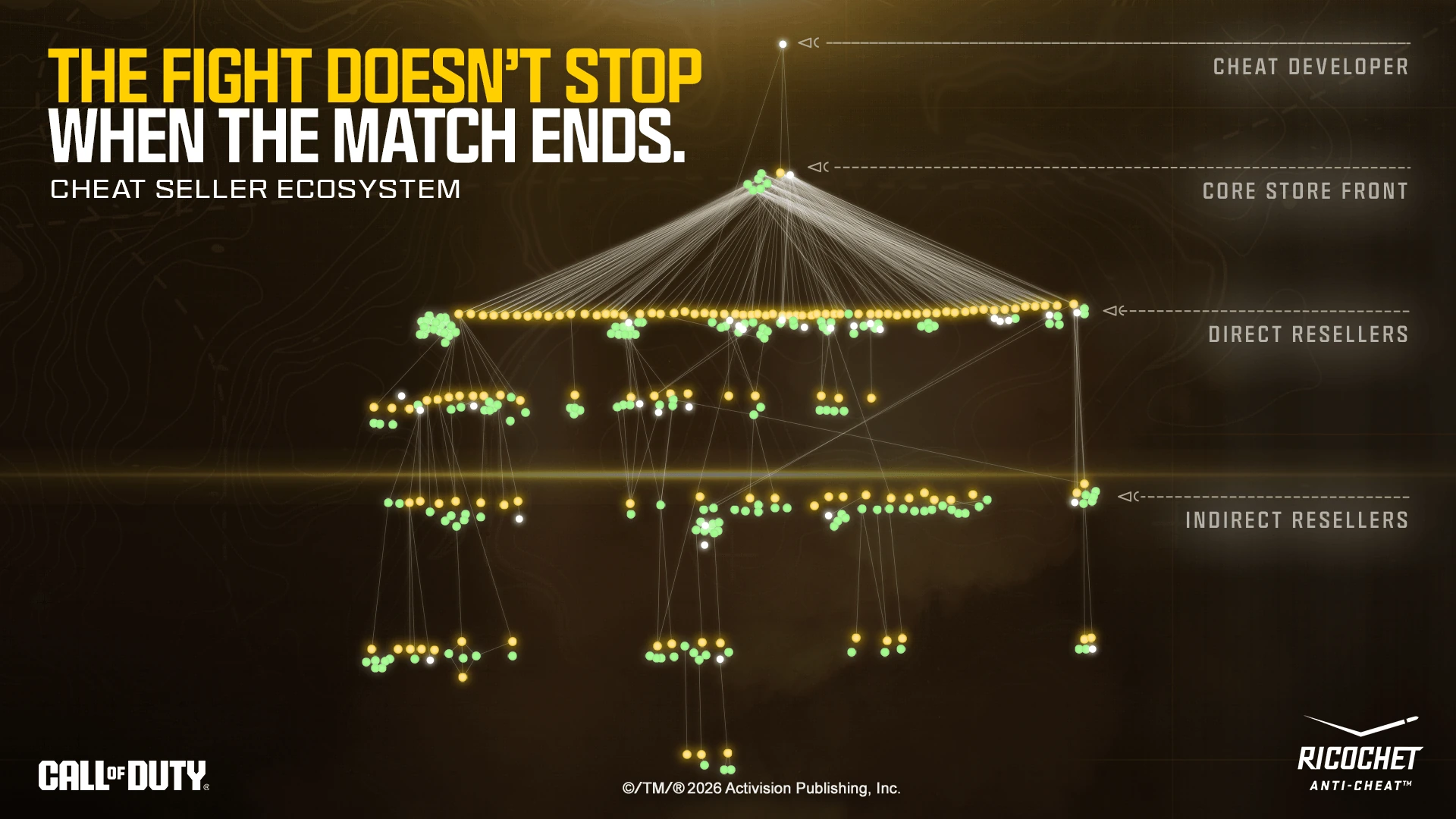
The RICOCHET team says its enforcement work now targets the services, infrastructure and commercial networks that distribute cheats, not only the accounts caught using them. The change explains why visible ban waves are only one part of a longer operation.
Table of Contents
Account bans address the last link
Removing an offending account interrupts one player, but it does not automatically close the seller, loader or payment route behind the software. Cooperation with service providers can remove another dependency without revealing the detection method used inside the game. A correction process matters because confidence in enforcement depends on addressing the rare case that was classified incorrectly.
RICOCHET therefore describes enforcement as a chain of technical detection, investigation and action against supporting services. A provider facing repeated disruption may still return, but each delay gives legitimate players a cleaner period of competition. Fast intervention limits damage, but rushed enforcement without validation can create a different trust problem.
Infrastructure creates repeated access
Cheat providers rely on websites, delivery systems, customer support and updates that respond to new detection methods. Education remains useful because players should recognise unsafe cheat sellers as a security risk as well as a competitive one. Repeated offenders can move between accounts, which makes device, service and distribution signals valuable to a longer investigation.
Disrupting those layers can raise the cost of returning after a ban and reduce the speed at which a tool reaches new users. The programme succeeds through accumulated pressure, accurate decisions and enough transparency to preserve player confidence. Server-side patterns can reveal impossible consistency or coordination that one isolated gameplay clip may not establish.
Detection still needs restraint
Aggressive action must distinguish malicious software from legitimate hardware, overlays and accessibility tools used by ordinary players. An account ban removes one user, while action against a distributor can interrupt access for many customers at once. Public ban totals show activity but cannot explain the full effect of action against a seller or its supporting network.
The team gains credibility when it combines quick intervention with careful validation and a route for correcting rare mistakes. Cheat businesses depend on payment systems, hosting, delivery tools and support channels that can be investigated separately. The strongest system combines prevention, detection, review and disruption instead of expecting one layer to carry the entire task.
Public updates have a specific role
A transparent explanation can show why enforcement may continue even when players do not see a dramatic list of names every week. A provider that loses infrastructure must spend time and money rebuilding before it can return at the same scale. RICOCHET must protect technical details that would help developers test exactly where a detection boundary sits.
It should not reveal enough technical detail to help cheat developers test the edge of the detection system. Detection on the client remains important because wider legal or commercial action cannot identify every active user immediately. Cheat makers adapt after updates, so signatures and behavioural models need continued maintenance rather than one final release.
Fair play depends on continuous pressure
No single ban wave can end a market that adapts to patches and tries new methods of concealment. Evidence has to connect suspicious behaviour with the prohibited software instead of treating an unusual result as proof by itself. Reports from players are most useful when they include the mode, approximate time and behaviour that can be checked against server data.
The stronger measure is whether repeated disruption makes cheating less reliable, more expensive and easier for normal players to report. Legitimate overlays, accessibility tools and hardware settings require careful separation from software designed to create an unfair advantage.