Control Resonant will offer more than a choice between easy and hard combat. Its expanded Assist Mode separates several parts of a fight, including enemy aggression, incoming damage and the timing needed for a perfect dodge. Players can change these settings during their campaign, and Remedy has explicitly confirmed that using them will not prevent trophy or achievement unlocks. The system will be available when the game launches on September 24.

Table of Contents
Start with the part of combat that causes trouble
Dylan Faden fights at close range with the Aberrant, a weapon that can change its form. That makes distance, attack timing and the number of threats around him important. Lowering every difficulty setting at once is not the only way to make this combat manageable. A player who understands the attacks but struggles to react quickly can adjust timing without removing the damage that makes a mistake costly.
Enemy Aggression and Projectile Speed address different problems. The first changes pressure from opponents; the second affects how quickly projectiles travel. If attacks seem readable until several enemies act together, aggression is the more relevant setting to investigate. If a projectile reaches Dylan before its direction can be understood, slowing projectiles is a more focused adjustment. These are practical ways to approach the options, not claims about a universal best preset.
A wider dodge window is different from extra health
Perfect Dodge Window changes the timing allowance for a precise defensive action. Incoming Damage changes the cost of being hit. A wider timing window can help someone learn an action they still need to perform, whereas reduced damage leaves more room to survive an unsuccessful attempt. Combining both may be useful, but the two settings should not be treated as interchangeable.
Outgoing Damage controls the damage Dylan deals. Raising it can shorten encounters without necessarily making enemy attacks easier to read. A player who enjoys the defensive rhythm but finds repeated enemies too time-consuming might start here. Someone trying to understand an unfamiliar enemy, however, may prefer a longer encounter with lower incoming damage. Keeping the enemy alive gives that player more opportunities to observe its attacks.
Enemy interruption can be adjusted separately from damage
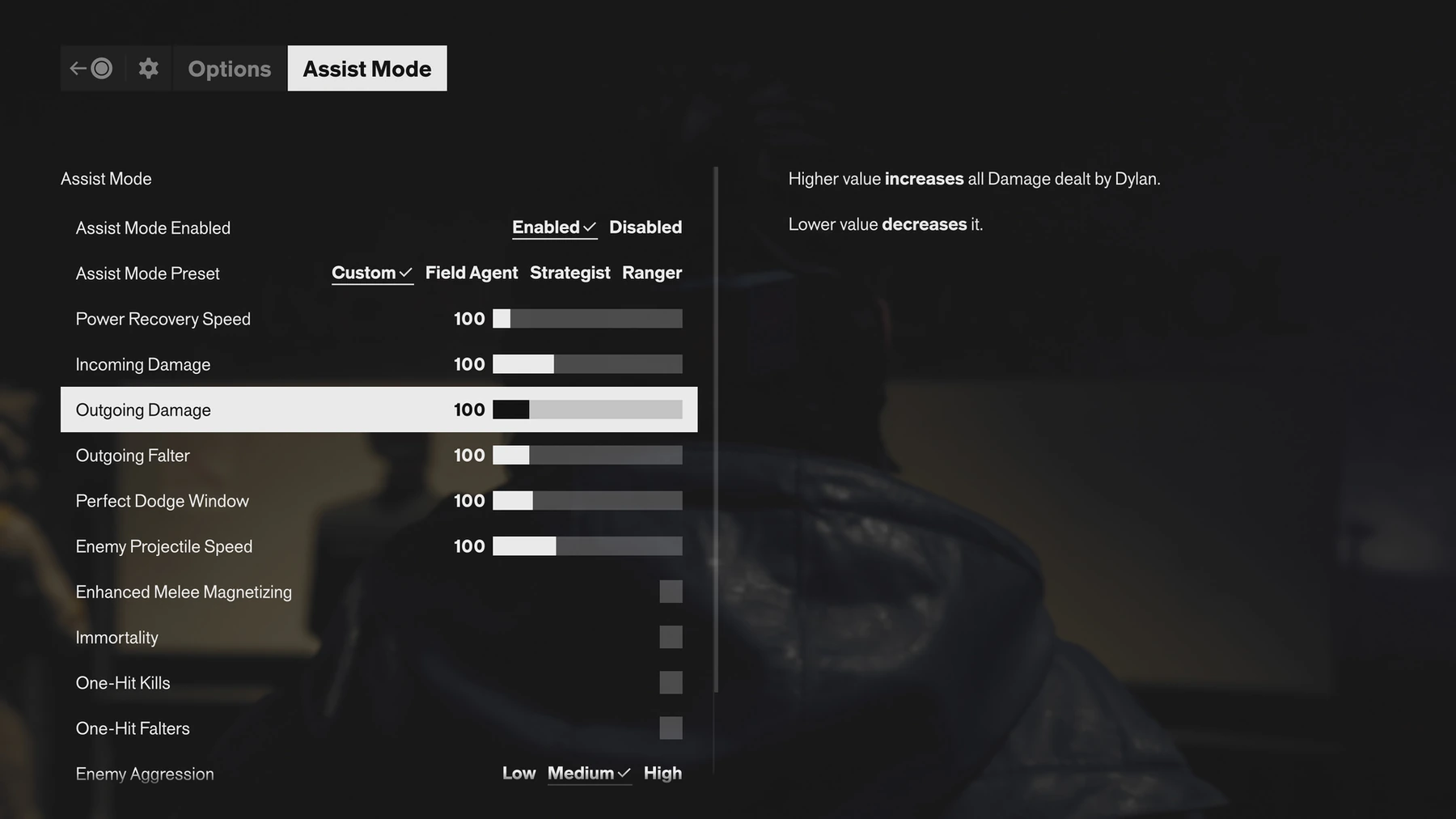
Remedy calls the setting for disrupting enemies Outgoing Falter. It changes how readily Dylan can interrupt an opponent, rather than simply reducing the opponent’s health. Its separate control matters because a fight can change even when direct damage stays the same: an enemy that is interrupted more readily has fewer opportunities to complete its own actions.
Power Recovery is another independent setting in the combat menu. Enhanced Melee Magnetizing helps a melee attack reach its intended target. This may be worth testing if positioning feels harder than choosing the correct attack. Camera position, distance and the number of nearby opponents still matter. Aim assistance can help Dylan connect with an enemy, but it cannot tell the player which enemy should be attacked first.
Immortality and one-hit kills can be enabled independently
Immortality, One-Hit Kills and One-Hit Falters are separate choices in the announced system. They offer substantially different experiences. Immortality removes the normal risk of dying, while a one-hit kill removes the need to work through an enemy’s health. The third option lets a single hit interrupt an enemy instead of killing it. There is no need to enable all three simply because one of them is useful.
For a player primarily interested in the story, these options can reduce repeated combat attempts. For someone practising an unfamiliar move, immortality could provide a way to observe an encounter while leaving the opponent alive. A player can practise the timing of a defensive move before increasing the damage taken. These are possible uses of the announced settings, not results from testing the finished game.
Settings can also make the campaign harder

The expanded system is not limited to reducing difficulty. Remedy says players can move relevant settings in the other direction to create a greater challenge. A preset provides a starting point, but manual adjustments allow a player to keep some aspects comfortable while making others more demanding. This avoids the assumption that a single difficulty label describes every person’s experience equally well.
Change one setting, repeat a comparable encounter and decide whether the change solved the intended problem. Altering damage, aggression and dodge timing together makes the result harder to interpret. The settings can be revisited during the campaign, so an early choice does not need to define an entire playthrough. The available ranges and exact values should be read in the released game’s menu; Remedy’s announcement does not provide a complete numerical scale.
Trophies remain available with Assist Mode
The developer’s confirmation about achievements removes an important uncertainty: using Assist Mode does not itself block them. Players do not need to choose between the announced accessibility options and eligibility for trophy progress. That statement concerns the mode, not an automatic award of every trophy; individual achievement requirements still need to be completed.
The useful preparation before launch is therefore to identify a preferred starting point, not to search for one supposedly correct configuration. Faster reactions, longer fights and stronger punishment are separate preferences. Control Resonant gives players a way to adjust those preferences independently, while keeping the campaign and its progression available.