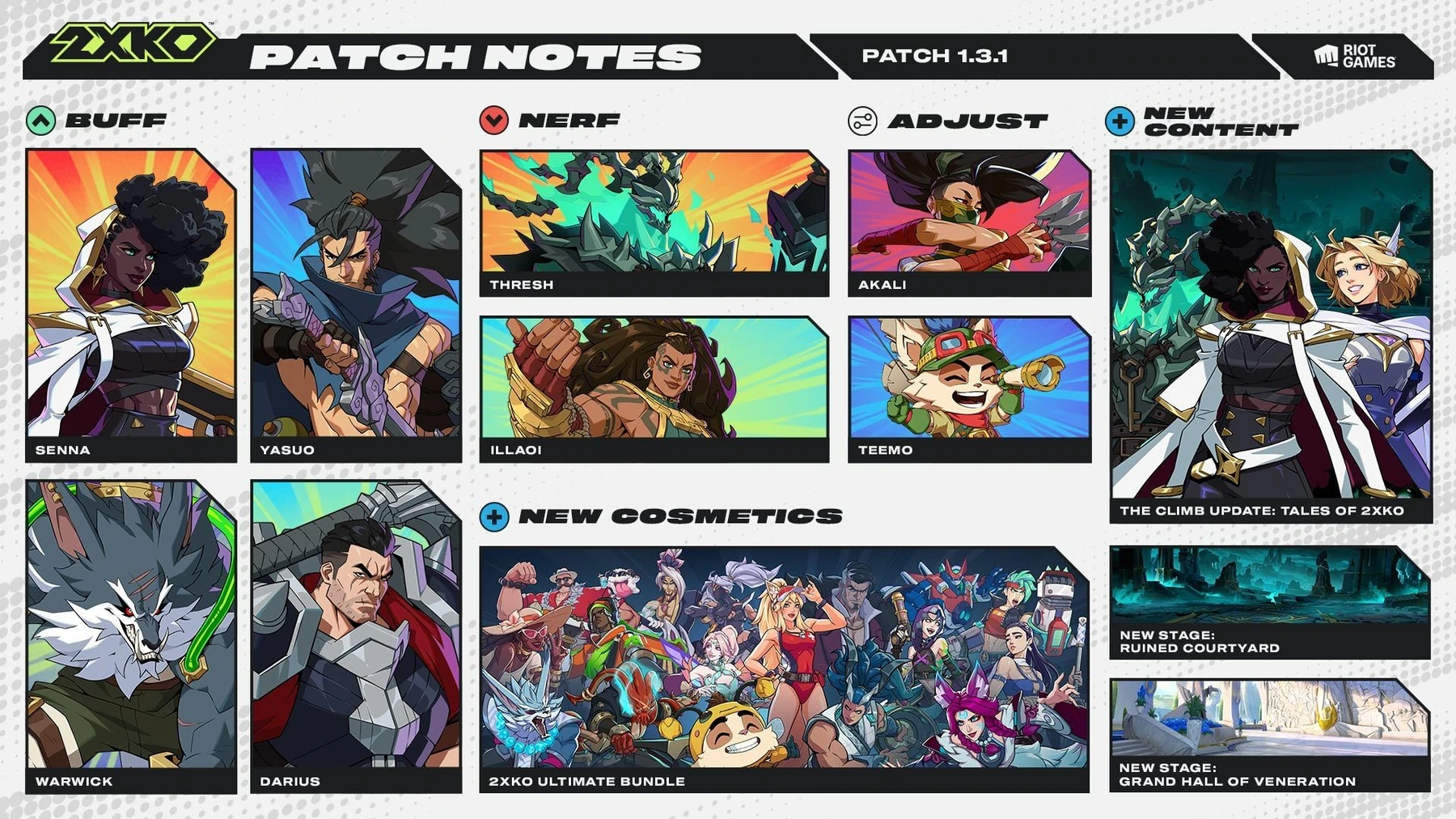
2XKO patch 1.3.1 introduces Lux as an all-rounder mage with aerial movement and several projectile angles. The Climb receives Expert and Pro difficulties, an endless Ascension option and new story dialogue. Private lobbies now support up to 40 players with optional lobby-wide voice chat. Riot has also unlocked every champion, removed champion tokens and the Battle Pass, suspended Ranked mode and revised defensive systems, hurtboxes, assists and the in-game store.
Table of Contents
Lux controls space from unusual angles
Lux uses light projectiles and distinct movement in the air, giving her tools to change the line of an approach rather than only winning from the ground. An all-rounder label does not mean every range is equally safe. Players should learn which projectile covers an assist, which movement leaves her exposed and how she returns to the floor. A short training sequence against standing, crouching and airborne targets will reveal more than copying a long combo before understanding the first hit.
The Climb can now continue after the final boss
Expert and Pro difficulty settings raise the initial challenge. After defeating the final boss, Ascension lets a team continue while selecting a penalty that makes later encounters harder. This turns a completed attempt into a risk-management choice. The best penalty depends on the two-player team and the augments already collected. Fifteen general augments and five Lux-specific augments widen the possibilities, while Tales of 2XKO adds dialogue when Lux, Thresh or Senna is selected as the point champion.
| Area | Change |
|---|---|
| Roster | Lux joins as an all-rounder mage |
| PvE | Expert, Pro and Ascension in The Climb |
| Lobbies | Up to 40 players with optional voice |
| Progression | All champions unlocked; tokens removed |
| Ranked | Disabled in patch 1.3.1 |
Forty-player rooms improve community events
The larger private lobby uses the same map as the casual lobby and includes voice chat across the room. Owners can disable voice, and it is enabled by default. A tournament host should choose that setting before sending invitations, then publish a simple rule for who may speak during matches. Forty players can support brackets, rotating sets or a club session, but the room still needs a clear match order. Size alone does not solve waiting time or people speaking over each other.
Progression removes several barriers
Every champion is now unlocked automatically, champion tokens and the Battle Pass are gone, and the Credits cap has been removed. Most avatar items, chromas, stages and selected player cards can be earned with Credits. Champion mastery advances in all modes, and unusually slow progression paths now advance faster. Existing players should inspect their balances and unlocks after the patch before spending. Old advice about saving a champion token or finishing a pass is no longer valid.
Ranked is paused while the systems change
Ranked mode is disabled in 1.3.1. Riot has changed progression, defense and much of the cast in the same patch, so competitive results would be difficult to compare with the earlier environment. Players can use the pause to rebuild teams in casual or private matches. The goal should be a small set of reliable sequences: one response after an opponent’s mistake, one safe pressure route and one defensive escape. A full ranking prediction made on the first day will age faster than practical matchup notes.
Pushblock creates more distance at a cost
Pushblock now sends opponents 33 percent farther but has four additional recovery frames. Tagging immediately after a pushblock can phase the point champion out when no other action is taken. The change makes space more meaningful while preserving chances for an opponent to continue pressure from light attacks or a jump-in. Defenders should test the exact distance against common attacks. Attacking automatically after every block may waste the new separation or expose the longer recovery.
Assists take more permanent damage
Assists now receive 75 percent true damage, which leaves less life available to recover. Riot paired that risk with more ways to protect an assist through pushblock, Break and Handshake Tag. Team building therefore needs both an offensive reason to call an assist and a safe exit plan. An assist that extends a short combo but loses a large part of its health may be a poor exchange. Review the health lost by both characters, not only the damage dealt by the active character.
Standard hurtboxes make combos more consistent
Standing and crouching hurtboxes are grouped into clearer size categories, and most head positions are standardized. The game now uses one wall-impact collision rule for every champion. These changes target combos that worked on one character and failed unexpectedly on another. They do not make every body identical: several champions keep unique properties and move-specific interactions remain. Players should retest important routes against several character sizes, then remove obsolete notes instead of carrying conflicting versions into matches.