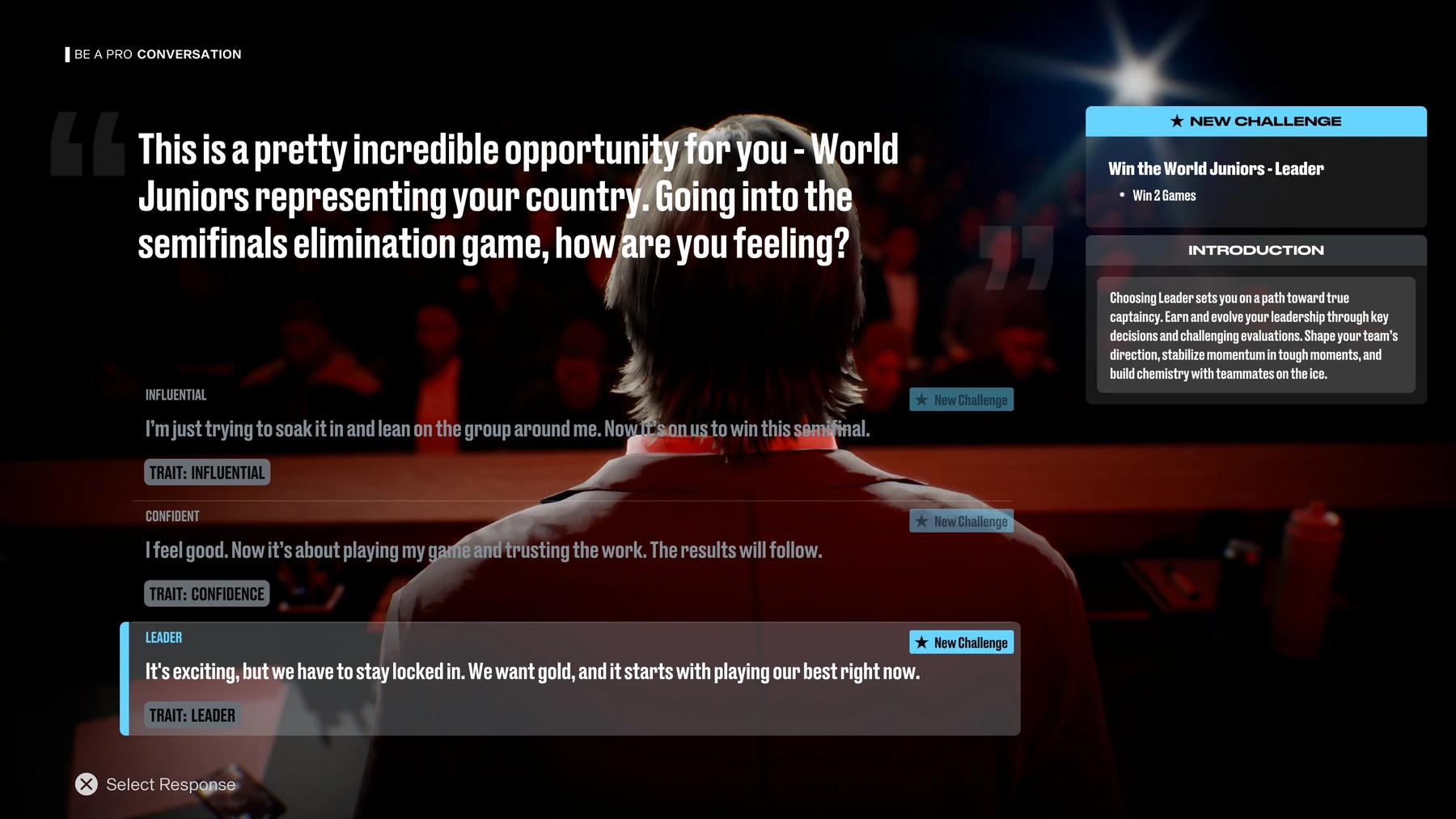
NHL 27 expands Be a Pro with a leadership storyline that begins at the first media interview and continues across an 84-game regular season. Skaters can progress from non-leader to Leader, Alternate Captain and Captain. Goalies follow a separate route through Leader, Presence and Cornerstone. Promotions depend on roster status, likeability levels, coach feedback and season challenges rather than one strong match.
Table of Contents
The first interview changes the early route, not the final guarantee
At the opening media interview, the player chooses an Influential, Confident or Leader trait. The Leader option immediately gives captaincy at the World Juniors and Memorial Cup, or an alternate captain role when the career begins in the Champions Hockey League. The other choices do not receive those tournament roles. None of them gives an automatic NHL letter. Once the created player reaches the league, leadership must be earned through the same professional requirements. This keeps the first choice meaningful without allowing one dialogue answer to replace performance across an entire season.
Preseason creates three separate checks
A candidate must unlock the first trait in the new Leader Skill Tree, survive the four-game preseason and reach level one in both Team and Management Likeabilities. Selecting the Leader path grants the first skill-tree trait automatically, but the roster and relationship requirements still remain. A first-overall prospect drafted through the World Juniors can receive the formal Leader role as a rookie after meeting the preseason benchmarks. Other careers enter the regular challenge structure. Players should therefore read every coach objective before simulating, because missing one category can matter even when the scoring totals look strong.
| Stage | Requirement or result |
|---|---|
| Preseason | Make the NHL roster after four games |
| First half | Coach grades across games 1-42 unlock the next phase |
| Second half | Evaluation continues through game 84 |
| Decision | New status is delivered in the offseason |
The season is divided into two equal evaluations
Games one through 42 form the first phase. Meeting the relevant coach standards opens phase two, which covers games 43 through 84. Coach Feedback grades are the main measure in both halves. The design rewards repeated role execution rather than one hot scoring streak. A defensive player may need positioning and team play as much as points, while a forward who chases goals can lose grades through turnovers or missed assignments. The promotion is announced during the offseason and applies to the next season, so reaching the target in game 84 should not be mistaken for an instant letter on the current uniform.
Skaters and goalies have different names for senior status
The skater ladder runs from non-leader to Leader, Alternate Captain and Captain. Goalies move from non-leader to Leader, then Presence and Cornerstone. The final two goalie labels reflect the fact that a goaltender does not wear the same captain’s letter in NHL competition. Their gameplay meaning is still tied to increased influence and responsibility. Guides should preserve these official names instead of translating Cornerstone as a literal roster position. A user comparing two careers should also compare equivalent levels on the two paths, not assume that an Alternate Captain is automatically above a goalie with Presence status.
Overachievement can accelerate promotion
Completing the assigned objectives normally moves a player up one step. Overachieving can advance a non-leader directly to Alternate Captain or Presence, and in some cases to Captain or Cornerstone. A current Leader can also move faster. Partial completion may preserve the existing rank, while failure can cause a demotion. An Alternate Captain or goalie with Presence can fall to Leader, and a serious miss can return the player to non-leader status. The system therefore records both progress and decline. Players should balance difficult bonus targets against the reliable coach grades needed to protect the current role.
Changing teams carries a visible cost
An AHL demotion removes the player’s NHL leadership rank and returns the career to non-leader status on the next NHL call-up. A former Captain who is traded or signs elsewhere through free agency joins the new club as an Alternate Captain and has to earn the top role again. That rule gives roster movement a consequence beyond line placement. A trade may still be worthwhile for ice time or team strength, but the leadership cost belongs in the decision. Saving before a requested move allows the player to understand the effect without confusing it with a bug in the promotion system.