The ranking ladder in Dota 2 is not just a set of pixels in a profile, but a strict filter that separates casual fans from those who live by esports. If you are stuck in the trenches, it means that the Glicko algorithm has not yet been convinced of your exclusivity — by the way, it is on this mathematical model that modern player selection is based. The system takes into account not only the bare numbers of the rating (MMR), but also the Rank Confidence parameter, which acts as an invisible judge of your real skill.
Table of Contents
The rank system from Recruit to Titan in Dota 2
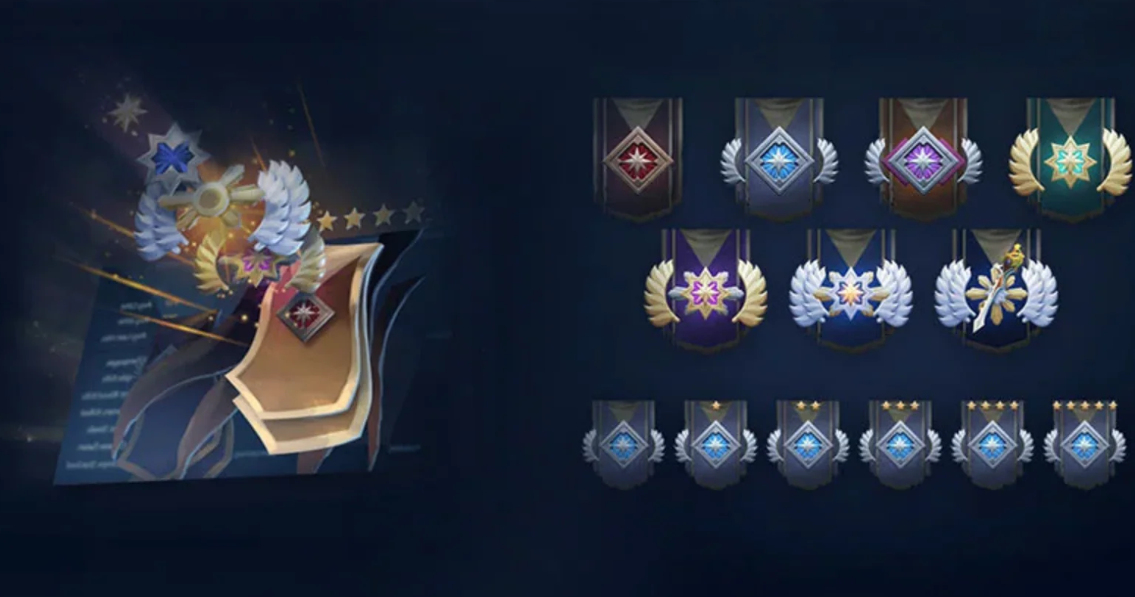
There are a total of 8 main levels of progression in the game. Almost each of them is divided into 5 subtapes — stars, indicated by Roman numerals from I to V. Think of it as a marathon with checkpoints — you can’t just jump from mud to princes.
-
The Herald is the starting point where chaos rules the ball.
-
Guardian and Crusader — this is where players start pressing the buttons in the correct order.
-
Archon and Legend are the “golden mean” where the majority of the community lives.
-
Ancient and Divine are the vestibule of the professional stage.
-
Immortal is the top of the food chain.
Mechanics of MMR accrual and hidden rating of Dota 2
MMR is your hidden numeric self. On average, the system awards 25 points for one win, and a defeat takes the same amount. It is noteworthy that Valve’s algorithm absolutely does not care about your personal statistics (KDA) — only the final demolition of the throne is important. The medal is just a public showcase, whereas MMR is the harsh reality that matchmaking is looking for you.
An insider from the pros: Owen Harsono, who currently occupies 1770th place in the top of Southeast Asia at the Immortal rank, emphasizes that at high levels the game turns into survival chess. His experience confirms that the system is ruthless towards those who lose concentration.
Immortal Leaderboard and Regional Top Dota 2
After reaching the rank of “Immortal”, you leave the five-star system. Then the endless race of numbers begins. This is where the regional leaderboard comes into effect:
-
Top 5000 – you are officially on the list of the best.
-
Top-100 and Top-10 is an elite club where stars of the scale of Team Spirit or Gaimin Gladiators play.
-
Top-1 is the status of the god of the region.
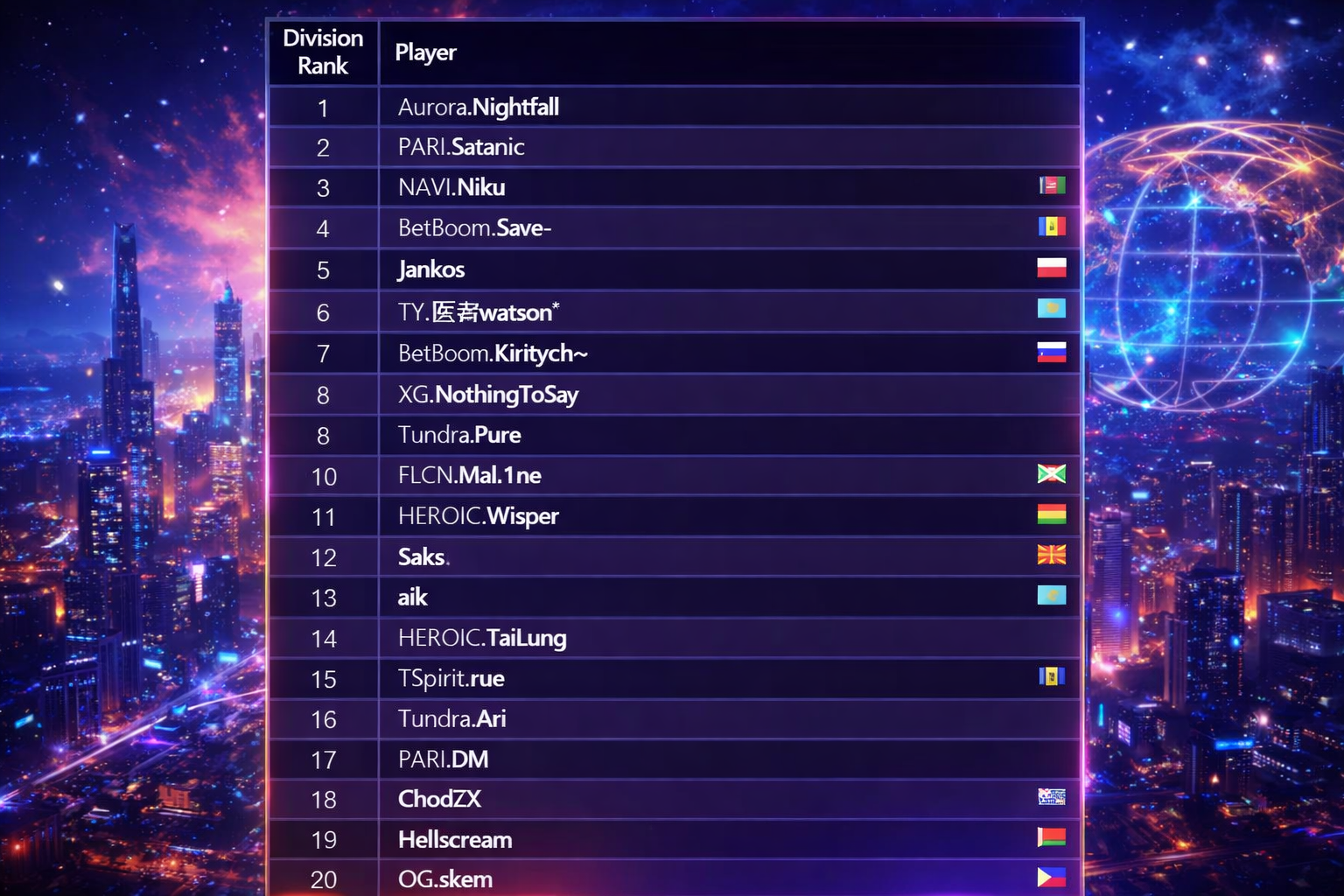
If your MMR is not high enough to enter the Top 5,000, you remain just an “Immortal” with no numbers on the medal. By the way, the leaderboards are public and updated in real time — anyone can check if you are worthy of your place in the Valve hierarchy.
Dota 2 MMR Guide: Revealing the mechanics of matching and calibration in 2026
The Dota 2 ranking is your personal digital hell or Olympus, tied to the MMR system. Treat him like a toxic sidekick who accompanies you in every matchmaking session. In fact, it’s these numbers that tell Valve’s algorithm which skill pit to throw you into and which allies to choose for another attempt to demolish the throne. — By the way, it depends on MMR whether you will play with adequate strategists or get into the circus of the absurd.
The Mathematics of Wins and Losses: How Scoring works
By entering the search, you are literally putting your rating up for auction. On average, one skating rink costs 25 MMR points — this is the price of your time and nerves.
But the main paradox is hidden here: the system absolutely doesn’t care if you made a Rampage with a score of 34-3 or finished the game with a shameful 1-12, being a burden to the team. The reward and punishment are fixed for all members of the team. — If you win, you take about 24 points from your opponents, if you lose, you give your own. This is a cycle of points in nature, where you are either a predator or a food source.
The Glicko algorithm and Rank Confidence in the selection of players
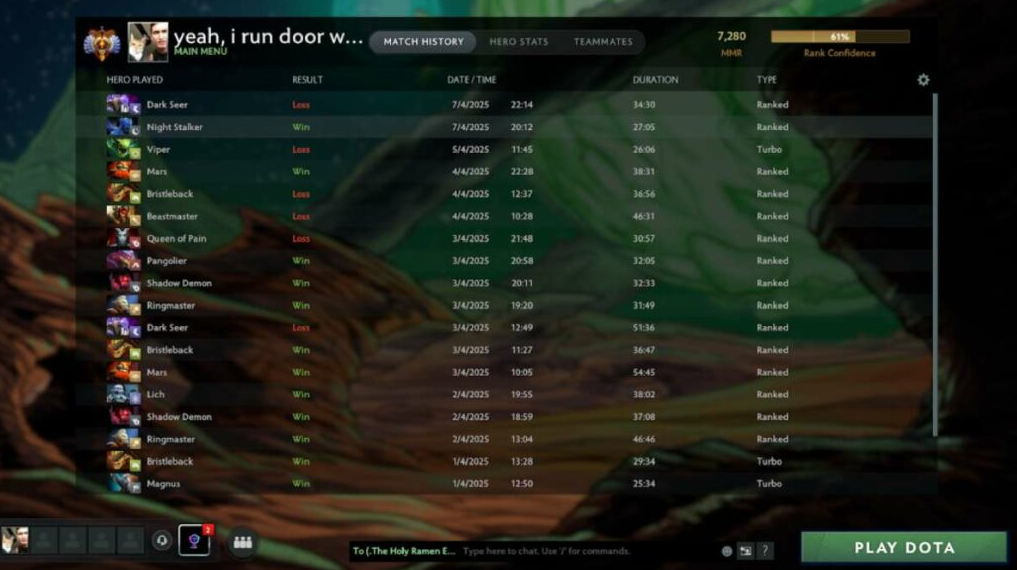
In addition to the visible numbers, the Glicko algorithm works behind the screen. He calculates the “Rank Confidence” — a percentage indicator of how Valve believes in the adequacy of your current rating.
-
Starting from scratch: Beginners always enter with 0% confidence.
-
Aggressive Calibration: While this counter is low, your MMR jumps can be insane — the system is trying to push you to your real level faster.
-
Stability point: The “calibrated” status arrives only at around 30%. — If for some reason (for example, long inactivity) confidence falls below this level, the medal will disappear, and the MMR will disappear into the fog of war until new victories.
Unified rating and cancellation of MMR division by roles
Forget about the days when you could be a “Divine” carrier and a “Legendary” support. Valve finished off the system of separate MMRs by roles back in the spring of 2020. With the release of global patch 7.33, known as “New Frontiers,” the game has become completely level-headed. Now your rating is a monolith. It doesn’t matter if you are dragging on the Foreign Ministry or sacrificing yourself in the fifth position, the figure in the profile will change the same way.
Important note: You can check the current calibration status and the exact number of points directly in your profile by looking at the hero stats tab — that’s where Valve hides the truth about your progress.
Ascension Guide: How to not just play in 2026, but burn out MMR in Dota 2
If you’re Googling how to raise your rating and hoping for a miracle, forget it. In 2026, just “riding a lot” is the way to low priority or eternal stagnation on “Recruits”. The system now feeds only those who turn micro, macro and discipline into a sharp blade. The path from “Recruit” to “Titan” is not about luck, but about your personal win rate, which should be well above 50% over the distance. — By the way, it all starts with how you adapt to the current meta and which characters you pick up, because in modern realities, the numbers in your profile are just a by—product of your effectiveness.
Working methods of conquering the top in 2026
Effective MMR grind today is based on three pillars: the narrowest possible pool of characters, strict discipline, and an understanding of what is happening on the map (timings and economics). — If you’re still sprayed with everything, you’re fodder. Below we will analyze the strategies for each range that really work in actual matchmaking.
Low ranks (recruit – guardian): exit the sandbox
Your main problem here is chaos. To get out of this swamp, you need to stop playing the “random button simulator” and implement a database.
-
2-3 signatures instead of 20 random ones. — Focus on a couple of heroes to understand their limits and builds at the instinctual level. Spectre, Sniper, or Viper at this level forgives a ton of mistakes and pulls out ice rinks in leith simply due to stats.
-
Positions 1-2 are your ticket to life. On low-MMR, the easiest way is through Kerry or the Ministry of Foreign Affairs, where everything is decided by the farm. The plan is simple: you don’t die on the line, you take out a key slot (like BKB or Aganim) and go break faces around Roshan.
-
The farm is sacred. In these ranks, people love to die “out of habit.” Your goal is to have a stable GPM. Up to 12 minutes — minimum fights, maximum lasthit. — Do you see the danger on the line? Get out into the woods right away, don’t feed the enemy.
-
Minimum vision and SO on. Even if you are a support, a couple of wards and a timely teleport to help an ally are “free” kills and your way to victory.
The main mistake here is endless fights under other people’s towers without an advantage. While they’re fighting over nothing, you have to take the card. — And when the base is laid, the game of minds begins at the middle ranks.
Middle ranks (crusader – legend): the age of mindfulness
You already know how to press buttons here, so it’s time to turn on your head. Strategies are shifting towards team actions and macro solutions.
-
Stable role pool. Gain a foothold in 1-2 positions. For example, if you’re an offline dolby on Timbersaw or Mars. You have to hit a familiar pattern in every rink.
-
Goals on the liner. Forget about the abstract “stand”. Your goal by 10 minutes is a conditional 60+ creeps and a tower advantage. — Have you lost your T1? Shift, farm safely, and create pressure in response.
-
Windows of power (Power Spikes). Your win rate depends on how you implement timings. Did Leshrac take out the BKB in the 18th minute? Immediately call the team to pick up Roshan or T2. Don’t let the enemy breathe while you’re at your peak.
-
Converting files to objects. Killed three people — don’t go farm your forest. Take the tower, the outpost, or Roshan. — The middle ranks are about the question: “What will we get for this frag?”.
If you learn how to take resources for each action, it will only be a matter of time before you reach the “Ancient One.” — And that’s where the real dota begins, where every mistake is worth a title.
High ranks (ancient – immortal): a survival game
There are few ordinary tips on the “Ancient” and above. Details, knowledge of match-ups and a deep understanding of the pace of the game decide here.
-
Meta is your best friend. Forget about the “favorites”. Check Dotabuff, see the win rates, and adapt the pool to the current patch. Strong players always know who is the imba and who is the trash.
-
Deep macro and smokey. You need to know how to keep the lines drawn while you farm the triangle. Smoke ganges are synchronized here with important cooldowns and the appearance of Aegis.
-
Risk management. Do not enter the high ground without a vision or if the enemy has buybacks. One mistake when entering the base — and the rink is overturned. — At the “Titan” level, MMR climbing is about stability and the ability to adapt to any peak.
Priority table: where’s your focus?
Dota 2 Rank Climbing Strategy
| Rank Range | Core Focus | Typical Climbing Path |
|---|---|---|
| Herald — Guardian | Basic mechanics, signature heroes | 2–3 heroes, farming, minimal deaths in lane |
| Crusader — Legend | Macro, timings, advantage conversion | Playing around timings, correct objectives |
| Ancient — Divine | Drafting, macro depth, tempo | Meta heroes, smoke timings, map control |
| Divine — Immortal | Decision details, risk management | Consistency and adaptation in every game |
Individual skill and training
Even the best strategies will crumble if you have wooden fingers. Cold practice is what separates the pro from the amateur.
-
Lasthit without whining. Go into customizations and practice finishing without an opponent. Your GPM should grow not from luck, but from skill.
-
Button patterns. If you play Pangolier, you should give ulta perfectly 8 out of 10 times. Practice combos to the point of automatism, so that in a fight you don’t think, but act.
-
Replay analysis. Watch your games. Do you see an extra death or a missed stack? Remember and don’t repeat it. — It is enough to disassemble 1 skating rink per day to see your system jambs.
The goal is to remove randomness. You have to become a machine that repeats successful patterns. — By the way, the next important step will be the ability to choose the right characters for a specific situation.
The choice of heroes: between love and profit
Your pool should be narrow but flexible. Experienced players keep 5-7 characters who complete various tasks, from a quick push to a hard leit.
-
Power timings. You need to know exactly when your hero is a god and when he is a ballast. Dragon Knight should push early, and scalers can afford to overfeed.
-
Counter-peaks without fanaticism. Don’t take a hero you have 3 games on just because he “counters” the enemy. It’s better to take a proven charm with a neutral matchup than to embarrass yourself with a difficult one.
As a result, winning the draft is a 50% success rate, but only if you understand what to do next on the map. — It is the work with the map and the macro game that will become the foundation on which you will build your empire in 2026.
Macro game: your main trump card
Macro is the foundation. This is what distinguishes the “stuck” from those who are flying up the rankings.
Vision is like a weapon. Wards are needed not for beauty, but for killing. Put them deep, block the enemy’s view after fights and deprive the enemy of space.
Roshan is the key. Aegis decides the outcomes of matches. An agreed exit under Roshan and control of the area around him is the base for any serious approach to the throne.
Pressure lines. Always push at least one line. This makes the enemy glow on the map and gives you information for maneuvers.
By developing macro, you stop hoping for highlights and start winning systematically. — Remember: your MMR points are just a reflection of how effectively you make decisions in every second of the match.
The MMR threshold in Dota 2 for each rank
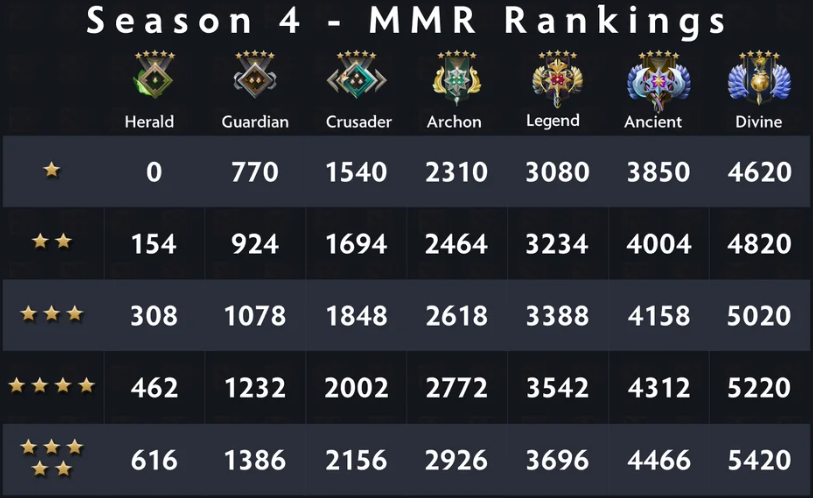
We’re figuring out how many points you need to pump in so that your Dota 2 medal doesn’t look like a stigma. If you’re still confusing “Recruit” with “Guardian,” here’s a hard look at the numbers. — By the way, the progress here is non-linear, so get ready for the fact that the grind will become even tougher at high ranks.
Table of ranks and MMR of Dota 2 current figures 2026
Dota 2 Ranks & MMR Ranges (2025/2026)
| Dota 2 Rank Medal | MMR Range |
|---|---|
| Herald 1 | 1–154 |
| Herald 2 | 154–308 |
| Herald 3 | 308–462 |
| Herald 4 | 462–616 |
| Herald 5 | 616–769 |
| Guardian 1 | 770–924 |
| Guardian 2 | 924–1078 |
| Guardian 3 | 1078–1232 |
| Guardian 4 | 1232–1386 |
| Guardian 5 | 1386–1540 |
| Crusader 1 | 1540–1694 |
| Crusader 2 | 1694–1848 |
| Crusader 3 | 1848–2002 |
| Crusader 4 | 2002–2156 |
| Crusader 5 | 2156–2310 |
| Archon 1 | 2310–2464 |
| Archon 2 | 2464–2618 |
| Archon 3 | 2618–2772 |
| Archon 4 | 2772–2926 |
| Archon 5 | 2926–3080 |
| Legend 1 | 3080–3234 |
| Legend 2 | 3234–3388 |
| Legend 3 | 3388–3542 |
| Legend 4 | 3542–3696 |
| Legend 5 | 3696–3850 |
| Ancient 1 | 3850–4004 |
| Ancient 2 | 4004–4158 |
| Ancient 3 | 4158–4312 |
| Ancient 4 | 4312–4466 |
| Ancient 5 | 4466–4620 |
| Divine 1 | 4620–4820 |
| Divine 2 | 4820–5020 |
| Divine 3 | 5020–5220 |
| Divine 4 | 5220–5420 |
| Divine 5 | 5420–5620 |
| Immortal | 5620+ |
A caveat for mathematicians: Each star on the way to the “Lord” costs about 154 points (a total of about 770 for a full medal). But as soon as you fly into the “Deity”, the bar is raised — now the star is worth 200 MMR. — To be officially considered a “Titan”, please pay 5,620 points.
Statistics on the distribution of players by Dota 2 ranks
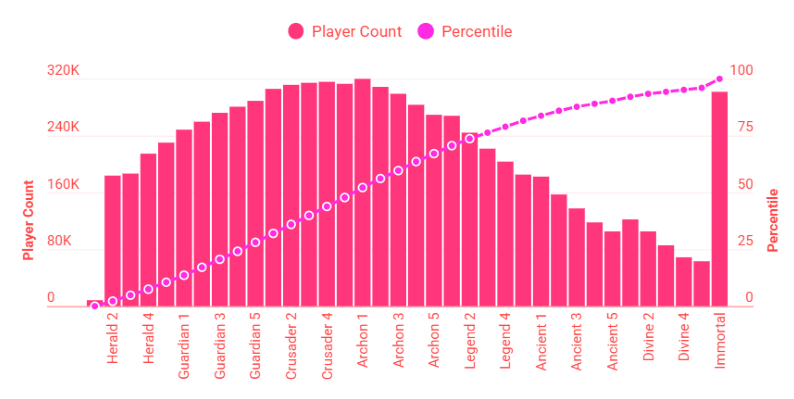
Numbers in a vacuum don’t mean anything without context. Based on OpenDota data (a sample of 7.8 million active users as of March 2026), the world picture looks like this:
-
The bottom and the sandbox (Herald, Guardian, Crusader): Either absolute beginners or those who fundamentally ignore the existence of the mini-map live here.
-
The Golden Mean (Archon, Legend): “Home is home” for most. Here, people have either already learned how to press buttons, or they just go in for a beer after the factory.
-
Elite (Ancient, Divine): Top 20% of players. If you’re here, congratulations, you really understand macro and micro.
-
Cosmos (Immortal): A closed club for pros and nerds. Remember: the gap between an ordinary “Titan” and a top 200 player in the region is greater than between a “Recruit” and a “Legend”.
Draining rank for inactivity and degradation of Rank Confidence
In Dota 2, there is no direct drain of points for inactivity, but there is something worse – the degradation of “Rank Confidence”. — Have you stopped playing? Your confidence is slowly creeping towards zero. As soon as it breaks through the bottom of 30%, the medal evaporates, and the MMR goes into the inventory.
If you come back in a year, you’ll have to prove to the system again that you’re not a bot. If you haven’t logged in for five years and your confidence has dropped below 5%, prepare for the fact that you may be thrown a couple of ranks lower during recalibration.